50 pesos 1877
Market Prices
About This Note
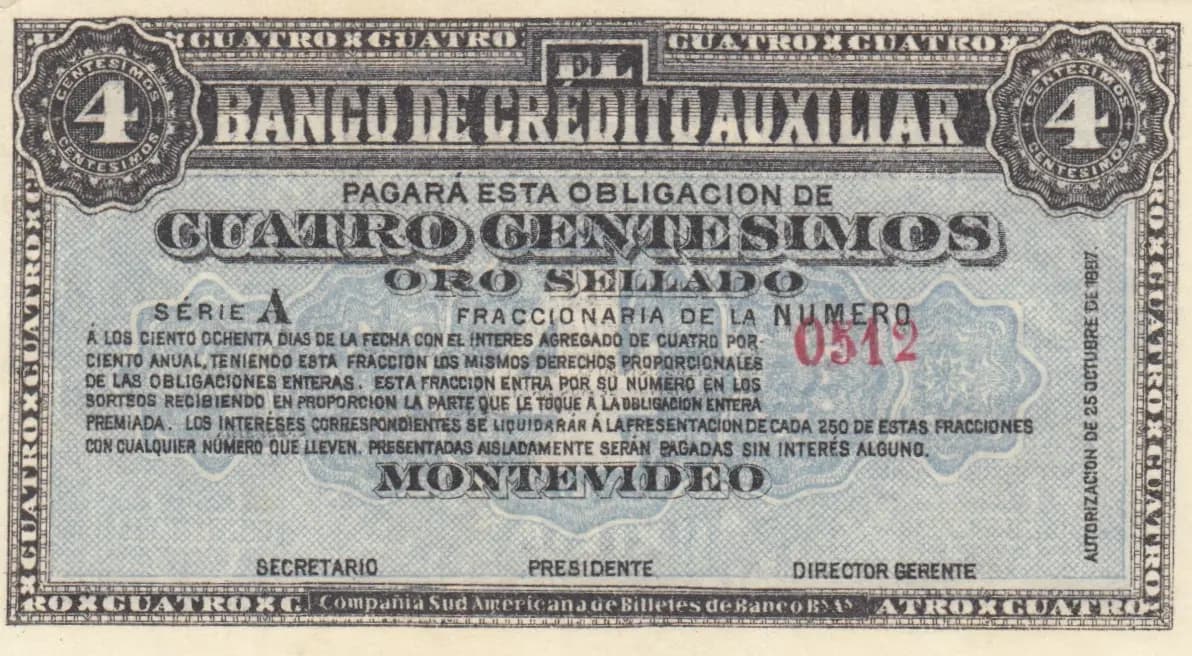
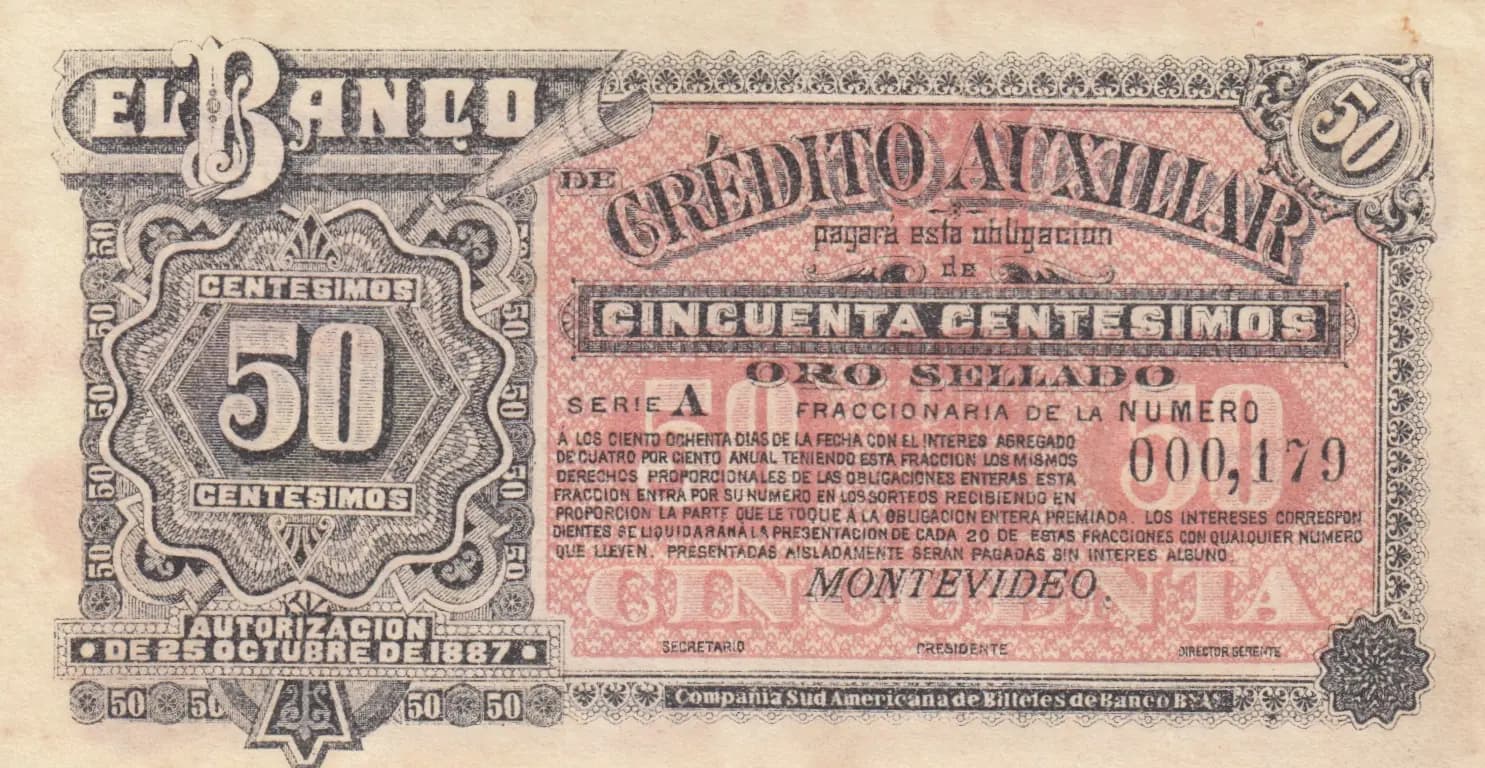
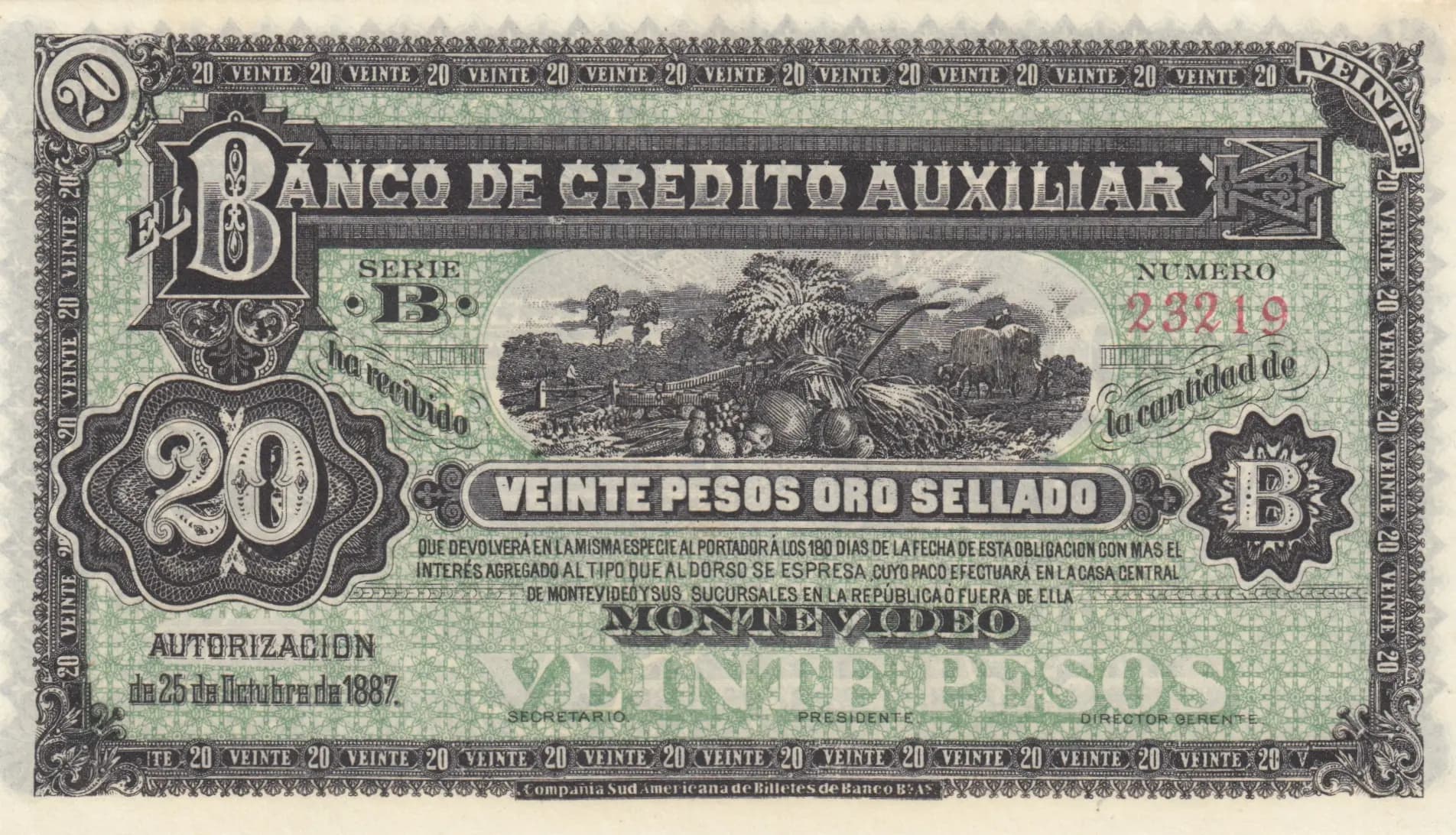
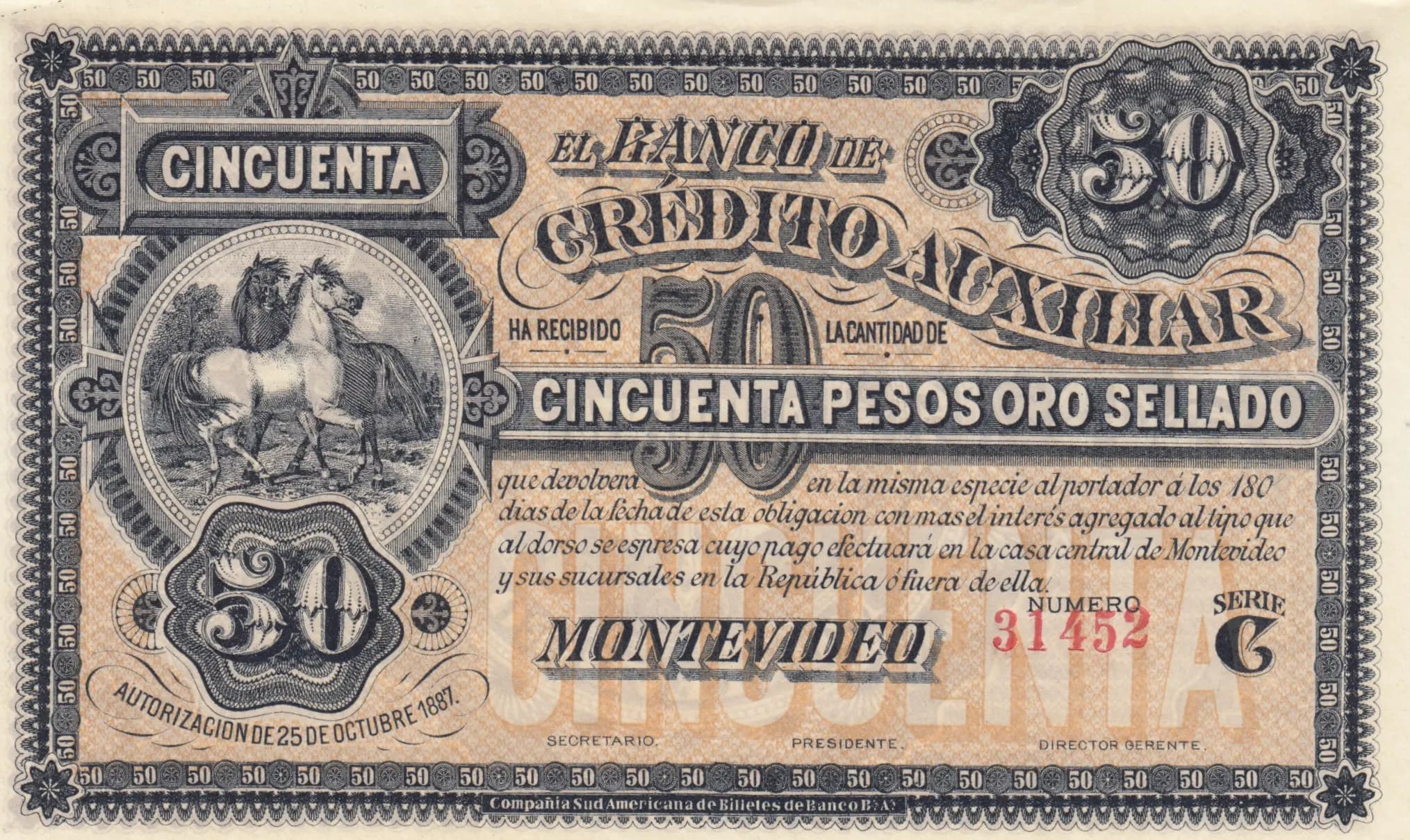
An exceptional uncirculated example of the 50 Pesos Oro Sellado issued by El Banco de Crédito Auxiliar, authorized October 25, 1887, and printed by the South American Bank Note Company (CSABB) in Buenos Aires. The note features a striking tan underprint with navy blue engraving, highlighted by an ornate circular medallion on the obverse containing a detailed equestrian vignette—a horse with handler—centered within elaborate decorative borders. This remainder banknote exhibits pristine condition with sharp engraving throughout, clean paper stock, and no visible wear, making it an attractive example for collectors of Uruguayan financial history.
Common. Despite being cataloged as a remainder banknote (unsigned, unissued state), the eBay price data provided shows multiple UNC examples trading in the $2-$6 range with occasional higher outliers at $95, indicating robust supply in the collector market. The median pricing for uncirculated specimens hovers around $3-5 USD, consistent with common banknotes from this period. While Uruguayan 1880s-era notes have collector interest, the high availability and low baseline values confirm this is a commonly encountered variety rather than a scarce issue.
This note represents Uruguay's late 19th-century financial development, issued during a period of economic modernization following independence when private credit banks played a crucial role in monetary circulation. El Banco de Crédito Auxiliar operated in Montevideo during the 1880s, issuing credit notes (obligaciones) redeemable in gold pesos after 180 days—a common financial instrument before central bank monopolization of note issuance. The prominent equestrian imagery reflects the importance of horse breeding and ranching to Uruguay's pastoral economy and national identity during the period.
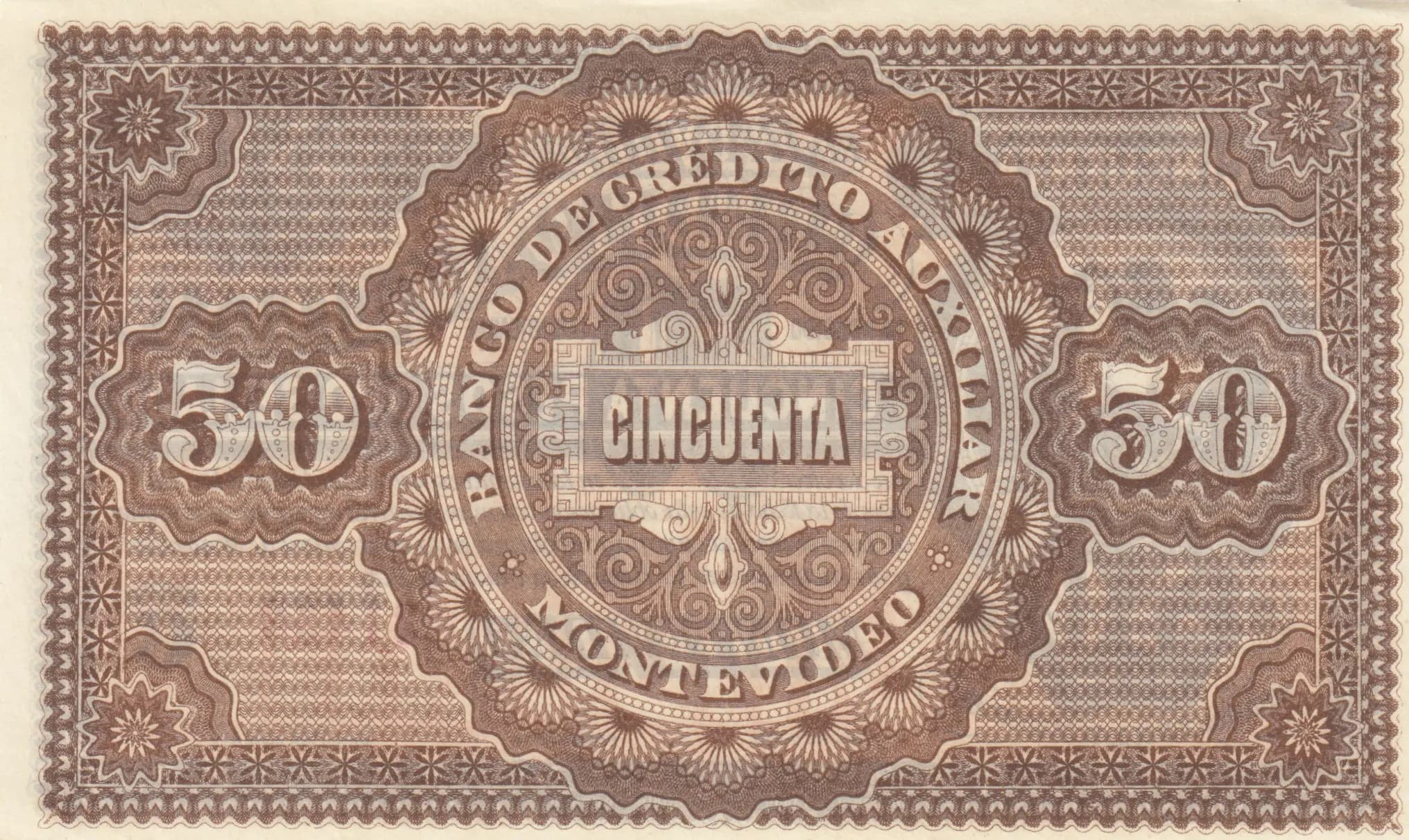
The obverse features a sophisticated engraved design centered on a circular medallion containing an equestrian vignette depicting a horse being led or handled, symbolizing the importance of livestock to Uruguay's economy. The composition employs a tan/beige background with navy blue and black engraved elements forming an ornate protective border frame. The design incorporates repeating denomination numerals (50) as a security measure throughout the margins and borders. Decorative rosettes and floral patterns occupy the corners, while elaborate geometric lattice work and filigree provide additional anti-counterfeiting complexity. The reverse presents a more minimalist approach, centering on a large symmetrical circular seal with radiating fan-like patterns emanating from the word 'CINCUENTA,' surrounded by decorative scalloped borders and corner cartouches containing the denomination. Fine-line engraving techniques are evident throughout, creating intricate mesh patterns and geometric designs typical of high-quality security printing of the era.
OBVERSE: 'El Banco de Crédito Auxiliar' (The Auxiliary Credit Bank) | 'Cincuenta Pesos Oro Sellado' (Fifty Gold Pesos Sealed) | 'Ha recibido la cantidad de' (Has received the amount of) | 'que devolverán en la misma especie al portador á los 180 días de la fecha de esta obligacion con mas el interés agregado al tipo que al dorso se espresa cuyo pago efectuará en la casa central de Montevideo y sus sucursales en la República ó fuera de ella' (which will be returned in the same form to the bearer at 180 days from the date of this obligation with added interest at the rate expressed on the back, whose payment will be made at the central house of Montevideo and its branches in the Republic or outside it) | 'Autorización de 25 de Octubre 1887' (Authorization of October 25, 1887) | 'Número 31452' (Number 31452) | 'Serie G' (Series G) | 'Montevideo' | 'Presidente' (President) | 'Director Gerente' (Managing Director) | 'Secretario' (Secretary) | 'Compañía Sud Americana de Billetes de Banco E.A.' (South American Bank Note Company E.A.). REVERSE: 'Banco de Crédito Auxiliar' | 'Cincuenta' (Fifty) | 'Montevideo'
Steel plate engraving and letterpress printing. The note was produced by the Compañía Sud Americana de Billetes de Banco (CSABB) in Buenos Aires, one of the premier security printers of the region during the 1880s. The complex intaglio engraving is evident in the fine lines, geometric patterns, repeating security numerals, and the dimensional quality of the vignettes. The multi-color printing (tan underprint with navy blue and black engraved elements on obverse; light brown/tan with dark brown engraving on reverse) indicates careful plate registration and high-grade paperstock typical of bank note production.
This example is Pick catalog P-S165r, a remainder banknote variant produced by CSABB (Compañía Sud Americana de Billetes de Banco). The Pick catalog distinguishes this from P-S165a, indicating at least two variants exist for the base denomination. The visual analysis identifies this as Series G (Serie G), number 31452. The note is unissued in its remainder state, lacking signatures, which is characteristic of remainder banknotes that never entered circulation. The authorization date of October 25, 1887, and the printer attribution to CSABB Buenos Aires align with the catalog data showing an 1888 issue date, suggesting authorization preceded actual printing by several months.