20 pesos 1877
Market Prices
About This Note
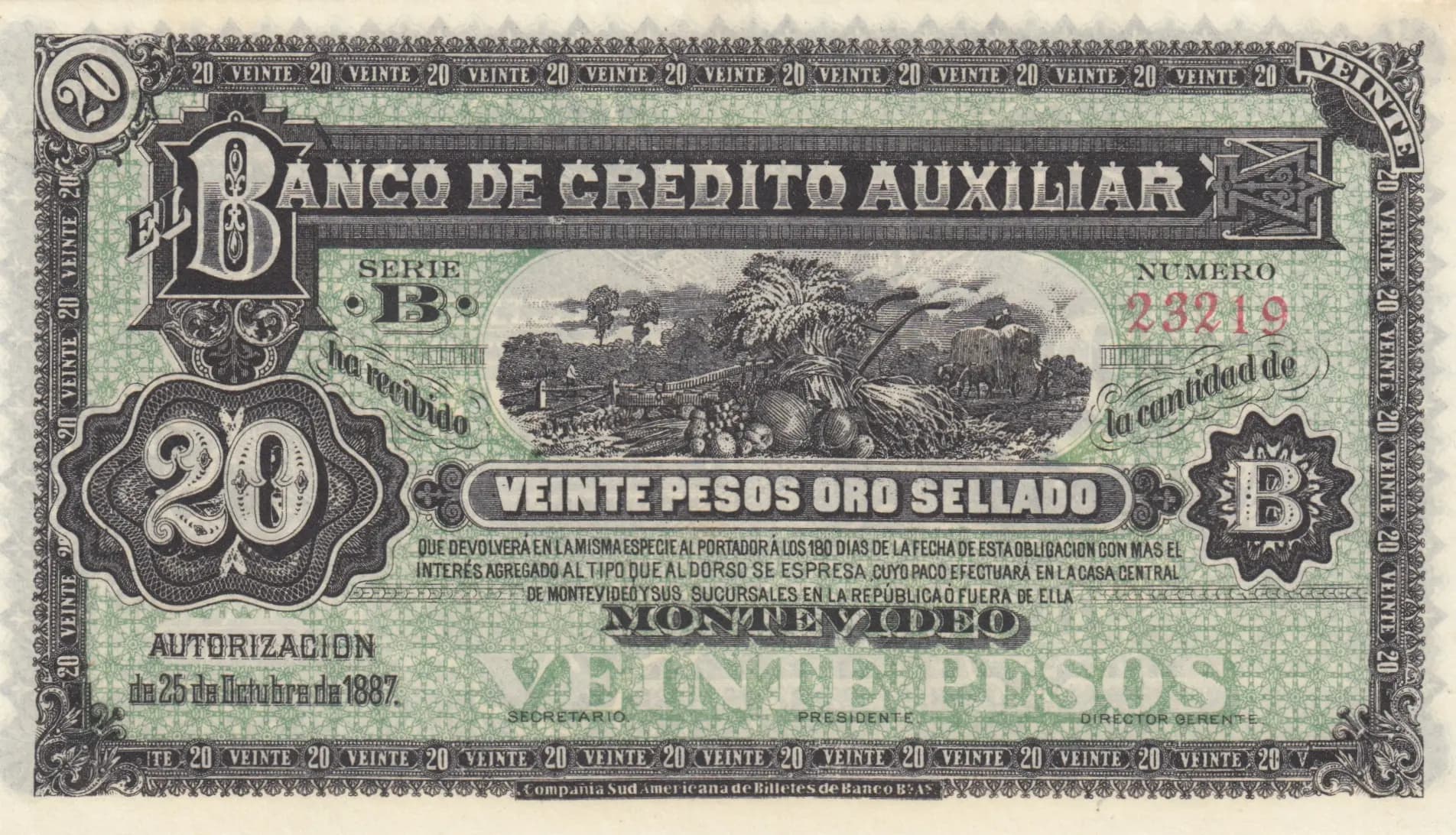
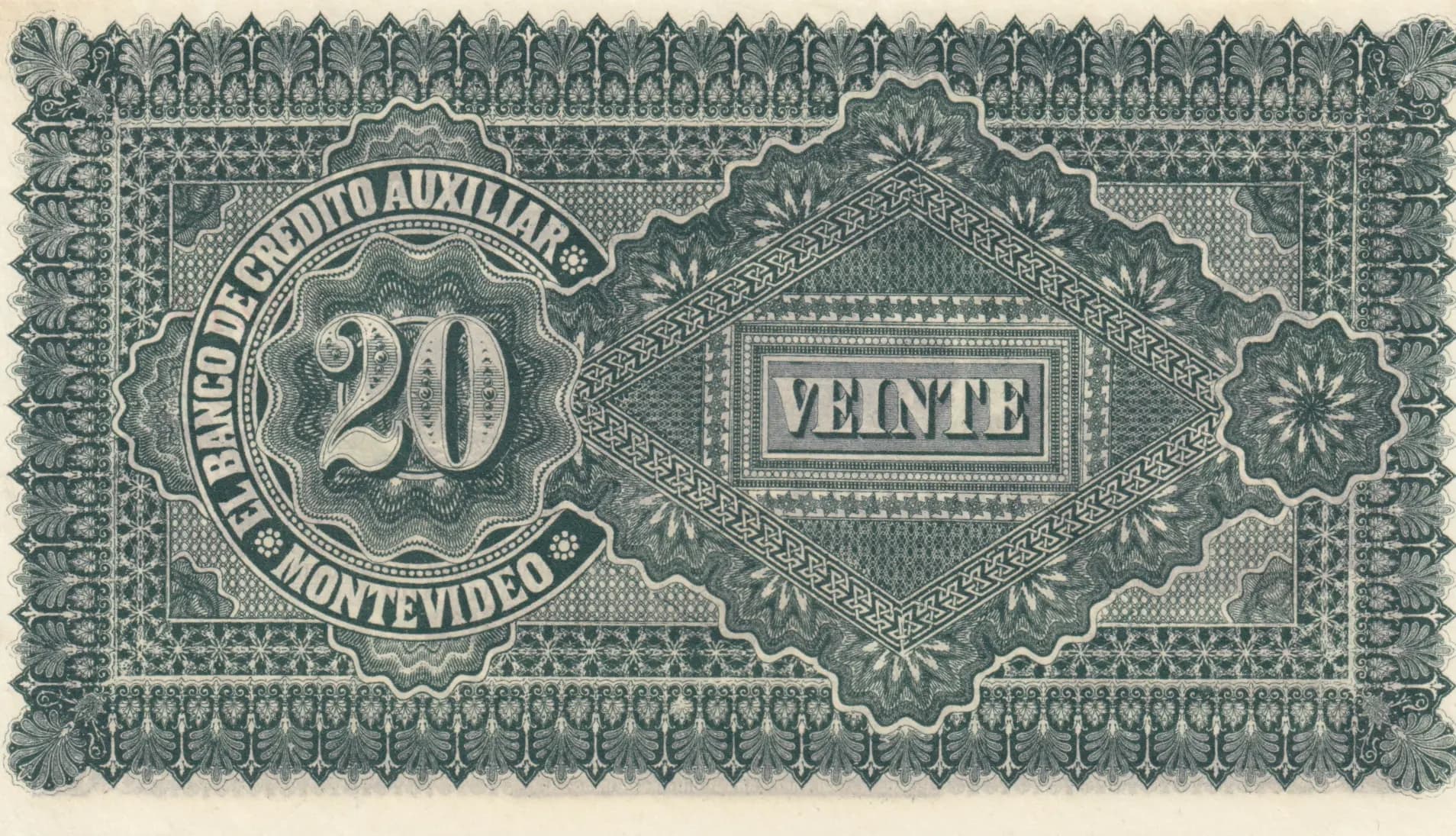
An exceptionally crisp uncirculated example of this scarce 1887 Uruguayan credit note from Banco de Crédito Auxiliar. The obverse features an elaborate central agricultural vignette with palm trees and harvest imagery rendered in green, black, and red inks on a light green underprint, enclosed by ornate Victorian-style borders with repeating 'VEINTE' text. The reverse displays intricate ornamental floral and geometric patterns in symmetrical arrangement with a prominent circular seal bearing the bank's name and denomination—a design typical of high-security bank notes from this era.
Uncommon. While the eBay price tracking data shows considerable variation in realized prices (ranging from $79.99 to $1,065.00 USD), the concentration of sales in the $95–$172 range for UNC and XF specimens, combined with the availability of multiple examples in the secondary market, indicates this is an uncommon rather than rare issue. The fact that unsigned remainder notes exist suggests a moderate to substantial original print run. This variety (Pick S164r designation indicating a remainder note) is less common than standard issued notes but far more obtainable than truly rare Uruguayan bank notes. The wide price variation likely reflects both buyer inexperience and the scarcity of pristine examples rather than fundamental rarity.
This 20 pesos note represents the late 19th-century financial expansion in Uruguay, issued under an October 25, 1887 authorization by Banco de Crédito Auxiliar of Montevideo. The agricultural imagery prominently featured in the central vignette—with palm trees and cultivated fields—reflects Uruguay's economy at this period, which remained heavily dependent on agricultural production and pastoral industries. The 180-day redemption clause and mention of 'sealed gold' (oro sellado) indicate this was issued as a credit instrument or promissory note rather than circulating currency, typical of banking instruments during the transitional period before modern central banking systems were fully established in South America.
This credit note showcases the refined engraving standards of late 19th-century South American banking instruments. The obverse centers on an agricultural vignette depicting a pastoral Uruguayan landscape with prominent palm trees, cultivated fields, and harvest imagery—symbols of the nation's agricultural wealth and economic foundation. The design is framed by an ornate double border with repeating denomination text ('VEINTE') in Victorian-style typography. Large ornamental circles containing the numeral '20' flank the central vignette on left and right. A decorative monogram 'B' and shield emblem represent the issuing bank. The reverse employs a purely ornamental approach, with no figurative imagery; instead, it features symmetrical arrangements of floral palmettes, geometric diamonds, and fine-line filigree patterns typical of security printing of the era. A large circular seal on the reverse bears the bank name, location (Montevideo), and denomination (20), serving as both design element and authenticating feature. The color scheme—light green underprint with dark green, black, and red accent inks—was a sophisticated security approach for the period.
FRONT SIDE: 'BANCO DE CRÉDITO AUXILIAR' (Auxiliary Credit Bank); 'VEINTE' (Twenty) [repeated around border]; 'SERIE B' (Series B); 'NÚMERO 23219' (Number/Serial 23219); 'la cantidad de VEINTE PESOS ORO SELLADO' (the quantity of Twenty Pesos in Sealed Gold); 'QUE DEVOLVERÁ EN LA MISMA ESPECIE AL PORTADOR A LOS 180 DÍAS DE LA FECHA DE ESTA OBLIGACION CON MÁS EL INTERÉS AGREGADO AL TIPO QUE AL DORSO SE EXPRESA CUYO PAGO EFECTUARÁ EN LA CASA CENTRAL DE MONTEVIDEO Y SUS SUCURSALES EN LA REPÚBLICA Ó FUERA DE ELLA' (Which will be returned in the same species to the bearer at 180 days from the date of this obligation with the interest added at the rate expressed on the back, the payment of which will be made at the central house of Montevideo and its branches in the Republic or outside of it); 'MONTEVIDEO'; 'VEINTE PESOS'; 'AUTORIZACIÓN de 25 de Octubre de 1887' (Authorization of October 25, 1887); signature lines for 'PRESIDENTE' (President), 'DIRECTOR GERENTE' (Managing Director), and 'SECRETARIO' (Secretary); 'Compañia Sud Americana de Billetes de Banco B.A.' (South American Bank Note Company B.A. [Buenos Aires]). BACK SIDE: 'BANCO DE CRÉDITO AUXILIAR' (Auxiliary Credit Bank); 'MONTEVIDEO'; 'VEINTE' (Twenty); '20' [in circular seal].
Fine-line steel engraving (intaglio/copperplate printing), executed by the Compañía Sud Americana de Billetes de Banco in Buenos Aires. The visual evidence of crisp, precise line work, intricate filigree detailing, and the professional security printing characteristics are consistent with the highest-quality bank note production standards of the 1880s. The multi-color printing (green underprint with black and red overprinting) indicates sequential printing passes, a hallmark of security-conscious financial institutions of the era. The note exhibits no letterpress elements, confirming pure engraved plate production.
This note is specifically identified as Pick S164r, the 'r' suffix designating it as an unsigned remainder—a note that was never activated for circulation and bears no bank official signatures. This is confirmed by the visual analysis noting the presence of blank signature lines for President, Managing Director, and Secretary. Series B is present. Serial number 23219 is observed. Remainder notes from this authorization typically command collector interest as they represent the banking institution's excess production capacity and serve as historical documentation of late 19th-century credit banking practices in Uruguay.