10 pesos/ 1 doblon 1870
Market Prices
About This Note
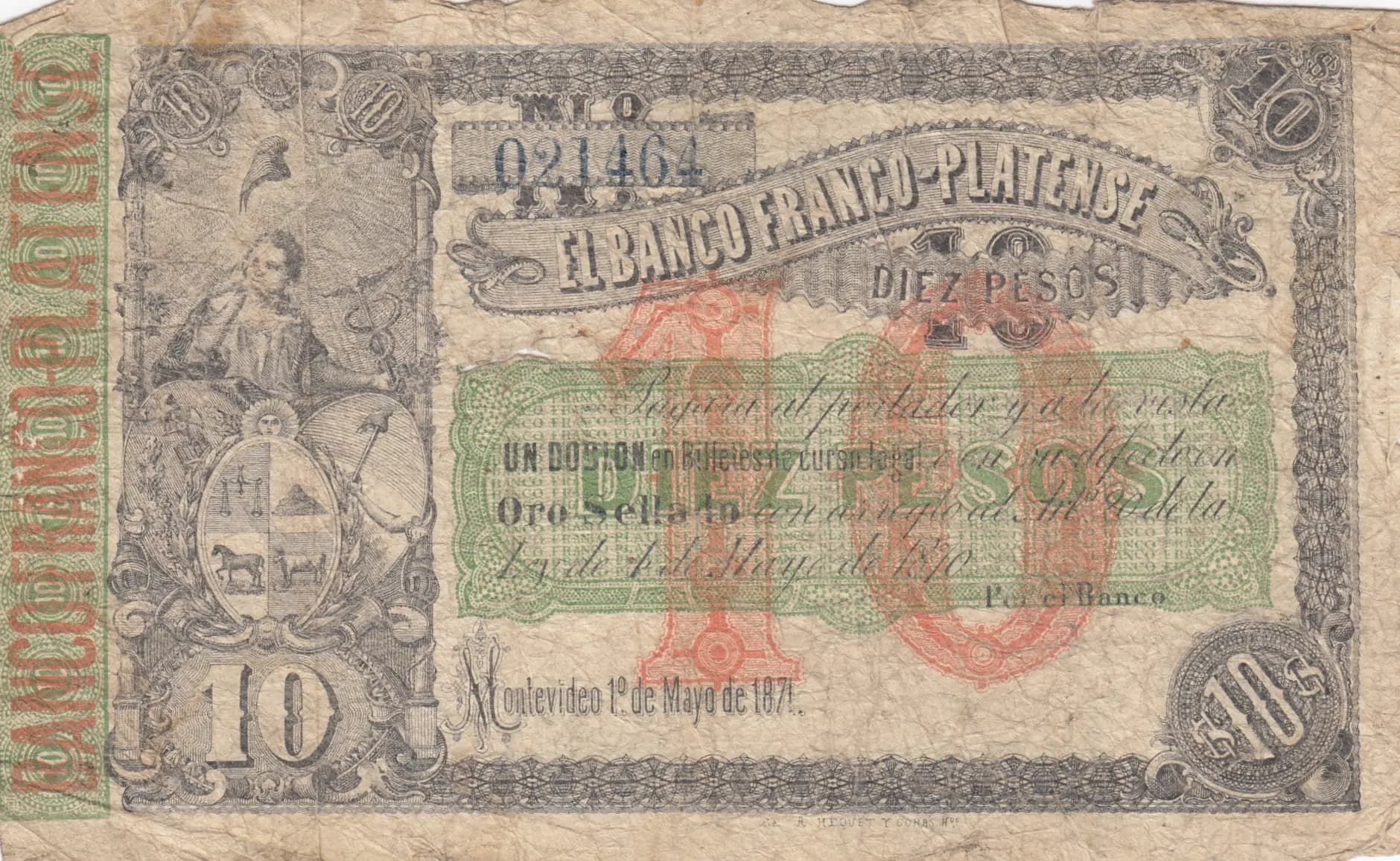
This is a Banco Franco-Platense 10 Pesos / 1 Doblon note from 1870-1871, a historically significant early Uruguayan banknote in VG condition. The note displays the characteristic ornate engraving of the era with a female allegorical portrait (Liberty) on the obverse and extensive decorative borders in black, green, and red tones. Despite significant circulation wear including creases, water staining, and foxing throughout, the engraved details remain visible, and handwritten annotations document its historical use in commerce.
Common. eBay market data shows this note trading at widely varying prices ($4.89 to $237.60 USD), with most sales clustering between $15-$100, indicating active collector market circulation. The VG condition grade observed in this specimen typically prices at the lower-to-mid range ($15-$30 estimated). The Banco Franco-Platense issued notes regularly during this period, and the Pick catalog designation P-S171 (with 'S' indicating a standard issue) suggests this was a regular production run rather than a limited or emergency issue. The presence of multiple handwritten dates and commercial annotations indicates the note circulated broadly in commerce, suggesting substantial print quantities.
The Banco Franco-Platense was a crucial financial institution in 19th-century Uruguay, and this denomination represents the transition period in Uruguayan currency standardization. The female allegorical figure with caduceus references classical Liberty imagery common to Latin American banking institutions of the era, while the heraldic shields and coat of arms reflect the bank's European heritage and legitimacy. The handwritten date of May 1, 1877, and commercial annotations ('Boston en Crédito Curzado,' 'Oro Sell') provide evidence of this note's active use in international trade and domestic commerce during the post-independence period.
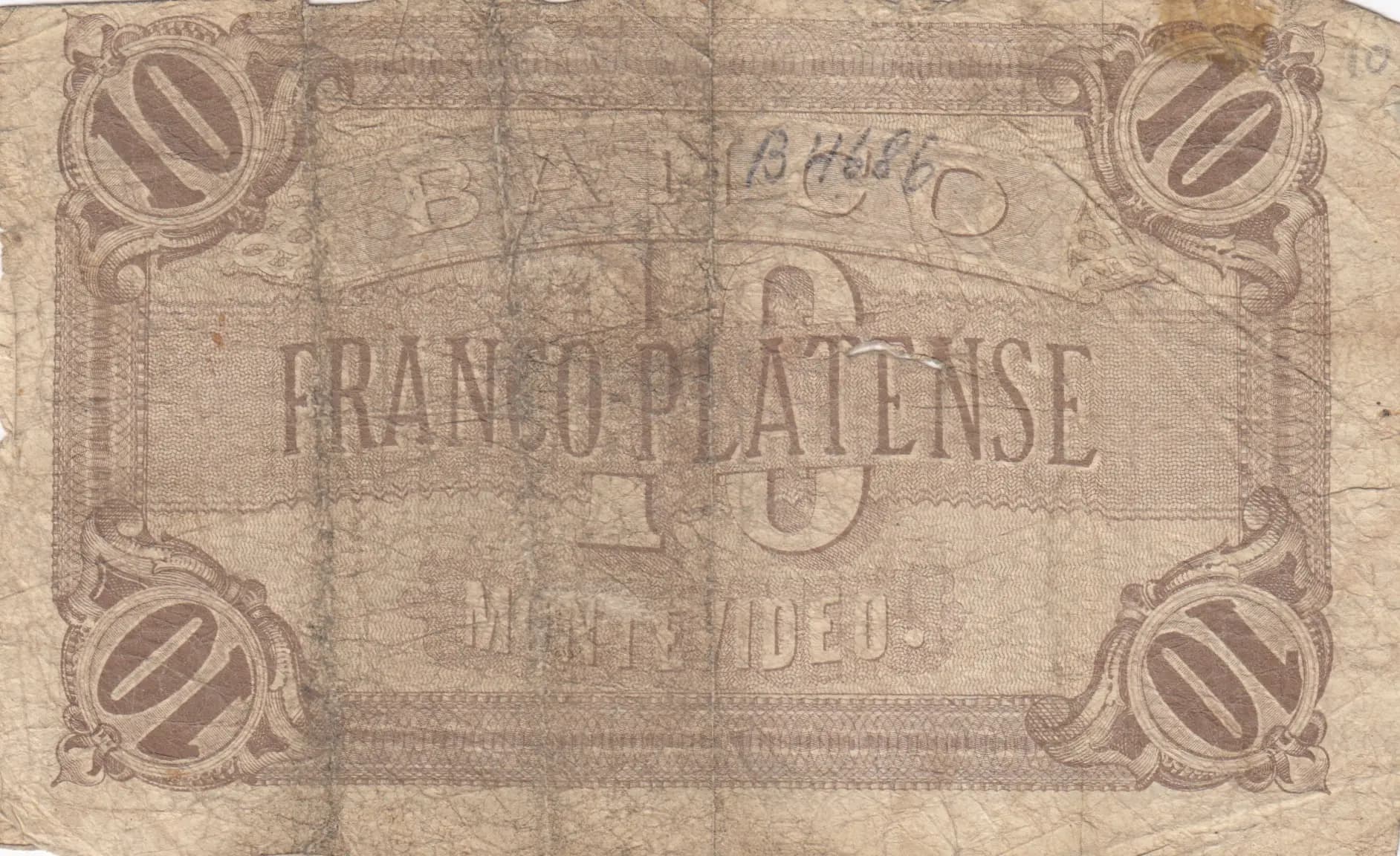
The obverse features a left-facing female allegorical figure representing Liberty, rendered in fine engraved line work characteristic of 19th-century security printing. She wears period dress and is accompanied by a caduceus (the winged staff of Mercury/Hermes), symbolizing commerce and legitimate authority. Below the portrait is an oval heraldic cartouche containing a coat of arms or shield design, likely representing Uruguay or the bank itself. The design employs a tri-color scheme with black engraving on green and orange underprints, with denomination '10' displayed in all four corners. The reverse presents a symmetrical composition with 'GRAN DEUDA' (Great Debt) as the primary inscription within an ornate rectangular frame, rendered in brown/sepia tones. Decorative corner ornaments featuring circular frames with diagonal stripe patterns appear on both sides. The overall layout reflects the neoclassical and Victorian design aesthetics dominant in Latin American banking during this period.
FRONT SIDE: 'CREDITO' (Credit) - vertical text on left margin; '10' - denomination numerals; 'II BANCO FRANQUEADO PLENITUD' (II Franked Bank Plenitude); 'DIEZ PESOS' (Ten Pesos); 'Montevideo 1º de Mayo de 1877' (Montevideo May 1st, 1877); 'Un Boston en Crédito Curzado' (A Boston in Crossed Credit - handwritten); 'Oro Sell' (Gold Sell - handwritten); Serial number '024401'. BACK SIDE: 'GRAN DEUDA' (Great Debt) - primary text within ornamental frame; '10' - denomination numeral; 'DEUDA' (Debt - repeated at bottom); '10 Pablo' (handwritten notation).
The note was produced using steel engraving and intaglio printing techniques, the standard security method for banknotes of this era. The printer identified as 'A. Hequet y Cohas Hos.' (A. Hequet and Co. Brothers) executed the fine line work evident throughout the design. The multi-color printing (black, green, red, brown) was achieved through sequential passes, with the colored underprints applied before the primary engraved design. The intricate border work, fine line hatching in the heraldic elements, and the quality of portrait rendering are all consistent with hand-engraved and hand-pulled intaglio production methods.
This note is dated 1870 in the catalog but displays a handwritten date of May 1, 1877, common for commercial and financial instruments of this period where notes were reused or circulated with transaction dates added by hand. The serial number 024401 is relatively low, suggesting an earlier production batch. Handwritten annotations ('Boston en Crédito Curzado,' 'Oro Sell,' '10 Pablo') represent transaction records rather than issuing authority variations. No overprints, specimen markings, or printer's variants are evident. The signature characteristics noted in the catalog ('Signed banknote') appear consistent with authorized bank officer signatures rather than numbered signature varieties.