20 pesos 1871
Market Prices
About This Note
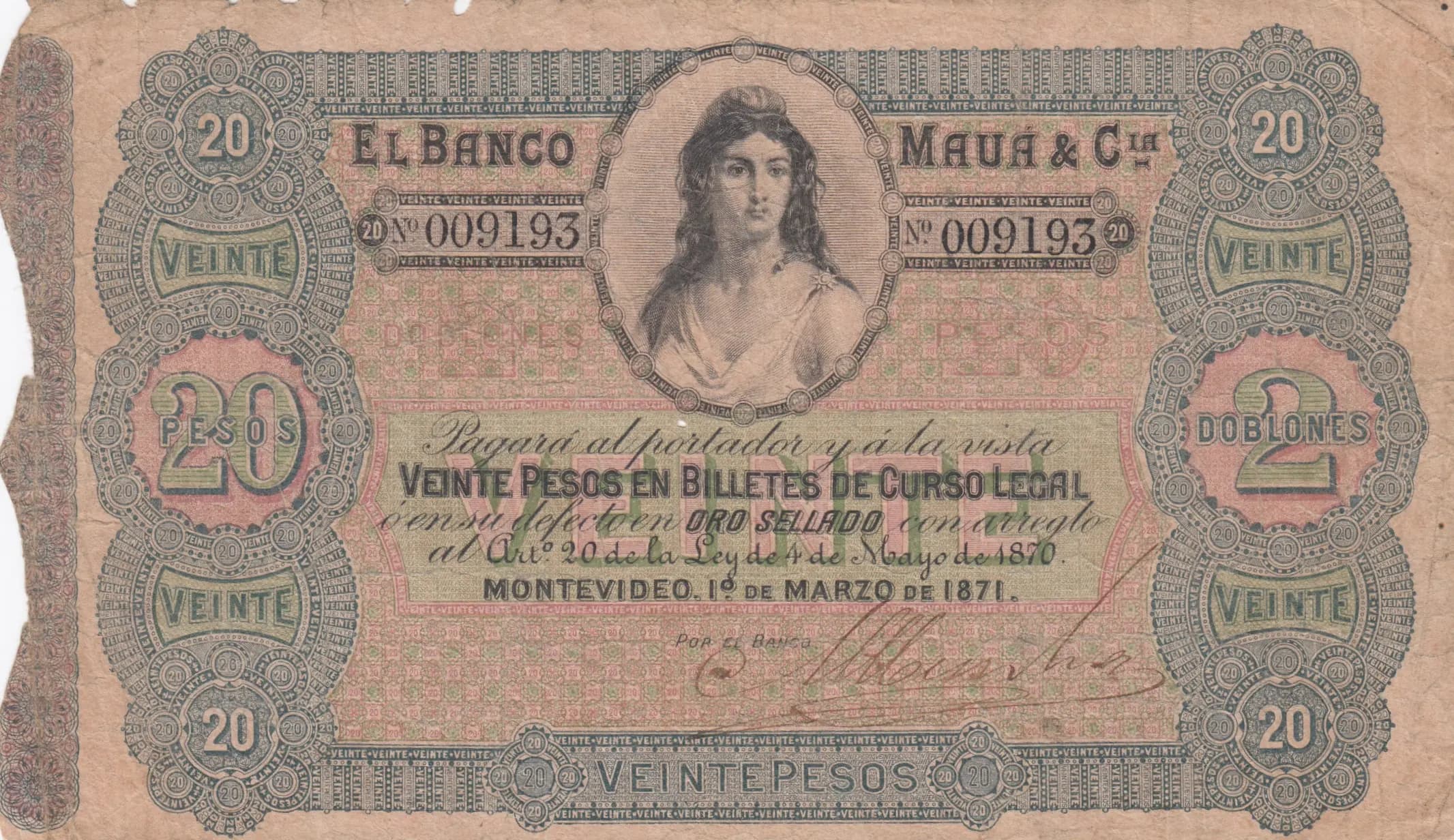
This is a VG-graded 20 Pesos note from Banco Maúa dated March 1, 1871, representing an important early Uruguayan banknote issue. The note features an elegant classical female portrait in a central oval medallion surrounded by intricate ornamental circular borders rendered in brown, pink, and green inks on rose paper. Despite significant evidence of 19th-century circulation—including prominent creasing, foxing, and age-related discoloration—the engraved security details remain clearly visible, making this an interesting example of early South American banking currency.
Common. The eBay price data shows consistent sales ranging from $2.13 to $400.00 USD across various condition grades, with multiple recent listings, indicating an active market with adequate supply. Notes in VG condition appear regularly priced in the $50-$100 range based on the comparable AU and F grades listed. The note's age (1871) and the historical significance of Banco Maúa do not overcome the fact that sufficient examples exist in the collector market at modest price points. Banco Maúa was a legitimate, established institution with reasonable print runs, and no evidence suggests limited mintage or recall.
Issued by Banco Maúa in March 1871, this note reflects Uruguay's early banking development following the Law of May 4, 1870, which regulated currency backed by sealed gold. The classical female portrait symbolizes the feminine representation of commerce or the nation, a common allegorical motif in 19th-century Latin American currency design. The dual denomination marking (20 Pesos = 2 Doblones) illustrates the transitional currency system of post-colonial Uruguay, bridging colonial Spanish monetary units with modern peso-based denominations.
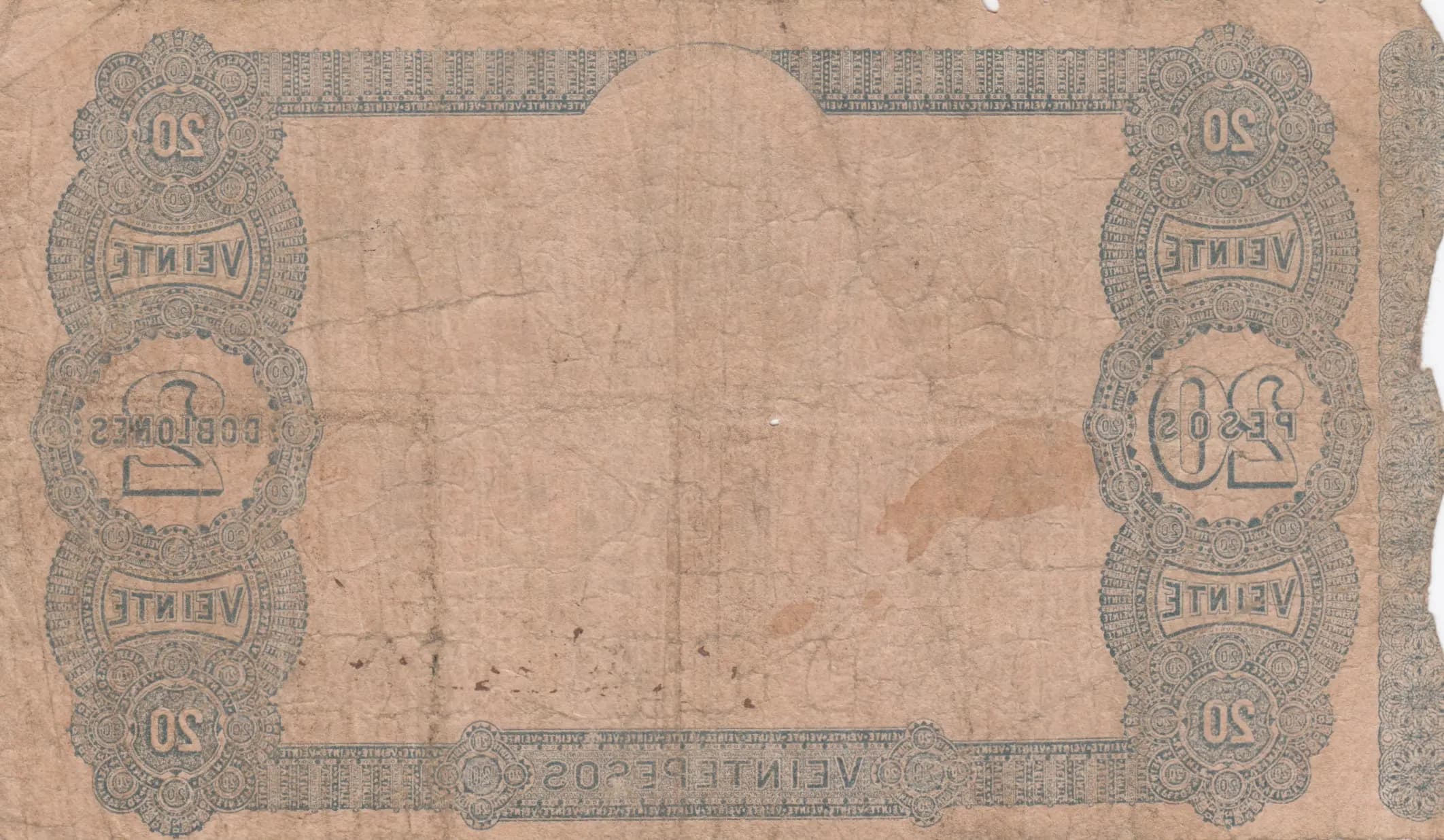
The obverse features a formal classical female bust portrait in an oval frame with beaded circular border, rendered in fine engraving. The portrait depicts a bare-shouldered woman with long curled hair wearing draped classical drapery, representing the allegorical personification of commerce or the state. This central portrait is surrounded by elaborate concentric circular ornamental patterns forming elaborate border frames with repeating geometric designs. Denomination numerals '20' appear in all four corners with matching ornamental corner frames. The reverse retains the decorative corner frames and border patterns but is otherwise largely blank in the center, typical of period banknote design. The color scheme combines brown/tan overprints on rose paper with green accents, creating a distinctive aesthetic consistent with Victorian-era Latin American currency.
FRONT: 'EL BANCO' (The Bank) / 'Maúa & Cía' (Maúa & Company) / '20' and 'VEINTE' (Twenty) / 'PESOS' / 'DOBLONES' (Doubloons) / 'Pongo al portador y a su vista' (Put to the bearer and at their sight) / 'VEINTE PESOS EN BILLETES DE CURSO LEGAL' (Twenty pesos in legal tender notes) / 'o en su defecto en ORO SELLADO con areglo' (or failing that in sealed gold according) / 'al Art. 6º de la Ley de 4 de Mayo de 1870' (to Article 6 of the Law of May 4, 1870) / 'MONTEVIDEO. 1º DE MARZO DE 1871' (Montevideo. March 1, 1871) / 'Por el Banco' (For the Bank) / Serial number: 'Nº 009193'. BACK: Repetition of denomination markers '20', 'VEINTE', 'DOBLONES', and 'VEINTE PESOS' in corner ornamental frames.
Intaglio engraving (line engraving), evidenced by the fine, precise line work visible in the ornamental borders, geometric patterns, and portrait detailing. The intricate circular motifs, geometric repeating patterns, and the depth of the portrait engraving are characteristic of steel or copper plate engraving. The multi-color printing effect (black on rose, green accents) suggests overprinting of separately engraved plates. This note was likely produced by a specialized security printer with expertise in 19th-century banknote production; European printers were commonly contracted for South American currency of this era.
This specific example bears serial number 009193, issued March 1, 1871. The Pick catalog designation P-S292 represents the standard 20 Pesos denomination for regular issue by Banco Maúa from this date. No overprints, color variations, or signature variations are apparent from the visual analysis. The note appears to represent the standard issued variety without error or rarity variants.