20 pesos/ 2 doblones 1870
Market Prices
About This Note
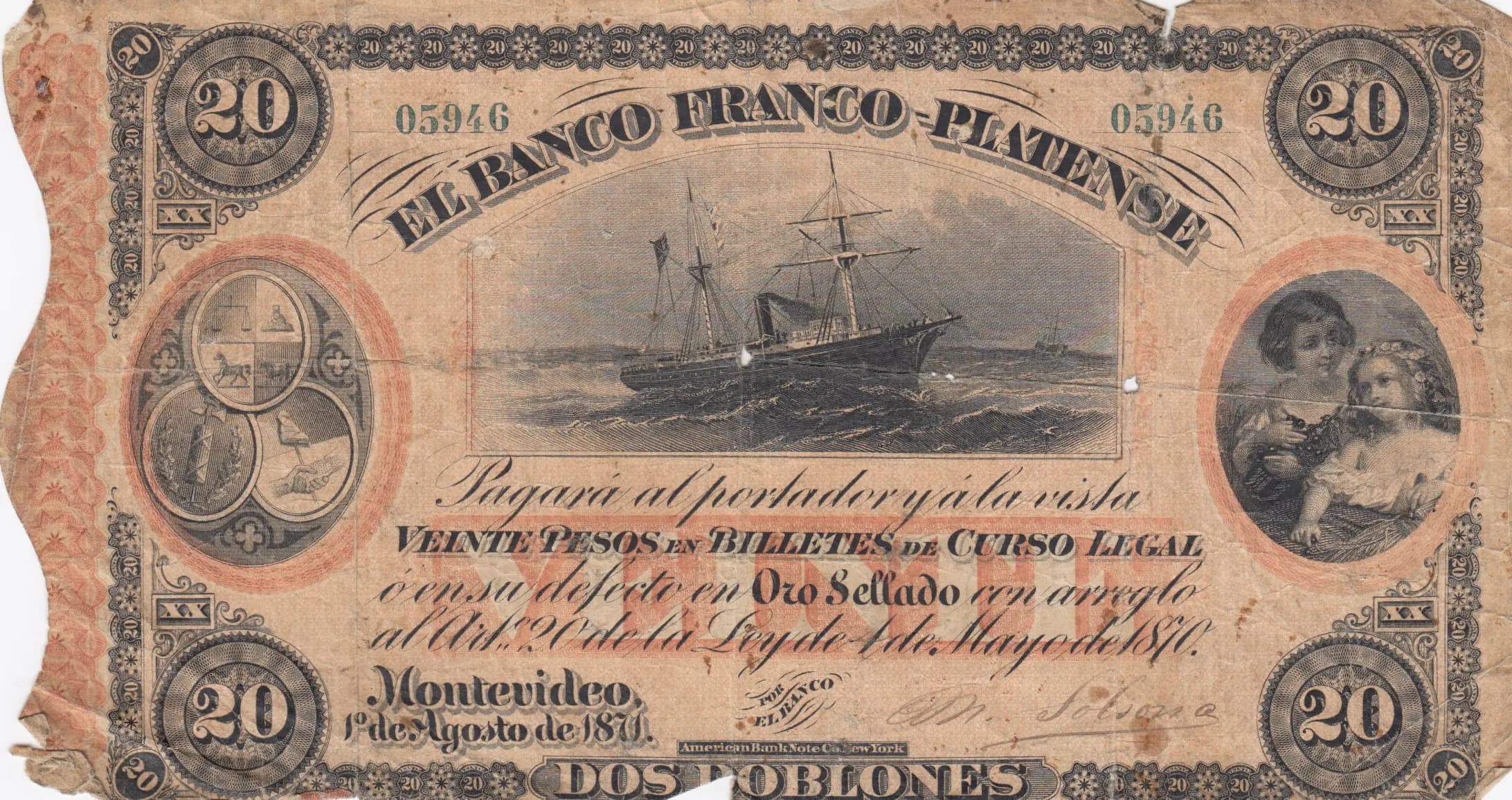
This is a scarce 1870-1871 issue 20 Pesos (2 Doblones) banknote from El Banco Franco-Platense, printed by the American Bank Note Company. The note features exceptional engraved artwork including a central steamship in stormy seas, portrait medallions, and ornate decorative borders in black, gray, and red/pink on beige stock. In Grade G (good) condition, it displays significant period wear with creases, folds, and foxing consistent with 150+ years of circulation, making it a historically important example of 19th-century Uruguayan banking currency.
Common. While this is a 150-year-old note from a defunct private bank, eBay market data shows multiple sales across various grades ranging from $2.13 to $400, with most mid-grade examples selling in the $50-100 range. The presence of multiple PMG-graded variants (P-S173a and P-S173b) suggests adequate surviving population. The Grade G condition assessment and modest pricing indicate this variety remains readily available to collectors despite its age.
El Banco Franco-Platense was a private bank operating in Montevideo during the 1870s, and this note represents the bank's legal tender issued under a May 1871 Legislative Decree. The steamship depicted at center symbolizes Uruguay's importance as a maritime trading nation in the Río de la Plata region, while the formal iconography and American Bank Note Company printing reflect the era's international financial standardization. The note's redemption clause ('Pagaran al portador y al visto' / 'Pay to bearer at sight') and gold-backing provisions demonstrate the specie-based monetary practices of mid-19th century South America.
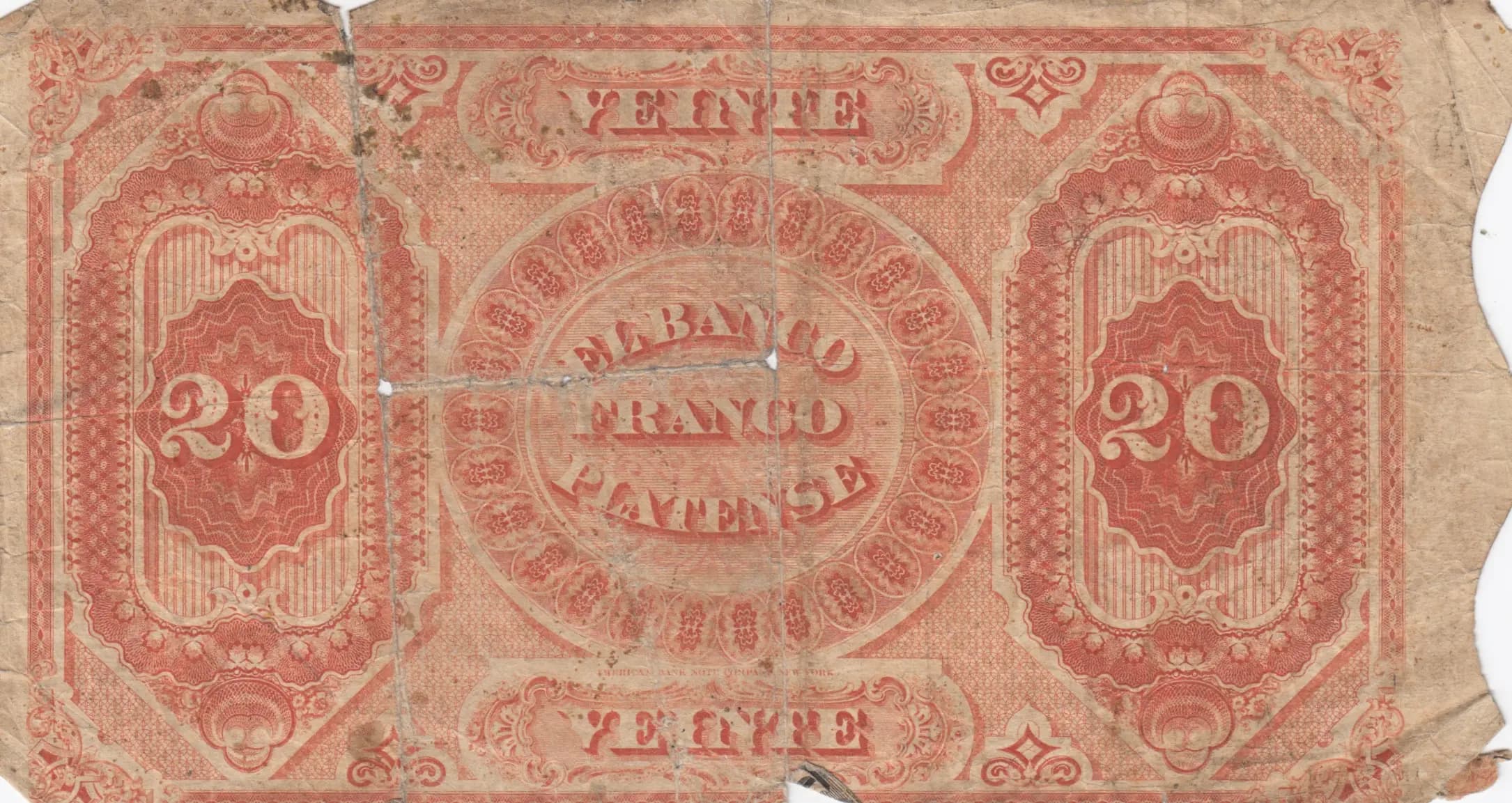
The obverse presents a sophisticated multi-vignette composition typical of ABNC's high-security banknote design. The central motif depicts a full-rigged steamship navigating heavy seas, symbolizing maritime commerce and Uruguay's trading heritage. On the left side, an oval medallion contains two male profile portraits in classical engraved style, likely representing bank officials or national figures. The right side features a woman's portrait paired with a cherub figure in an ornate oval frame, representing prosperity or commerce personified. The note is framed by intricate floral and geometric border patterns with denomination cartouches containing '20' in all four corners. The reverse exhibits a restrained but elegant design with a symmetrical pattern of red/pink geometric and floral ornaments, anchored by a central circular seal containing the bank name. The color scheme of black, gray, and red on beige provides excellent contrast for security purposes.
FRONT SIDE: '20' and 'VEINTE PESOS' (Twenty Pesos) in corners and center; 'EL BANCO FRANCO-PLATENSE' (The Franco-Platense Bank); Serial number '05946'; 'Pagaran al portador y al visto' (Pay to bearer at sight); 'VEINTE PESOS en BILLETES de CURSO LEGAL' (Twenty pesos in bills of legal course); 'DOS DOBLONES' (Two Doubloons); 'O Comprobado en Oro Sellado con arreglo al Decreto del Fomento Legislativo Nro. Mayo de 1871' (Or proven in sealed gold according to Legislative Development Decree No. May 1871); 'Montevideo'; '1º de Agosto de 1871' (August 1st, 1871); 'American Bank Note Co. New York' (printer attribution). BACK SIDE: 'VEINTE' (Twenty) at top and bottom; '20' in ornamental cartouches; 'EL BANCO FRANCO-PLATENSE' in central circular seal.
Steel engraving (intaglio) executed by the American Bank Note Company of New York, one of the era's most respected security printers. The production technique employed multiple engraved steel plates for different color layers—black for primary design elements and text, gray for shading and security line work, and red/pink for decorative borders and reverse design. The fine line work, portrait detailing, and complex border patterns visible in the visual analysis are characteristic of high-quality 19th-century intaglio printing, which provided superior anti-counterfeiting protection through the difficulty of reproducing fine engraved lines.
This note is cataloged as Pick P-S173a, the ABNC-printed variant. The visual analysis confirms ABNC attribution through the 'American Bank Note Co. New York' imprint on the obverse. The issue date of August 1, 1871 (printed on note) aligns with the May 1871 legislative authorization. Serial number 05946 is visible. PMG records indicate a P-S173b variant exists, suggesting potential differences in printer or design elements between variants, though the specific distinguishing characteristics require comparison of specimens.