20 centesimos 1887
Market Prices
3 salesAbout This Note
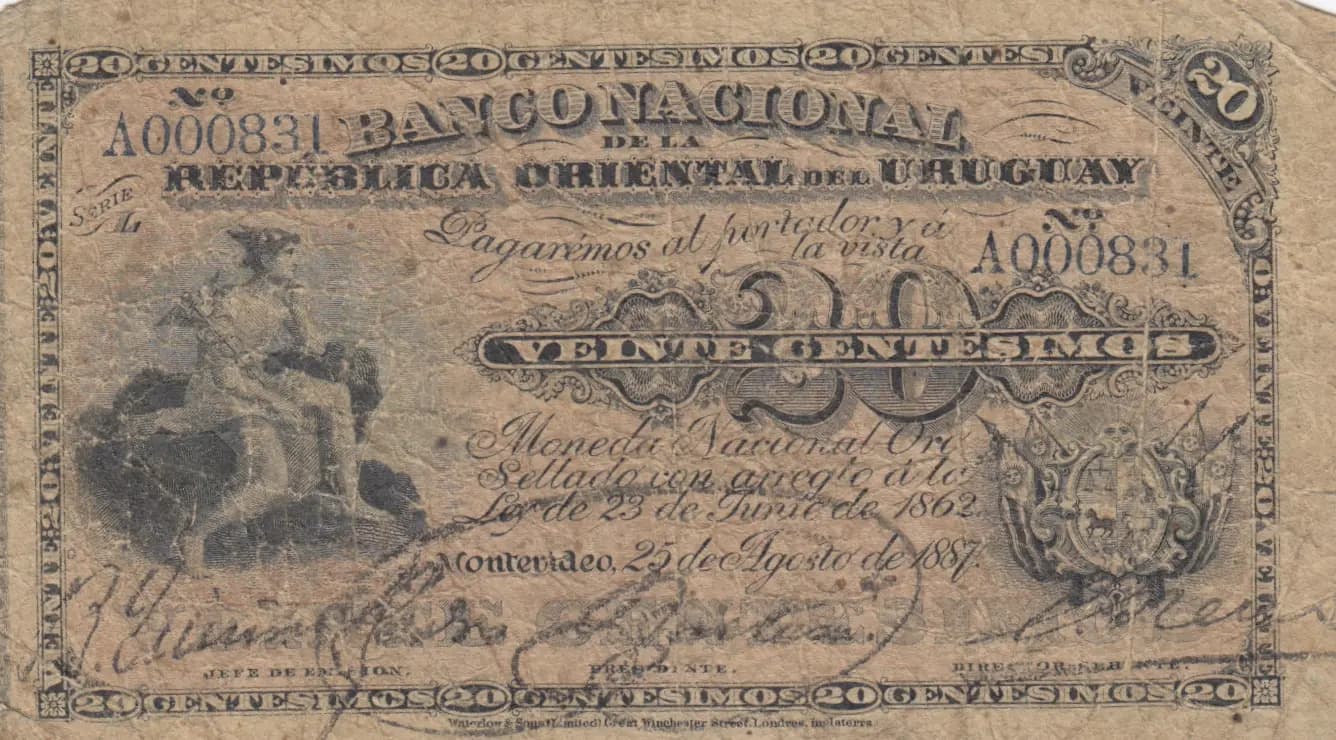
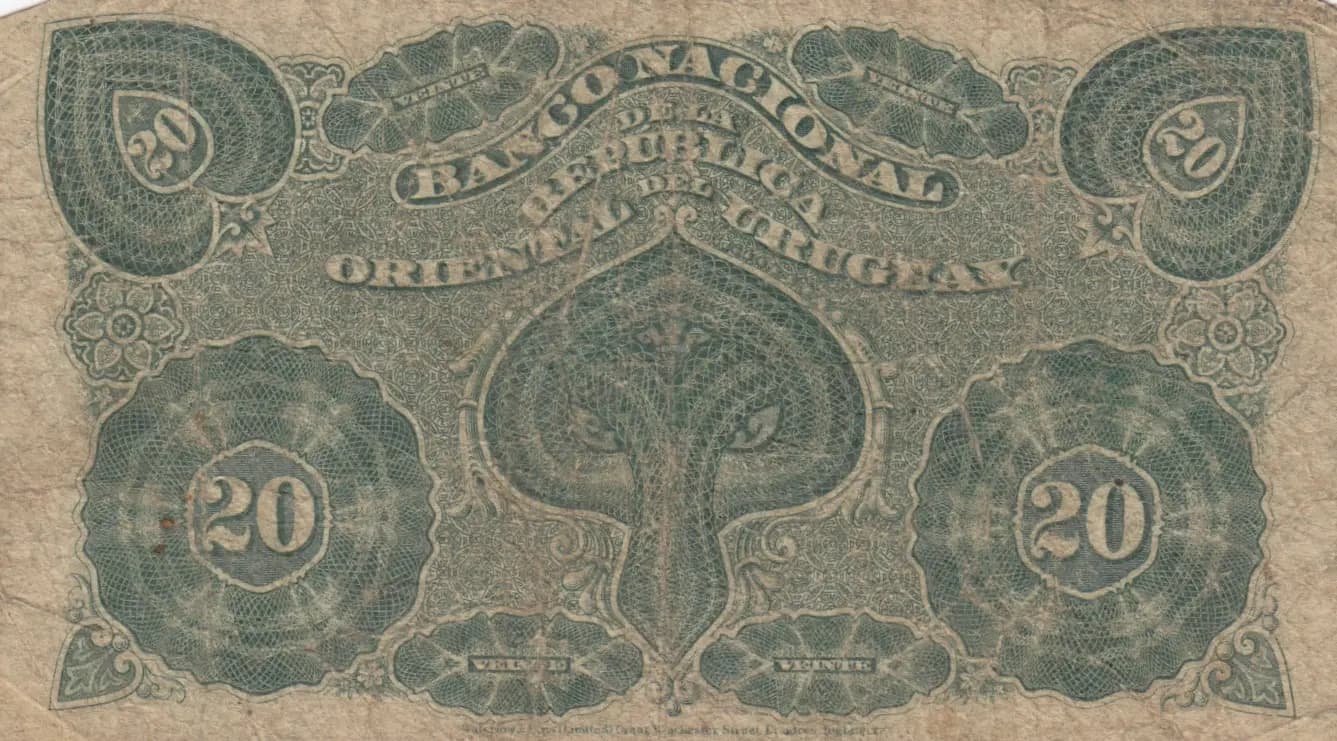
This is a VG-grade example of the scarce 1887 Uruguayan 20 Centésimos from the Banco Nacional de la República Oriental del Uruguay, printed by Waterlow & Sons. The note displays the characteristic allegorical Mercury figure on the obverse with ornate classical engraving, rendered in brown and black on pink underprint, while the reverse features a green heraldic coat of arms with central shield emblem. Heavy circulation wear is evident throughout with multiple creases, foxing, and age-related discoloration typical of a note surviving 135+ years, making this a desirable early example of Uruguayan banknote production.
Common. Despite being over 135 years old, this denomination appears with sufficient regularity in the numismatic market to command modest valuations. eBay historical data shows examples in comparable or better condition (F grade) selling for $15-23 in the 2013-2020 period, with VG examples at $2.25, placing it solidly in the common range for early Uruguayan currency. The 2016 catalog value of $4 for G condition further supports a common classification. Print runs from the Banco Nacional's 1887 production were substantial enough that survivors are available to collectors, particularly in circulated grades.
Issued on August 29, 1887, this note represents the Banco Nacional's early period of currency production during Uruguay's nation-building era in the late 19th century. The prominent use of Mercury—the Roman god of commerce and trade—reflects the bank's aspirations to represent economic prosperity and modern banking practices. The elaborate classical design with heraldic coat of arms underscores Uruguay's republican identity and institutional stability during a formative period of South American financial development.
The obverse features a classical allegorical female figure identified as Mercury, seated at the left side of the note in the traditional pose of commerce and trade. She is accompanied by ornamental scrollwork and decorative flourishes framing the composition. The reverse displays a central heraldic coat of arms with a shield containing what appears to be the national emblem, likely incorporating the ceibo flower or related national symbol. Both sides employ elaborate ornamental borders and corner ornaments typical of high-security Victorian-era banknote design. The note's color scheme—brown/tan with black on pink underprint for the obverse, and green for the reverse—was typical of late 19th-century Central Bank printing practice to aid in rapid identification and reduce counterfeiting.
FRONT: 'Banco Nacional de la República Oriental del Uruguay' (National Bank of the Oriental Republic of Uruguay); '20 Centésimos' / 'Veinte Centésimos' (Twenty centesimos); Serial number 'No A000831'; 'Pagaremos al portador y a la vista' (We will pay to the bearer on sight); 'Moneda Nacional Ory. Sellado que prescribe a los' (National Currency sealed that prescribes to the...); 'Montevideo, 29 de Agosto de 1887' (Montevideo, August 29, 1887); 'Waterlow & Sons Limited, Banknote Printers, Warren Street, London' (printer attribution). BACK: 'República Oriental del Uruguay' (Oriental Republic of Uruguay); 'Banco Nacional de la República Oriental del Uruguay' (National Bank of the Oriental Republic of Uruguay); Denomination '20' displayed prominently.
Steel engraving with fine line work and cross-hatching, executed by Waterlow & Sons Limited of London, a premier British security printer. The complex decorative border patterns, intricate scrollwork, and detailed allegorical figure work are characteristic of intaglio printing from steel plates. Multiple color printing (brown/pink on front, green on back) indicates sequential passes through the printing press, a hallmark of security printing standards of the era. No evidence of branch office perforations or overprints is present on this issued note.
This note is cataloged as Pick P-A88, with two known variants in the PMG population (P-A88b and P-A88c), both printed by W&S (Waterlow & Sons). The serial number A000831 observed on this example places it in early production. Signature varieties are noted in catalog references for this issue, though the specific signatures are not clearly legible in the visual analysis provided. The absence of branch office perforation or overprint confirms this as a regular issued note rather than a special institutional variant.