20 centesimos 1918
Market Prices
4 salesAbout This Note
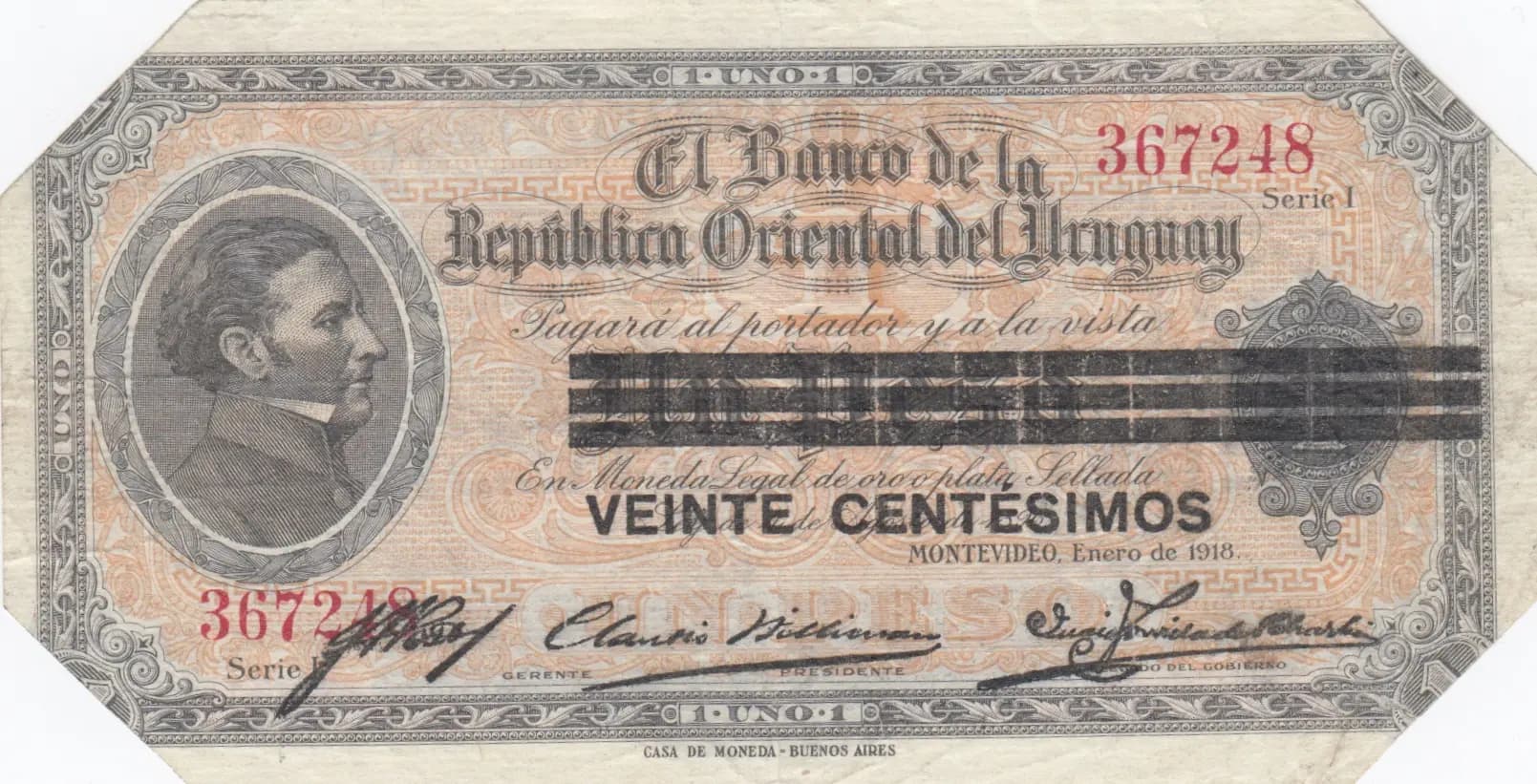
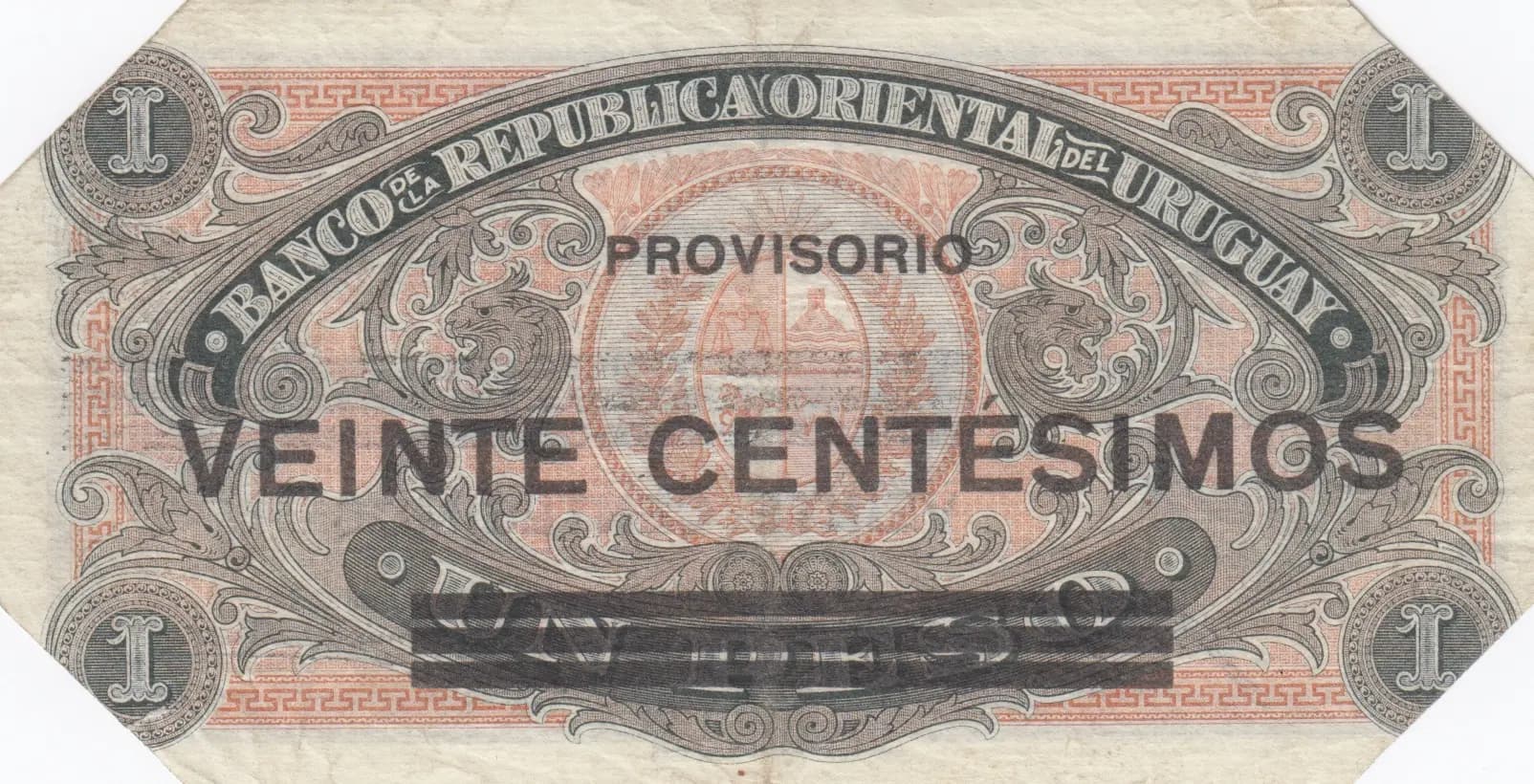
This is a 1918 Uruguayan 20 Centésimos note issued by Banco de la República Oriental del Uruguay, notable for being an overprinted denomination conversion from a 1 Peso note. The note displays the characteristic design of early 20th-century Uruguayan currency with an elegant portrait of General José Gervasio Artigas in profile on the left, surrounded by ornate scrollwork and geometric border patterns in cream and orange-red tones. In Good (G) condition, the note bears a prominent diagonal black overprint across both sides indicating the denomination change, with visible creasing and aging consistent with circulation, and notably features the four corner cuts that were standard for this particular issue.
Common. The eBay price data provided shows recent sales of comparable grades ranging from $12.50 to $40 for Fine examples, with the subject note in Good condition representing a well-circulated specimen. Notes trading in this price range ($12.50-$40) are standard circulated issues with healthy collector demand but substantial surviving populations. The provisional overprint nature and four-corner cuts were standard production features rather than indicators of rarity. No evidence from PMG population data or catalog information suggests this Pick number was issued in limited quantities.
This note represents a transitional monetary period in Uruguay following World War I, when the bank issued provisional overprinted denominations to meet changing currency demands. The January 1918 date and Buenos Aires printer mark reflect the practical realities of South American banking at the time, when currency conversion was managed through overprinting existing stock rather than commissioning entirely new plates. The prominent display of General Artigas—the founding father of Uruguayan independence—on the obverse anchored the note's legitimacy and national identity during this period of monetary adjustment.
The obverse features a fine three-quarter profile portrait of General José Gervasio Artigas, the principal founder and national hero of Uruguay, rendered in classical intaglio style facing rightward in formal 19th-century dress. The portrait is positioned at the left with an elaborate ornamental border featuring scrollwork, Greek key geometric patterns, and decorative circular medallions in the corners. The reverse displays a symmetrical design centered on an ornate oval frame containing what appears to be the national arms or seal, surrounded by complementary scrollwork and corner emblems marked with Roman numeral 'I'. Both sides carry the prominent diagonal black overprint lines with denomination text, a defining characteristic of this provisional issue. The color scheme throughout employs cream and beige paper tones with orange-red tinted decorative elements and black printing.
FRONT: 'El Banco de la Republica Oriental del Uruguay' (The Bank of the Oriental Republic of Uruguay); 'Pagara al portador y a la vista' (Pay to the bearer on sight); 'En Moneda Legal de oro puro, Sellada' (In legal currency of pure gold, sealed); 'VEINTE CENTESIMOS' (Twenty centésimos); 'MONTEVIDEO, Enero de 1918' (Montevideo, January 1918); 'Serie I' (Series I); Serial number 3672448; 'GERENTE' (Manager); 'PRESIDENTE' (President); 'CASA DE MONEDA - BUENOS AIRES' (Mint - Buenos Aires). BACK: 'BANCO DE LA REPUBLICA ORIENTAL DEL URUGUAY' (Bank of the Oriental Republic of Uruguay); 'PROVISORIO' (Provisional); 'VEINTE CENTESIMOS' (Twenty centésimos).
Intaglio engraving, printed by Casa de Moneda (Mint) in Buenos Aires. The fine line work evident in the portrait, the intricate border patterns, and the detailed scrollwork throughout are characteristic of high-security intaglio production. The overprint denomination markings were applied as a secondary process using black line work overprinting the original 1 Peso design, a common practice for provisional currency conversions of the period.
This note is Series I with serial number 3672448 printed in black. The catalog data indicates three serial number varieties exist for this issue (red or black serial numbers noted). The visible overprint with black lines and new denomination on both face and back is standard for the P-14 issue. The four corners being cut off is a defining production characteristic of this 1918 provisional issue rather than a variety marker. The note was issued January 1918 from a single printing by Casa de Moneda, Buenos Aires.