1000 pesos 1939
Market Prices
14 salesAbout This Note
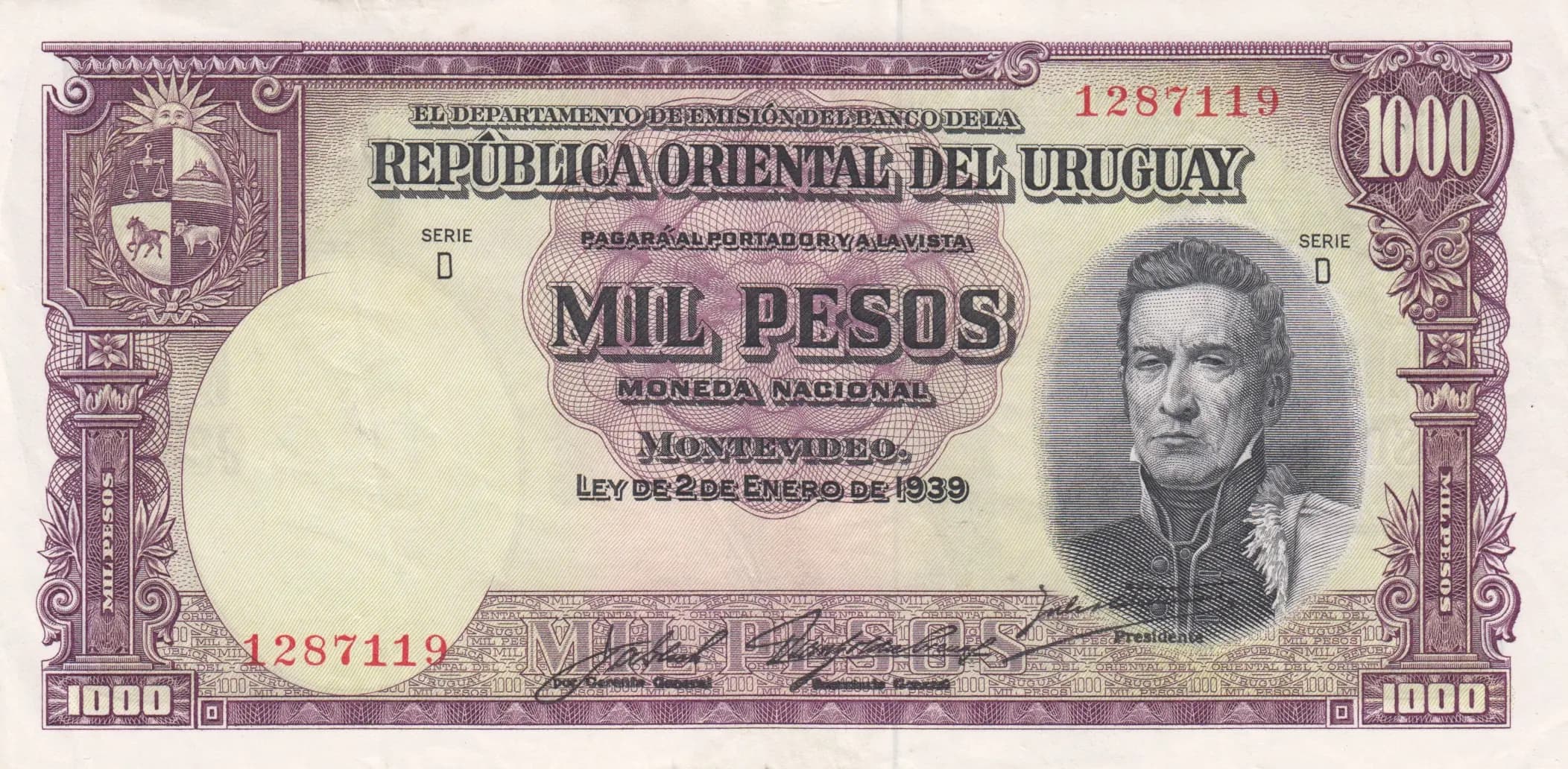
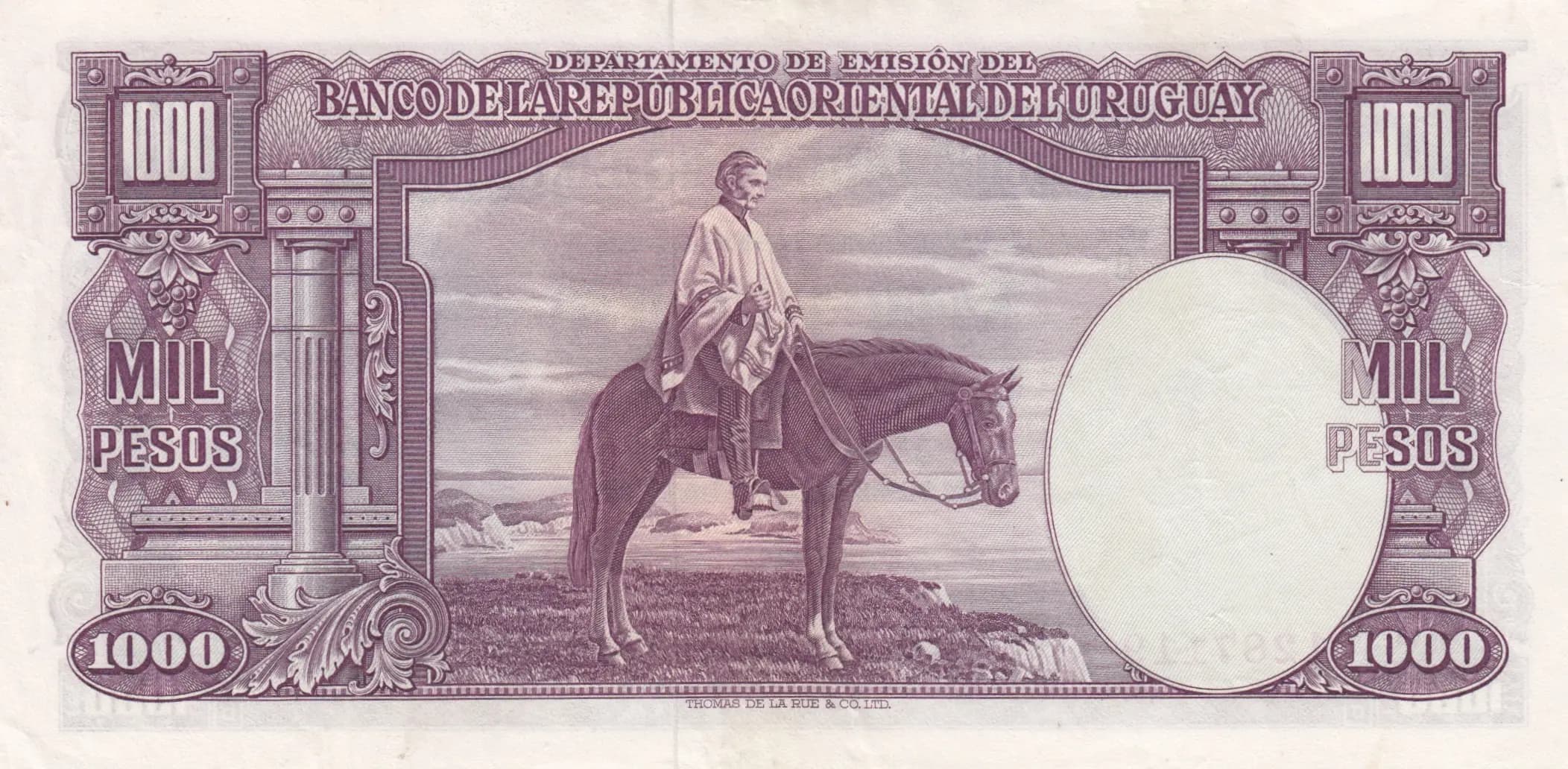
This is a VF-graded 1000 pesos banknote from Uruguay issued in 1939 by the Departamento de Emisión del Banco de la República Oriental del Uruguay. The note exhibits the characteristic purple and mauve color scheme with intricate engraving throughout, featuring General José Gervasio Artigas on the obverse and a mounted horseman on the reverse. Despite catalog values suggesting modest worth ($5 in VF per 2016 data), the note's age, historical significance, and fine engraving quality make it an attractive addition to Uruguay currency collections.
Common. This is a standard regular issue from 1939 with no evidence of limited print runs, recall status, or short-lived issuing authority. The eBay price history shows consistent sales in the $4.99–$12.50 range for VF examples over multiple years (2014–2022), with most transactions occurring at well under $20, strongly indicating robust availability in the secondary market. Catalog values of $5 in VF further confirm this is a common date and denomination for collectors.
This note was issued under the law of January 2, 1939, during a period of significant monetary reorganization in Uruguay. The portrait of General José Gervasio Artigas, the founding figure of Uruguayan independence and national hero, reflects the nation's emphasis on historical continuity and patriotic identity in its currency design. The mounted horseman on the reverse further emphasizes Uruguay's gaucho heritage and agricultural roots during the early 20th century.
The obverse features a formal portrait of General José Gervasio Artigas, positioned on the right side in 19th-century military dress, facing left. The coat of arms of Uruguay appears on the upper left, displaying the characteristic sun rays (Sol de Mayo), a bell tower or monument representing Montevideo, and a horse within a decorative shield. The reverse depicts a mounted horseman in traditional period clothing and gaucho attire, positioned beside his horse in a pastoral landscape setting, symbolizing the gaucho culture and rural heritage of Uruguay. Both sides are framed by ornamental classical columns and intricate scrollwork borders with grape vine motifs in the corners, executed in the fine-line engraving style characteristic of Thomas de la Rue's premium banknote production.
FRONT SIDE: 'EL DEPARTAMENTO DE EMISIÓN DEL BANCO DE LA REPÚBLICA ORIENTAL DEL URUGUAY' (The Emission Department of the Bank of the Oriental Republic of Uruguay); 'PAGARÁ AL PORTADOR Y A LA VISTA' (Will pay to the bearer on sight); 'MIL PESOS' (One Thousand Pesos); 'MONEDA NACIONAL' (National Currency); 'MONTEVIDEO' (Montevideo); 'LEY DE 2 DE ENERO DE 1939' (Law of January 2, 1939); 'SERIE D' (Series D); Serial number '1287119'. BACK SIDE: 'DEPARTAMENTO DE EMISIÓN DEL BANCO DE LA REPÚBLICA ORIENTAL DEL URUGUAY' (Emission Department of the Bank of the Oriental Republic of Uruguay); 'MIL PESOS' (One Thousand Pesos); 'THOMAS DE LA RUE & CO. LTD.' (Printer attribution).
This note was produced using traditional intaglio (steel plate engraving) printing by Thomas de la Rue & Co., Ltd., London, one of the world's premier security printers of the era. The fine line work, intricate geometric patterns, cross-hatching in background vignettes, and complex decorative borders are all hallmarks of steel plate engraving. The multi-color printing (purple/mauve primary color with black and additional color separations) was achieved through multiple pass printing, a standard security technique for high-denomination notes of this period.
This note is identified as Series D (visible on obverse as 'SERIE D'), with serial number 1287119 shown in red. The catalog data indicates signature and signature title varieties exist for this Pick number, though the specific signature combination of this example would require close examination of the signature blocks. The note bears the Thomas de la Rue printer attribution (TDLR) on the reverse. No overprints or unusual variants are apparent in the visual analysis.