100 pesos 1883
Market Prices
About This Note
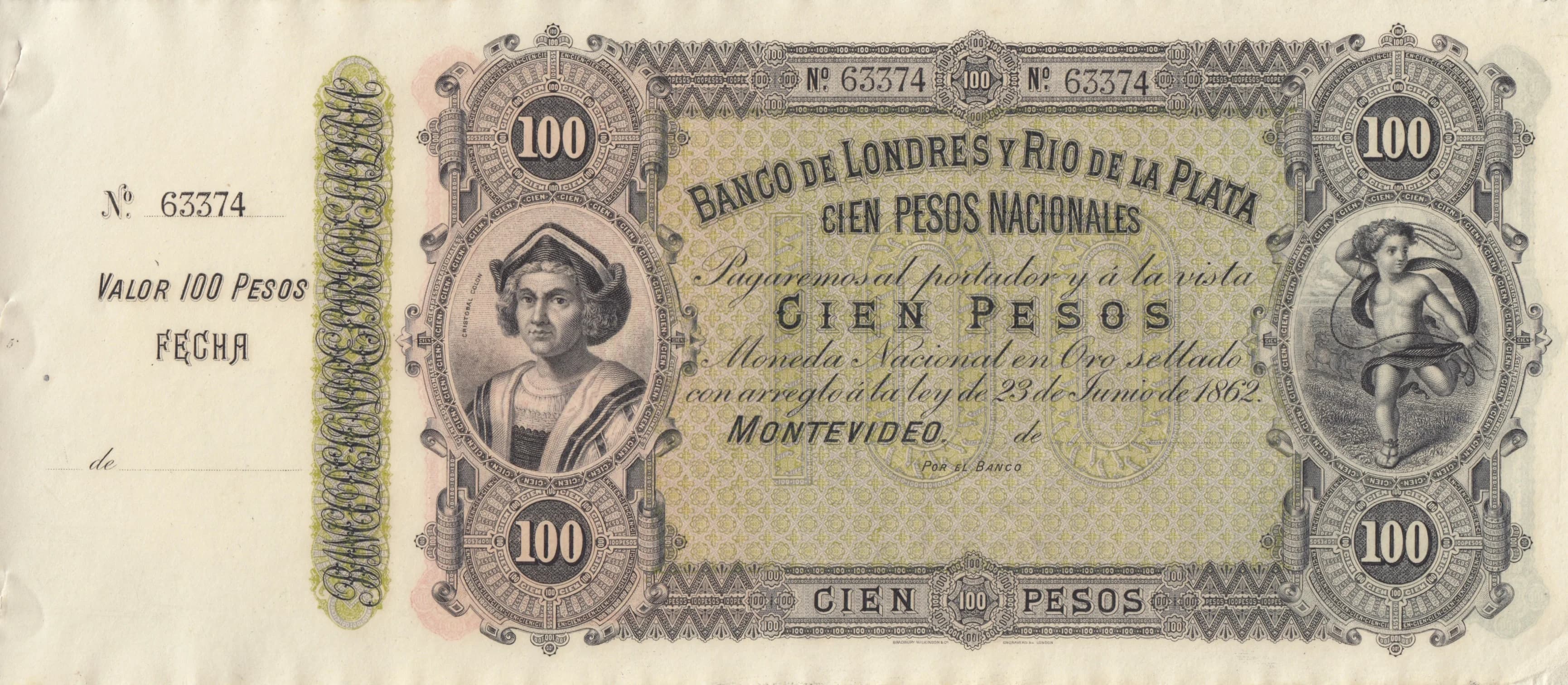
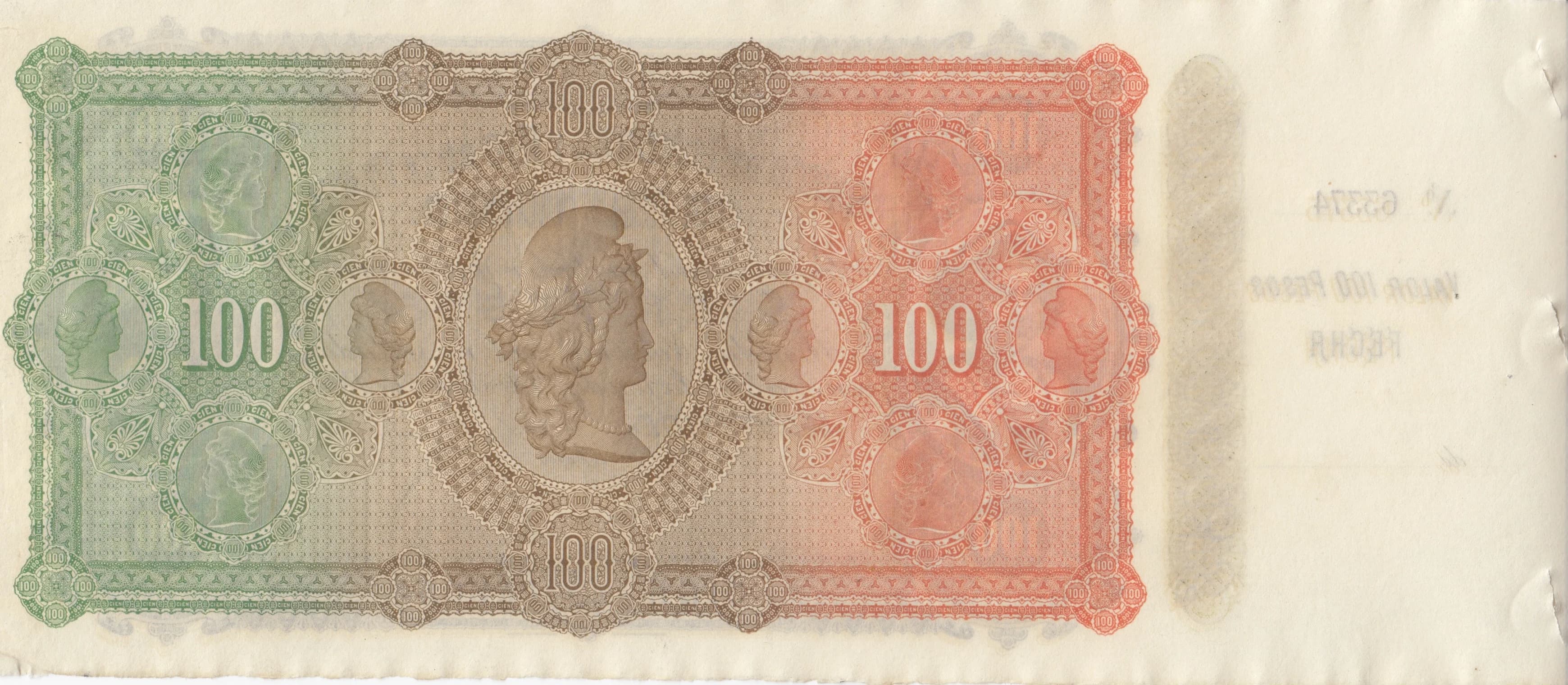
This is a striking 100 Pesos banknote from the Banco de Londres y Río de la Plata, issued in 1883 as a remainder (unsigned) specimen by the British-American Bank Note Company (BWC). The note displays excellent Victorian-era engraving with a split dual-color design (black on yellow obverse, green and rose reverse), featuring classical portraiture and ornate filigree work. In AU condition, this historical note shows expected aging with foxing and yellowing consistent with nearly 140 years of preservation, yet maintains strong visual definition and no significant damage.
Common. This note circulates frequently in collector markets with eBay price data showing typical AU specimens selling in the $100 range, consistent with accessible 19th-century Latin American banknotes. The denomination, issuer longevity, and the fact that remainder specimens exist in quantity all suggest a substantial original print run. Price variance in eBay listings ($3–$249) reflects grading inconsistencies and market fluctuations rather than inherent scarcity; AU-condition examples are neither difficult to locate nor commanding premium prices typical of rare issues.
The Banco de Londres y Río de la Plata was a major financial institution operating during Uruguay's nation-building period following independence. This 1883 issue reflects the late 19th-century Latin American practice of engaging European security printers (BWC) to produce currency backed by gold standards, as evidenced by the note's Spanish inscription referencing 'Moneda Nacional en Oro sellado' (National Currency in sealed Gold) in compliance with the 1862 gold law. The classical male portrait with laurel crown on the reverse and female Renaissance figure on the obverse reflect the period's celebration of classical ideals and emerging national identity.
The obverse features a classical female portrait in Renaissance-style dress with ornamental headdress positioned in the left-center medallion, symbolizing classical learning or virtue. A cherub (putto) figure appears on the right side, consistent with 19th-century allegorical banking imagery. The reverse displays a dominant central male portrait wearing a laurel crown, depicted in classical profile—likely representing a historical or allegorical figure of commerce, wisdom, or national leadership. Multiple smaller circular portrait medallions frame the design edges. The dual-color printing technique (yellow-green and pink/rose accents on reverse, black on yellow obverse) creates visual distinction between denominations. Elaborate filigree borders, scrollwork, and coiled serpent or rope motifs on the left margin exemplify the security engraving standards of the era. The ornamental crown at the top and repeated numerical denominations in circular frames reinforce the note's authority and value.
OBVERSE: 'Banco de Londres y Río de la Plata' (Bank of London and Rio de la Plata); 'Cien Pesos Nacionales' (One Hundred National Pesos); 'Pagaremos al portador y a la vista' (We will pay to the bearer on sight); 'Moneda Nacional en Oro sellado, con arreglo a la ley de 23 de Junio de 1862' (National Currency in sealed Gold, in accordance with the law of June 23, 1862); 'Montevideo' (Montevideo); 'Por el Banco' (By the Bank); 'Valor 100 Pesos' (Value 100 Pesos); 'Fecha' (Date); Serial number 'Nº 63374' (No. 63374). REVERSE: Denomination '100' repeated in corners. The note is identified as a remainder banknote, printed unsigned without authorization signatures.
Intaglio (steel plate) engraving, the standard security printing method for high-value banknotes of this era. The British-American Bank Note Company (BWC), a prominent security printer, produced this note using fine-line engraving techniques with complex interlocking geometric and floral patterns to prevent counterfeiting. The dual-color printing on the reverse (green and rose) was achieved through multiple plate passes, a sophisticated technique for 1883. The visual evidence of fine line work, ornamental borders with repeating motifs, and the absence of any lithographic characteristics confirm traditional intaglio security printing.
This specimen is cataloged as Pick P-S245r (the 'r' suffix denoting 'remainder'—an unsigned, unissued note). The Pick catalog identifies two variants: P-S245r and P-S245s. This particular note is a remainder banknote, printed unsigned without authorization signatures or date completion, as was common practice for security printers to produce excess inventory. Serial number 63374 is visible on this example. The unsigned status and absence of completion signatures are the defining characteristics of the P-S245r variety.