100 pesos 1887
Market Prices
1 saleAbout This Note
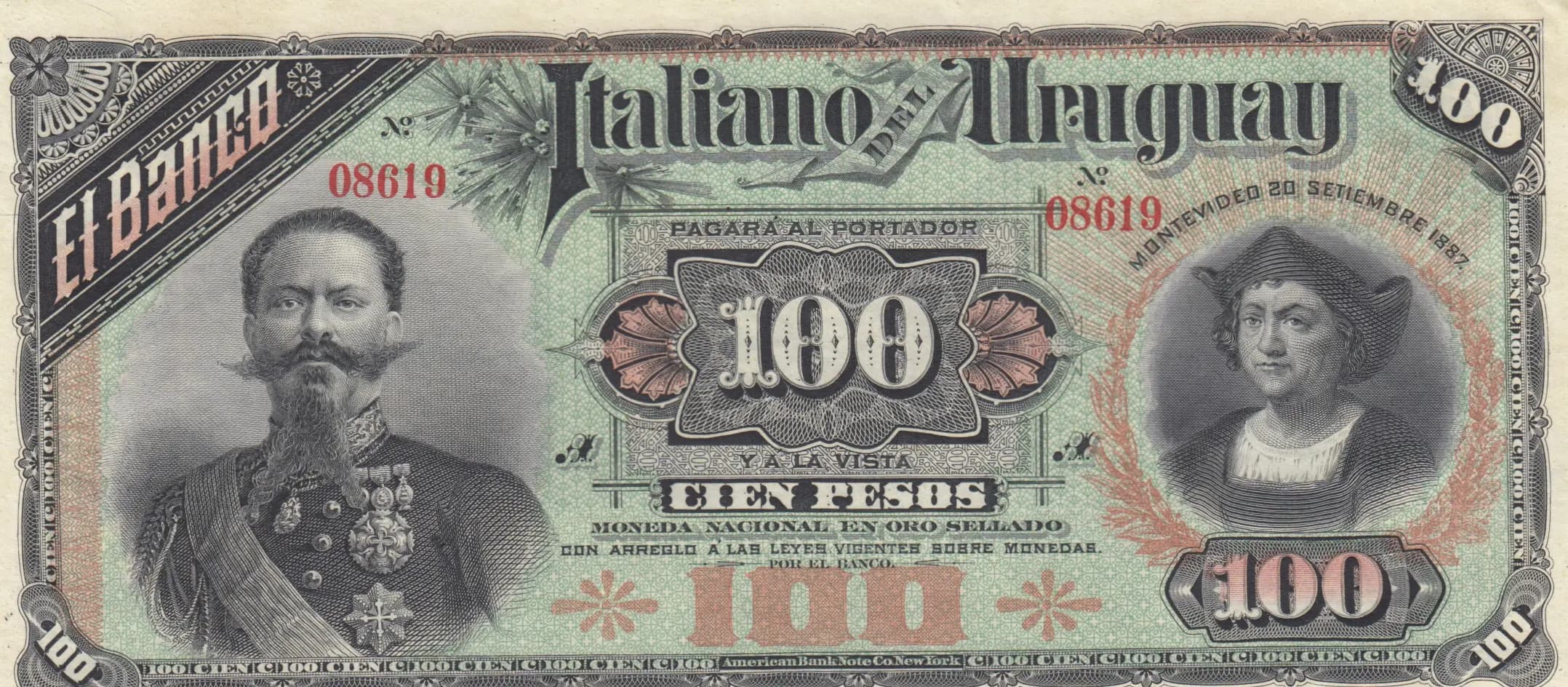
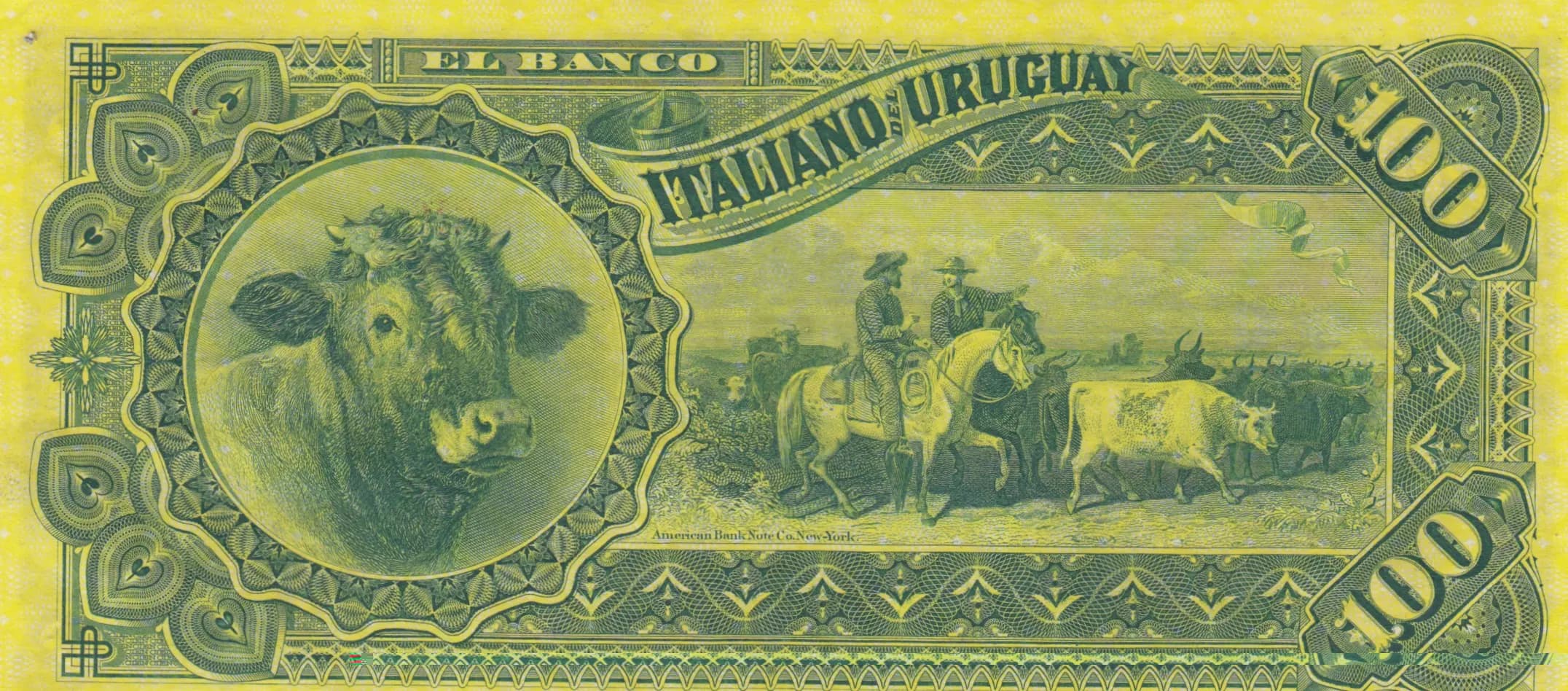
A striking 100 Pesos banknote from Banco Italiano del Uruguay (1887) in exceptional uncirculated condition, featuring ornate Victorian-era engraving with portraits of King Vittorio Emanuele II and Christopher Columbus on the obverse, and pastoral agricultural imagery—a bull's head and mounted vaqueros with cattle—on the reverse. The note exhibits vibrant green and yellow underprints with crisp black engraving, elaborate filigree borders, and the distinctive American Bank Note Company craftsmanship, representing a fascinating intersection of Italian banking presence in Uruguay and late 19th-century South American economic history.
Common. While Banco Italiano del Uruguay notes are not encountered frequently in general circulation, this specific denomination and year (P-S215) shows no evidence of exceptional rarity. The eBay market data indicates recent sales at $126.75 for UNC examples, suggesting moderate collector demand and reasonable availability. As a remainder banknote (never issued for circulation, printed but not distributed), it has survived in better condition than circulation notes, but such remainders were typically printed in substantial quantities. No evidence of limited print runs or recall status exists for this Pick number.
Issued on September 20, 1887, by Banco Italiano del Uruguay—a private Italian-owned bank operating in Uruguay during the late 19th century—this note reflects both European financial influence in South America and Uruguay's pastoral economy. The iconography deliberately blends Old World legitimacy (portraits of European historical figures: King Vittorio Emanuele II of Italy and Christopher Columbus) with New World economic identity (the cattle and vaquero scene depicting the gaucho culture and ranching wealth that defined the Uruguayan economy). The note's emphasis on 'moneda nacional en oro sellado' (national currency in sealed gold) underscores the gold-standard monetary framework of the period.
The obverse features a symmetrical composition with King Vittorio Emanuele II of Italy (left, in military dress with medals and decorations) and Christopher Columbus (right, shown in profile with characteristic long hair) flanking a central denomination cartouche reading '100' and 'VALE CIEN PESOS.' Ornate shield designs frame the denomination, while palm fronds accent the upper center, and elaborate geometric and floral filigree patterns form decorative corner emblems and borders throughout. The reverse depicts economic prosperity through agricultural imagery: a bull's head in a circular medallion (left) representing livestock wealth, and a pastoral landscape scene (right) showing mounted vaqueros overseeing a cattle herd—imagery celebrating the ranching foundation of Uruguayan prosperity. The color scheme combines green, yellow, black, and cream throughout, with red ink used for serial numbering.
OBVERSE: 'Banco Italiano Uruguay' (Bank Italian Uruguay) / 'Vale Cien Pesos' (Worth One Hundred Pesos) / 'Pagará al Portador' (Will Pay to the Bearer) / 'Moneda Nacional en Oro Sellado' (National Currency in Sealed Gold) / 'De acuerdo a las leyes vigentes sobre monedas' (In Accordance with Current Laws Regarding Currency) / 'Por el Banco' (By the Bank) / 'Emitido 20 Setiembre 1887' (Issued September 20, 1887) / 'American Bank Note Co. New York' (printer attribution). REVERSE: 'El Banco Italiano Uruguay' (The Italian Bank Uruguay) / '100' (denomination) / 'American Bank Note Co. New York' (printer attribution). Serial number visible: 08619.
Intaglio engraving (steel plate engraving) as executed by American Bank Note Company (ABNC), New York. The elaborate fine-line work, complex geometric patterns, and intricate filigree demonstrate the high-security engraving standards characteristic of ABNC's late 19th-century production. Security features include the detailed border engraving, fine-line geometric patterns serving as anti-counterfeiting measures, and the sophisticated landscape and portrait rendering achievable only through master engraving techniques.
This is cataloged as P-S215 (base number). PMG has identified a variant P-S215r (Montevideo), suggesting location-based variety differences exist within this Pick number, though the specific distinguishing features are not detailed in available data. The serial number 08619 and issue date of September 20, 1887 are consistent with the official emission date. The 'remainder banknote' designation indicates this particular specimen was never placed into circulation and represents the bank's stock of unissued notes.