10 pesos 1867
Market Prices
2 salesAbout This Note
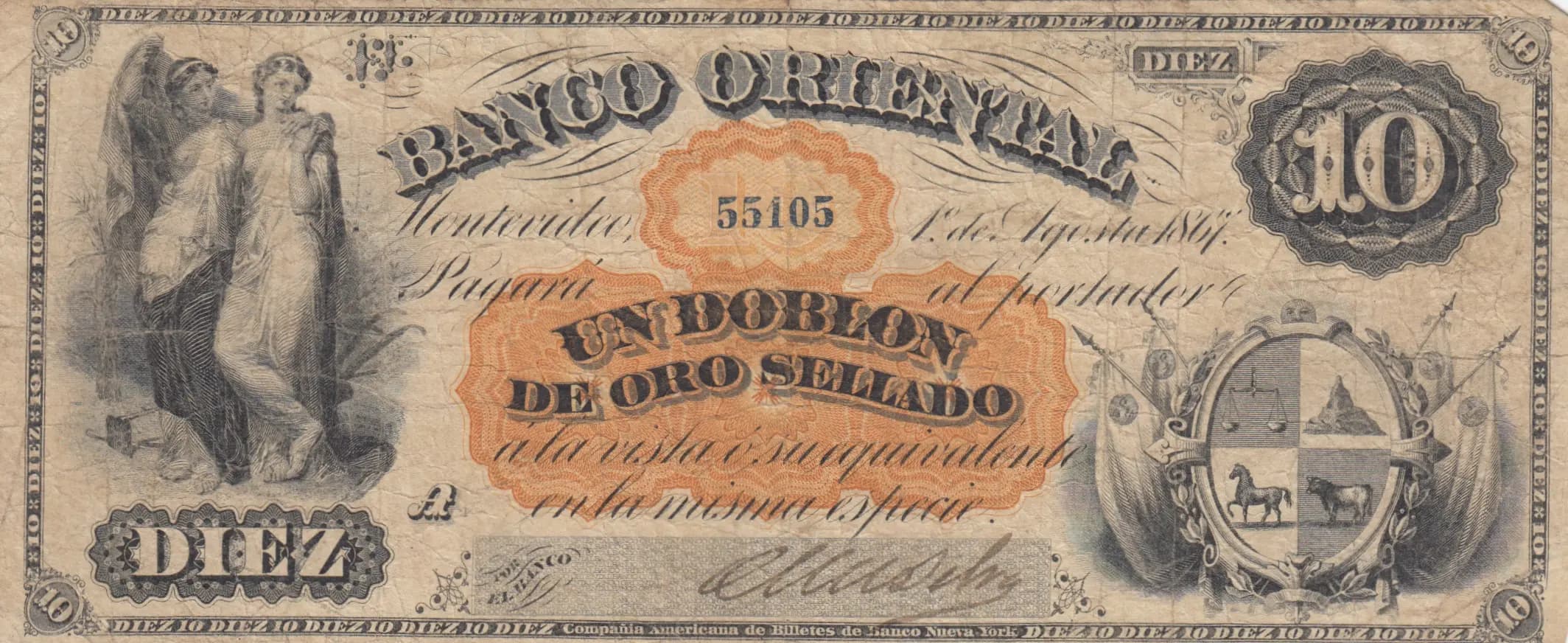
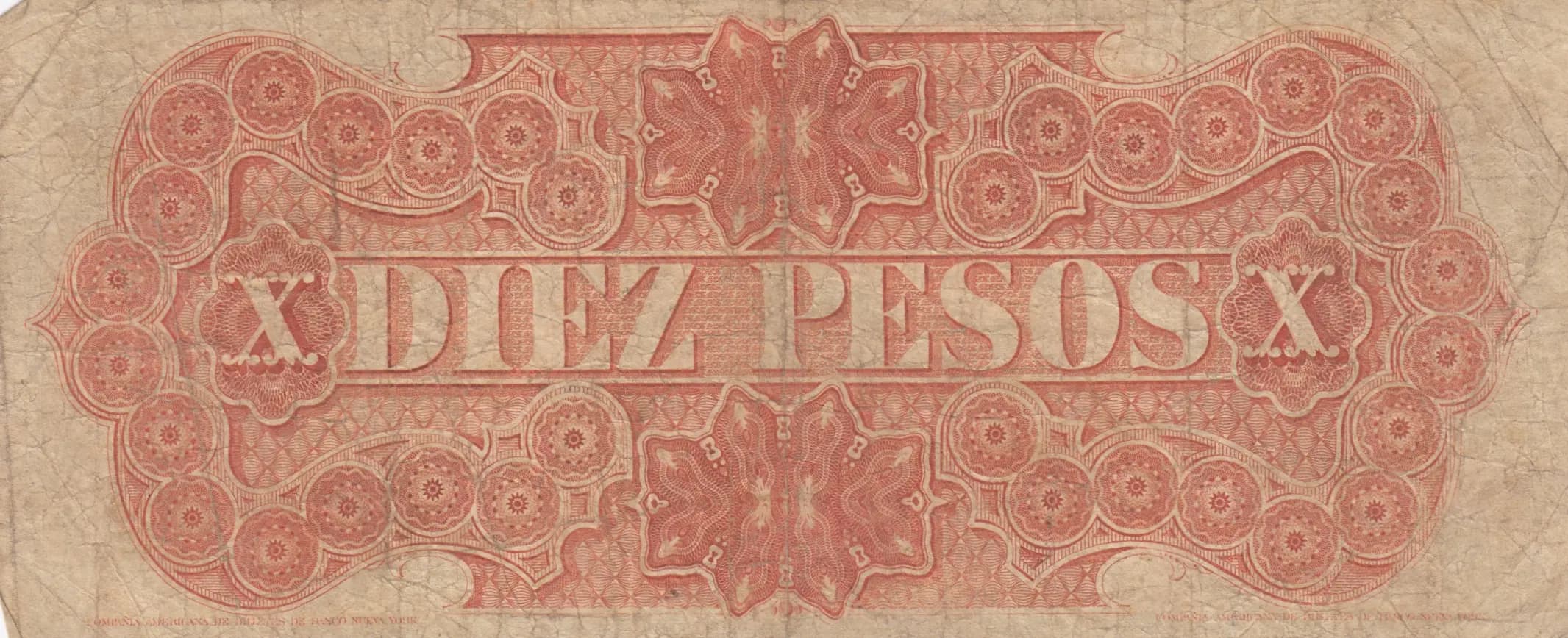
This 1867 Banco Oriental 10 Pesos note is a handsome example of mid-19th century Uruguayan currency, featuring two allegorical female figures representing 'North and South' in classical style on the obverse, complemented by a pastoral landscape vignette and intricate orange and black printing on a tan stock. The reverse displays elaborate symmetrical geometric and floral ornamentation in red/pink ink, characteristic of ABNC security printing of the era. In Fair condition with visible age, creasing, and wear consistent with circulation, this early example remains legible and displays the fine engraving typical of this iconic series.
Common. eBay market data shows recent sales of VF examples at $48-$53 (November 2024 and August 2024), indicating active collector interest but at modest price points typical of common 19th century banknotes. This note type had a substantial print run by Banco Oriental and was widely circulated during its period of issue, with multiple examples surviving to present day. The Fair condition grade of the cataloged example would typically trade below the VF comparables shown, consistent with common banknote market patterns.
The Banco Oriental, founded in 1862, was one of Uruguay's first banks and this 1867 note represents the early republican period of Uruguayan monetary independence. The dual allegorical female figures ('North and South') depicted on the obverse symbolize the unity and development of the newly consolidated Uruguayan nation, while the denomination's equivalence to 'Un Doblon de Oro Sellado' (One Sealed Gold Doubloon) reflects the gold standard underpinning mid-19th century monetary systems and Uruguay's commitment to sound currency backed by precious metal reserves.
The obverse depicts two standing allegorical female figures on the left side representing 'North and South,' rendered in classical style with draped garments, positioned as symbols of national unity and territorial integrity. These figures are accompanied by heraldic arms at the lower right. A circular vignette on the right side presents a pastoral Uruguayan landscape scene featuring trees, rolling terrain, and what appears to be a church or civic structure, symbolizing the nation's agrarian character and religious heritage. The central orange cartouche contains the denomination and serial number information. The reverse employs a highly symmetrical design composed of intricate geometric patterns, floral scrollwork, and circular medallions with star/sun motifs arranged in a mirror-image layout around the central 'X DIEZ PESOS X' text, serving both decorative and security purposes. The overall design reflects the aesthetic conventions of mid-Victorian currency design by the American Bank Note Company.
OBVERSE: 'BANCO ORIENTAL' (Oriental Bank) — issuing authority; 'UN DOBLON DE ORO SELLADO' (One Sealed Gold Doubloon) — denomination equivalency; 'DIEZ' (Ten) and 'DIE' (Ten, abbreviated) — denomination indicators; 'Compañía Americana de Billetes de Banco Nueva York' (American Company of Bank Notes, New York) — printer credit (ABNC); Serial number '55105'; Border text 'DIE 10 DIE 10' repeated throughout decorative frame. REVERSE: 'X DIEZ PESOS X' (Ten Pesos) — central denomination marking in Spanish.
Steel engraving with multiple color intaglio printing. The obverse employs black primary printing over an orange underprint cartouche on beige stock. The reverse utilizes red/pink intaglio printing in a highly detailed symmetrical security pattern. This sophisticated multi-color engraved approach was characteristic of American Bank Note Company (ABNC) production and served as an effective anti-counterfeiting measure through the complexity of the fine line work and intricate geometric designs that were difficult to reproduce with period reproduction technology.
Serial number 55105 visible on obverse. Pick catalog number P-S385 represents the standard regular issue of 1867. No overprints, countermarks, or obvious reissue markings observed. The specific serial number and any signature varieties (if present but not clearly visible in provided imagery) would constitute minor variety distinctions within this Pick number, though this denomination was issued in substantial quantity and represents a single, standard variety rather than a recognized major variety type.