10 pesos 1883
Market Prices
1 saleAbout This Note
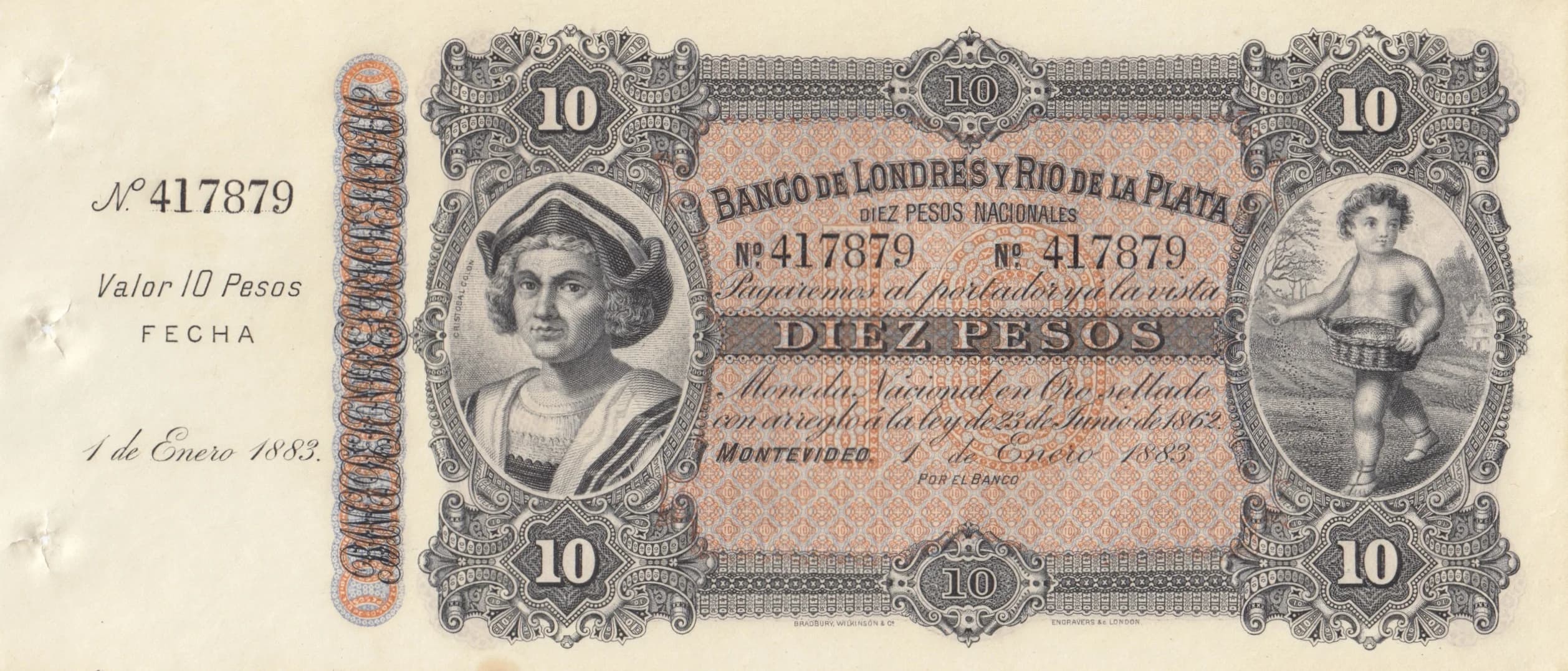
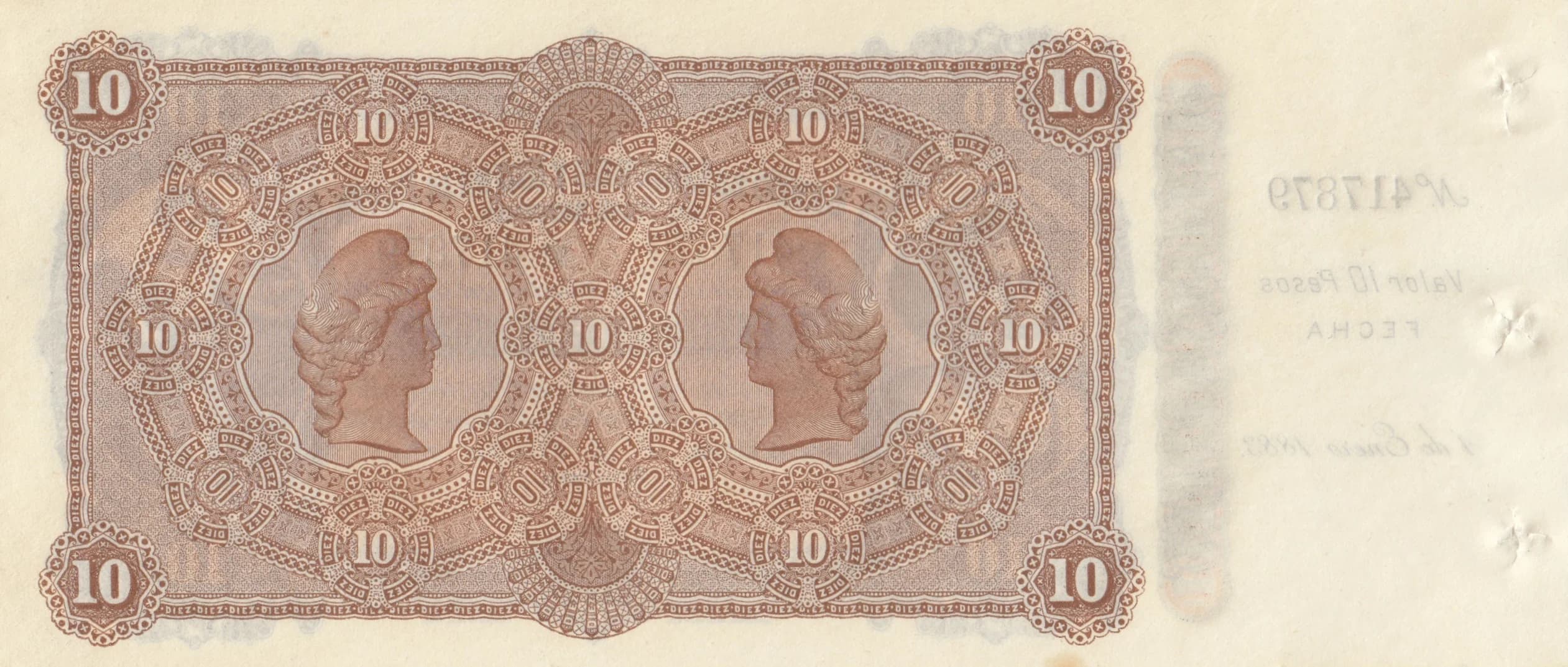
This 10 Pesos Nacionales from the Banco de Londres y Rio de la Plata (1883) is an unsigned remainder banknote featuring classical allegorical imagery: a woman in period dress on the obverse and a cherub figure on the reverse, accompanied by two symmetrical male portrait medallions. The note displays the characteristic age-related patina expected of a 140+ year old document, with foxing, creasing, and yellowing throughout, consistent with circulation and long-term storage. Despite its aged appearance and wear, the intricate ornamental engraving and fine line work remain well-preserved, making it an interesting example of 19th-century South American bank note design.
Common. eBay market evidence shows PMG 66 examples selling for approximately $160 USD, which falls well within the typical range for common to uncommon 19th-century Latin American bank notes. The 1883 issue date and the existence of multiple examples in the collector market indicate adequate original print runs. This Pick number does not appear to have been a short-lived issue or subject to recalls, and the unsigned remainder status, while specific, does not significantly restrict availability.
This note was issued on January 1, 1883, by the Banco de Londres y Rio de la Plata during a period of institutional financial modernization in Uruguay. The inscriptions reference authorization under the law of June 2, 1862, indicating compliance with gold-backed currency standards of the era. The classical allegorical imagery—particularly the cherub representing commerce or prosperity—reflects the 19th-century bank note convention of embodying abstract economic concepts through European artistic traditions, while the dual male portraits on the reverse suggest the bank's leadership or foundational figures.
The obverse features a classical female allegorical figure wearing a bonnet or head covering, positioned in profile within an elaborate oval frame on the left side, representing either Commerce, Liberty, or a Muse—common motifs in 19th-century bank note design. The right side displays a winged cherub or putto in classical Greco-Roman style, reinforcing themes of prosperity or divine favor over commerce. The reverse presents two identical male portrait medallions arranged in symmetrical fashion on either side, likely representing prominent bank founders or officials, each enclosed within decorative circular frames. The entire design is framed by ornate scrollwork, geometric patterns, and corner diamonds containing the denomination '10', with intricate lattice and repeating geometric motifs filling the background as an anti-counterfeiting measure. The color scheme utilizes black and dark gray engraving on a cream underprint with orange/rust red text elements on the obverse and brown/tan engraving on the reverse.
FRONT: 'BANCO DE LONDRES Y RIO DE LA PLATA' (Bank of London and Rio de la Plata); 'DIEZ PESOS NACIONALES' (Ten National Pesos); 'Valor 10 Pesos' (Value 10 Pesos); 'FECHA 1 de Enero 1883' (Date: 1st of January 1883); 'Pagadero al portador y la vista' (Payable to bearer on sight); 'Autorizado en Oro sellado, con arreglo a la ley de 2 de Junio de 1862' (Authorized in sealed gold, in accordance with the law of June 2, 1862); 'MONTEVIDEO'; 'POR EL BANCO' (By the Bank); Serial number 'N°417879'. BACK: Denomination '10' in corner frames only; design primarily ornamental with no additional text.
Steel plate intaglio engraving, produced by Bradbury Wilkinson & Co. (BWC), as indicated in the catalog reference. The fine line work, elaborate ornamental borders, geometric security patterns, and detailed portraiture are characteristic of high-security intaglio production standards of the 1880s. The quality of the engraving and the complexity of the repeating patterns throughout both sides indicate professional security printing designed to resist counterfeiting.
This is an unsigned remainder banknote (as noted in the catalog), distinguishing it from issued and signed examples. Serial number observed: 417879. The Pick number P-S242r indicates this is a remainder variety; signed examples would be catalogued separately. The date of issue is January 1, 1883, consistent with the bank's establishment of the currency series. Collectors should note that signed and circulated examples may exist as distinct varieties with different catalog designations.