1 peso 1875
Market Prices
About This Note
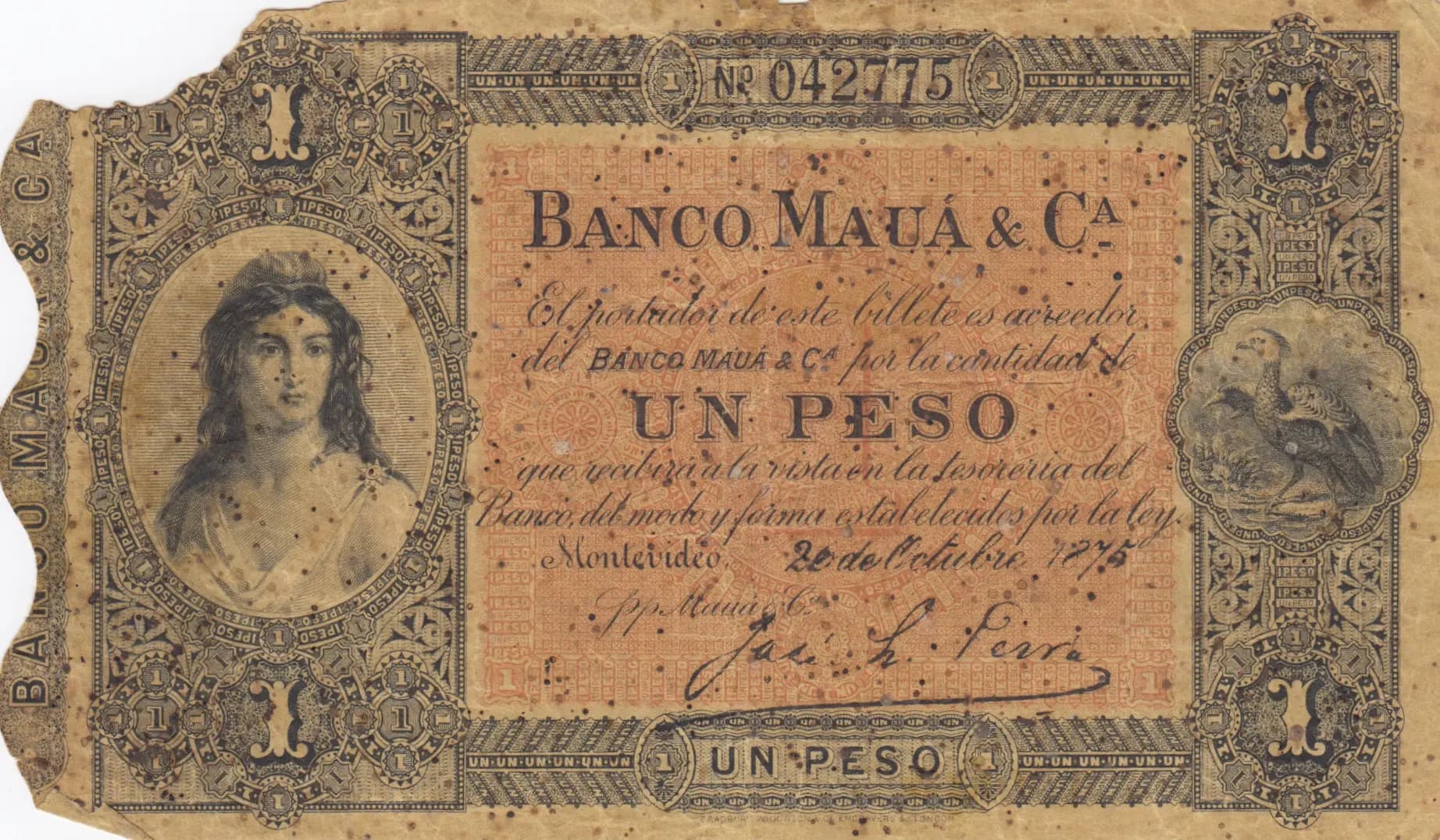
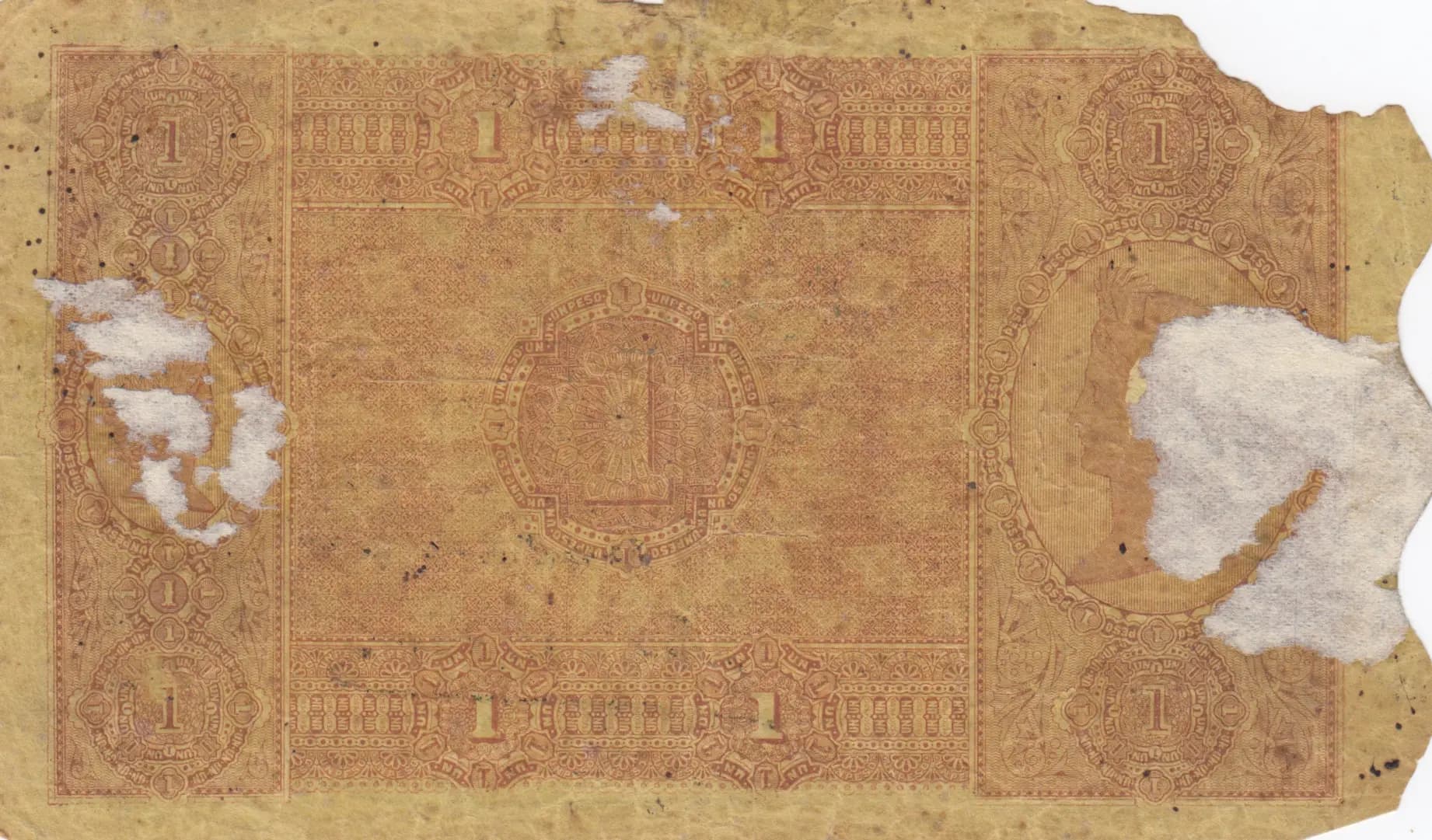
This is a Banco Maúa & Cía 1 peso note from 1875, featuring an ornate design with a portrait of Liberty on the left and an eagle emblem on the right against a salmon/coral colored front. The note shows considerable age-related deterioration with extensive foxing, creasing, edge damage, and material loss, particularly visible on the reverse. Despite its heavily circulated G condition with significant wear, this early Uruguayan banknote represents an important piece of 19th-century South American financial history.
Common. This note represents a regular issue from a well-established private bank with evidently substantial circulation, as demonstrated by its heavily worn condition. eBay market data shows prices ranging primarily from $9.00-$174.95 USD across various grades, with the G condition specimen valued around the lower-to-mid range. The presence of multiple examples in circulation and the relatively modest price points indicate this was a standard issue with no known scarcity constraints. Early Uruguayan banknotes from this period, while historical, are not particularly scarce in the numismatic market.
The Banco Maúa & Cía was a prominent private bank operating in Uruguay during the 1870s, with this note issued on February 20, 1875, during a period of economic development in the young nation. The Liberty portrait reflects Enlightenment ideals common to the era, while the eagle emblem symbolizes national sovereignty and strength. The Spanish-language bearer promise and Montevideo location situate this note within Uruguay's early independent banking system, representing the transition from colonial to modern financial institutions in South America.
This ornate banknote features a classical allegorical design typical of 1870s South American currency. The obverse displays a portrait of Liberty (or Libertad) as a young woman with long flowing hair positioned in an elaborate oval frame on the left side, representing republican ideals. The right side contains a majestic eagle in a corresponding oval frame, symbolizing national power and authority. The design employs symmetrical ornamental borders with geometric and floral patterns throughout, characteristic of high-security banknote design of the period. The center contains the issuer information and bearer promise printed on a distinctive salmon/coral colored background. The reverse features a largely blank but heavily ornamented design with repeating '1' denomination markers in circular medallions at the corners and sides, maintaining the symmetrical aesthetic.
FRONT: 'BANCO MAÚA & Cía' (Bank Maúa & Company) — 'El portador de este billete es acreedor del BANCO MAÚA & Cía por la cantidad de UN PESO que recibió la vista en la secretaría del Banco, del modo y forma establecidos por la ley' (The bearer of this note is a creditor of BANCO MAÚA & COMPANY for the sum of ONE PESO which was received in the Bank's office, in the manner and form established by law) — 'Montevideo' — '20 de Febrero 1875' (February 20, 1875) — Signatures: 'P. Nunez C.' and 'Juan A. Tarra' — Serial number: 'Nº 042775' — 'UN PESO' (appears twice as denomination markers). BACK: '1' (denomination markers in corners and medallions).
This note was produced by BWC (Banknote and Security Printers Company or similar English security printer), employing intaglio/engraving printing techniques standard for banknotes of the 1870s. The fine geometric borders, portrait detailing, and precise denomination markers are consistent with steel plate engraving. The distinctive salmon/coral colored underprint on the obverse and light brown tones on the reverse were likely achieved through separate color printing passes, characteristic of multi-color banknote production of the Victorian era.
This specific example bears serial number 042775 and is signed by P. Nunez C. and Juan A. Tarra, dated February 20, 1875. Known varieties of this Pick number may include different signature combinations and serial number ranges, though no major overprints or unusual denominations are evident in this specimen. The condition and paper color (yellow/cream with significant foxing) are consistent with the standard issue described in the reference catalog.