1 peso 1935
Market Prices
5 salesAbout This Note
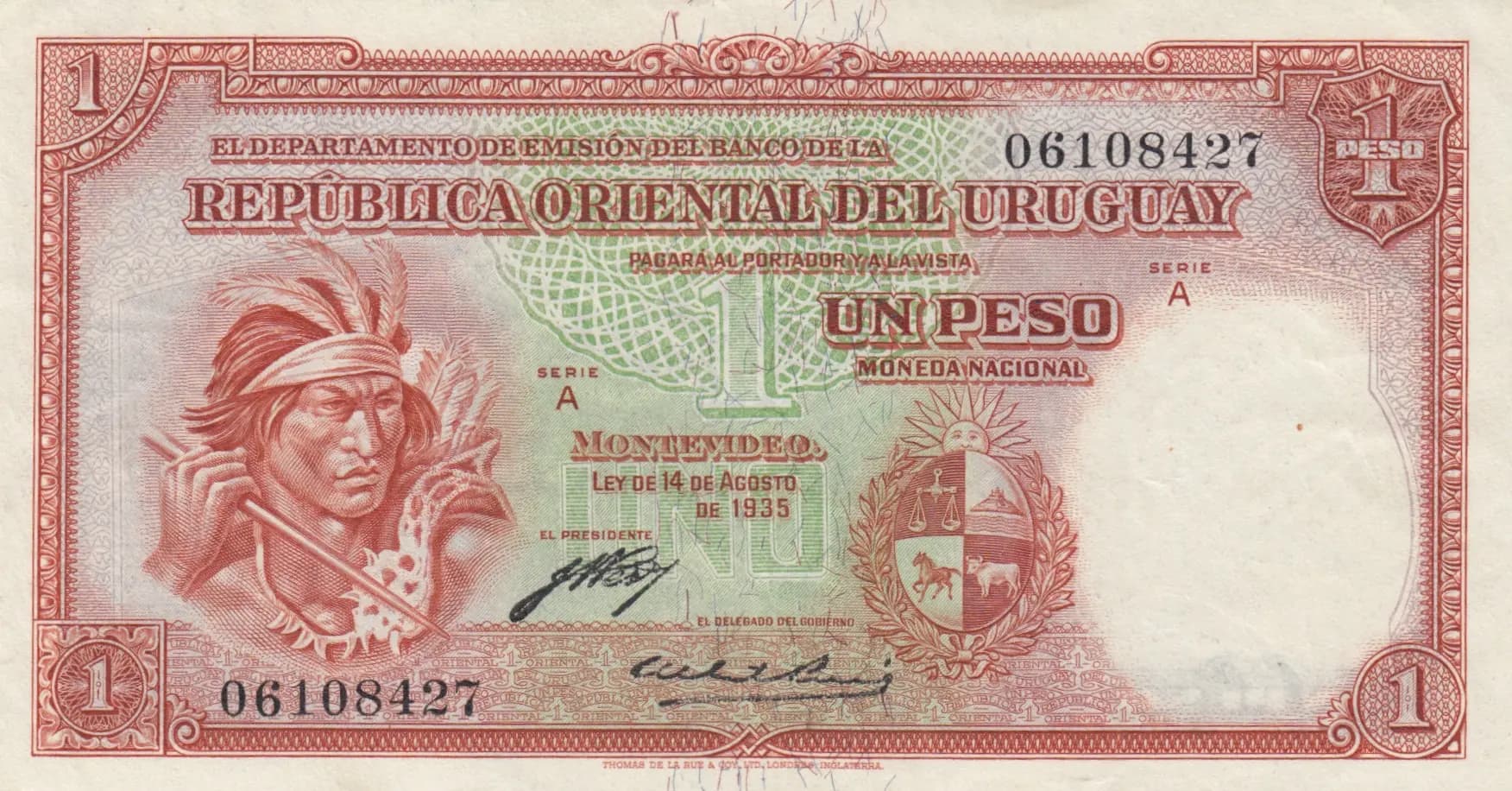
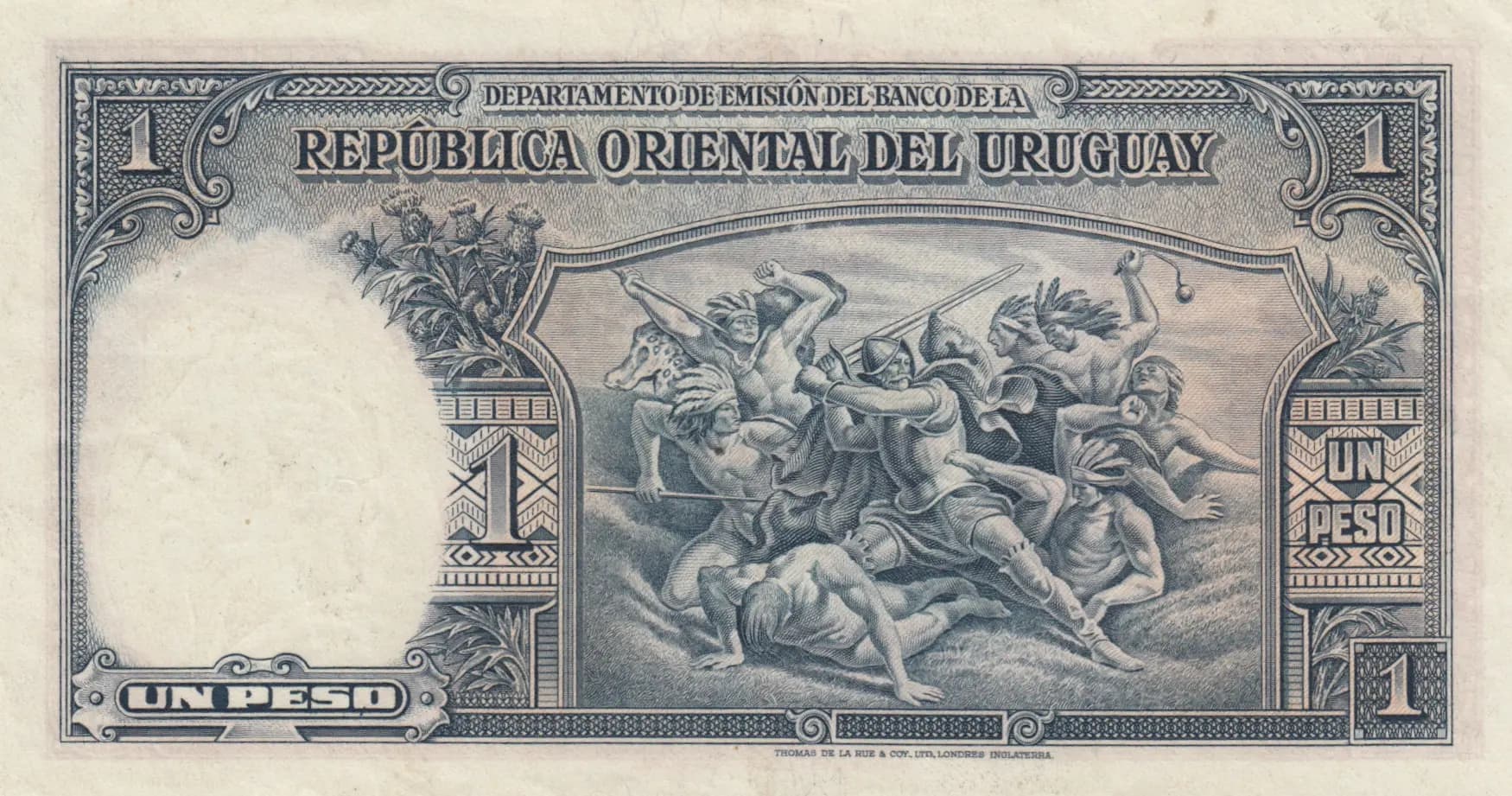
This is a well-preserved example of Uruguay's 1935 one peso note (Pick P-28), issued by the Departamento de Emisión del Banco de la República Oriental del Uruguay. The front features a striking portrait of an indigenous man with a feathered headband rendered in classical engraving style, accompanied by the national coat of arms, while the reverse depicts an allegorical scene with cherub figures and floral elements in blue ink. The note shows its age with light foxing and surface wear, but remains in EF (Extremely Fine) condition with crisp printing and well-preserved ink on both sides.
Common. Despite being nearly 90 years old, this note trades regularly on secondary markets (eBay evidence shows multiple sales between 2009-2023 at prices ranging from $2.60 to $6.50), indicating adequate circulation and surviving examples. The 2016 catalogue value of $10 for VF condition and $30 for UNC reflects typical common note pricing. Large print runs by Thomas de la Rue for regular issues, combined with the note's continued availability in the collector market, confirm common status. The observed EF condition grade places this example in the middle range of collector interest without commanding premium prices characteristic of scarce or rare issues.
This 1935 issue commemorates the law passed on August 14, 1935, and represents Uruguay's modernization of its currency during the interwar period. The indigenous portrait on the obverse reflects the historical imagery common to Uruguayan numismatic design, honoring the nation's pre-Columbian heritage, while the allegorical scene on the reverse with its classical cherub figures exemplifies the artistic sophistication of Thomas de la Rue's international banknote design tradition. The watermark of José Gervasio Artigas, Uruguay's national independence hero, further emphasizes the patriotic character of this regular issue.
The obverse features a classical profile portrait of an indigenous figure wearing a distinctive feathered headband, positioned on the left side in the style typical of historical engraved currency. The central design incorporates a large green numeral '1' as the denomination indicator. To the right is the elaborate coat of arms of Uruguay, containing a shield with heraldic elements including scales of justice (symbolizing law and order), a rising sun (representing national aspiration), and various heraldic animals. The design is framed by ornate red/brown decorative borders with classical scroll and floral motifs at the corners. The reverse depicts an allegorical or mythological scene rendered in blue ink, featuring multiple cherub figures (putti) in dynamic classical poses, accompanied by floral and plant arrangements on the left side. This allegorical composition represents classical artistic tradition in banknote design and is framed by geometric border patterns. The cream/off-white paper stock provides contrast to both the red/brown and blue color schemes employed on each side.
FRONT SIDE: 'El Departamento de Emisión del Banco de la República Oriental del Uruguay' (The Emission Department of the Bank of the Oriental Republic of Uruguay) / 'Pagará al Portador y a la Vista' (Will pay to the bearer on demand) / 'Un Peso' (One Peso) / 'Moneda Nacional' (National Currency) / 'Montevideo' (Montevideo) / 'Ley de 14 de Agosto de 1935' (Law of August 14, 1935) / 'El Presidente' (The President) / 'El Delegado del Gobierno' (The Government Delegate) / Serial number: 06108427 / Series marking: A. REVERSE SIDE: 'Departamento de Emisión del Banco de la República Oriental del Uruguay' (Emission Department of the Bank of the Oriental Republic of Uruguay) / 'Un Peso' (One Peso) / 'Thomas de la Rue & Co., Ltd., Londres, Inglaterra' (Thomas De La Rue & Co., Ltd., London, England).
Intaglio engraving, the traditional security printing method employed by Thomas de la Rue & Co., Ltd. of London. The fine line work evident in both the portrait, coat of arms details, and the complex allegorical scene on the reverse, combined with the precise border patterns and security elements, are characteristic of intaglio production. The multi-color printing (red/brown on green underprint for obverse; blue for reverse) was achieved through separate plate passes, a standard technique for high-security banknote production of this era. The crisp impression and fine detail preservation observed on both sides confirm professional intaglio execution.
This example belongs to Series A as marked on the obverse. The serial number observed is 06108427. The standard variety for Pick P-28 (1935 issue) has the orange-brown obverse with green underprint and blue reverse as seen here. While signature varieties and series designations may exist within the 1935 issue, no major cataloged varieties affecting collector value are evident from the Pick number designation. The Thomas de la Rue printer attribution is consistent with all standard examples of this issue.