50 lirasi 1842 specimen
Market Prices
2 salesAbout This Note
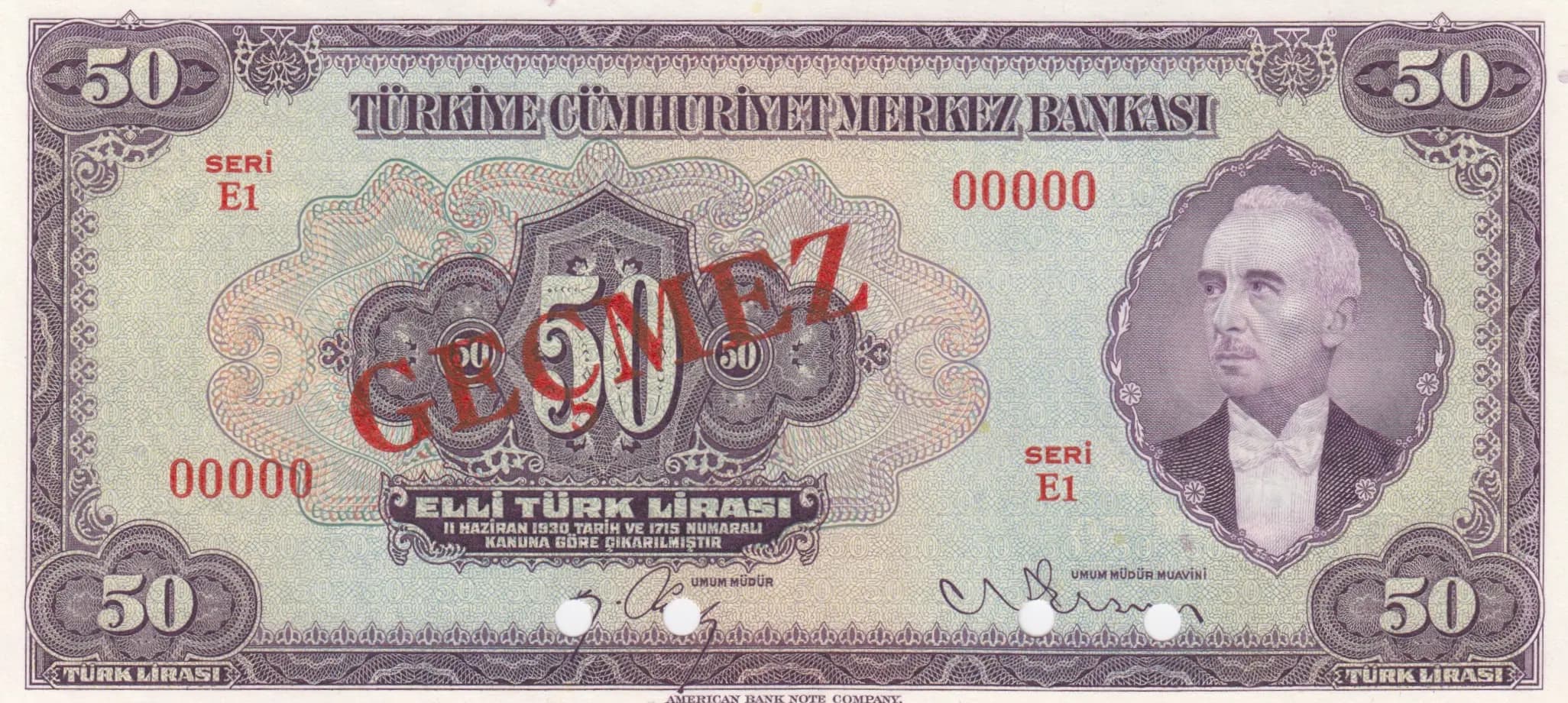
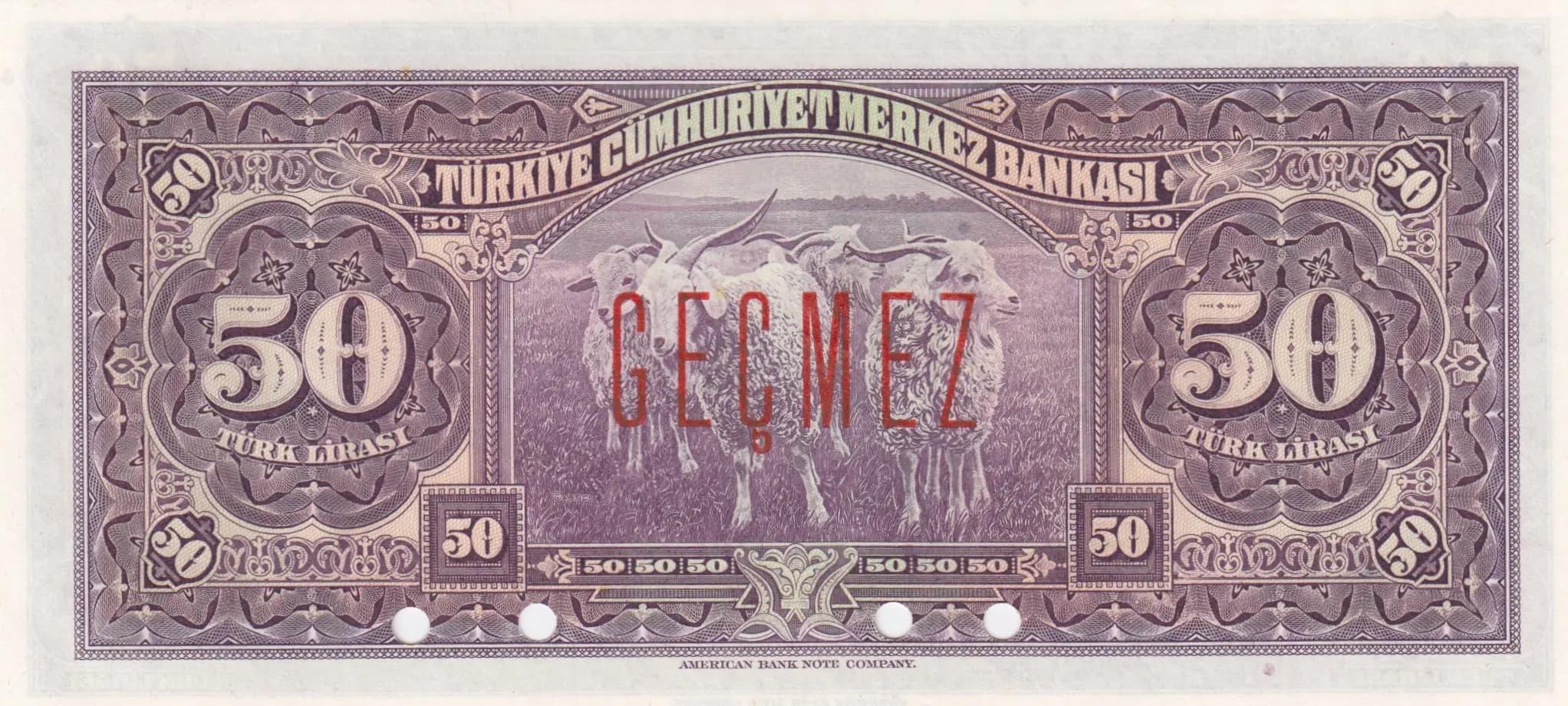
This is a Turkish 50 Lira specimen banknote from 1930, printed by the American Bank Note Company in uncirculated condition. The note features a dual portrait vignette on the obverse and a pastoral scene of Angora goats on the reverse, both rendered in purple and multicolor printing with intricate Ottoman-style geometric and floral ornamental designs. The 'GEMEZ' (specimen) red overprint across both sides, combined with all-zero serial numbers and the pristine condition, identifies this as a presentation or archive specimen note of numismatic significance.
Uncommon. While the base Pick number P-142 represents a standard 1930 Turkish issue that would have been printed in substantial quantities for circulation, the specimen variant (P-142s or P-142As) with the 'GEMEZ' overprint and all-zero serial numbers is significantly less common than circulated examples. eBay market data from 2015 shows specimen UNC examples selling in the $213–$280 range, with catalog valuations at $700, indicating a modest but recognized collector premium. Specimen notes were typically produced in limited quantities for official presentation, archive, or security printer retention purposes, making them scarcer than regular circulation strikes while not rising to 'rare' status.
This note was issued under the authority of the newly established Turkish Republic's Central Bank (Türkiye Cumhuriyet Merkez Bankası), established by law on 11 June 1930 during the early modernization period of Atatürk's Turkey. The imagery—featuring historical Turkish personages in the central vignette and Angora goats (a prized Ottoman and Turkish breed) on the reverse—reflects the nation's cultural heritage while the contemporary design and American Bank Note Company printing demonstrated Turkey's engagement with modern, internationally-recognized security printing standards. This 1930 issue represents the early currency standardization efforts of the Turkish Republic in the interwar period.
The obverse features a symmetrical dual portrait vignette in the center, depicting two male historical Turkish figures (likely Ottoman or early Republican personages) within circular portrait medallions, framed by elaborate arabesque and geometric ornamental designs characteristic of Ottoman imperial art. The reverse showcases a pastoral landscape vignette of a herd of Angora goats—an animal breed historically significant to Turkish heritage and economy—depicted in a naturalistic countryside setting. Both sides are bounded by ornate decorative borders featuring corner medallions containing the denomination '50' within elaborate geometric and floral frames. The color palette of purple, green, brown, cream, and red is applied in a sophisticated multicolor printing technique. Signature blocks for 'UMUM MÜDÜR' (General Director) and 'UMUM MÜDÜR MUAVINI' (Deputy General Director) appear on the front, reflecting official authorization protocols of the Central Bank.
Front: 'TÜRKIYE CÜMHURİYET MERKEZ BANKASI' (Central Bank of the Turkish Republic) / 'ELLİ TURK LİRASI' (Fifty Turkish Lira) / 'SERI E1' (Series E1) / '11 HAZIRAN 1930 TARİHİ VE İZLİ NÜMARASı KANUNA GÖRE ÇIKARILMIŞTIR' (Issued pursuant to law dated 11 June 1930 with authorized number) / 'UMUM MÜDÜR' (General Director) / 'UMUM MÜDÜR MUAVINI' (Deputy General Director) / 'TÜRK LİRASI' (Turkish Lira) / 'AMERICAN BANK NOTE COMPANY' (printer attribution) / 'GEMEZ' (Specimen - red overprint). Back: 'TÜRKİYE CÜMHURİYET MERKEZ BANKASI' (Central Bank of the Turkish Republic) / 'TÜRK LİRASI' (Turkish Lira) / 'AMERICAN BANK NOTE COMPANY' (printer attribution) / 'GEMEZ' (Specimen - red overprint).
Intaglio engraving (steel plate engraving) combined with multicolor letterpress or offset lithography, as evidenced by the fine line work, intricate micropatterns in geometric and floral designs, and the complexity of the landscape and portrait vignettes. Produced by the American Bank Note Company, New York—one of the world's premier security printers of the era—employing their proprietary combination of engraved plates with multiple color applications to create both aesthetic beauty and anti-counterfeiting security features. The specimen overprint 'GEMEZ' in red indicates this is a marked non-circulating example.
This note is cataloged as P-142As (specimen variant). The visual analysis confirms this is the variant with 'GEMEZ' (specimen) overprint, all-zero serial numbers (00000), and the characteristic dual portrait design. According to PMG population data, multiple variants exist for this base Pick number (P-142Afp, P-142bp, P-142ctbp, and P-142s), suggesting differences in signature combinations, security printer details, or serial number patterns. The 'SERI E1' notation visible on this example indicates Series E1, which may be a distinguishing feature among print runs. The white bowtie variant mentioned in external references does not appear to apply to this particular note based on visual inspection of the portrait.