5 lirasi 1971
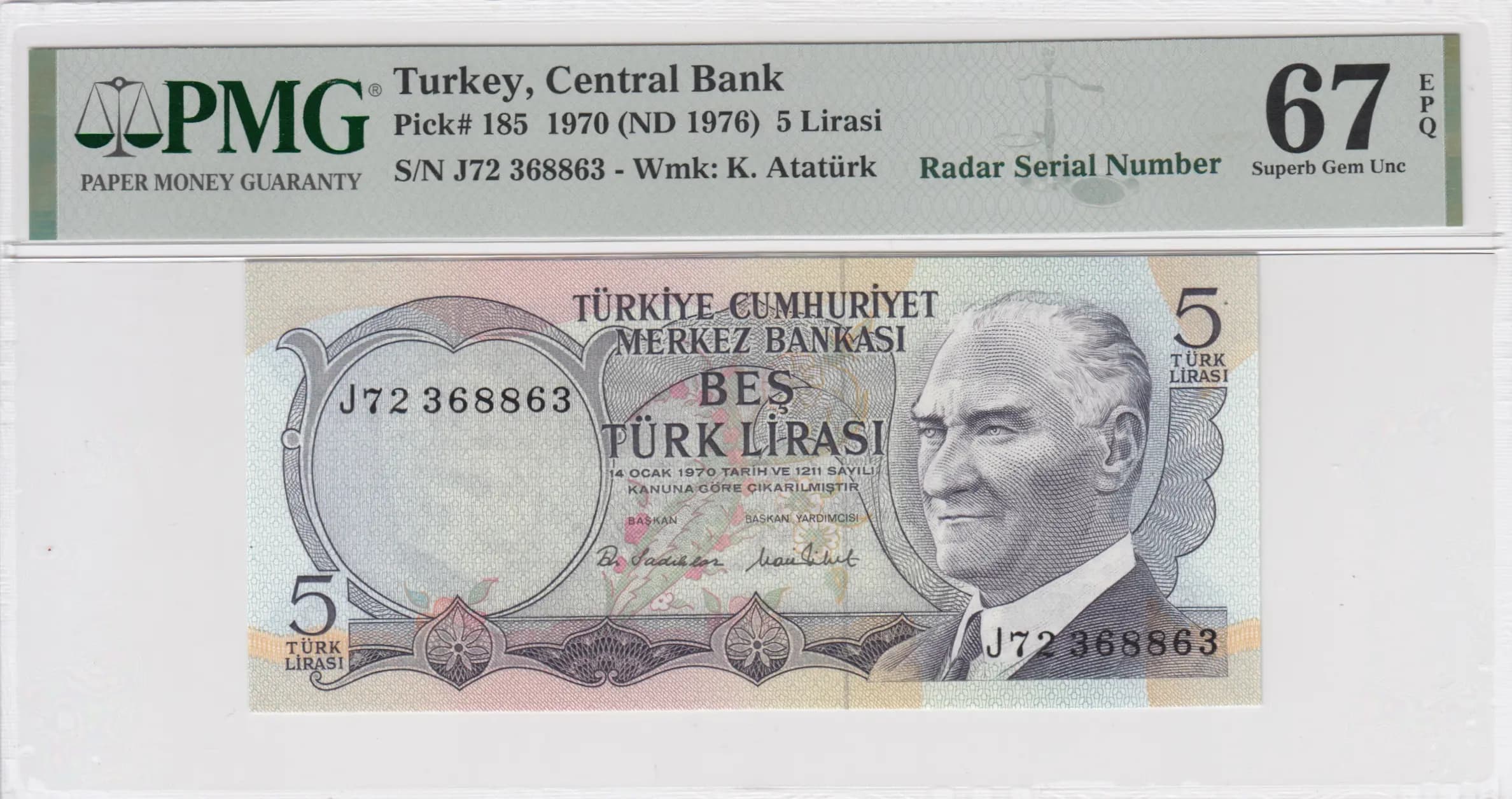
“radar #”
Market Prices
24 salesAbout This Note
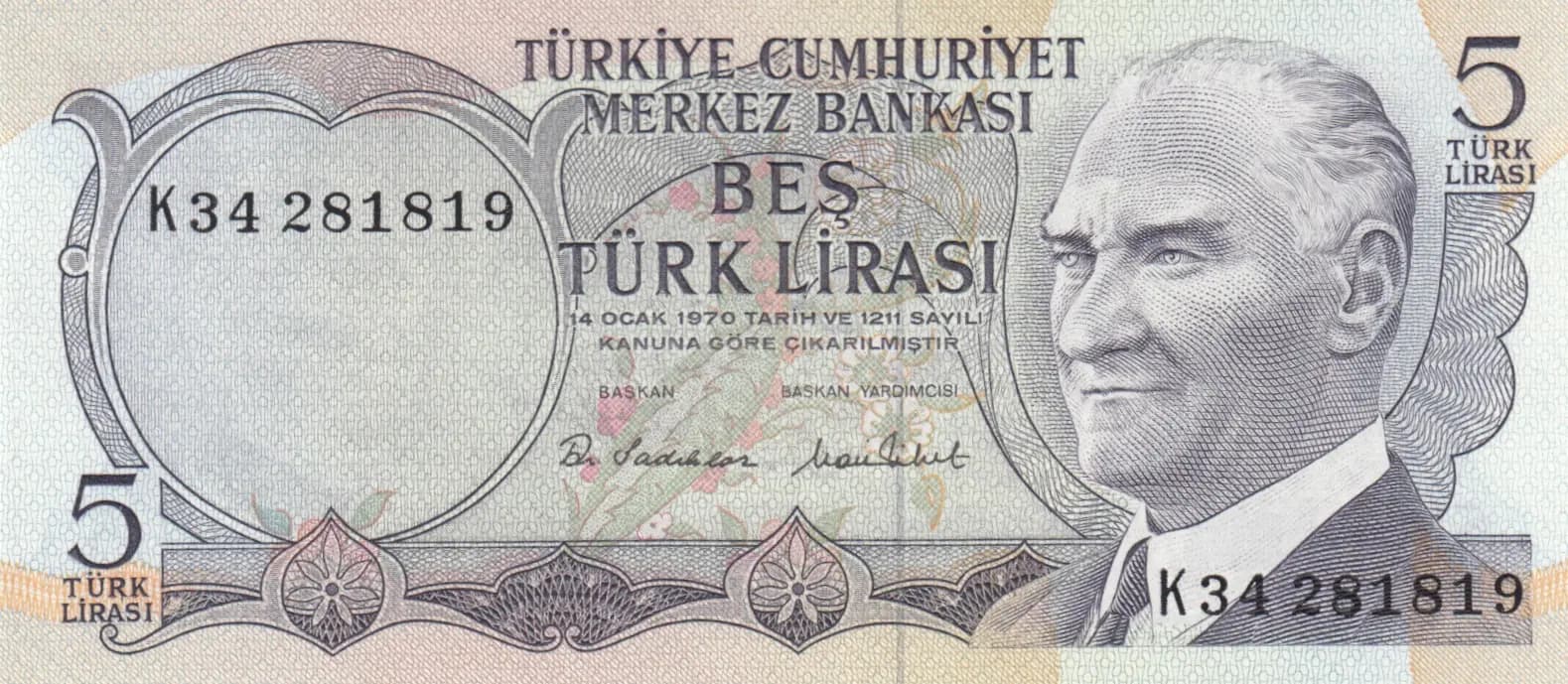
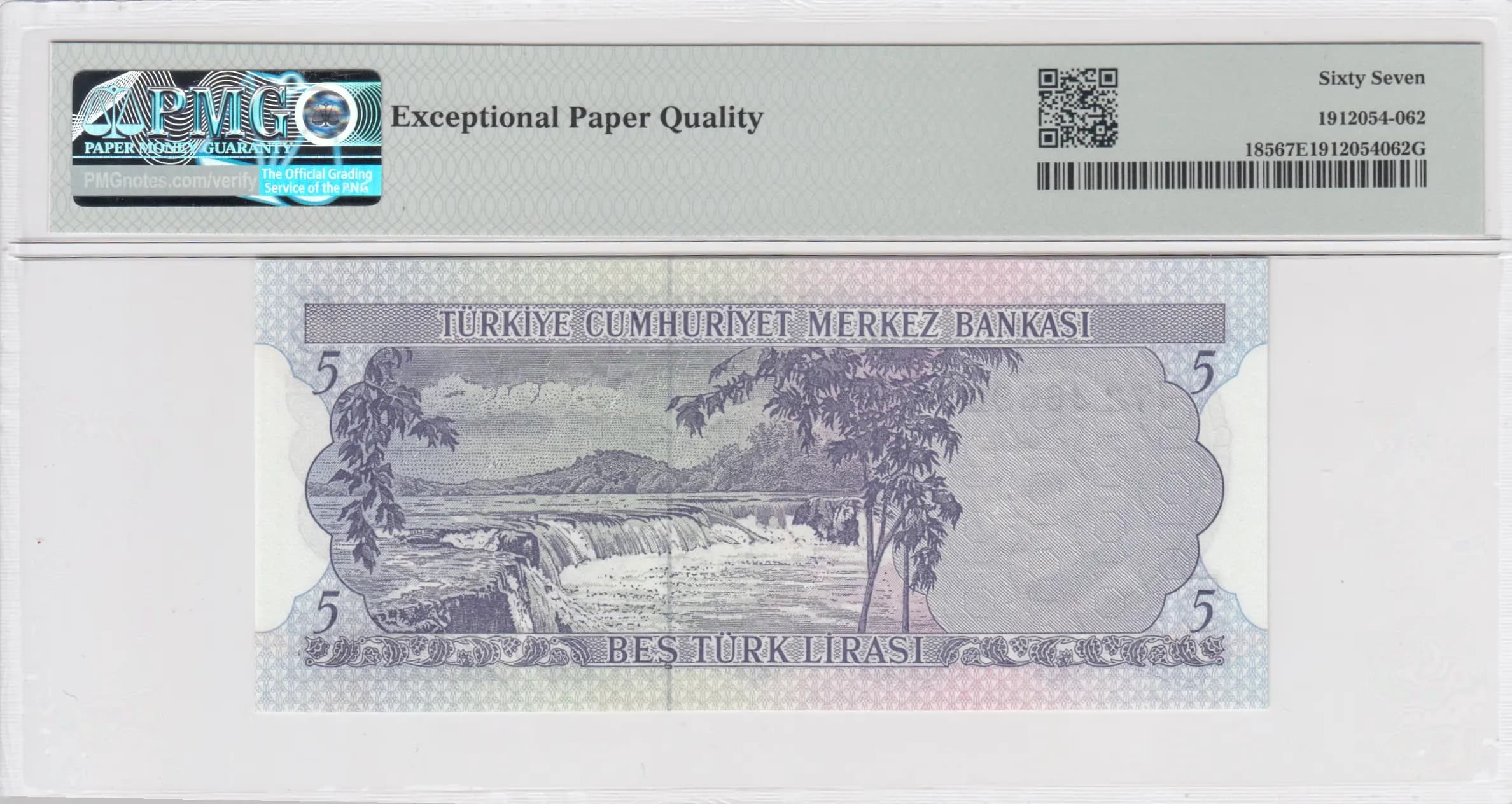
This is a PMG Grade 67 Superb Gem Uncirculated example of the Turkish 5 Lirasi from 1970 (Law of January 14, 1970), featuring exceptional preservation with sharp, crisp printing throughout and no visible wear. The note showcases a portrait of Mustafa Kemal Atatürk in profile on the obverse and the iconic Manavgat waterfalls landscape on the reverse, rendered in fine line engraving with multicolored security printing. The PMG 67 EPQ grade with noted radar serial number (J72 368863) makes this a premium example desirable to collectors seeking high-grade Turkish currency from this era.
Common. This is a regular issue of the Turkish Central Bank from 1970 with substantial circulation and surviving examples. eBay market data shows consistent sales of PMG 67 examples ranging from $15-$22 over the past decade, with lower-grade examples selling for under $5, indicating healthy supply in the collector market. The note was produced in significant quantities as part of standard Turkish currency circulation and has no documented print run limitations or recall status.
Issued in 1970 under Law No. 1211 of the Turkish Central Bank, this note commemorates the early period of the Turkish Republic through its prominent portrait of Atatürk, the nation's founding father and first president. The reverse design featuring the Manavgat waterfalls near Antalya reflects Turkey's natural heritage and economic resources, while the 1970 issuance date places the note in the period of post-1960s Turkish monetary stability and modernization efforts.
The obverse features a left-facing profile portrait of Mustafa Kemal Atatürk positioned at the right side of the note, rendered in detailed line engraving with fine cross-hatching typical of high-security currency design. An ornate circular medallion frame occupies the left side of the obverse with decorative floral and geometric elements characteristic of Turkish Central Bank design aesthetics. The reverse depicts a landscape scene of the Manavgat waterfalls in Antalya, with cascading water, surrounding mountains, and drooping willow trees framing the composition on both sides. The overall color scheme combines pink/rose, light blue, and gray line work on a cream background, with purple-blue tinted security areas. Both sides feature ornate corner numerals and decorative borders, typical of 1970s Turkish banknote design.
OBVERSE: 'TÜRKİYE CUMHURİYET MERKEZ BANKASI' = 'Republic of Turkey Central Bank'; 'BEŞ TÜRK LİRASI' = 'Five Turkish Lira'; '5 TURK LİRASI' = '5 Turkish Lira'; 'J72 368863' = Serial number; '14 OCAK 1970 TARİH VE 1211 SAYILI KANUNA GÖRE ÇIKARILMIŞTIR' = 'Issued according to Law No. 1211 dated January 14, 1970'; 'BAŞKAN' = 'Governor'; 'BAŞKAN, YARDIMCISI' = 'Vice Governor'. REVERSE: 'TÜRKİYE CUMHURİYET MERKEZ BANKASI' = 'Republic of Turkey Central Bank'; 'BEŞ TÜRK LİRASI' = 'Five Turkish Lira'; '5' = denomination numeral.
Intaglio line engraving (gravure printing), characteristic of premium currency production. The noted printer for replacement notes is DBM-A (without imprint on the regular series). Multiple color printing was used to achieve the multicolor underprint effects visible in the pink/rose and blue color zones, with black line engraving providing the primary security detail. The watermark features a portrait of K. Atatürk, integrated into the papermaking process.
This specific example features serial number prefix 'J72', indicating it is from the regular issue series (replacement notes used prefixes Z91-Z95). The note bears two signatures corresponding to Governor and Vice Governor positions. The Law of 1970 dating distinguishes this from earlier 1930 law issues referenced as P-179. The radar serial number property noted by the collector (J72 368863) is a desirable characteristic for numismatists, though does not significantly affect rarity classification for this common issue type.