5 lirasi 1966
Market Prices
16 salesAbout This Note
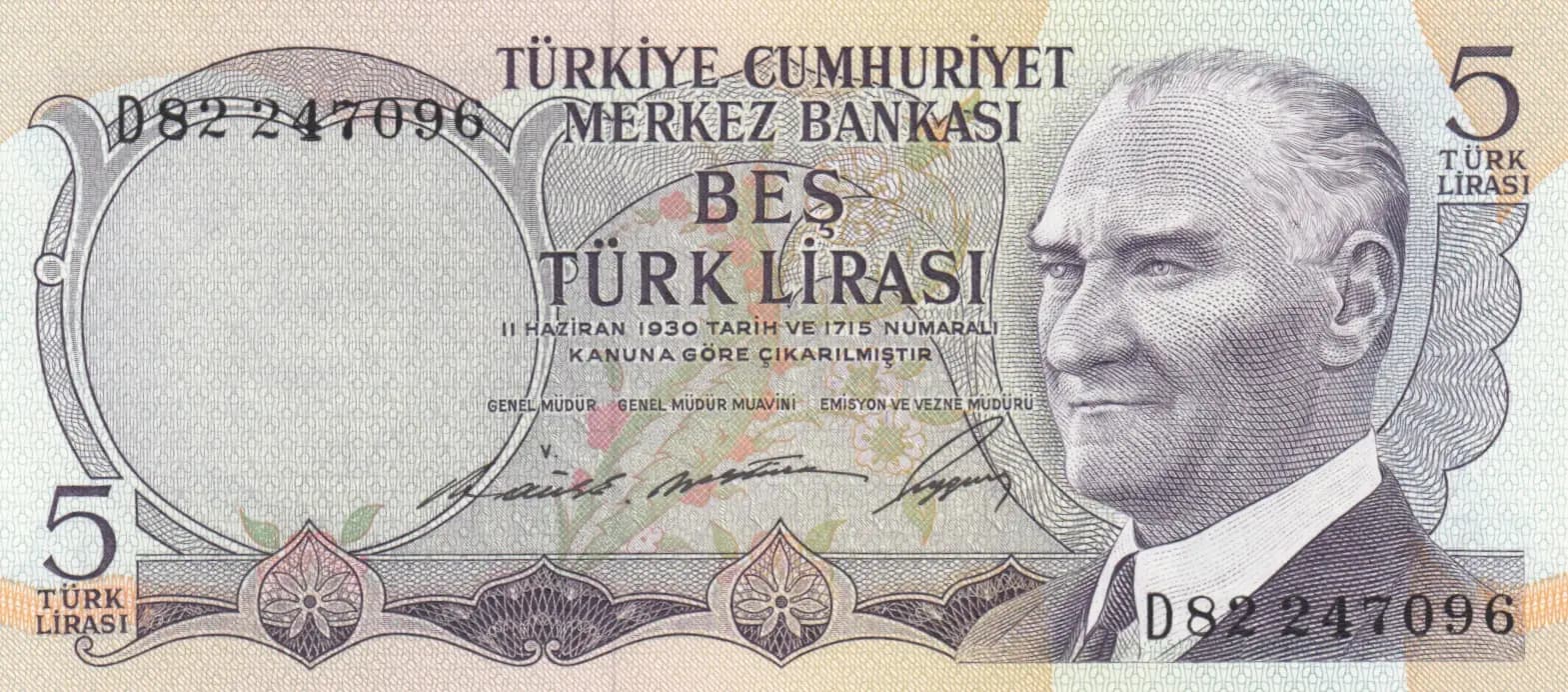
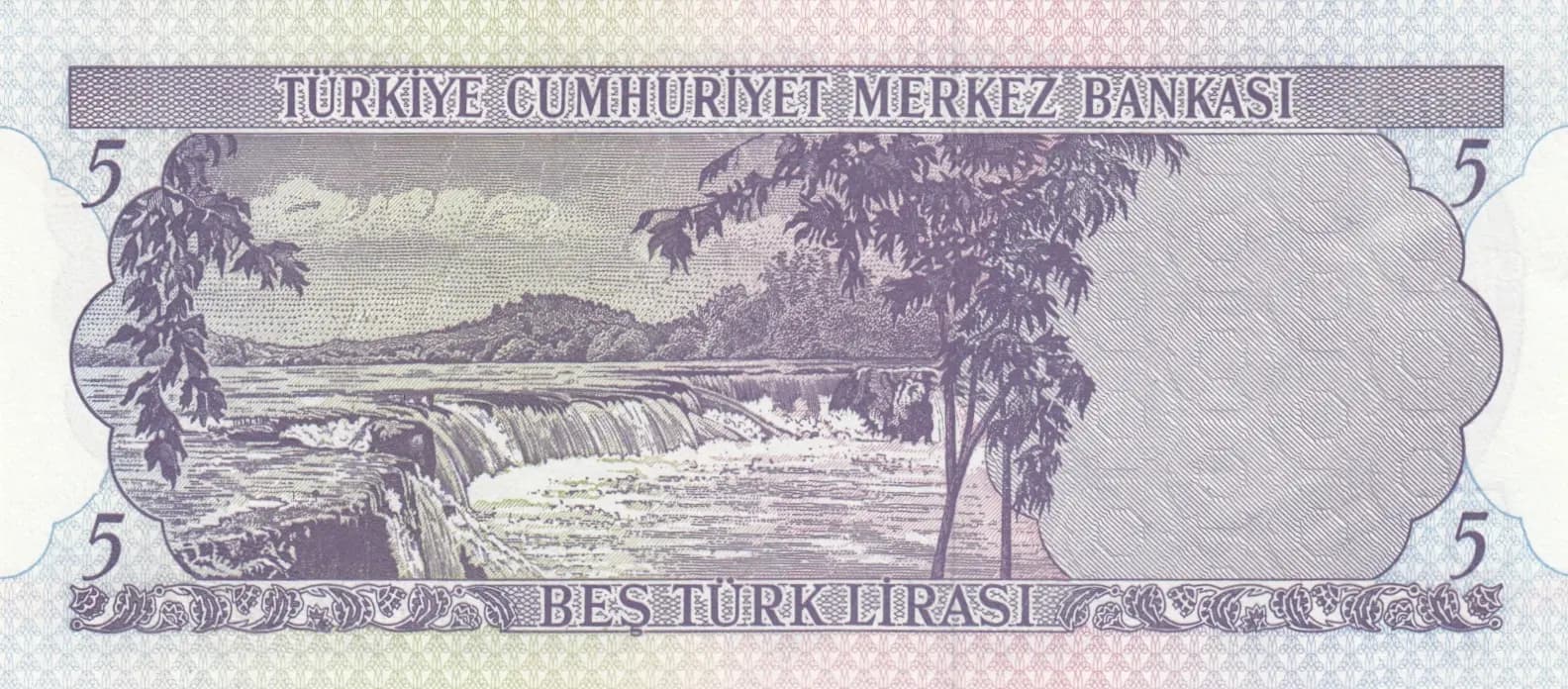
This is an exceptionally well-preserved example of the Turkish 5 Lira note (Pick P-179) from 1966, presented in UNC condition with crisp, clear printing throughout. The note showcases fine engraving on both sides—featuring a dignified portrait of Mustafa Kemal Atatürk on the obverse and the scenic Manavgat waterfall on the reverse—with intricate filigree borders and ornamental details that demonstrate the security printing standards of the Turkish Central Bank. The pristine condition, sharp detail retention, and complete absence of wear or damage make this an exemplary collectible specimen of mid-20th century Turkish currency.
Common. Market evidence from the eBay price tracking data provided shows this note selling regularly in the $1–$7 range for UNC examples across multiple sales spanning 2014–2022, with only occasional examples reaching the $24–$29 price point. The 2019 catalogue value of $5 for UNC condition confirms this is a standard, readily available note for collectors. No print run restrictions, recall history, or short-lived issuing authority applies to this Pick number, and the regular market circulation of multiple examples indicates substantial production quantities.
This banknote was issued during a period when Turkey was modernizing its currency and central banking systems under the Turkish Republic Central Bank (Türkiye Cumhuriyet Merkez Bankası). The prominent placement of Atatürk's portrait reflects his enduring significance as the founder and first president of the Turkish Republic, a revered figure whose image appeared on currency to reinforce national identity. The reverse design depicting the Manavgat waterfall in Antalya represents Turkey's natural heritage and regional geography, a common thematic choice in mid-century banknote designs that celebrated the nation's diverse landscapes.
The obverse features a finely engraved portrait of Mustafa Kemal Atatürk rendered in profile facing right, depicted in formal attire with prominent white collar detail, exemplifying the refined portraiture typical of official currency of this era. The portrait is positioned at the right side of the note and is framed by an ornamental circular design with elaborate scrollwork on the left. The reverse depicts the Manavgat waterfall (Manavgat Şelalesi) located in Antalya, southern Turkey, shown as a naturalistic landscape vignette with cascading water, weeping willow or similar trees flanking the composition on both sides, and elevated terrain in the background. The entire design is executed in fine line engraving with detailed cross-hatching and filigree patterns, and decorative border elements frame both sides of the note in a grayish-purple color scheme with cream/beige underprinting. Three signature lines appear on the obverse for the General Director, Deputy General Director, and Emission and Treasury Director.
FRONT SIDE: 'TÜRKİYE CUMHURİYET MERKEZ BANKASI' = 'Republic of Turkey Central Bank'; 'BES TÜRK LİRASI' = 'Five Turkish Lira'; '11 HAZİRAN 1930 TARİH VE 1715 NUMARALI KANUN'A GÖRE ÇIKARILMIŞTİR' = 'Issued according to the Law dated June 11, 1930 and numbered 1715'; 'GENEL MÜDÜR' = 'General Director'; 'GENEL MÜDÜR MUAVINI' = 'Deputy General Director'; 'EMİSYON VE VEZNE MÜDÜRÜ' = 'Emission and Treasury Director'; Serial number: 'D82 247096'. BACK SIDE: 'TÜRKİYE CUMHURİYET MERKEZ BANKASI' = 'Republic of Turkey Central Bank'; 'BES TÜRK LİRASI' = 'Five Turkish Lira'.
Intaglio engraving (line engraving), the standard security printing method for this period. The visual analysis confirms fine, detailed engraving work with characteristic crisp lines and intricate filigree patterns. The printer is identified in catalog sources as DBM-A (without imprint visible on the note itself), consistent with Turkish Central Bank currency production standards of the 1960s.
This specimen carries the serial number prefix 'D82,' which represents a standard production series for this issue. The visual analysis confirms this is consistent with the L. 1930 (legal basis date) / 8.1.1968 (actual issue date) variety as documented in realbanknotes.com reference data. The note exhibits three signatures, consistent with the standard design for this Pick number. No visible overprints, special markings, or deviations from the standard design are evident. The similar later note with L. 1970 issue date is cataloged separately as Pick P-185, confirming this as the earlier variety of the 5 Lira type.