20 lirasi 1971
Market Prices
22 salesAbout This Note
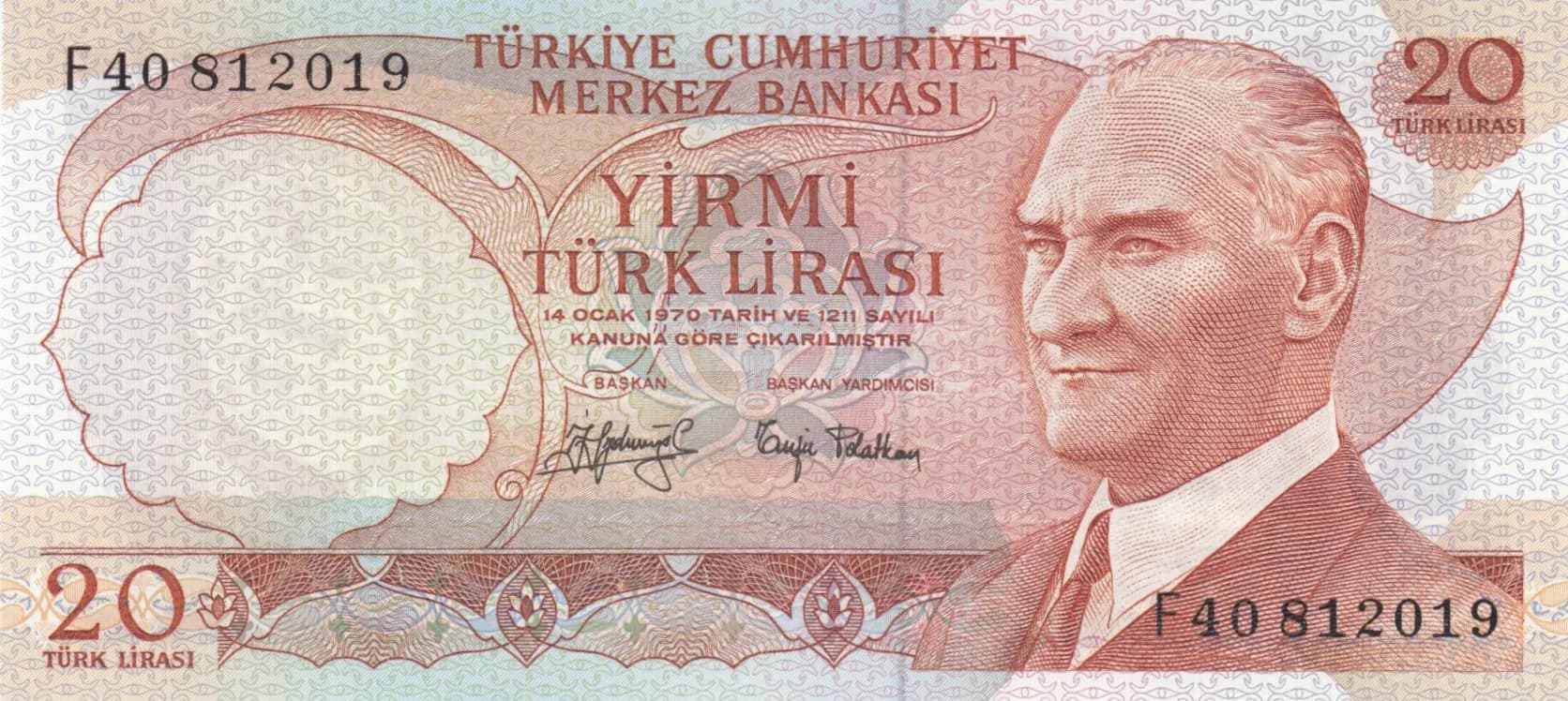
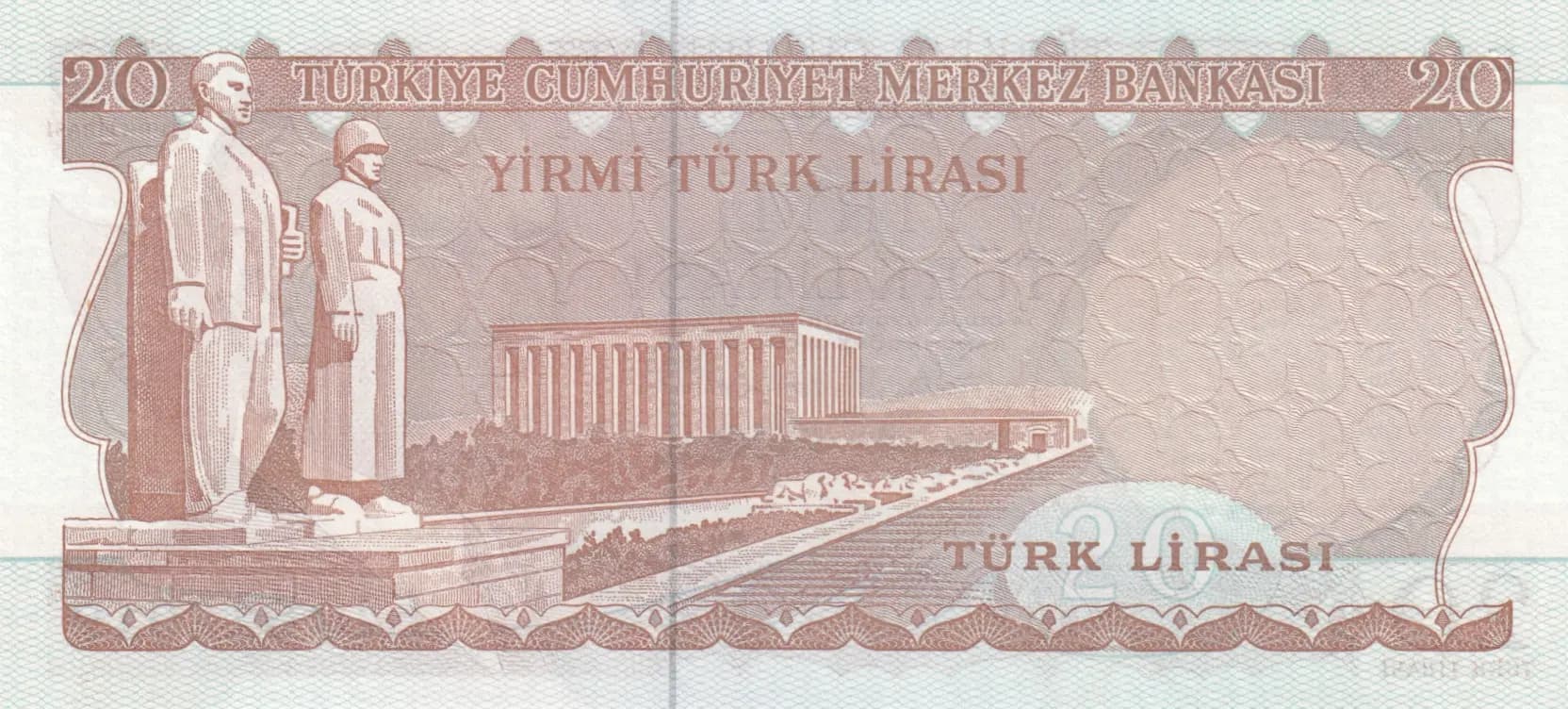
This is a Turkish 20 Lira banknote from the 1970 issue (L.1970), presented in circulated condition with visible central fold creasing and wear consistent with moderate circulation. The note features a classical portrait of Mustafa Kemal Atatürk on the obverse and the iconic Atatürk Mausoleum on the reverse, rendered in fine engraving with the characteristic pink/rose and cream color palette of this series. Despite circulation wear, the note retains good detail definition in the engraved elements and remains a recognizable example of Turkish Republican-era currency design.
Common. The eBay price data shows consistent sales ranging from $0.99 to $26, with most examples in circulation grades (F, VF, AUNC) selling for $1-$3 and premium graded specimens (PMG 66) commanding $10-$26. The 2019 catalog value of $5 for UNC grade indicates this is a standard, readily available issue with healthy circulation in the collector market. The L.1970 issue date represents a regular circulation issue with substantial print runs, and no evidence of short print runs, recalls, or limited availability exists in the catalog records.
Issued in 1970 under the authority of Law No. 1211 dated January 14, 1970, this banknote commemorates the founding principles of the Turkish Republic through its dual imagery of Atatürk and his mausoleum in Ankara. The note's design reflects the mid-20th century Turkish state's emphasis on nationalist iconography and the veneration of the republic's founder, with the mausoleum serving as a monumental symbol of the nation's modern identity. This denomination and issue represent Turkey's currency during a period of significant economic transition in the early 1970s.
The obverse features a formal three-quarter portrait of Mustafa Kemal Atatürk, the founder and first president of the Turkish Republic, positioned on the right side of the note in classical engraving style wearing a formal business suit and white shirt. The left side contains an ornamental empty cartouche or frame design serving as the watermark area. The reverse depicts the Atatürk Mausoleum (Anıtkabir) in Ankara with its distinctive neoclassical columned facade, accompanied by two standing figures rendered as statues or monuments in the foreground, representing commemorative or allegorical elements of the nationalist monument. Both sides feature intricate geometric background patterns, decorative borders with floral motifs, and the crescent and star emblem reflecting Turkish national symbolism. The color scheme of pink/rose, cream, and brown tones provides the characteristic aesthetic of this 1970 series.
FRONT: 'TÜRKİYE CUMHURİYET MERKEZ BANKASI' (Central Bank of the Turkish Republic); '20 TURK LİRASI' (20 Turkish Lira); 'YİRMİ TÜRK LİRASI' (Twenty Turkish Lira); '14 OCAK 1970 TARİH VE 1211 SAYILI KANUNA GÖRE ÇIKARILMIŞTIR' (Issued according to the Law dated January 14, 1970 and numbered 1211); 'BAŞKAN' (Governor); 'BAŞKAN YARDIMCISI' (Vice Governor); Serial number 'F40 812019'. BACK: 'TÜRKİYE CUMHURİYET MERKEZ BANKASI' (Central Bank of the Turkish Republic); 'YİRMİ TÜRK LİRASI' (Twenty Turkish Lira); 'TÜRK LİRASI' (Turkish Lira); Denomination '20' appears on both left and right margins.
Intaglio engraving (line engraving) on a multicolor underprint, executed by DBM-A (Devlet Basımevi-Ankara, the Turkish State Printing Works), as confirmed by catalog references indicating the printer without imprint mark. The fine line work visible in the portrait, architectural details, and decorative elements is characteristic of high-security intaglio production. The multicolor underprint provides additional security layering beneath the primary engraved imagery.
This note is cataloged as P-187a (1970 issue), with a known earlier variety P-181 dated L.1930. The visual analysis shows serial number F40 812019 with a black signature configuration. Catalog references note '2 varieties' exist for this issue type, likely distinguished by signature variations or serial number prefixes. The note displays the 'without imprint' printing characteristic typical of DBM-A production for this series. No specific overprints or exceptional variety features are evident in the observed example.