2 pa'anga 1967
“3.04.67”
Market Prices
About This Note
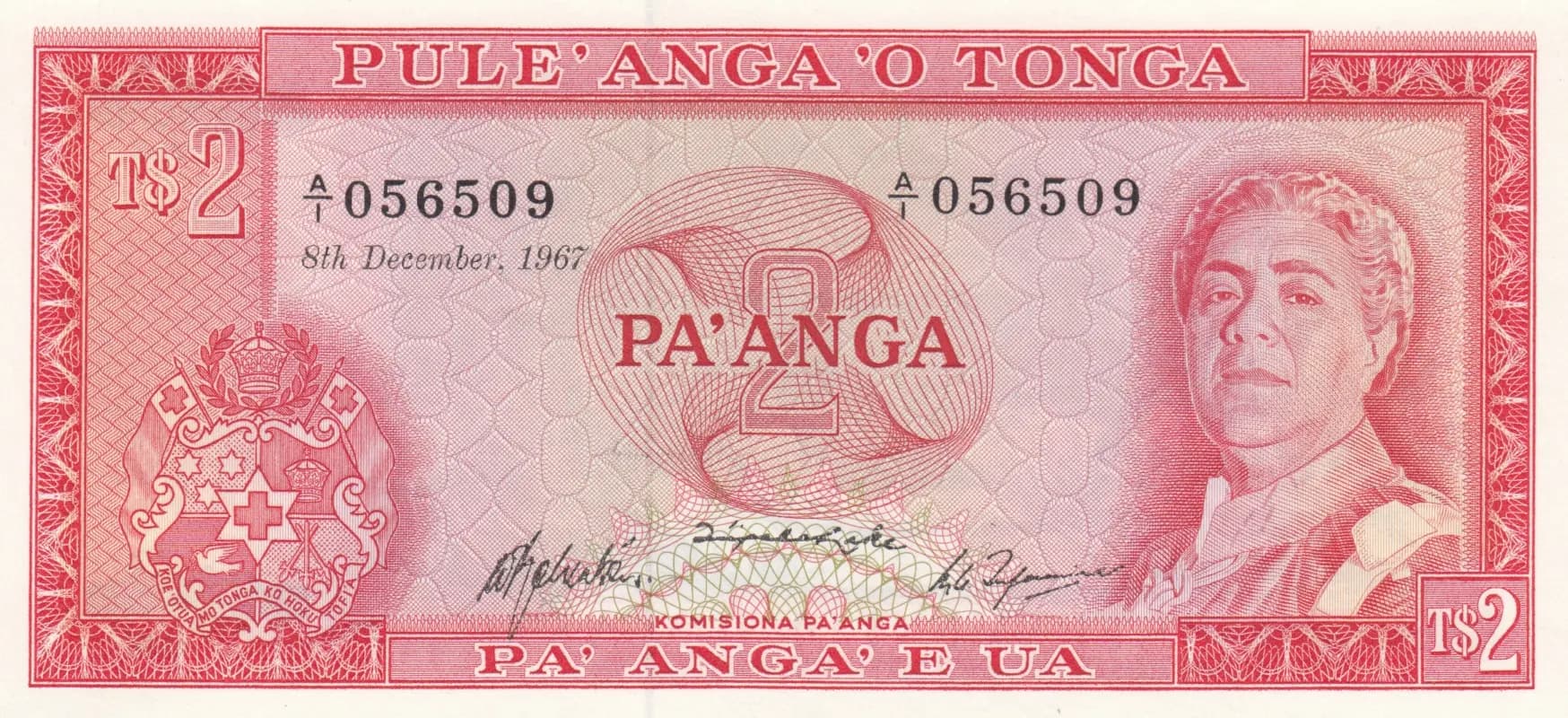
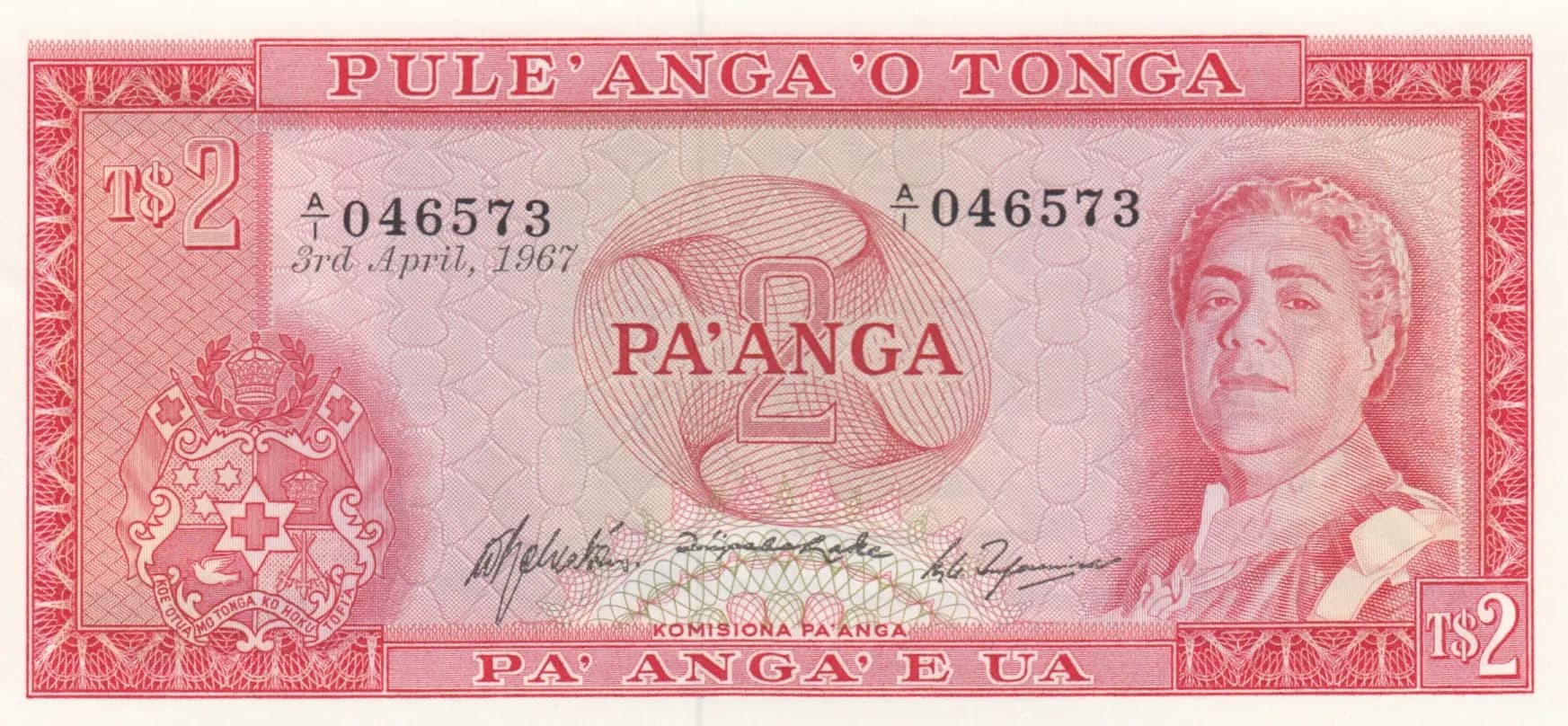
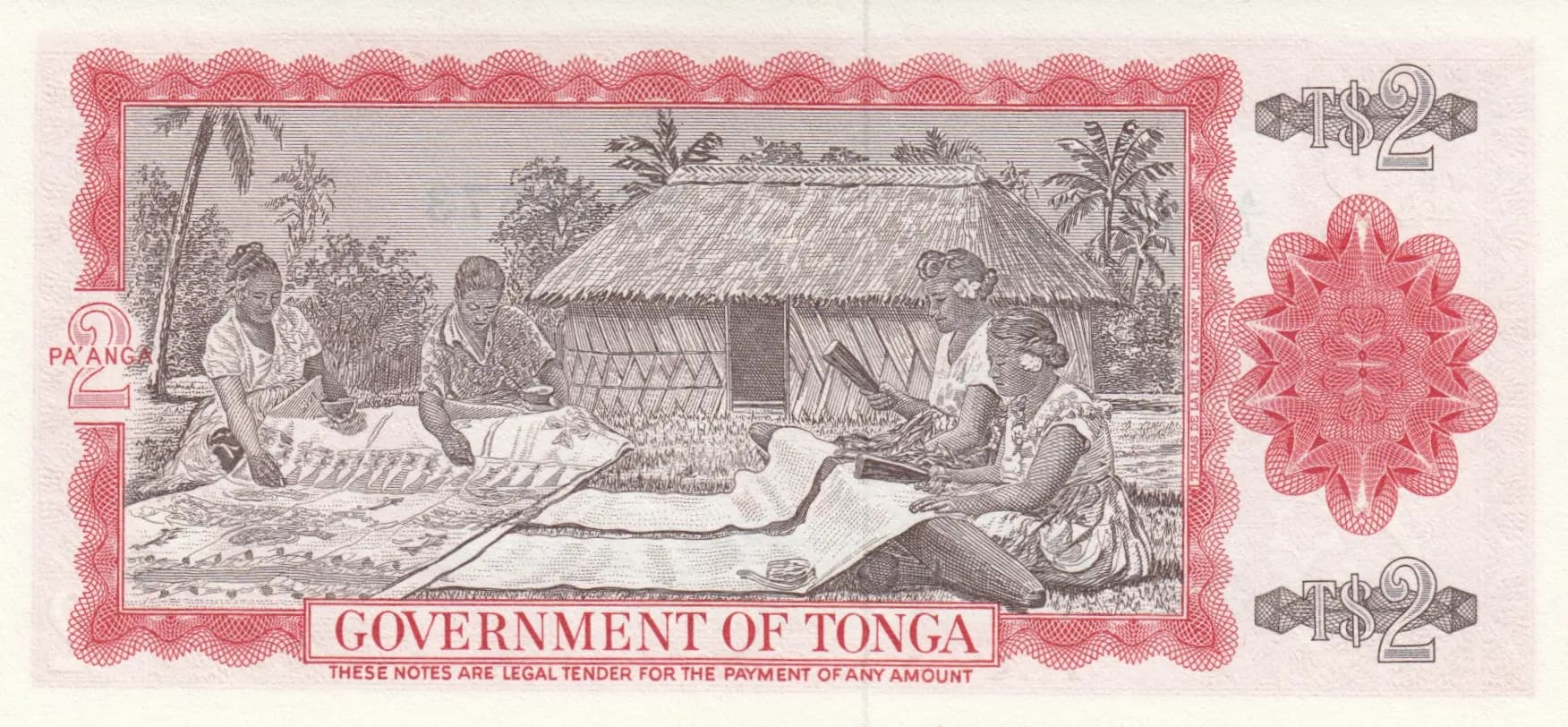
A stunning uncirculated example of Tonga's first currency commission issue from 3rd April 1967, featuring Queen Salote Tupou III in formal portrait on the obverse and a detailed scene of traditional Tongan domestic life on the reverse. The note exhibits pristine condition with crisp, sharp printing in rose-pink and red inks, displaying the fine engraving work characteristic of Thomas de la Rue's London production. This early commemorative date variant represents an important milestone in Tonga's post-colonial monetary independence.
Common. The secondary market eBay pricing data provided shows UNC examples consistently trading in the $2.49–$4.75 USD range, with an average around $3.50, indicating strong supply and steady demand typical of common circulation-era issues. The 2019 catalogue valuation of $200 UNC appears significantly at odds with observed market realization and may reflect outdated or specialized collector pricing; real-world UNC transactions consistently realize under $5. This 1967 Currency Commission issue had substantial print runs across its 1967–1973 series window, and the Pick-15a variant remains readily available in the numismatic market.
This 2 pa'anga note was issued by the Komisiona Pa'anga (Currency Commission) in 1967, marking Tonga's transition toward greater sovereignty following its shift from British protectorate to independent kingdom status. The obverse portrait honors Queen Salote Tupou III, the reigning monarch who oversaw much of Tonga's modernization, while the reverse's depiction of women engaged in traditional tapa cloth production reflects the Kingdom's cultural heritage and domestic economic activities during this period of national identity consolidation.
The obverse features a three-quarter portrait of Queen Salote Tupou III positioned at right, depicted in formal regalia with draped cloth, flanked by the coat of arms of Tonga at lower left—a shield design incorporating a cross symbol and ornate heraldic flourishes. A large radiating fan or shell-pattern circular cartouche occupies the center, framing the denomination. The reverse depicts a detailed engraved scene of traditional Tongan village life centered on a characteristic peaked-roof fale (traditional house) surrounded by tropical vegetation including coconut palms, with multiple figures—adults and children—engaged in domestic activities, likely including the preparation or weaving of tapa cloth for which the note is documented. Decorative floral rosettes and scalloped borders frame both sides. The color scheme throughout is predominantly rose-pink with red and black-gray engraving.
Front side: 'PULE'ANGA 'O TONGA' (Kingdom of Tonga), 'PA'ANGA 2' / 'PA'ANGA E UA' (2 pa'anga in Tongan), 'KOMISIONA PA'ANGA' (Currency Commission), '3rd April, 1967' (issue date), 'T$2' (denominal notation). Back side: 'GOVERNMENT OF TONGA' (English authority statement), 'THESE NOTES ARE LEGAL TENDER FOR THE PAYMENT OF ANY AMOUNT' (legal tender clause), 'PA'ANGA 2' / 'T$2' (denomination repeated).
Intaglio engraving (line engraving and possibly steel plate production) executed by Thomas de la Rue, the prestigious London security printer. The fine line work visible in the portraiture, heraldic elements, and domestic scene engraving, combined with the multi-color printing (red, pink, black on cream underprint) and intricate background patterns, are characteristic of de la Rue's mid-20th-century banknote production methods. Security features include fine geometric background patterns and detailed engraving work serving as anti-counterfeiting measures.
This note is catalogued as Pick-15a, one of four recognized variants (P-15a, P-15c, P-15d, P-15s per PMG population data). Variants are typically distinguished by signature combinations, date varieties, and serial number prefixes across the 1967–1973 production period. The observed example bears the specific date '3rd April, 1967' and serial number 'A046573', identifying it within the early issuance window; without access to signature identification from the visual analysis, the exact sub-variety cannot be further refined, but the April 1967 date confirms P-15a classification.