20 baht 1939
Market Prices
14 salesAbout This Note
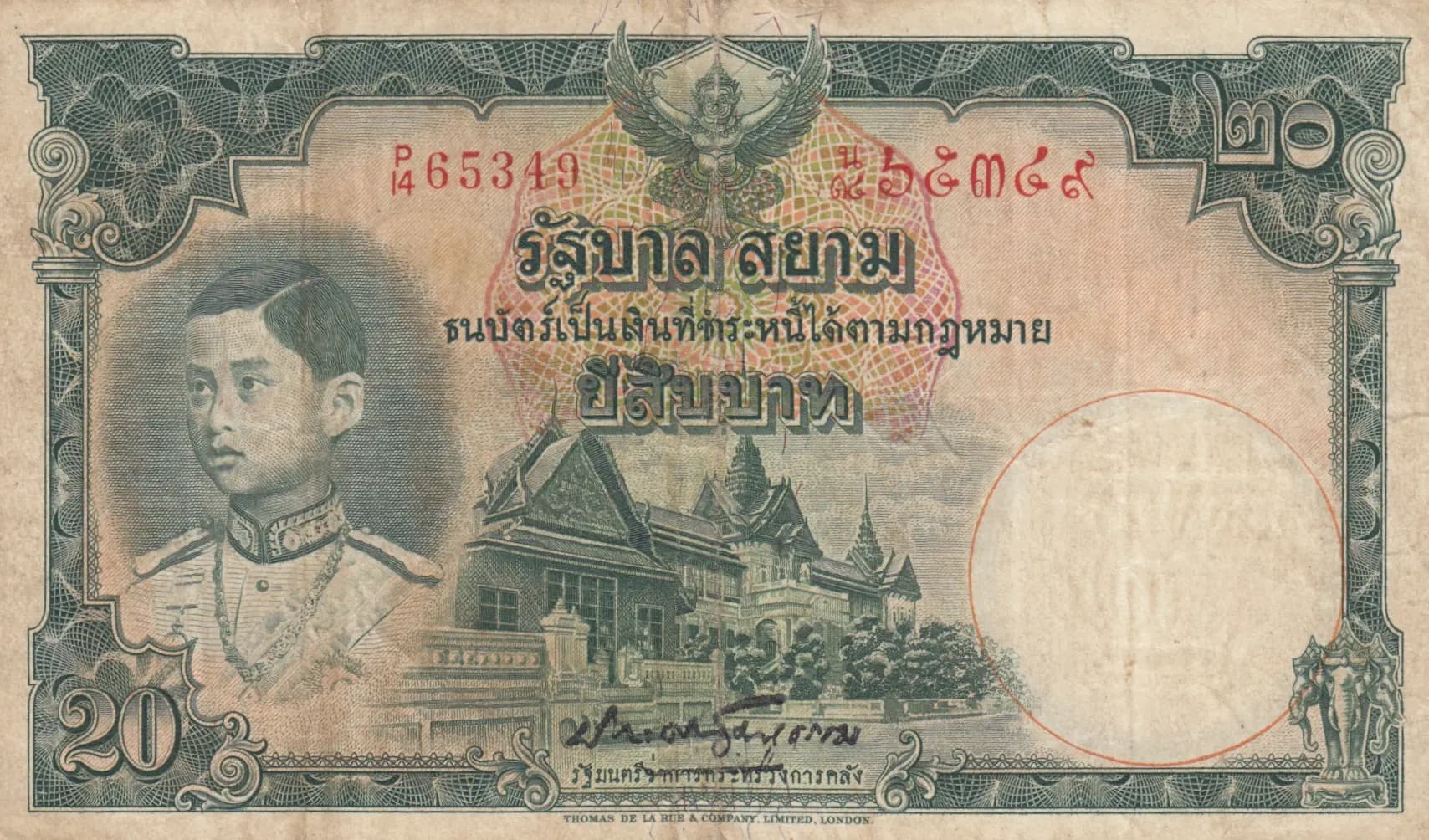
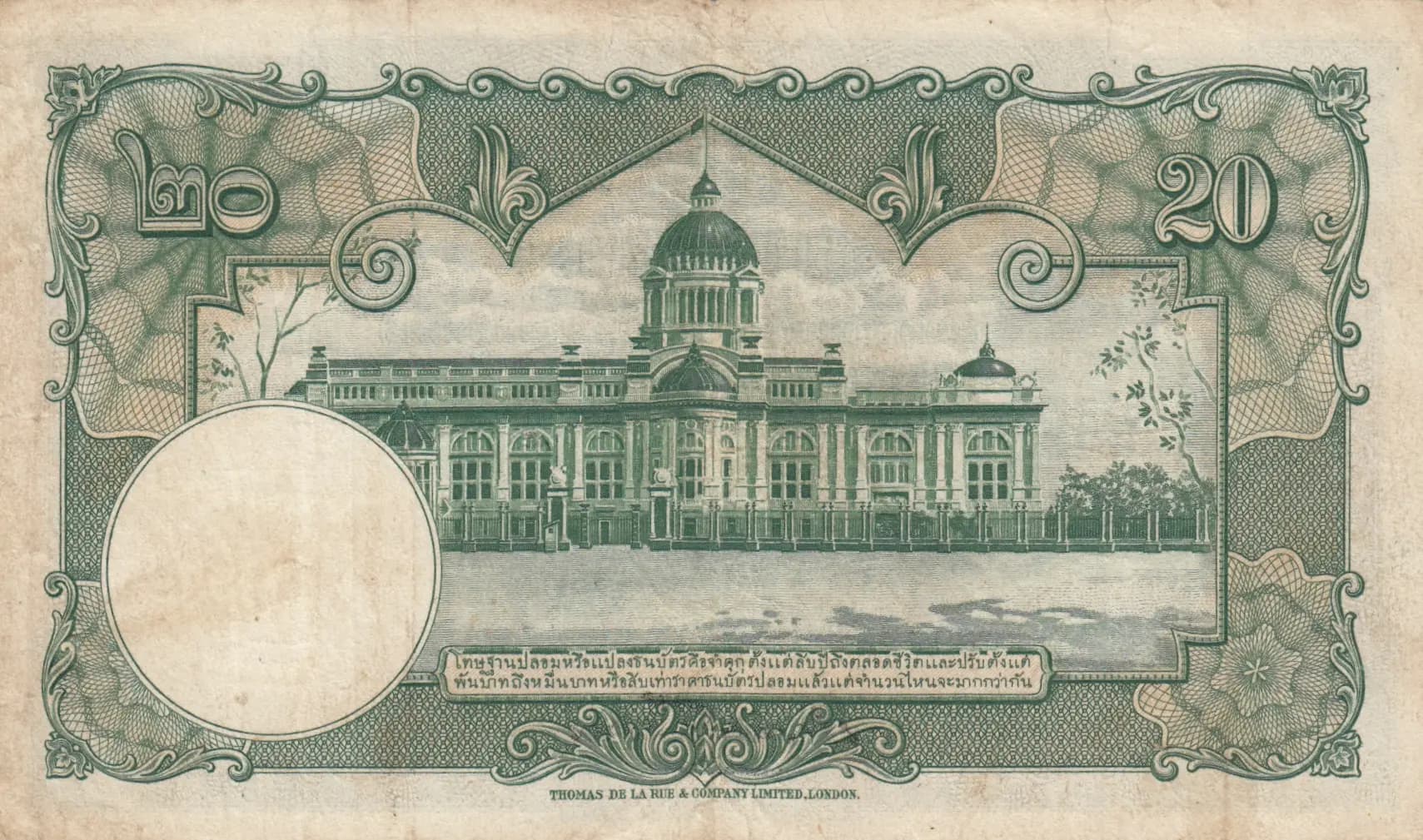
This is a well-preserved example of the Thailand 20 Baht P-36 from 1939, printed by Thomas de la Rue in London. The note displays the characteristic green-toned design with a portrait of the young King Rama VIII Ananda Mahidol on the obverse and an impressive neoclassical throne hall building on the reverse, both rendered in fine line engraving. In Fine condition, this note shows expected age-related patina with yellowing and light foxing, but maintains excellent structural integrity and vibrant ink impression—typical market pricing for F-grade examples ranges from $58–$112 USD.
Common. Catalog references note this as a regular issue with significant circulation during its issuing period. Market data from realbanknotes.com shows consistent sales activity with F-grade examples regularly achieving $58–$112 USD across multiple sales over the 2009–2020 period, indicating healthy supply in the secondary market. While not abundant, this denomination and issue was produced in sufficient quantity that examples in Fine condition remain accessible to collectors without premium pricing.
Issued during the reign of King Rama VIII (r. 1935–1946), this banknote represents the modernization of Siam's currency during the pre-World War II period. The portrait of the young king and the prominent depiction of the royal throne hall on the reverse reflect the governmental authority and ceremonial power of the Thai monarchy during a period of significant political transition in Southeast Asia. The Thomas de la Rue printing credentials and English-language text underscore Siam's continued reliance on Western security printing expertise during this era.
The obverse features a three-quarter profile portrait of King Rama VIII Ananda Mahidol positioned on the left side, depicted as a young man in formal military or ceremonial dress with an ornately decorated collar, characteristic of Thai royal portraiture of the period. At the top center is a winged emblem (the Thai royal seal or coat of arms). The right side displays the distinctive architecture of a Thai Buddhist or royal throne hall with characteristic pointed spires and classical Thai architectural elements. The reverse presents a neoclassical government building—likely a parliament house or administrative palace—with a prominent dome, columned portico, and classical proportions, framed by elaborate botanical ornaments and scrollwork. Both sides are extensively decorated with intricate guilloche patterns and fine engraving in the border and corner areas, typical of Thomas de la Rue's security printing standards. A three-headed elephant symbol appears at the lower right of the obverse.
FRONT: 'ธนาบัญชีสยาม' (Bank of Siam); 'ธนบัตรใบนี้บิณนักรี-นินได้ตามกฎหมาย' (This banknote is legal tender according to law); 'ยี่สิบบาท' (Twenty baht); '20' (denomination numeral); Serial number '465349'; 'THOMAS DE LA RUE & COMPANY, LIMITED, LONDON' (printer imprint). BACK: '20' (denomination numeral); Thai legal text regarding the banknote's preservation and legal status; 'THOMAS DE LA RUE & COMPANY LIMITED, LONDON' (printer imprint).
Intaglio (line engraving) on banknote paper. Printed by Thomas de la Rue & Company Limited, London, one of the world's premier security printers of the era. The note exhibits characteristic features of TDLR production: fine-line engraving throughout, intricate guilloche patterns as anti-counterfeiting measures, multicolor underprinting (green dominant with red overprints and cream background), and watermark elements. All security features are consistent with pre-World War II TDLR banknote production standards.
Pick catalog P-36 represents the primary regular issue of the 1939 20 Baht. The visual analysis confirms Type I heading format and TDLR printing characteristics consistent with the standard variety. The external catalog reference specifically directs attention to a related but distinct variety (P-41), which represents notes of 'inferior quality issued during Japanese Intervention'—implying this P-36 is the higher-quality original issue. Serial number 465349 is visible on the obverse, but without access to documented serial ranges, specific variety designation based on serial prefix cannot be determined from this example alone.