1 baht 1934
Market Prices
18 salesAbout This Note
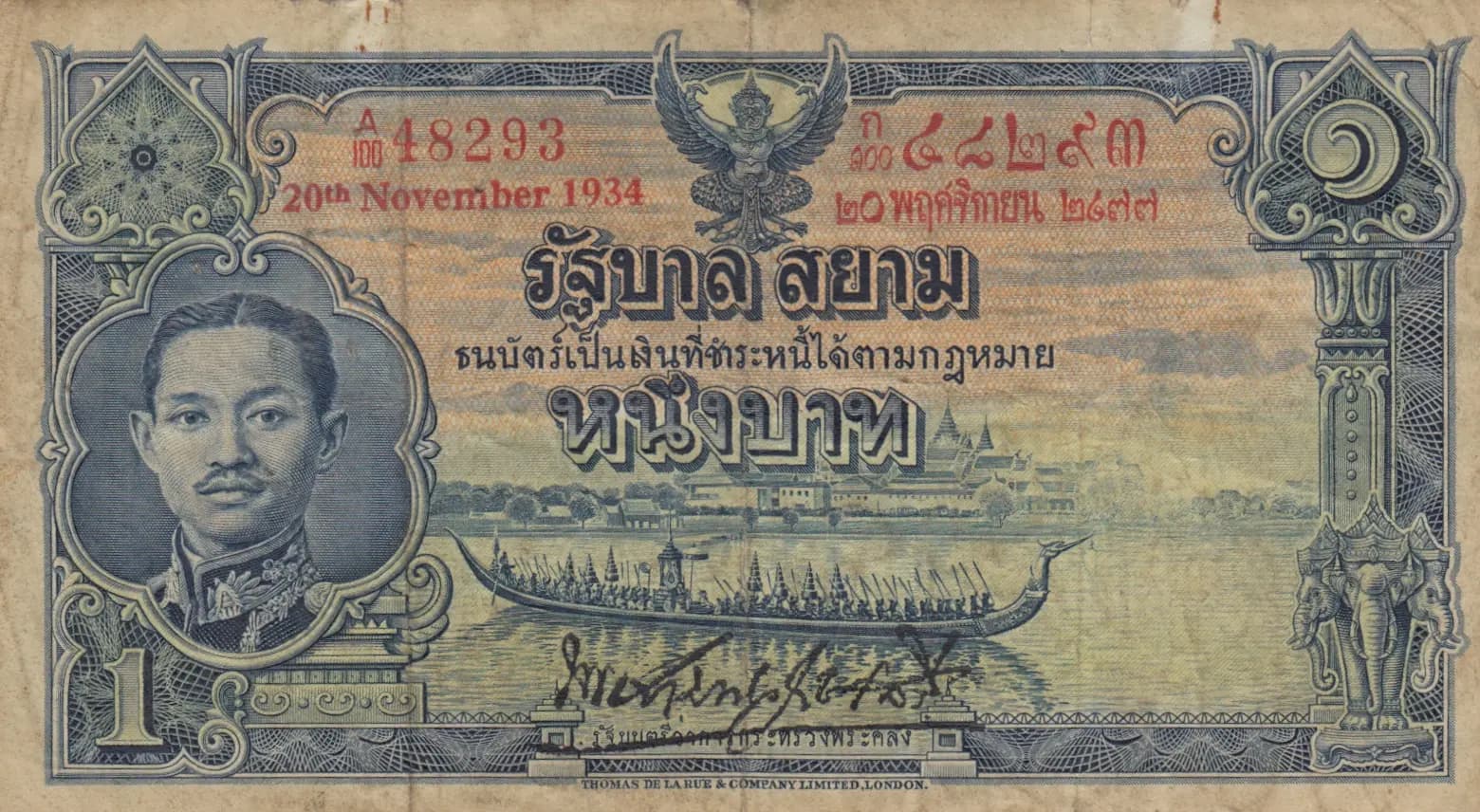
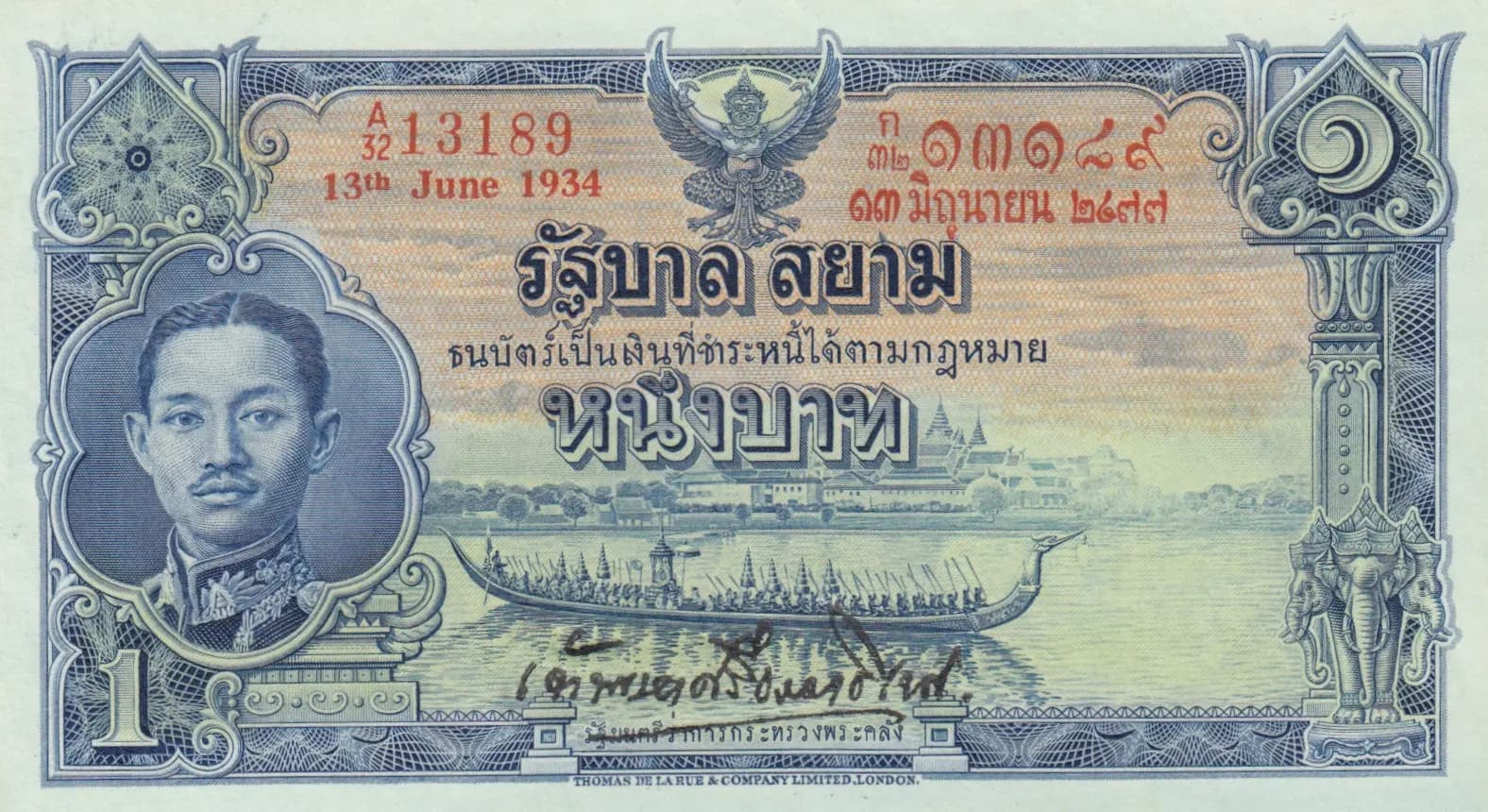
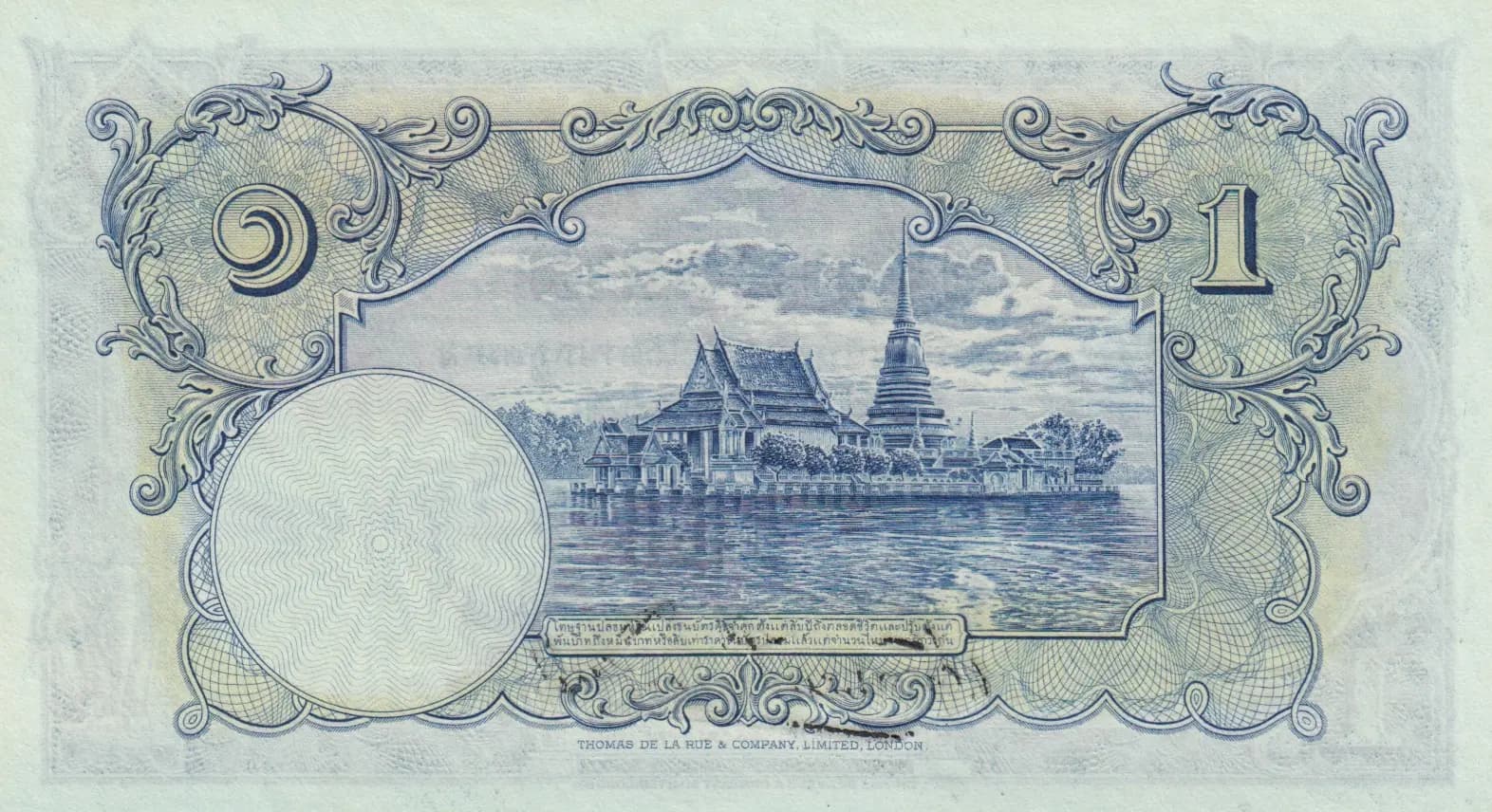
This is an exceptional example of the iconic Thai 1 Baht banknote from 1934, featuring a portrait of King Rama VII Prajadhipok on the obverse and a majestic temple complex on the reverse. The note is in UNC (Uncirculated) condition with vibrant colors, sharp printing, and no visible wear, representing a premium specimen of this historically significant issue. This early Government of Siam banknote is highly sought by collectors of Southeast Asian currency and Thai numismatic material, particularly in this pristine state of preservation.
Common. While this is a desirable early Thai banknote from a historically important reign, the eBay auction data provided shows consistent market availability with regular sales in VF to UNC grades, with UNC specimens typically achieving $40-70 in recent years. The 2016 catalog value of $40 for UNC grade and the consistent trading at moderate price points ($38-88 for VF examples) indicate healthy collector demand without supply constraints. This was likely produced in substantial quantities for the 1934-1935 circulation period, and many examples survive today.
Issued during the reign of King Rama VII Prajadhipok (1925-1935), this banknote represents the early modernization of Thai currency under the Government of Siam before the country's name change in 1939. The royal portrait and the depicted temple complex (Phra Samut Chedi) reflect the centrality of the monarchy and Buddhist religious institutions to Thai national identity during this period. The commission of this note to London's prestigious Thomas de la Rue printing firm demonstrates Siam's engagement with international currency standards and Western printing technology in the 1930s.
The obverse features a left-facing portrait of King Rama VII Prajadhipok wearing formal military dress with medals and insignia, framed within an ornate cartouche. At the top center is the Garuda (Thai royal winged emblem) with a crescent moon. The central vignette depicts the Royal Barge (Suphannahongse or similar state vessel) on water with a Thai temple or palace complex with multiple spires and traditional architecture in the background, reflecting in calm waters. The reverse presents a detailed engraved landscape of Phra Samut Chedi temple situated on water with traditional Thai architectural elements, surrounded by ornate decorative borders featuring spiral patterns and geometric designs. A three-headed elephant symbol appears in the lower right corner of the obverse. The dominant color scheme is dark blue on light yellow-green and pale orange underprint, with fine line engraving throughout providing intricate detail and anti-counterfeiting security.
FRONT: 'ศรีสุบณฑสยาม' (Sri Subhannasiam/Royal Siam), 'ธนบัตรเป็นสินทีระหนึ่งศตามภูฏหมาย' (This banknote is legal tender), 'หนึ่งบาท' (One Baht), 'กค 2477' (Thai Buddhist Era year 2477, equivalent to 1934 CE), 'A 32 13189' and 'ก 32 13189' (Serial numbers), '13th June 1934' (English date of issue), 'THOMAS DE LA RUE & COMPANY LIMITED, LONDON' (Printer identification). BACK: Large numeral '1' (Denomination), 'THOMAS DE LA RUE & COMPANY, LIMITED, LONDON' (Printer identification), Thai text in decorative panel (content not clearly legible in images provided).
Intaglio engraving (line engraving), the premium banknote printing method used exclusively by Thomas de la Rue & Company Limited for this issue. The fine line engraving patterns visible throughout the borders, backgrounds, and vignettes, combined with the sharp portrait detail and complex geometric patterns, are characteristic of intaglio printing. The precision of the multi-color overprinting (blue on yellow-green and pale orange) demonstrates the technical sophistication of 1930s British security printing standards.
The Pick catalog recognizes only one variant for P-22 per the PMG Population Report. This example displays serial number 'A 32 13189' / 'ก 32 13189' with an English date of '13th June 1934'. The Thai Buddhist calendar year shown as 'กค 2477' (confirming 1934 CE) is standard for this issue. Varieties for this note would typically involve different signature combinations or serial number prefix variations, though the catalog data suggests minimal variation within the P-22 designation.