20 baht 1936
Market Prices
16 salesAbout This Note
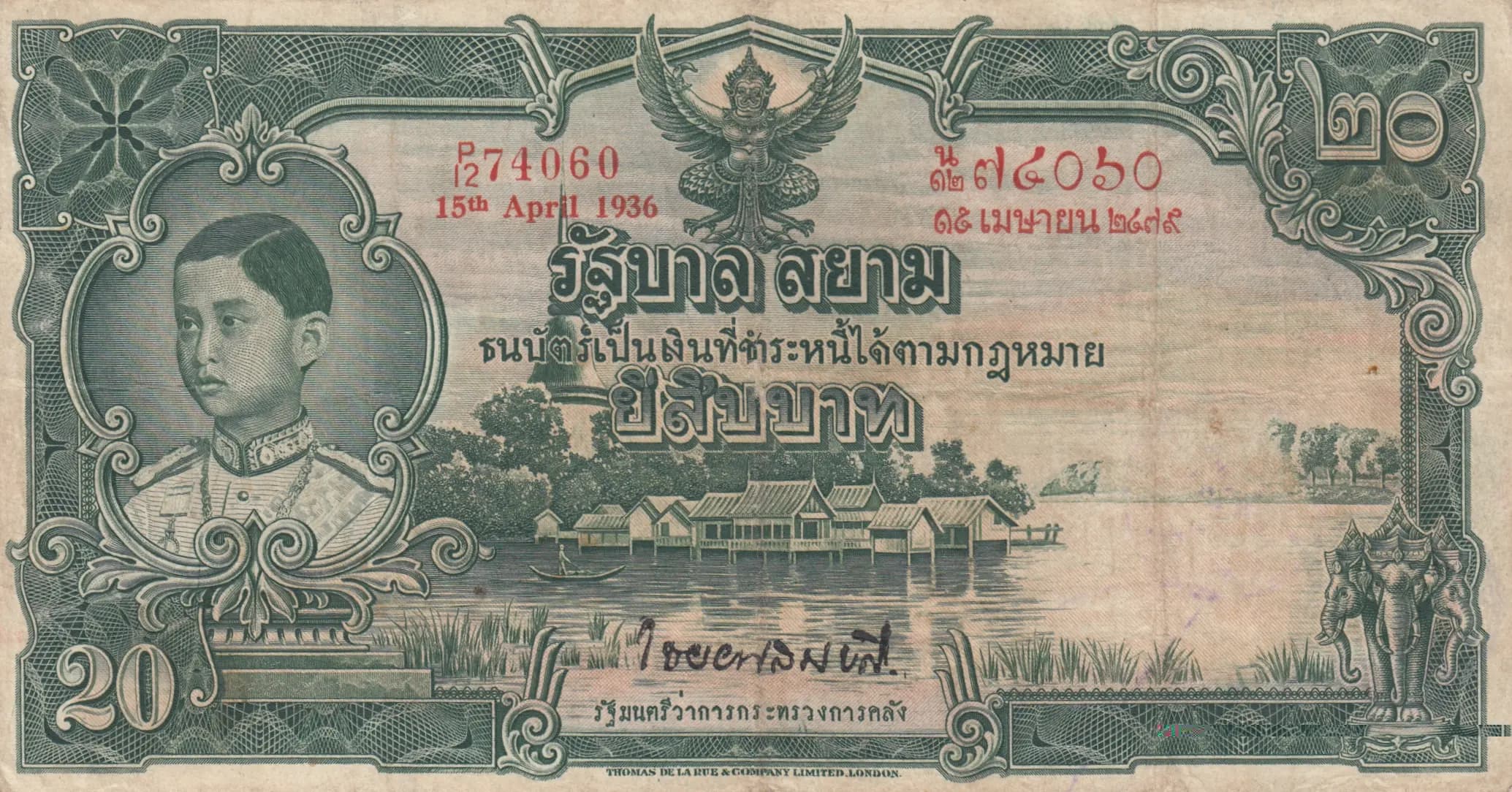
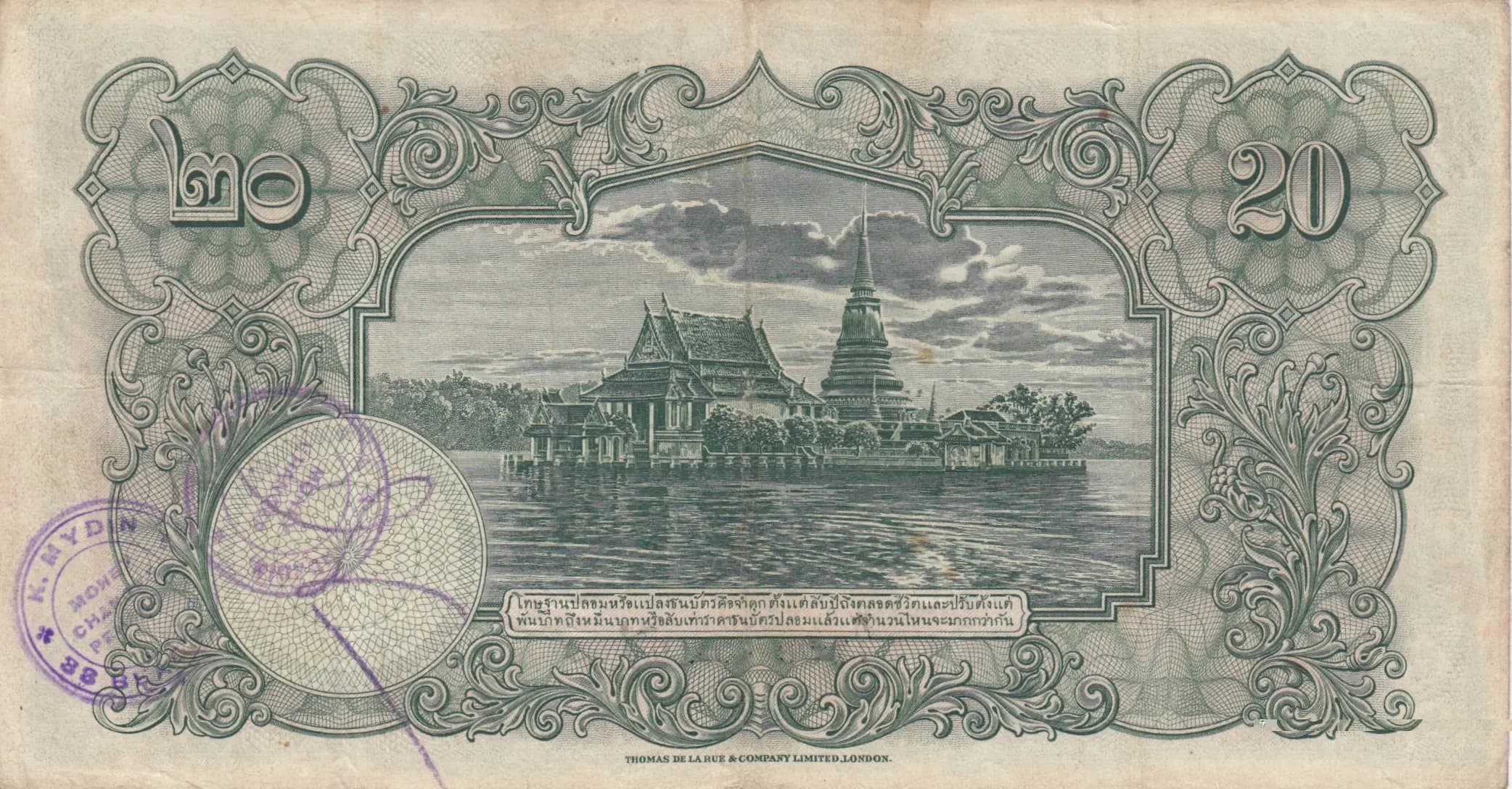
This is a Thailand 20 Baht note from 1936 (Pick-29) issued by the Government of Siam, printed by Thomas de la Rue & Company in London. The note presents in VF condition with moderate circulation wear, foxing, and age-related discoloration typical of notes nearly 90 years old. The obverse features a youthful portrait of King Rama VIII Ananda Mahidol on the left with traditional Thai architectural elements including stilt houses along a waterway, while the reverse displays the ornate Phra Samut Chedi temple, making this an important example of early Thai Kingdom currency.
Common. This note trades regularly on the secondary market with consistent eBay sales activity spanning from 2009 to 2025. The provided eBay market data shows VF examples consistently selling in the $70-$143 range, with PMG-graded examples in lower grades (VG-30 to VF-35) selling for $140-$325. The catalog value from 2016 lists VF at $40, indicating steady collector demand but no scarcity. Large print runs from Thomas de la Rue and the note's status as a regular issue during an active currency period account for its common availability today.
This note was issued during the reign of King Rama VIII Ananda Mahidol (1935-1946), who ascended the throne as a child following the abdication of his brother. The imagery reflects Siam's cultural identity during this transitional period, depicting the young monarch alongside symbols of Thai prosperity (riverside villages and Buddhist temples). The English-language printer attribution to London demonstrates Siam's engagement with Western security printing technology during the pre-World War II era, when the nation was modernizing its currency infrastructure while maintaining its Buddhist and royal iconographic traditions.
The obverse features a left-facing three-quarter portrait of King Rama VIII Ananda Mahidol as a young boy, rendered in fine intaglio engraving within an ornamental oval frame with elaborate scrollwork. The portrait is flanked by decorative borders featuring geometric and floral patterns. The central design element is the mythical Garuda (the Thai royal emblem showing a winged creature with distinctive horns), positioned prominently at the note's top center. The right portion depicts a traditional Thai landscape with pile-dwelling houses (stilt structures) arranged along a waterway with vegetation and trees, representing the rural prosperity of Siam. The reverse showcases the Phra Samut Chedi, an important Thai Buddhist temple, rendered as a detailed architectural vignette with distinctive peaked roofs and spires characteristic of Thai religious architecture, situated above or reflected in water. A lotus flower watermark design appears in a circular frame on the reverse's left side. The color scheme throughout is predominantly green and teal on a cream background, with fine guilloche (intricate line pattern) work providing additional security and aesthetic appeal.
Front: Serial number P274060 / ๒๗๔๐๖๐ (274060 in Thai numerals); Date: 15th April 1936 / ๒๕ เมษายน ๒๔๗๙ (15 April 2479 Thai calendar); Country and denomination text: ประเทศสยาม (Kingdom of Siam), ธนบัตร สยาม (Banknote of Siam), ธนบัตรเป็นสินทักษระหนึ่งได้ตามกฎหมาย (This banknote is legal tender according to law), ๒๐ (20 denomination in Thai numerals); Printer: THOMAS DE LA RUE & COMPANY LIMITED, LONDON. Back: Denomination ๒๐ (20); Printer: THOMAS DE LA RUE & COMPANY LIMITED, LONDON; Instructional text: โปรดใจคุณอ่านข้อความในกรอบสี่เหลี่ยมต่อไปนี้ (Please read the following message in the box); Additional regulatory text regarding the banknote in Thai language within rectangular frame.
This note was produced using traditional intaglio (steel plate engraving) printing, a security printing technique characteristic of Thomas de la Rue & Company's work during this era. The fine line engraving visible throughout—particularly in the portraits, guilloche background patterns, borders, and architectural details—confirms multi-color intaglio production. The complex, interwoven line work and ornate scrollwork patterns served dual purposes: aesthetic sophistication and anti-counterfeiting security measures. The crisp detail visible in the portrait and architectural elements, despite circulation wear, demonstrates the superior quality of period Thomas de la Rue printing standards.
This specific example shows the standard 1936 variety with English date inscription (15th April 1936) and Thai Buddhist calendar date (๒๕ เมษายน ๒๔๗๙). The serial number P274060 visible on the note places it within the documented range for this issue period. PMG population data indicates a single cataloged variant for Pick-29, confirming minimal variety differentiation within this denomination. The purple/violet bank stamp or official marking visible on the reverse may indicate processing by a particular financial institution but does not constitute a printing variety.