20 baht 1935
Market Prices
11 salesAbout This Note
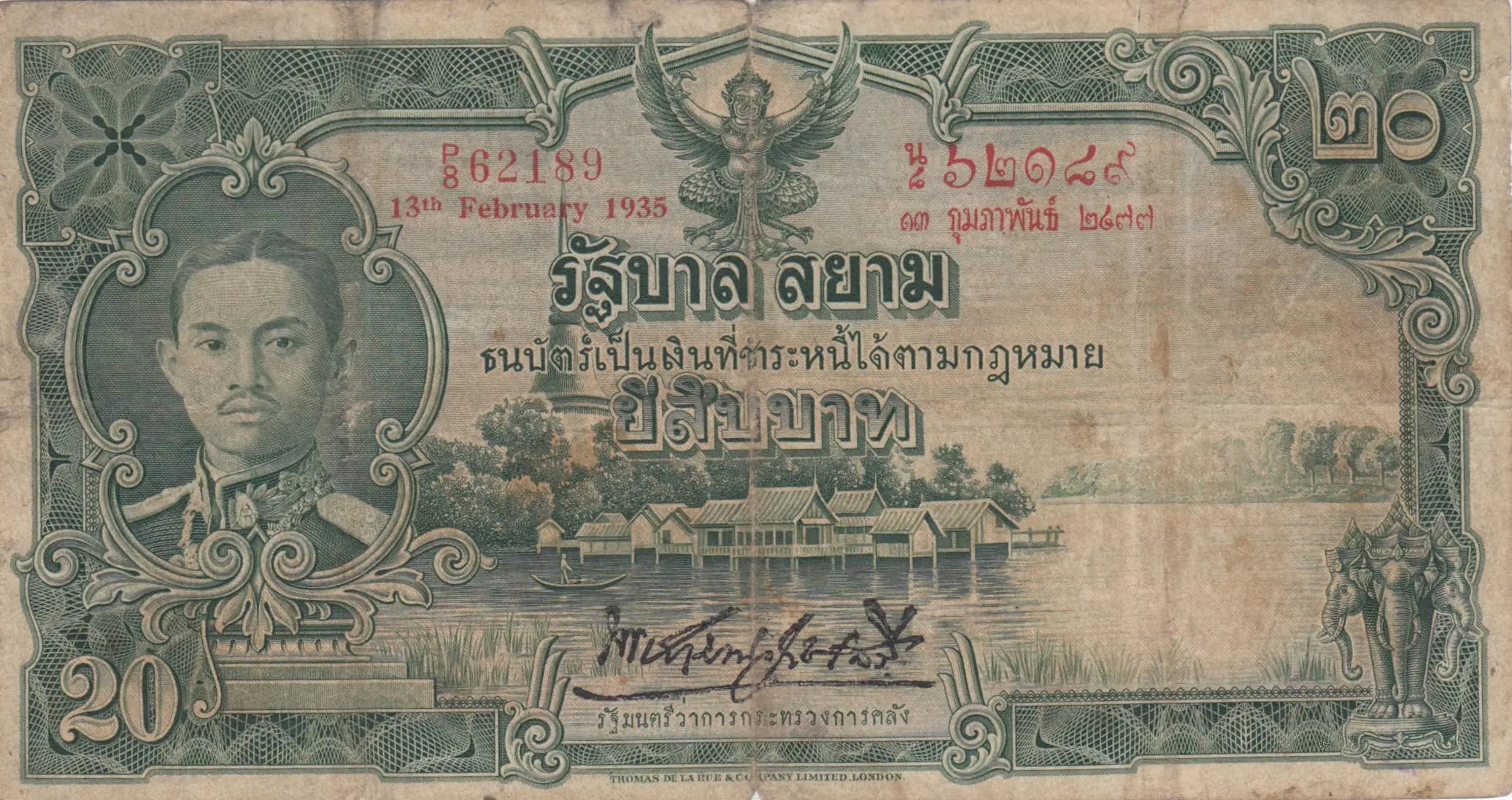
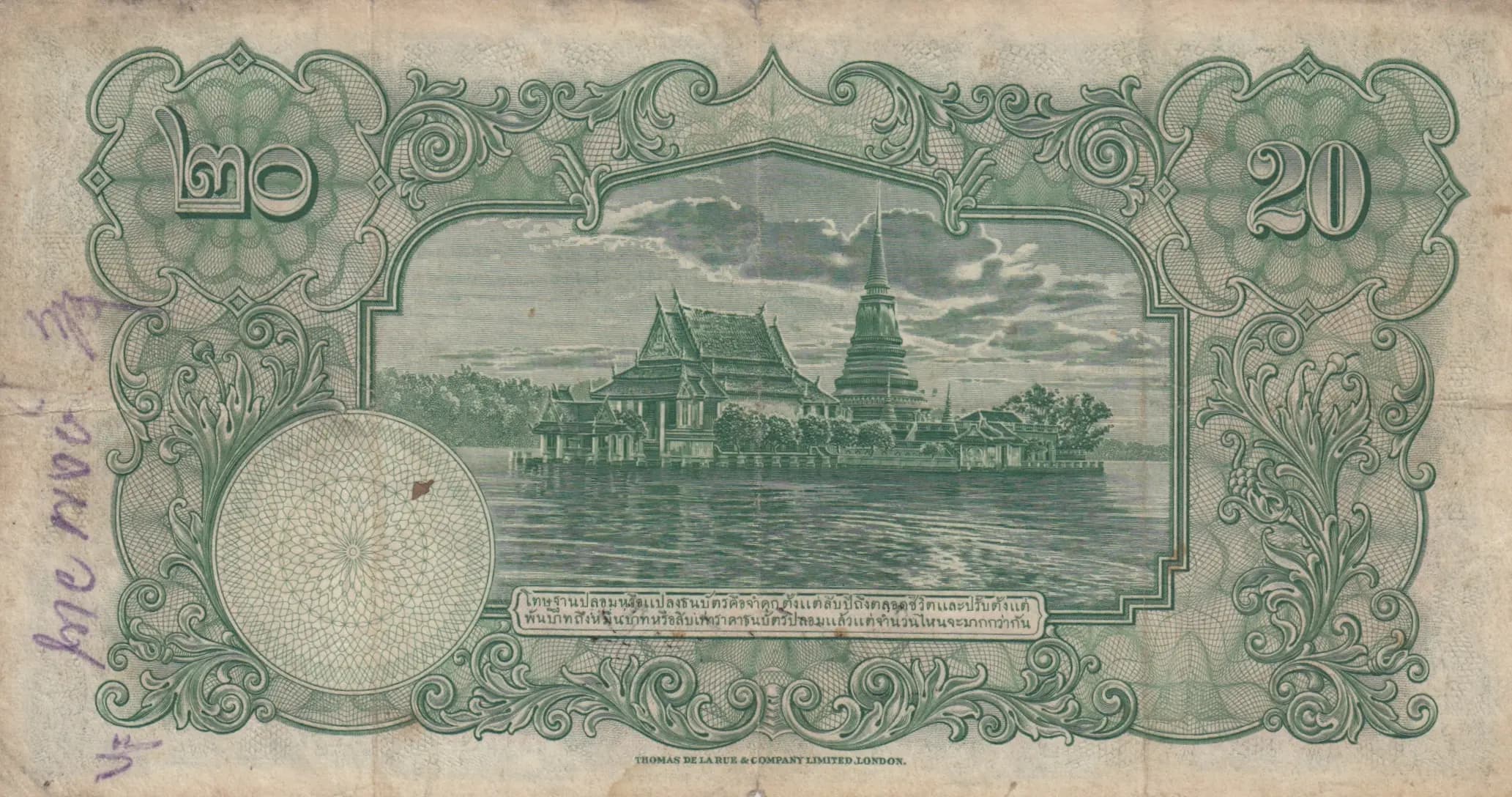
This is a Thailand 20 baht banknote from 1935, issued by the Government of Siam and printed by Thomas de la Rue in London. The note exhibits fair condition with visible age-related wear including foxing, discoloration, and creases consistent with nearly 90 years of circulation and storage. The obverse features a dignified portrait of King Rama VII Prajadhipok in profile within an ornate oval frame, accompanied by traditional Thai architectural imagery depicting a riverside village with pagoda, while the reverse showcases the ornamental Phra Samut Chedi temple reflected in water—both sides demonstrating the fine line engraving and intricate geometric patterns characteristic of TDLR's prestigious banknote production.
Common. The eBay market data shows consistent sales activity with notes in F condition selling in the $95–$155 range over the past decade, indicating a steady but not particularly scarce supply in the collector market. The PMG population report indicates only one catalogued variant for this Pick number, and the availability of multiple comparable sales suggests this is a regularly encountered issue for Siamese banknote collectors. The 1935 issue date does not correspond to any known recall, short print run, or issuing authority crisis that would artificially restrict supply.
This note was issued during the reign of King Rama VII (Prajadhipok), who ruled Siam from 1925 to 1935, a period marking the early modernization of the Siamese kingdom following the absolute monarchy period. The specific issue date of 13 February 1935 falls near the end of the king's reign and reflects the government's effort to establish a modern, internationally-respected currency backed by one of the world's leading security printers. The depicted landmarks—the riverside village with pagoda on the obverse and the temple complex on the reverse—represent important religious and cultural elements that anchored the national identity during this transitional period in Siamese history.
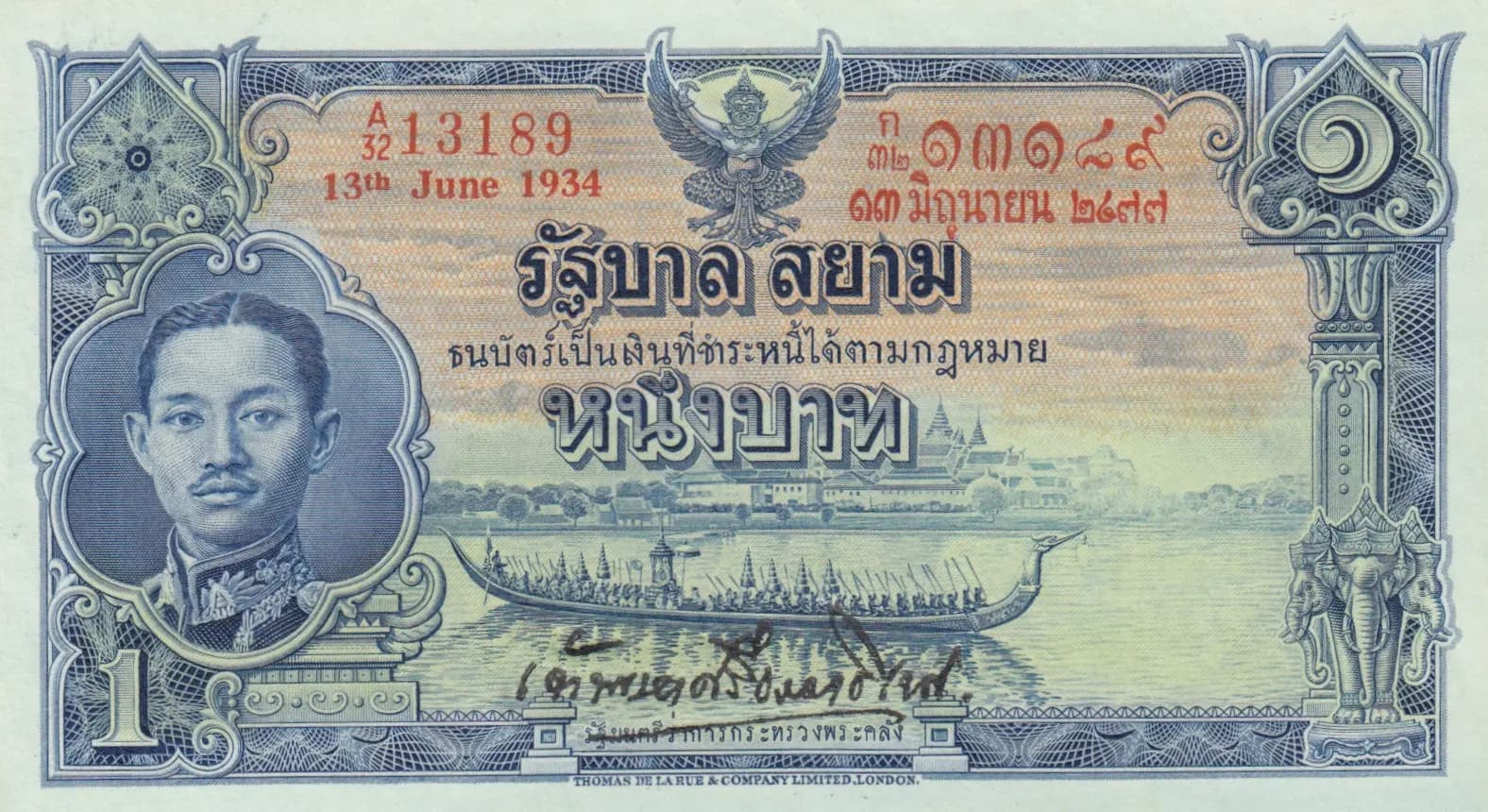
The obverse features a formal three-quarter profile portrait of King Rama VII Prajadhipok positioned within an ornate oval frame with elaborate scrollwork on the left side of the note, rendered with the fine detail characteristic of Thomas de la Rue's engraving work. At the top center sits a winged Garuda (the mythical bird of Thai and Hindu iconography), serving as a national symbol of sovereignty. The central composition depicts a serene landscape of traditional Thai architecture—including a riverside village with characteristic peaked roofs and a prominent pagoda—reflecting the natural and spiritual character of Siam. The reverse showcases the Phra Samut Chedi temple complex with multiple ornamental chedis (spires) mirrored in water below, emphasizing the religious significance of Buddhist monuments in Thai national identity. Both sides employ intricate decorative borders with fine-line engraving, cross-hatch geometric patterns in corner squares, and ornamental frames—all executed in green ink on a cream/beige paper base, with red accent text providing denomination and legal declarations.
FRONT SIDE: 'Government of Siam' (รัฐบาล สยาม) — issuing authority; 'Twenty baht' (อีสิบบาท) — denomination in Thai; '20' — Arabic numeral denomination; '13th February 1935' — specific issue date; 'Legal tender banknote' (ธนบัตรเป็นสนิทที่ระหว่างไลตามกฎหมาย) — legal declaration; Serial number '862189' — individual note identifier; 'THOMAS DE LA RUE & CO. LIMITED LONDON' — printer identification. BACK SIDE: '20' (appearing in upper left and right corners) — denomination markers; 'THOMAS DE LA RUE & COMPANY LIMITED, LONDON' — printer identification repeated; Thai text caption below temple scene — descriptive text identifying the depicted structure (partially unclear in image).
Intaglio engraving (line engraving) executed by Thomas de la Rue & Company Limited, London, one of the world's premier security printers of the early 20th century. The note exhibits the characteristic fine-line detail, intricate cross-hatch patterns, and geometric ornamentation that define high-security intaglio production. The multiple colors (green primary design with red accent text) indicate multi-plate printing typical of TDLR's banknote work. The quality and precision of the engraving, visible in the portrait detail and architectural renderings, demonstrate the technical excellence that made TDLR the printer of choice for numerous governments' currency.
This specific note is dated 13 February 1935 (within the known range of 15.01.1935 to 25.02.1935) and carries serial number 862189. The visual analysis confirms this is a standard Government of Siam issue printed by Thomas de la Rue (marked as TDLR in reference catalogs). PMG has catalogued one variant for Pick-25, and this note does not appear to exhibit any overprints, signature varieties, or other distinguishing features that would mark it as a rare sub-variety. The note represents the regular circulation issue of this denomination and year.