100 baht 1955
Market Prices
70 salesAbout This Note
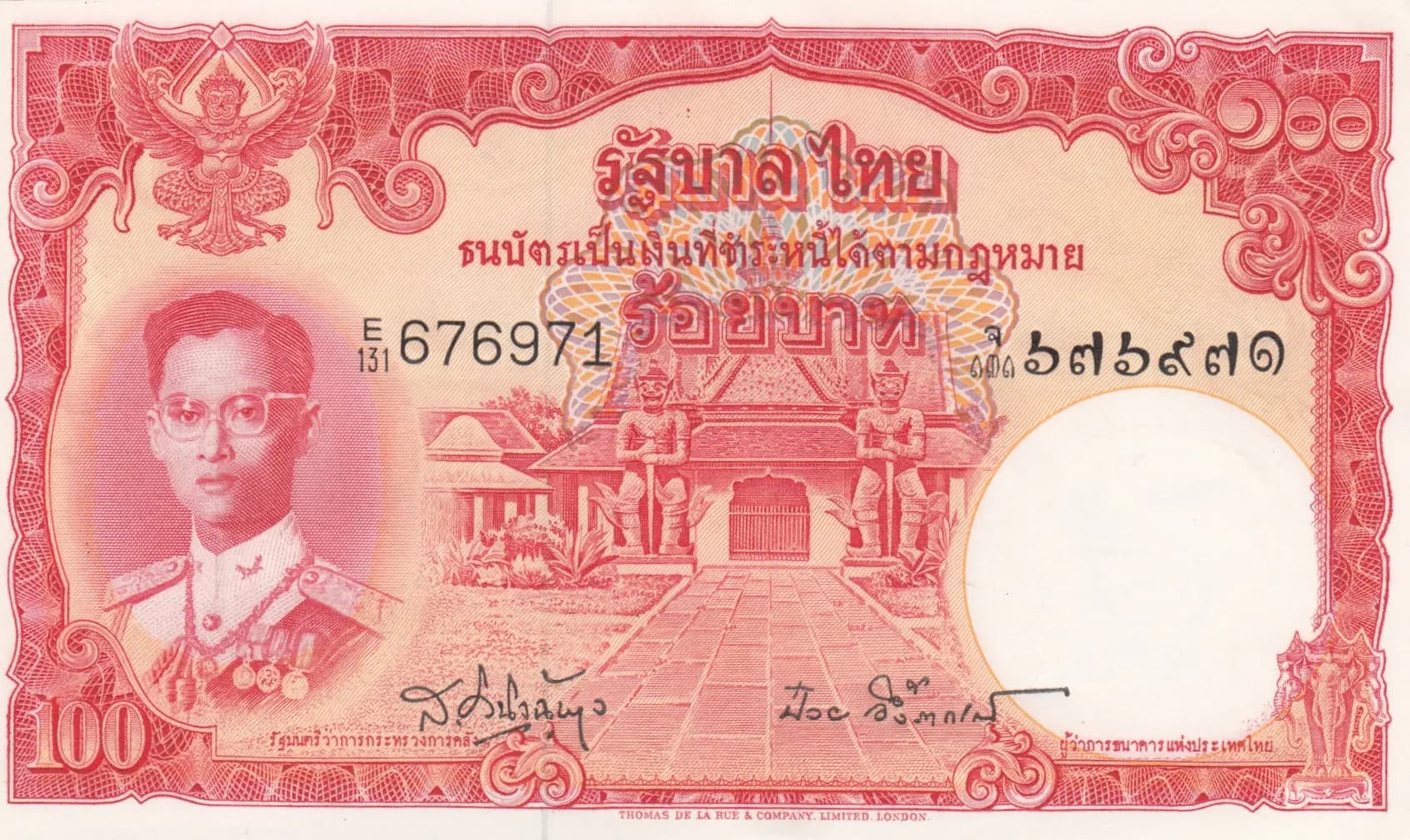
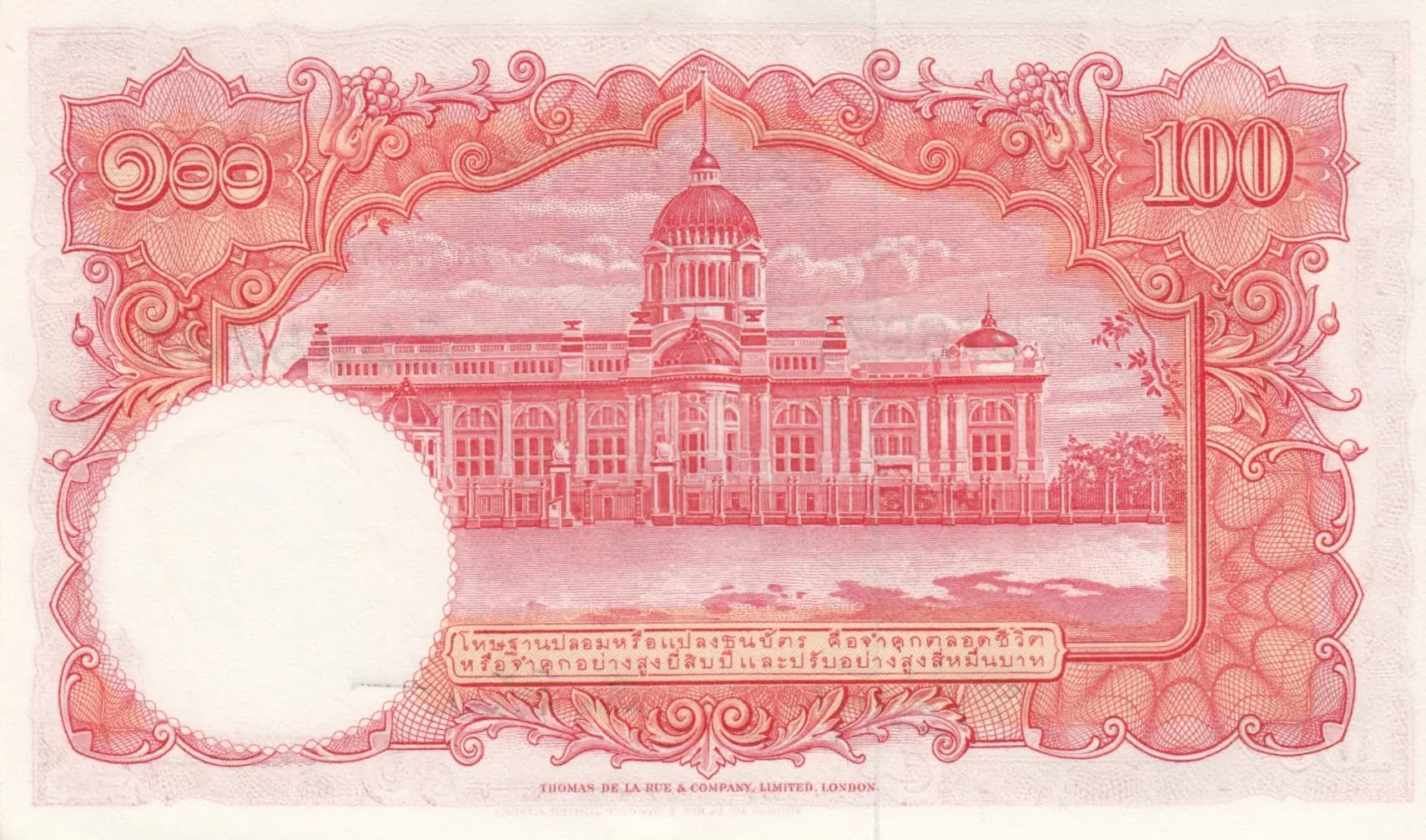
This Thailand 100 Baht note from 1955 presents an exceptional example of mid-20th century Thai currency design, printed by the prestigious Thomas de la Rue of London. The obverse features King Rama IX (Bhumibol Adulyadej) in Field Marshal's dress uniform with decorations, accompanied by the Temple of the Dawn, while the reverse displays a neoclassical government building—likely the Ananda Samakhom Throne Hall. The note exhibits uncirculated condition with crisp, vibrant coloring and excellent preservation of the fine engraved details throughout.
Common. The eBay auction price data provided shows consistent sales across multiple condition grades ranging from $9.50 to $370, with most UNC examples selling between $24 and $57 as of recent years, and 2019 catalog values listing UNC at only $15. The wide range of available examples at modest prices, frequent auction appearances, and stable mid-market pricing all indicate this is a readily available note. Print runs for Thailand's government-issued notes of the 1950s were substantial, and this Pick number (P-78d) does not appear to carry the scarcity indicators of a recall or short-lived issue.
This note commemorates the reign of King Bhumibol Adulyadej (Rama IX), who ascended the throne in 1946 and whose portrait in military regalia represents the monarchy's central role in Thai governance during the 1950s. The Temple of the Dawn (Wat Arun) depicted on the front symbolizes Buddhist heritage and Thai cultural identity, while the neoclassical government building on the reverse reflects Thailand's modernization efforts during this post-war decade under various constitutional governments.
The obverse features a formal portrait of King Bhumibol Adulyadej in Field Marshal's dress uniform positioned on the left, displaying military medals and insignia on his chest. The figure wears eyeglasses and faces left in three-quarter profile. To the right stands the iconic Temple of the Dawn (Wat Arun) with its distinctive Thai Buddhist architecture and ornamental spires. The reverse depicts the Ananda Samakhom Throne Hall (or similar neoclassical government building), a European-influenced structure with classical proportions, a prominent dome, multiple columns, and arched windows—representing Thailand's administrative and royal institutional architecture. Both sides are framed with elaborate Thai-style decorative scrollwork and floral borders with corner ornaments. The denomination '100' appears prominently in both Arabic and Thai numerals.
FRONT: 'ธนบัญชีไทย' (Bank of Thailand) / '๑๐๐' and '100' (Denomination - One Hundred Baht / 'ร้อยบาท' (One Hundred Baht written in Thai) / Serial numbers in Thai numerals / 'THOMAS DE LA RUE & COMPANY, LIMITED LONDON' (Printer attribution). BACK: '๑๐๐' and '100' in ornate corner frames (Denomination) / Thai inscription relating to government or institutional attribution / 'THOMAS DE LA RUE & COMPANY, LIMITED LONDON' (Printer attribution).
Intaglio engraving (line engraving), executed by Thomas de la Rue & Company, Limited of London. The visual characteristics—fine line work, intricate portrait rendering, detailed architectural engraving, and ornamental border patterns—are all consistent with high-quality steel engraving typical of this security printer's work. The multicolor underprint with red as the dominant color suggests selective color printing layered over engraved line work, a standard technique for currency production of this era.
This note is cataloged as Pick P-78d. The PMG population report indicates at least two other variants exist under this base Pick number (P-78c and P-78s), suggesting varieties may exist related to printer attribution (TDLR vs. other printers), signature combinations, or printing differences. The visual analysis confirms Thomas de la Rue printing ('THOMAS DE LA RUE & COMPANY, LIMITED LONDON' visible on both sides). Without access to a detailed comparison of all cataloged varieties, the specific distinction of P-78d variant versus P-78c or P-78s cannot be definitively determined from the images alone, though the visible serial numbers and printer attribution would be key identifying features.