100 baht 1945
Market Prices
About This Note
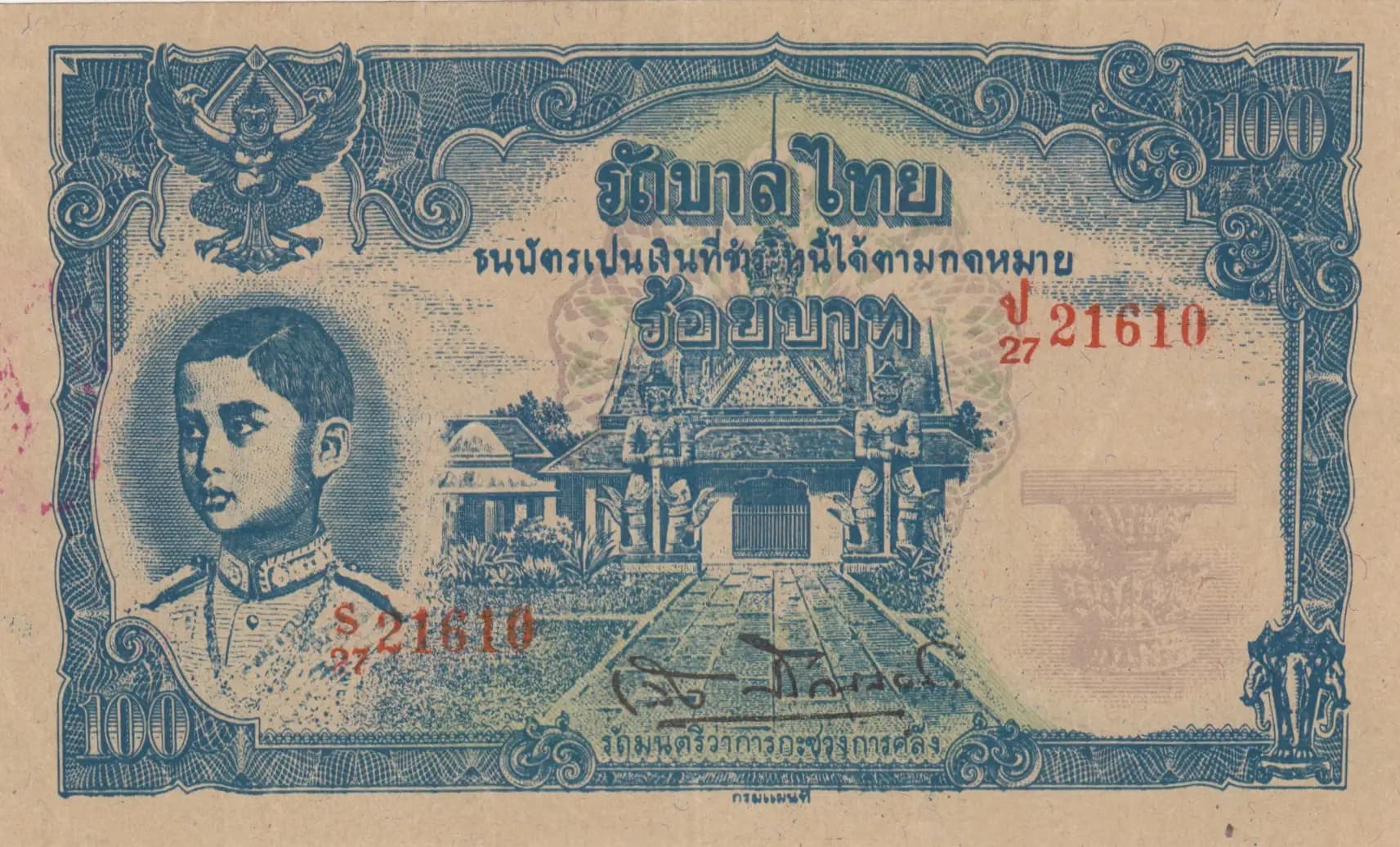
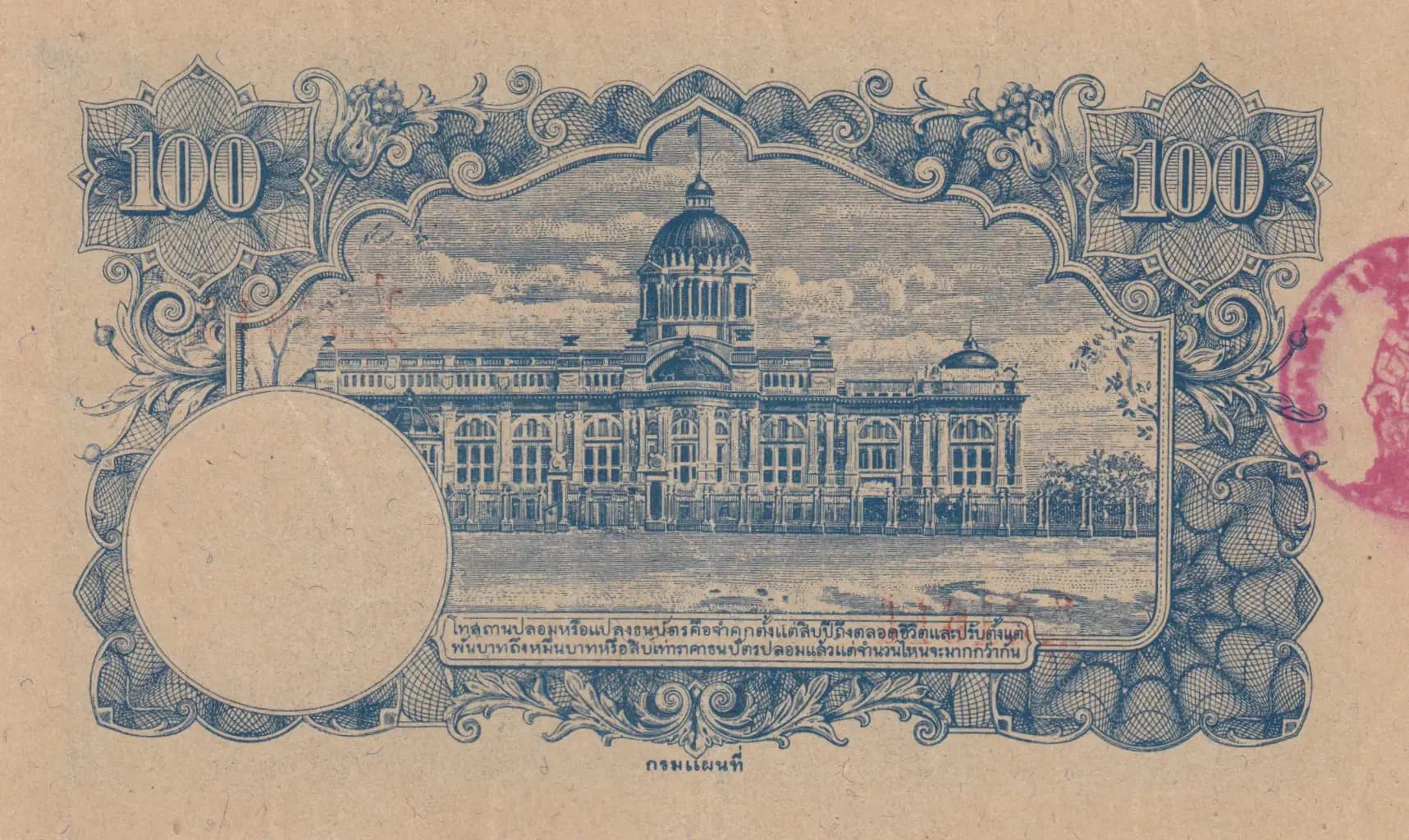
This Thai 100 baht note from 1945 (Buddhist year 2488) presents a handsome example of mid-20th century Thai currency design, graded AU with visible age-appropriate wear. The note features a portrait of a dignitary in formal military dress on the obverse alongside an ornate Thai temple or palace building, while the reverse displays a neoclassical government structure—likely the Chakri or Dusit Maha Throne Halls. Condition shows expected foxing, yellowing, and light creasing consistent with an 80-year-old note that has seen moderate circulation, with some pink/red markings suggesting archival storage or handling.
Common. Despite the historical significance of 1945 Thai currency, the eBay market data shows consistent pricing in the $5–$20 range for UNC examples, with catalogue values (2016) at $160 for UNC condition. The AU grade specimen observed would typically command $60–$100 based on 2016 VF pricing of $60. This denomination and series was printed in substantial quantities for regular circulation, and surviving examples remain readily available in numismatic markets. No evidence of scarcity or limited print run applies to Pick 53Bc.
Issued in 1945 during the final year of World War II, this banknote represents Thailand's post-absolute monarchy period under King Rama VIII (Ananda Mahidol), whose portrait appears in military dress on the obverse. The prominent depiction of the Chakri and Dusit Maha Throne Halls on both sides of the note reflects the Thai government's emphasis on royal institutional legitimacy and continuity during a turbulent period of political transition. This series was printed by the Army Map Department and Navy Hydrographic Office, indicating governmental coordination of currency production during wartime conditions.
The obverse features a left-facing portrait of King Rama VIII Ananda Mahidol in formal military dress uniform with ornate collar decoration, positioned in the left portion of the note. The center-right displays an intricate engraving of a Thai palace or temple building with characteristic central spire, decorative pillars, ornamental gates, and manicured grounds. The reverse showcases a neoclassical government building (identified as either the Chakri or Dusit Maha Throne Hall based on architectural style) with a prominent central dome, columned facade, multiple stories with arched windows, and formal forecourt landscaping. Both sides feature elaborate ornamental borders with scrollwork, guilloche patterns, and floral elements including grape vine motifs in the corner ornaments. A large circular watermark area is visible on the reverse left side. Thai numerals and denomination markers appear in corners, with Thai script inscriptions framing the central designs.
FRONT SIDE: 'ธนาคารไทย' (Bank of Thailand); 'หนึ่งร้อยบาท' (One hundred baht); 'ประกาศประณีธินที่จำหน่ายโดยธนาคารแห่งประเทศไทย' (Proclaimed and issued by the Bank of Thailand); 'ปี 2488' (Year 2488 Buddhist Era, equivalent to 1945 CE); '100' (Denomination in Arabic numerals). BACK SIDE: '100' (Denomination marker in multiple corners); Thai government decree text regarding legislative authorization and printer's notations. The reverse contains formal Thai text describing the governmental authority under which the note was issued.
Intaglio engraving (line engraving) throughout, evidenced by the fine detailed line work visible in the border guilloche patterns, architectural details, and portrait rendering. The printing was executed by the Army Map Department with Navy Hydrographic Office involvement, as noted in the imprint. Security features include wavy line watermark and silk thread integration visible in the paper structure. The note shows characteristic engraved border work and fine line detail consistent with high-security currency production of the 1940s era.
This note is catalogued as Pick P-53Bc (100 baht, 1945). The PMG population reports indicate multiple variants exist within the P-53 base designation, including P-53Aa (20 baht) and P-53r/P-53s1 (1000 baht notes with constitution watermark). The observed specimen appears to be the standard 100 baht variant with wavy line watermark and purple constitution overprint in circular format, consistent with the 'Like P42' reference in the realbanknotes.com data. Serial number component '27' visible on the obverse, though full serial details would require examination of both sides. No exceptional overprint varieties or signature variants are apparent from the visual analysis.