10 baht 1946
Market Prices
2 salesAbout This Note
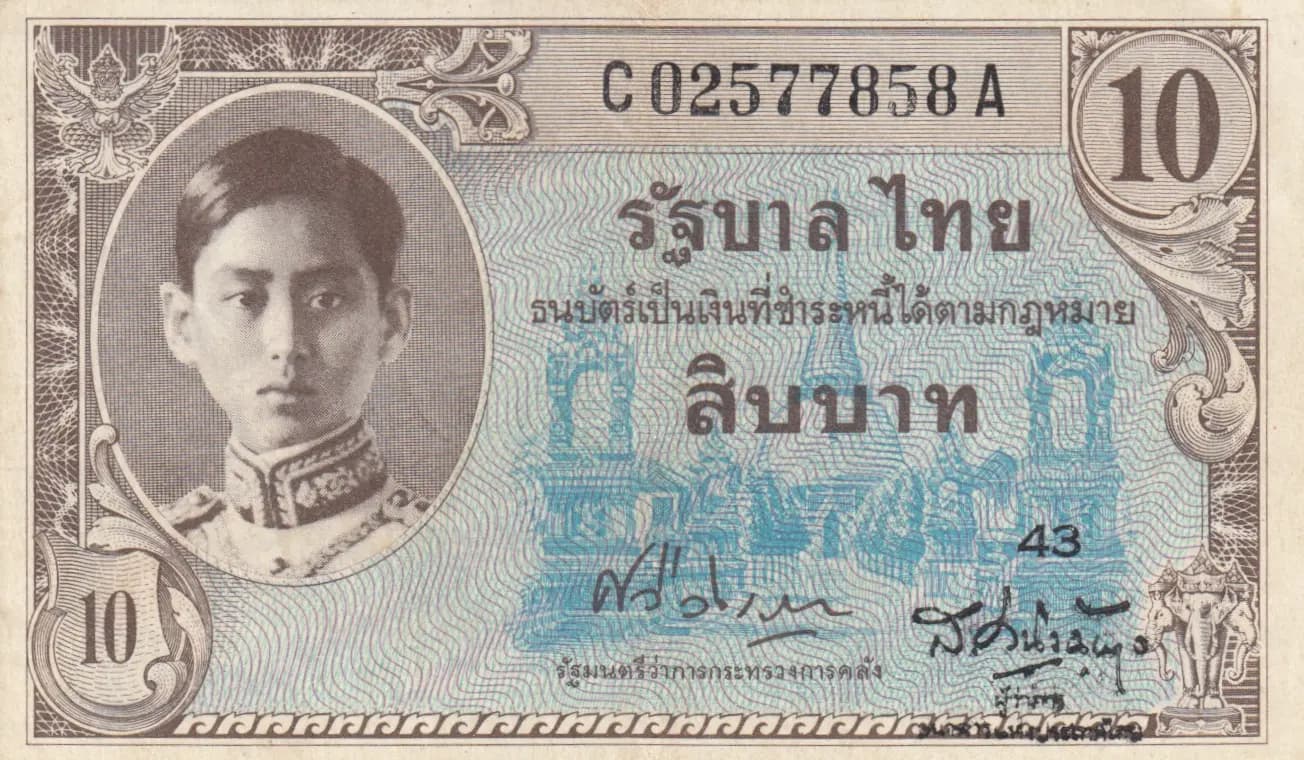
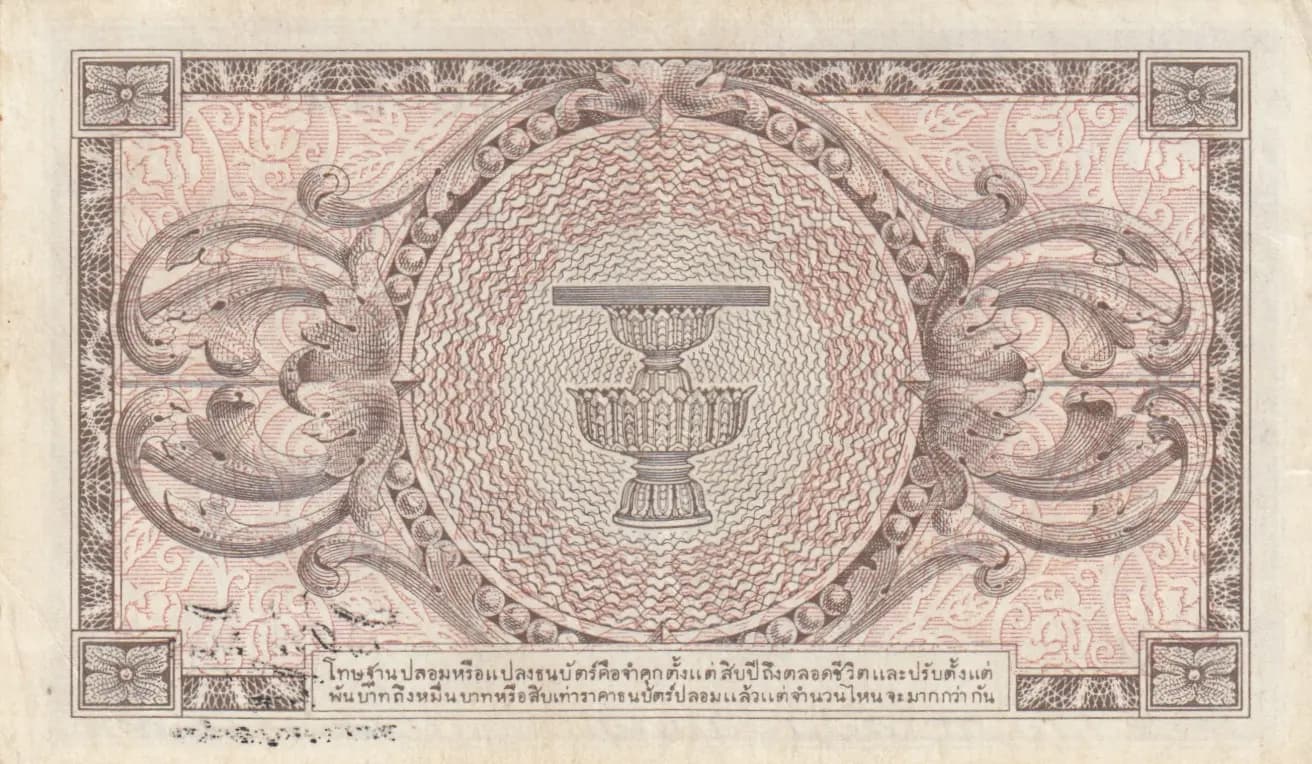
This is a VF-grade Thai 10 Baht note from 1946 (Pick-65a), featuring a portrait of King Rama VIII in formal military dress on the obverse and an ornate ceremonial vessel design on the reverse. The note exhibits characteristic brown and blue-green coloring with fine engraved security features and shows expected wear from circulation, including creasing, foxing, and age-related discoloration typical of a note nearly 80 years old. This early post-war Thai issue remains relatively common in the numismatic market, with catalog values around $15 in VF condition.
Common. This is a regular-issue banknote from a relatively high print run in 1946. Catalog values from 2016 list this note at only $15 in VF condition and $2 in VG, indicating broad availability in the collector market. eBay historical sales data shows these notes selling in the $100-$180 range for higher grades (PMG 64, AUNC), with multiple examples regularly appearing at auction. The note is widely held by collectors and institutions, making it a readily obtainable item for most Thai banknote collections. No print run restrictions, recalls, or issuing authority limitations apply to this Pick number.
Issued in 1946 by the Government of Thailand during the reign of King Rama VIII (Ananda Mahidol, 1935-1946), this note represents Thailand's monetary recovery in the immediate post-World War II period. The portrait of the young King, depicted in formal military uniform, appears on the obverse alongside Thai script authorizing the issuance of paper currency by law, while the reverse features an elaborate ceremonial vessel—a traditional Thai artistic motif—emphasizing cultural continuity and royal authority during a period of significant political transition following the war.
The obverse features a formal portrait of King Rama VIII Ananda Mahidol positioned in an ornate oval frame on the left side of the note. The King is depicted as a young man in full formal military dress with decorated collar insignia, shown in three-quarter profile facing slightly left. The composition includes Thai royal emblems in the upper left corner and elaborate decorative floral and scrollwork designs in the corners and margins. The denomination '10' appears in circular frames both at upper right and lower left. The reverse displays a large central circular medallion containing an ornate ceremonial urn or vessel—a traditional Thai artistic element—with elaborate handles and decorative detailing, surrounded by symmetrical floral and scrollwork border designs in all four corners. Both sides employ fine-line engraving with complex guilloche patterns and geometric security designs throughout.
FRONT SIDE: Serial number: C02577858A | Denomination markers: 10 (in circular frames, upper right and lower left) | 'ธนบัญชี ไทย' (Thai Bank/Thai Currency) | 'อนุญาตจำหน่ายเงินกระดาษได้ตามกฎหมาย' (Authorized to issue paper money according to law) | 'สิบบาท' (Ten Baht) | '43' (year or series indicator, likely BE 2488 or Buddhist calendar equivalent to 1946 CE) | 'ลงชื่อ' (Signature/Signed). BACK SIDE: Thai legal text regarding counterfeiting prohibitions and currency regulations (full text beginning with 'โดยสำนักปลอมหรือปลอมแปลง...').
This note was produced by letterpress and engraving techniques characteristic of 1940s banknote production. The printer was Tudor Press of Boston, as documented in catalog references. The note exhibits fine-line engraving patterns, complex guilloche work (wavy line security designs), and layered ornamental details typical of high-security banknote printing of the era. The presence of handwritten signature overprints in both blue and black ink indicates manual signing after the main printing process, a common practice for Thai government currency of this period.
Pick-65a is identified as Signature Variety #25 in the PMG population report. The PMG catalog records two variants for this base Pick number (P-65a and P-65b), with P-65a representing this signature variety. The observed serial number C02577858A and the presence of handwritten signature overprints are consistent with standard production for this variety. No rare or special overprints or variants are apparent in this example.