10 baht 1945
Market Prices
1 saleAbout This Note
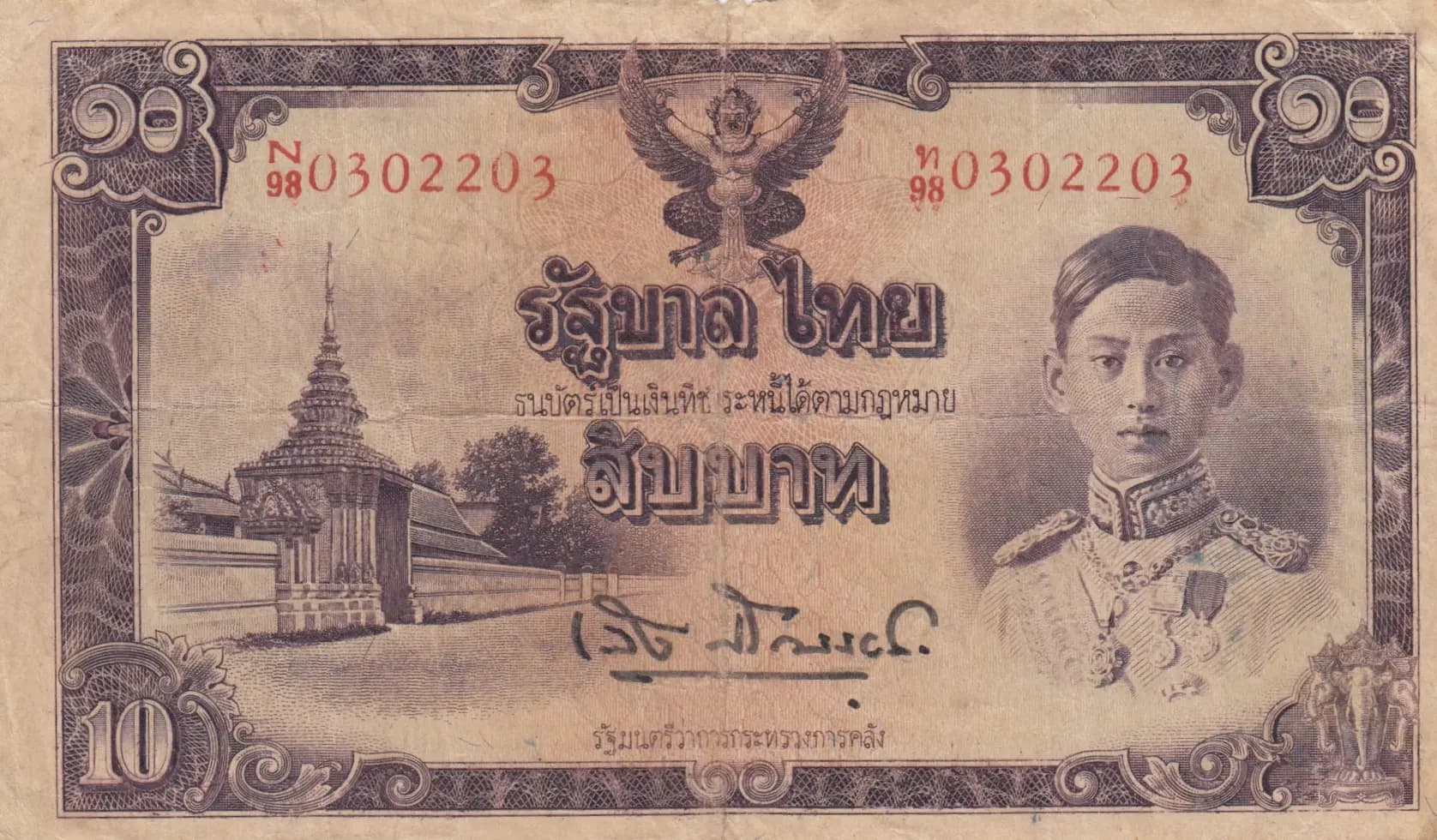
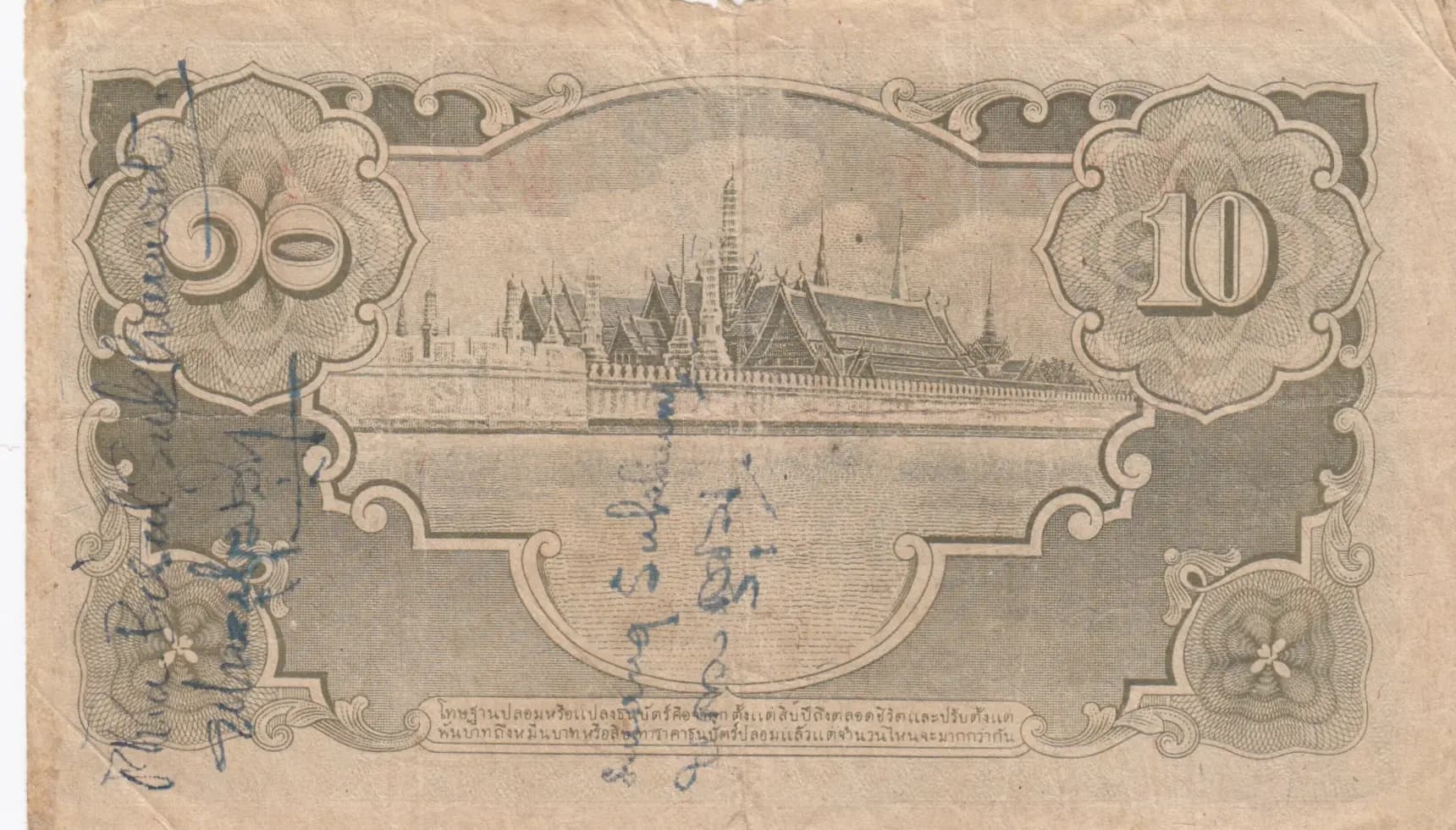
This is a Thai Government 10 baht banknote from 1945 (Pick P-48), featuring King Rama VIII Ananda Mahidol in formal military dress on the obverse alongside an illustration of Wat Chetupon temple, with the Royal Palace complex depicted on the reverse in light green. The note exhibits moderate circulation wear consistent with its age, including creases, fold marks, and patina, along with handwritten annotations on the reverse indicating extensive historical use; the purple-brown color scheme on the front and pale green back are characteristic of this issue.
common
Issued during 1945 in Thailand, this banknote reflects a critical period in Thai history during World War II and the reign of King Rama VIII (Ananda Mahidol, r. 1935-1946). The prominent depiction of Wat Chetupon (Wat Bowonniwet) on the front and the Royal Palace on the reverse underscore the connection between the Thai monarchy and national institutions during a turbulent wartime era. The Government of Thailand's issuance of this denomination represented an assertion of Thai sovereignty at a time when the nation was navigating complex geopolitical pressures.
The obverse features a formal portrait of King Rama VIII Ananda Mahidol in three-quarter right-facing pose, wearing military dress uniform with ornate collar details, positioned on the right side of the note. To the left stands a detailed engraved illustration of Wat Chetupon (Bowonniwet Vihara), one of Thailand's most significant Buddhist temples, rendered with fine detail showing its distinctive multi-tiered roofs and tall central spire. The reverse displays a sweeping panoramic illustration of the Grand Palace complex in Bangkok, depicted with its characteristic ornate multi-level roofs and spires mirrored in the waters below, rendered in the pale green color characteristic of this issue. Decorative elements throughout include ornate scrollwork borders, corner medallions featuring floral patterns and mythical creature designs (including Garuda motifs), and fine line engraving work typical of high-security currency production. The color scheme transitions from brown/purple-brown tones on the front to pale green on the reverse.
FRONT: 'ธนาญาณ ไทย' (Bank of Thailand) — centered heading; Serial number '98 0302203' appears twice on the note in red; Denomination '10' indicating 10 baht; Signature mark 'จ ยพศร' (official authorization mark); Fine print includes 'ธนาญาณไทยจดทะเบียนโดยระหนัดการคลัง' (Bank of Thailand registered with the Ministry of Finance). BACK: Denomination '10' appears in decorative shields in top corners (left and right); Thai script text visible at bottom edge (fine print, specific text not fully legible in image analysis) indicating issuing authority and regulatory information.
Intaglio engraving (line engraving), executed by Mitsui Trading Company (Japan), as was standard for Thai banknote production during this period. The security features visible in the visual analysis—intricate engraved borders, fine-line portrait and architectural details, and the complexity of the decorative patterns—are characteristic of intaglio printing, which creates the distinctive tactile raised surface and precise detail reproduction that made counterfeiting difficult. The watermark consisting of 'Constitution on tray on pedestal' would have been created during the paper manufacturing process.
The visual analysis confirms this as the light green back variant, which distinguishes it from the earlier P-47 (purple back) mentioned in the banknote.ws reference. This is the standard 1945 issue variety. The signature mark 'จ ยพศร' visible on the obverse represents the official authorization signature for this particular printing series. Serial number '98 0302203' is a unique identifier for this individual specimen but does not constitute a recognized cataloged variety; however, the double-digit prefix '98' may indicate a specific printing batch. No overprints or date variations are evident, confirming this as a standard regular issue example of the 1945 Government of Thailand 10 baht (Pick P-48).