10 baht 1942
Market Prices
About This Note
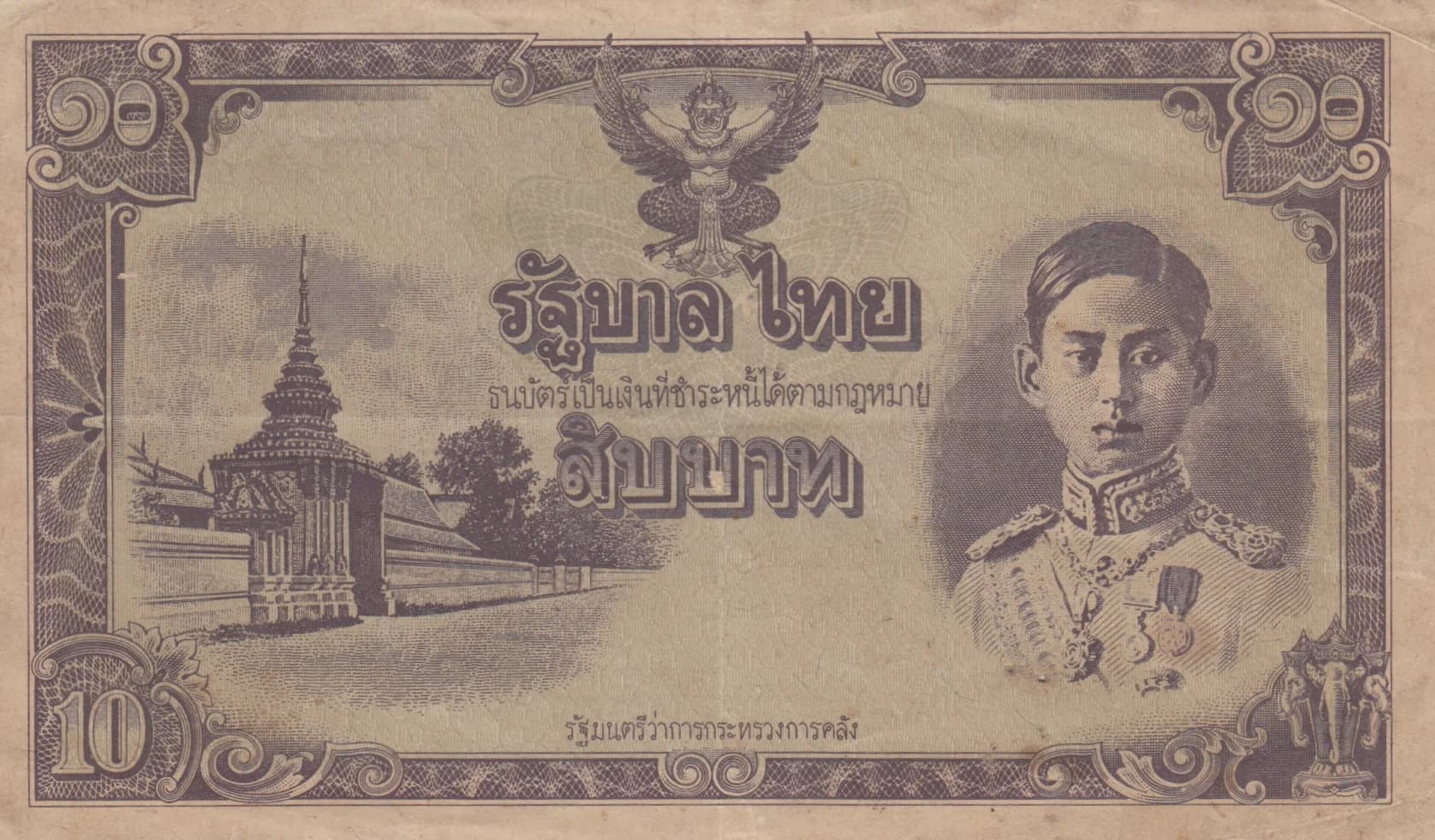
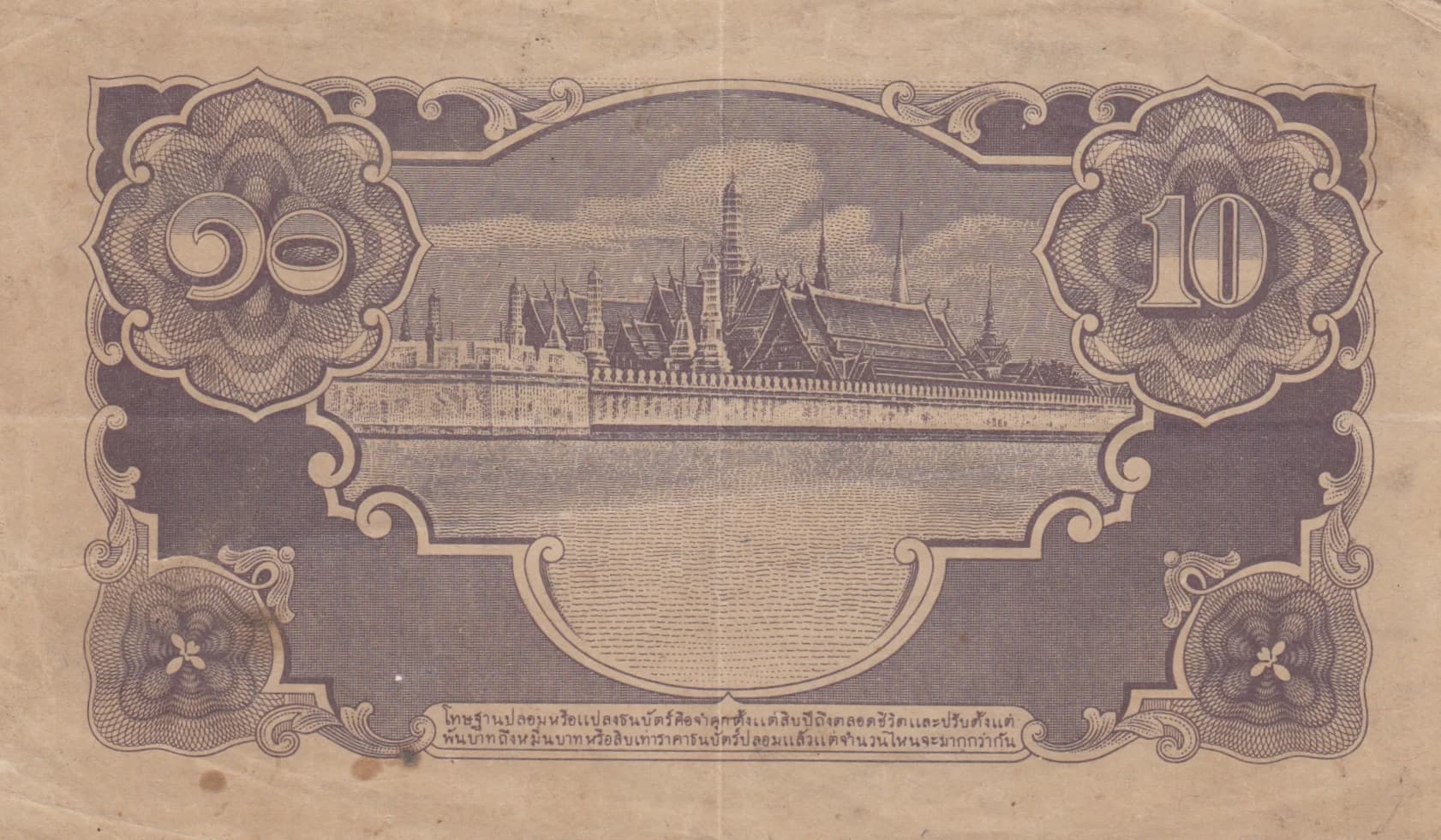
This is a Thai Government 10 Baht note from 1942 (Pick P-47), depicting King Rama VIII Ananda Mahidol in military dress uniform on the obverse and the Royal Palace, Bangkok complex on the reverse. The note exhibits significant age-appropriate wear with visible foxing and yellowing throughout, consistent with its VF condition grade; the fine line engraving and intricate decorative borders remain relatively clear despite nearly 80 years of aging, making this an important example of mid-20th century Thai currency design.
Common. While this is a 1942 government issue from a historically significant period, the eBay market data indicates substantial supply, with VF specimens consistently trading in the $255-$400 USD range and catalogue values at $50 for VF condition. The broad price range across multiple sales ($19.99 to $649.00 USD) reflects varying condition grades rather than scarcity of the type itself. Print runs for Thai 10 Baht notes from this period were substantial and circulation was widespread, making this Pick number readily available to collectors.
Issued during World War II under the Government of Thailand (before the establishment of the Bank of Thailand in 1942), this note features King Rama VIII Ananda Mahidol, who reigned during a tumultuous period of Thai history marked by political instability and external pressures. The inclusion of Wat Chetupon temple and the Royal Palace Bangkok on the obverse and reverse respectively reflects the enduring symbolic importance of Buddhist architecture and royal authority in Thai national identity during this transitional period.
The obverse features a formal portrait of King Rama VIII Ananda Mahidol positioned on the right side, shown in full military dress uniform with medals, decorations, and ornamental collar insignia. The left side displays Wat Chetupon (Wat Chatuphon Vimolmangklararm), identifiable by its distinctive tall golden spire with ornate Thai temple roof elements, surrounded by traditional fortress-style walls and vegetation. A Thai royal coat of arms featuring a garuda (mythical winged creature) appears at the top center. The reverse depicts the Grand Palace complex (Royal Palace, Bangkok) with multiple spires and elaborate architectural detailing along a waterfront setting. Both sides employ ornate decorative borders with scrollwork, floral motifs, and geometric patterns in all four corners, executed in the classical engraved banknote style.
FRONT: 'ธนบัญชี ไทย' (Bank of Thailand); '10' (Denomination in Arabic numerals); 'ธนบัญชีว่าการกระทรวงการคลัง' (Under the Ministry of Finance). BACK: '10' (Denomination cartouches, lower left and right); 'ในพระบาทสมเด็จพระมงกุฎเกล้าเจ้าอยู่หัวรัฐว่าการนครบางกอกได้ออกธนบัตรแบบนี้เพื่อใช้แทนเงินสดไทยตามกฎหมาย' (Under the authorization of His Majesty King Mongkut the Great, the Government of Bangkok has issued this banknote to serve as legal tender according to law).
This note was produced using fine line engraving and intaglio printing, as evidenced by the crisp detail in portraiture, the intricate border work, and the multi-layered decorative elements visible throughout. The printer is documented as Mitsui Trading Company. The precision of the fine lines and the quality of the detailed architectural rendering are characteristic of high-security engraved banknote production from this era.
The visual analysis shows three-digit serial numbers in Thai script positioned in the lower left of the obverse, which is consistent with the documented variety for this Pick number. The catalog reference notes a distinction between this issue (P-47, with purple back) and the later P-48 (with light green back), indicating this represents the earlier purple-back variety. Specific variety identification would require examination of serial number prefixes and any subtle design variations, but no overprints or exceptional markings are evident from the images provided.