10 baht 1935
Market Prices
12 salesAbout This Note
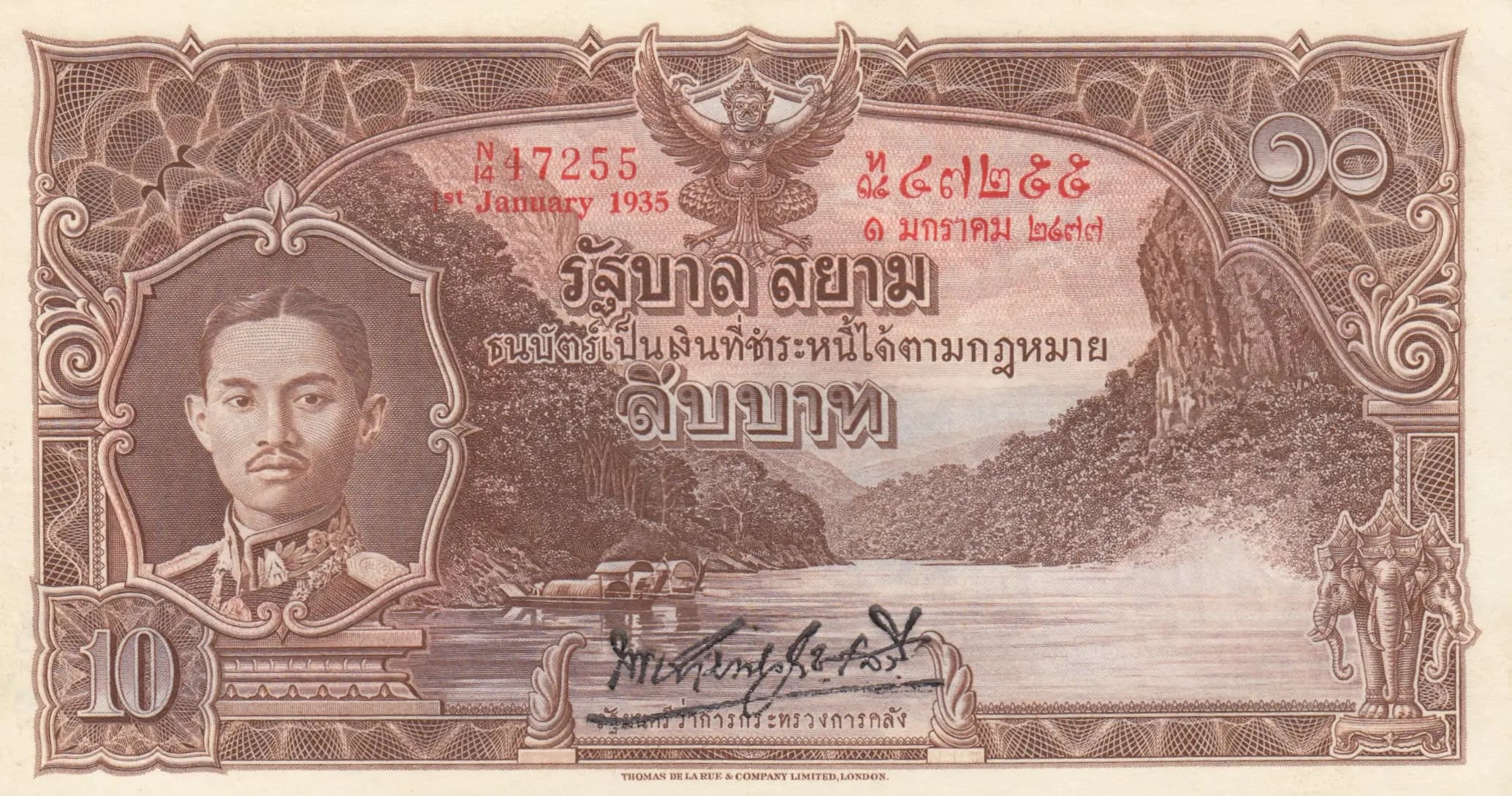
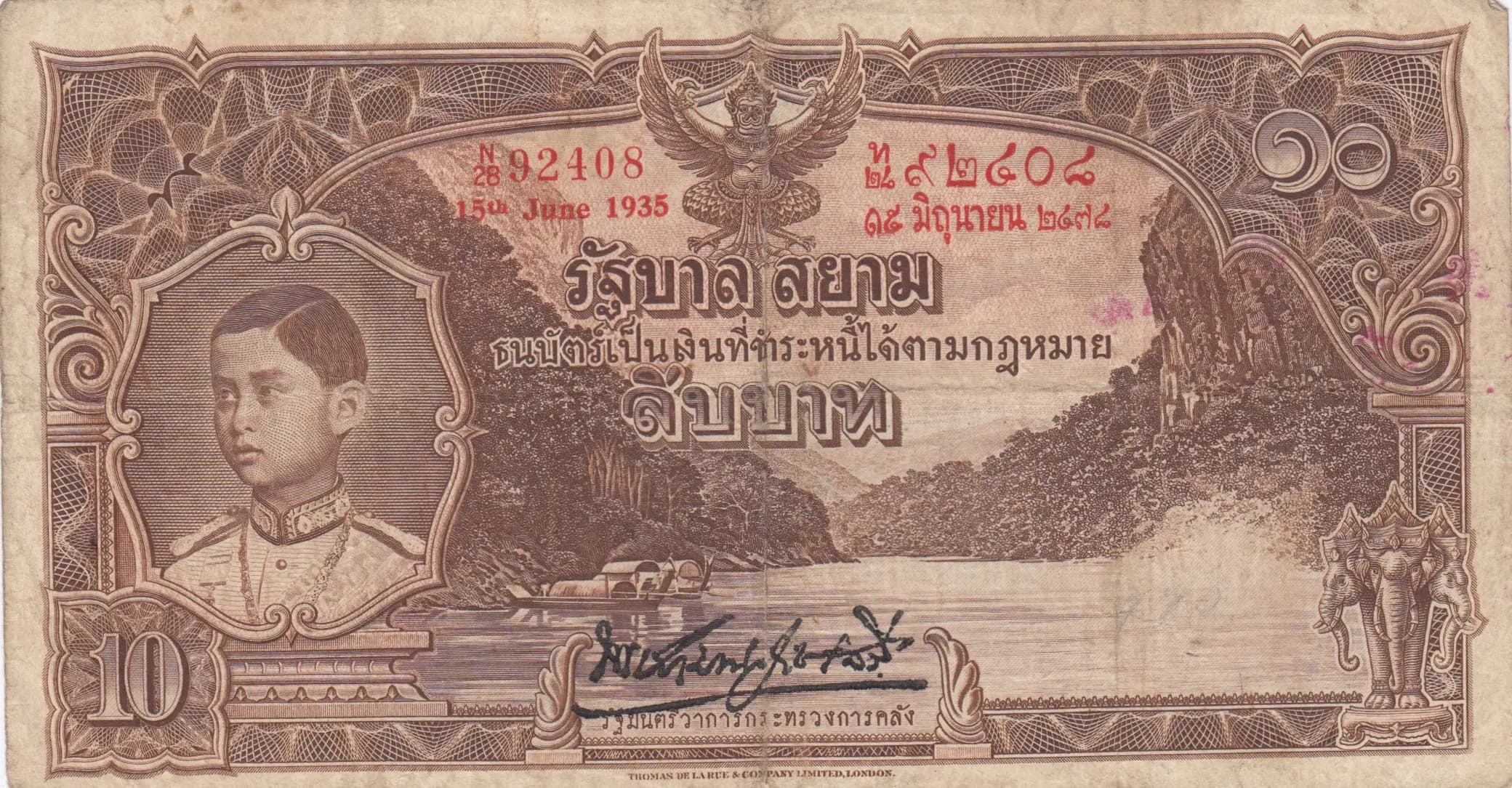
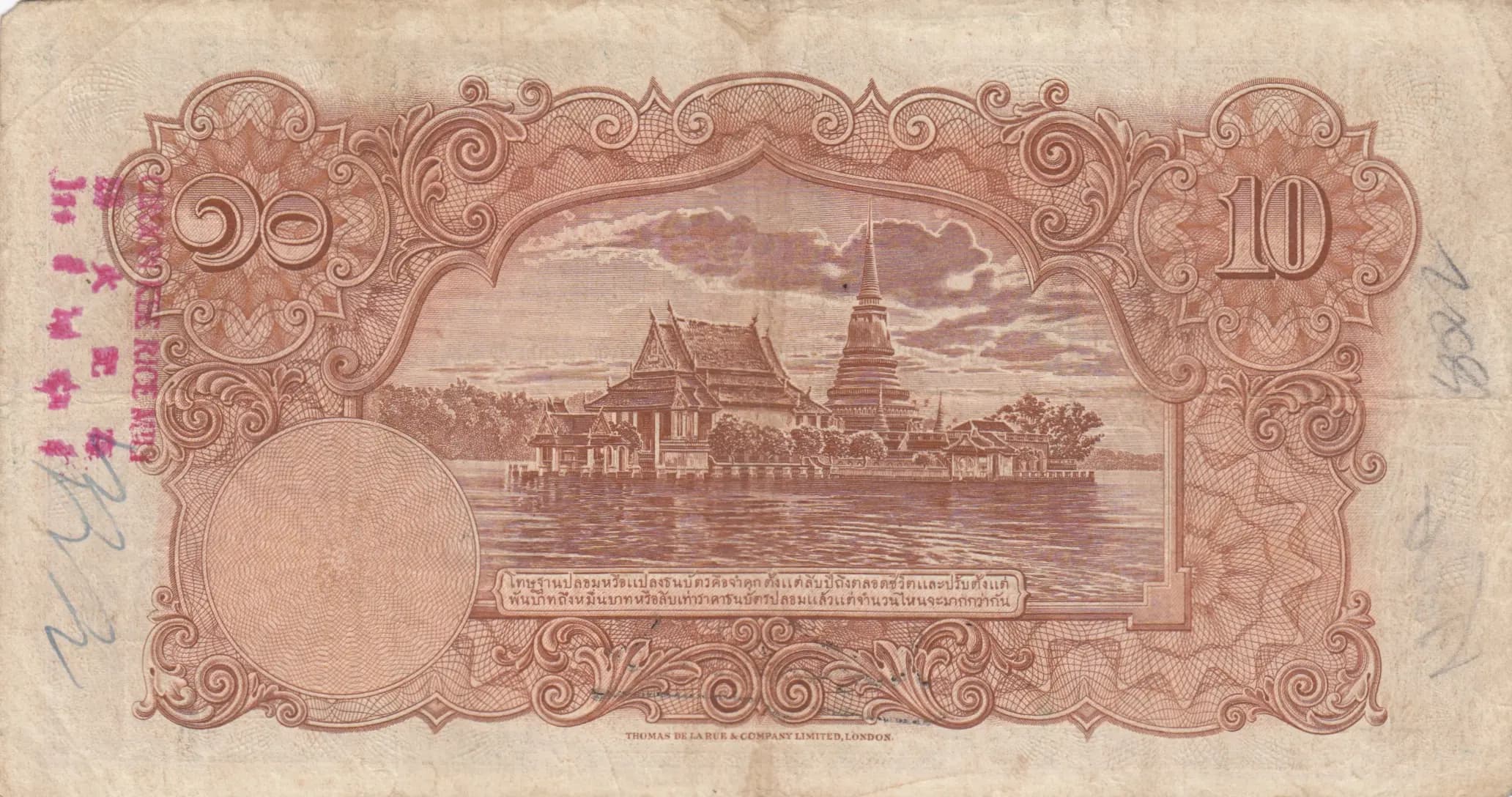
This is a Thailand 10 Baht banknote from 1935 (Pick P-28), issued by the Government of Siam and printed by Thomas de la Rue & Company in London. The note features a portrait of the young King Rama VIII Ananda Mahidol in formal military dress on the obverse, with a scenic landscape of a river and mountains, while the reverse depicts the ornate Phra Samut Chedi temple on water. In Fair (F) condition, this note exhibits significant aging with foxing, discoloration, and pink/magenta staining marks typical of its age and circulation history, with the fine engraving work still visible despite the wear.
Common. This is a regular issue note from a standard print run that circulated widely during 1935-1936. The eBay sales data provided shows consistent sales activity across multiple condition grades, with Fair condition notes regularly selling in the $78-$103 range (averaging approximately $90), indicating strong but not exceptional demand. The existence of PMG population reports and the availability of multiple examples across various grades confirms this was a substantial printing. While the note is nearly 90 years old and increasingly difficult to find in high grades, examples in Fair condition remain readily available to collectors at moderate prices.
Issued during the reign of King Rama VIII Ananda Mahidol (1935-1946), this banknote represents an important period in Siamese monetary history, as Thailand (then officially known as the Kingdom of Siam until 1939) modernized its currency system under royal authority. The prominent portrait of the young king and the depiction of the Phra Samut Chedi temple reflect the nation's emphasis on both the monarchy and Buddhist cultural heritage during the mid-1930s. The use of Thomas de la Rue & Company, the world's leading security printer of the era, demonstrates Siam's commitment to producing modern, high-security currency that could compete with contemporary international standards.
The obverse features a formal three-quarter facing portrait of King Rama VIII Ananda Mahidol as a young man, positioned on the left side within an ornate rectangular decorative frame. He is depicted wearing formal military attire with collar insignia appropriate to his royal status. The center and right portions of the note display a scenic landscape composition showing a river or lake with a small boat, forested hills and mountains in the background, representing Thailand's natural beauty. At the top center is a winged Thai national or royal emblem. The note is framed by elaborate Baroque-style decorative borders with scrollwork and geometric patterns throughout. The reverse (back) displays the Phra Samut Chedi temple, a significant Buddhist structure, prominently depicted on an island or peninsula surrounded by water, rendered in fine architectural detail. A large circular watermark area is visible on the left side of the reverse. The dominant color scheme throughout is brown, tan, and sepia tones, characteristic of the period's banknote aesthetic.
FRONT SIDE: Serial number 'No2408'; Issue date '15th June 1935'; 'รัฐบาลสยาม' (Government of Siam); 'สิบบาท' (Ten Baht); 'ธนบัตรเป็นสินทรัพยระหนึ่งสามารถนำไปจำหน่ายได้' (This banknote is an asset that can be sold or negotiated); 'THOMAS DE LA RUE & CO PARTY LIMITED, LONDON' (printer attribution). BACK SIDE: 'THOMAS DE LA RUE & COMPANY LIMITED, LONDON' (printer attribution); Thai text regarding economic or financial matters (exact translation unclear but relates to economic/treasury matters). Denomination '10' appears in multiple corners on both sides.
This note was produced using intaglio engraving, the standard security printing method of Thomas de la Rue & Company during this period. The fine line engraving is evident in the intricate decorative borders, complex geometric and floral patterns, ornate frames, and fine detail work visible in both the royal portrait and temple architecture. The high-quality engraving work, characteristic of TDLR's production standards, served as a primary security feature against counterfeiting. The precision of the line work and the depth of the engraved design are still discernible despite the note's age and wear.
The observed serial number is 'No2408' with an issue date of '15th June 1935'. This note falls within the documented date range of 29 May 1935 to 1 October 1936 for this Pick number. No specific overprints, color variations, or signature varieties are noted in the visual analysis that would distinguish this as a rare variety. The single variant catalogued by PMG for Pick P-28 appears to represent the standard emission with no known major varieties documented for this denomination and issuing authority.