10 baht 1935
Market Prices
5 salesAbout This Note
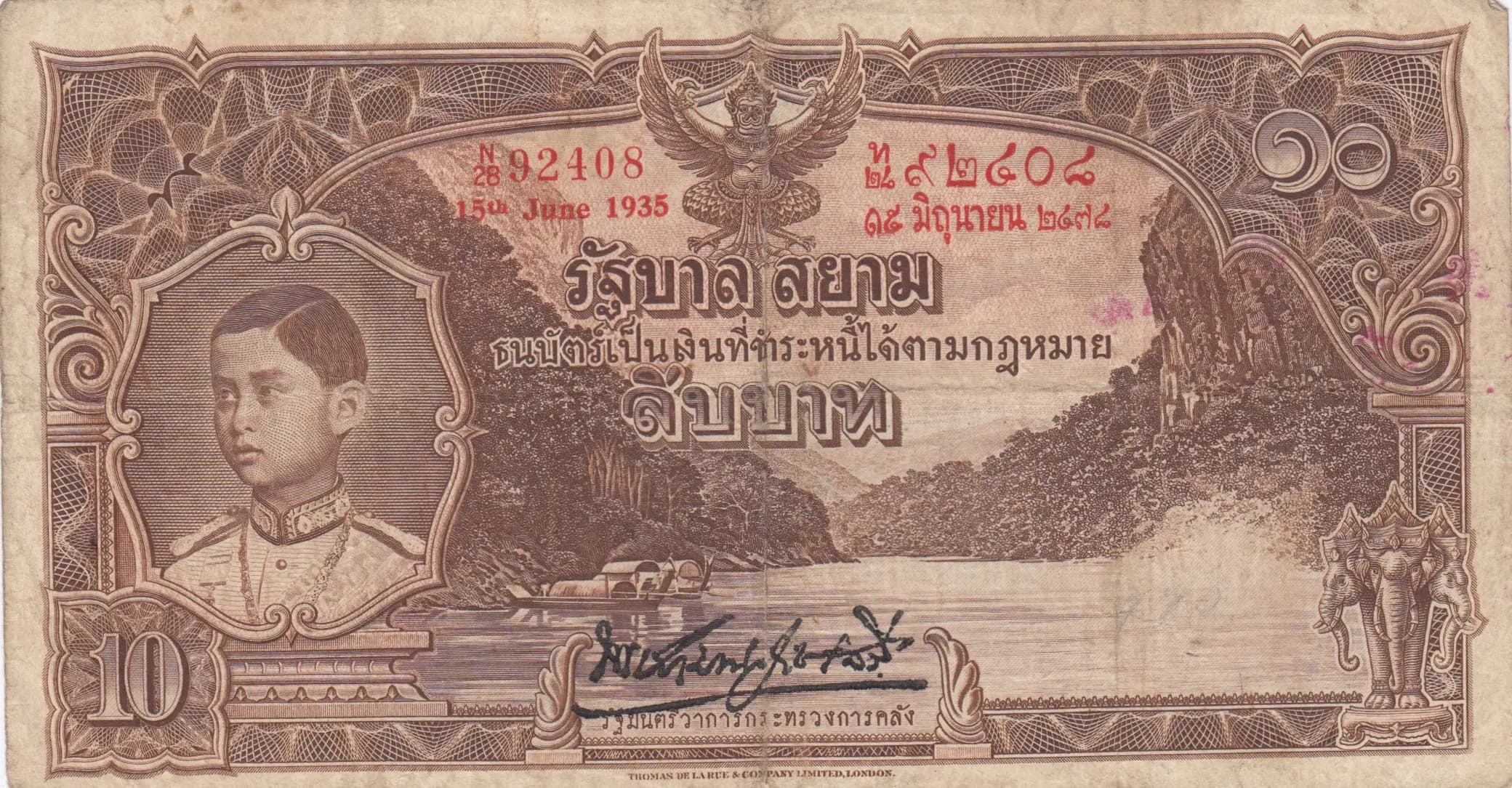
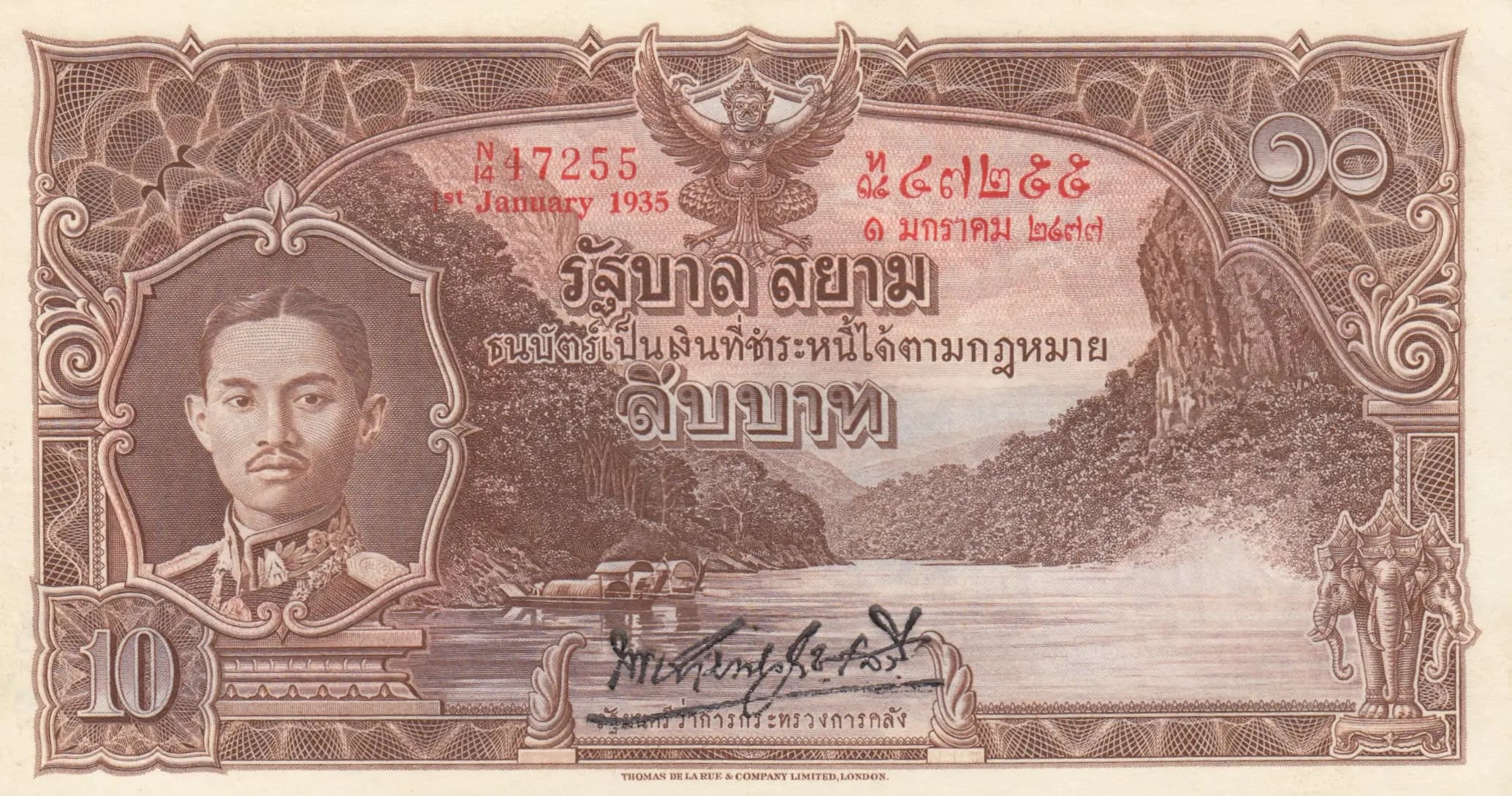
This 10 Baht note from 1935 represents an important early issue of the Thai monetary system under the Government of Siam. The note displays excellent period engraving work by Thomas de la Rue with a prominent portrait of King Rama VII Prajadhipok in formal military dress on the obverse, complemented by a scenic landscape featuring mountains and water. In VF condition, the note shows appropriate aging with visible creases and patina consistent with a note that circulated during its era, yet retains sharp print clarity and legible inscriptions throughout.
Common. The eBay market data provided shows this note type trading at modest prices in various grades (F-PMG 25 ranging from $79-127), with 2016 catalogue values of $30 for VF condition. These price levels, combined with visible trading activity over multiple years, indicate this is a regularly available note in the collector market. The issue was produced over a one-year period (1934-1935) with adequate print run. While early Thai banknotes have collector interest, the 10 Baht denomination from this period does not command premium pricing, confirming common status.
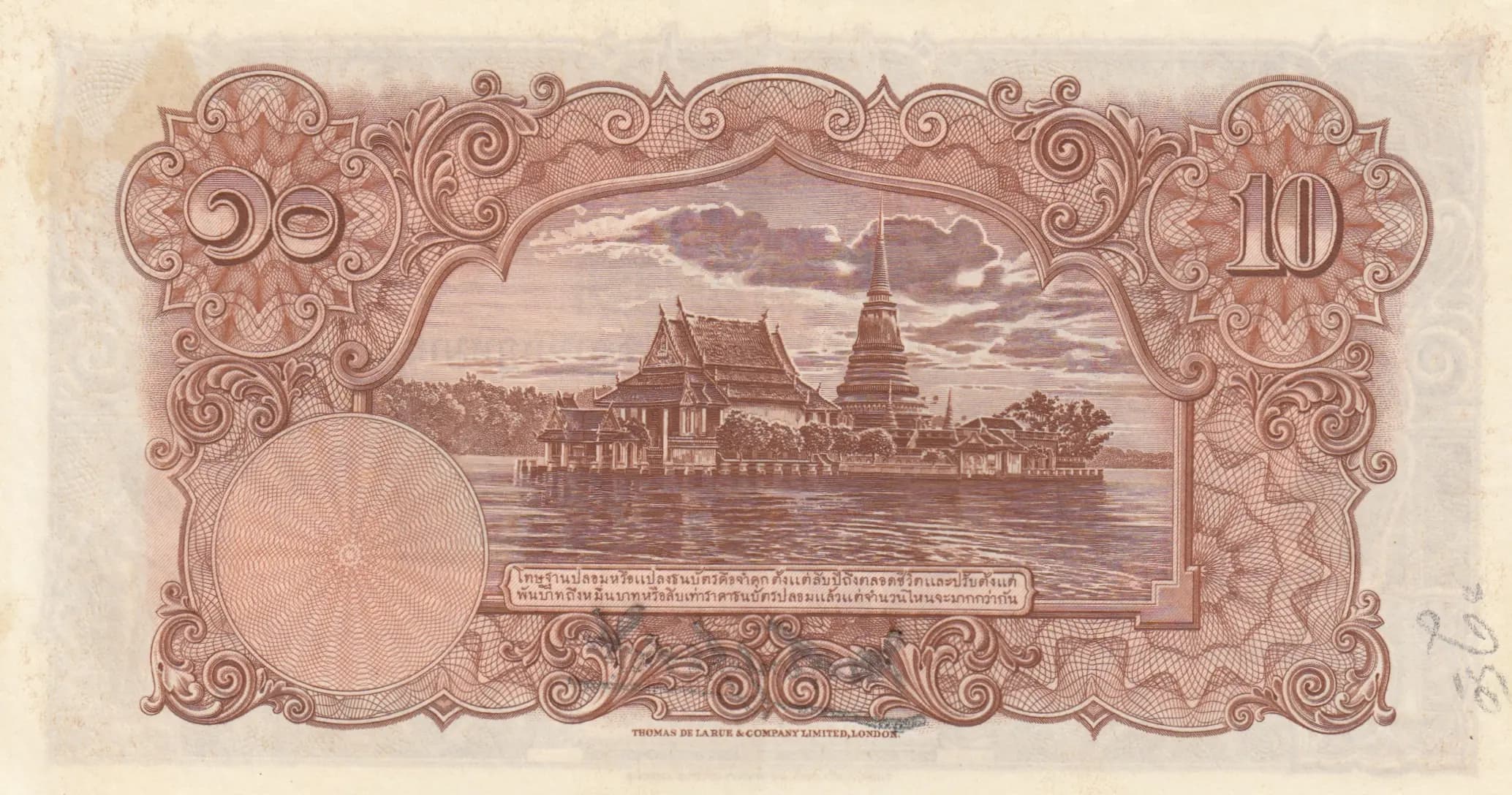
Issued between February 1934 and March 1935, this banknote was produced during the reign of King Rama VII Prajadhipok, a transitional period in Thai history following the 1932 revolution that transformed Siam from an absolute to constitutional monarchy. The reverse depicts Phra Samut Chedi, a significant Buddhist temple landmark, reflecting the enduring cultural and religious importance of Buddhist architecture in Thai national identity. The use of the Garuda emblem and three-headed elephant symbolism reinforces Thai sovereignty and royal authority during this modernization period.
The obverse features King Rama VII Prajadhipok (Phra Bat Somdet Phra Poramintharadhiraj Prajadhipok), depicted in left profile within an ornate rectangular frame wearing formal military dress uniform with visible medals and decorations on the chest. The central vignette displays a romantic landscape scene with a prominent mountain peak on the right side, a body of water in the foreground, and a small boat or vessel, suggesting the Mae Nam Chao Phraya or another significant river. The Garuda (ครุฑ) emblem with crown and wings appears at top center, a potent symbol of Thai royal authority. The lower right corner features a three-headed elephant motif. The reverse depicts Phra Samut Chedi temple, an iconic Buddhist structure with distinctive pointed Thai roofs and central spire, situated in a waterfront setting that may reference its historical location near Bangkok. The entire note is framed by elaborate scrollwork borders with ornamental flourishes characteristic of high-security banknote design.
FRONT SIDE: Serial Number: N 147255 | Date of Issue: 1st January 1935 | Thai Calendar Date: 6 มกราคม 2478 (6th January 2478 BE) | Issuer: รัฐบาลสยาม (Government of Siam) | Legal Tender Declaration: ธนบัญชีเป็นจำนวนที่ระหนึ่งได้สามารถมูกูหมาย (promissory note legal tender text, partially visible) | Denomination: 10 | Printer: THOMAS DE LA RUE & COMPANY LIMITED, LONDON | BACK SIDE: Denomination: 10 (appears upper left and upper right corners) | Descriptive Text: ประกาศโปรแกรมการโครงสร้างคงคาสิทธิ์ของสถาบันวัฒนาหลักสูตรและการวิจัยการจัดการที่อยู่ดี (Thai institutional/administrative text) | Printer: THOMAS DE LA RUE & COMPANY LIMITED, LONDON
Intaglio engraving (note printing), executed by Thomas de la Rue & Company Limited of London, the world's premier security printer of the era. The visual analysis reveals characteristic fine-line engraving throughout the border designs, complex geometric and ornamental patterns deployed as anti-counterfeiting measures, and fine mesh/crosshatch background patterns typical of intaglio work. The intricate nature of the scrollwork, the portrait rendering, and the landscape vignettes all demonstrate classical line-engraving techniques. The empty guilloche pattern space on the reverse indicates provision for a watermark security feature, standard in de la Rue's banknote production.
Serial number N 147255 is visible on the observed specimen. No overprints or signature varieties are apparent in the visual analysis. The date inscription shows both Western calendar (1st January 1935) and Thai Buddhist calendar (6 มกราคม 2478) formats. Standard varieties for this Pick number include different serial number prefixes and the standard printing without overprints, consistent with the specimen analyzed. No exceptional varieties are indicated by the visual evidence.