1 baht 1945
Market Prices
24 salesAbout This Note
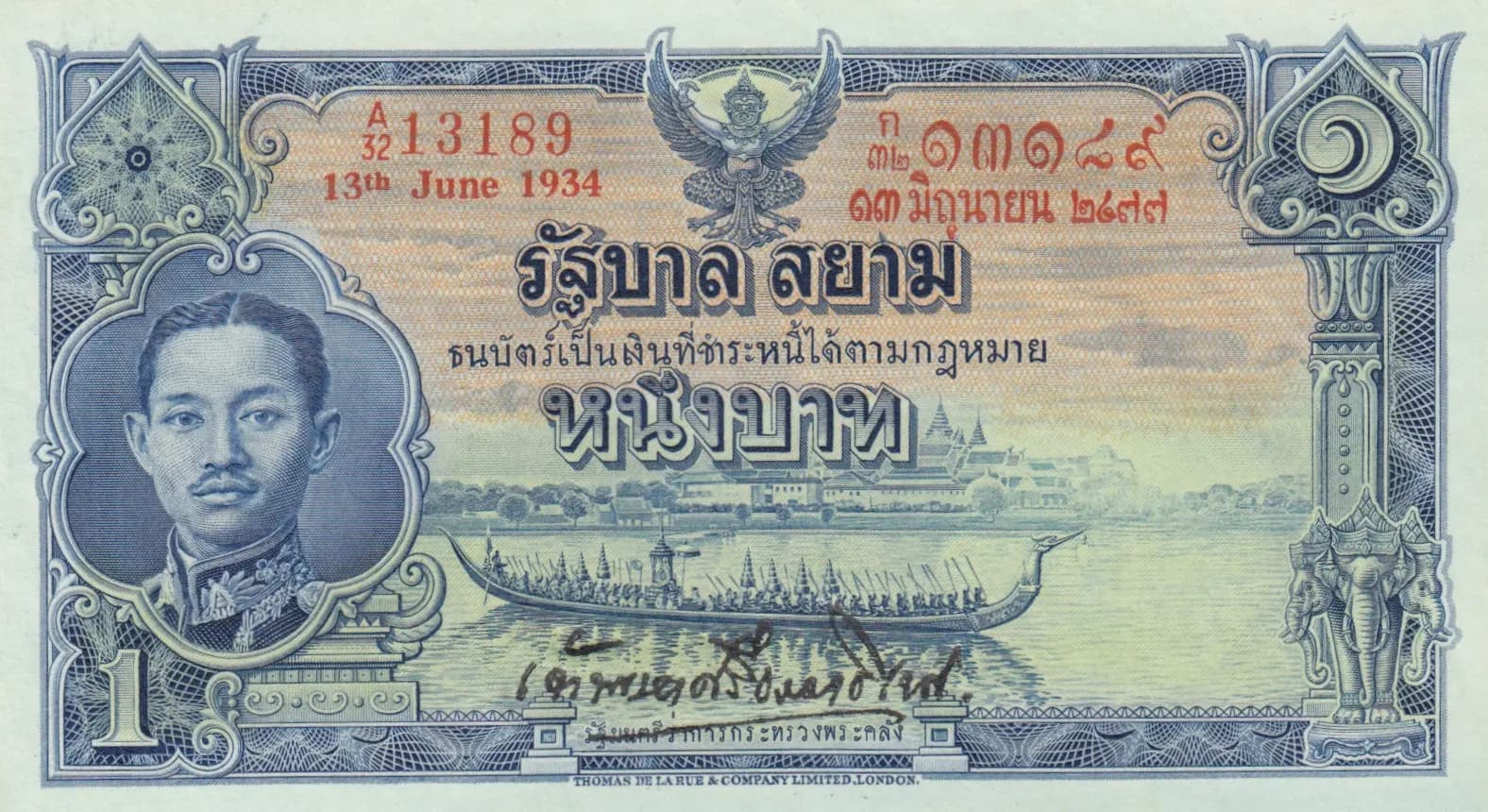
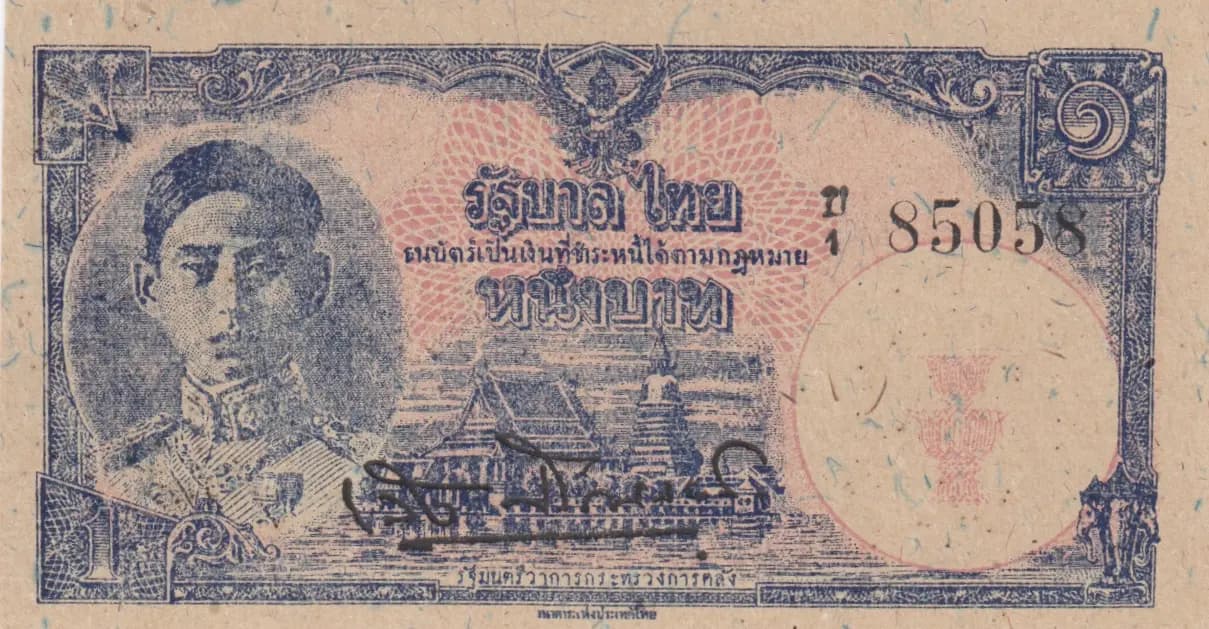
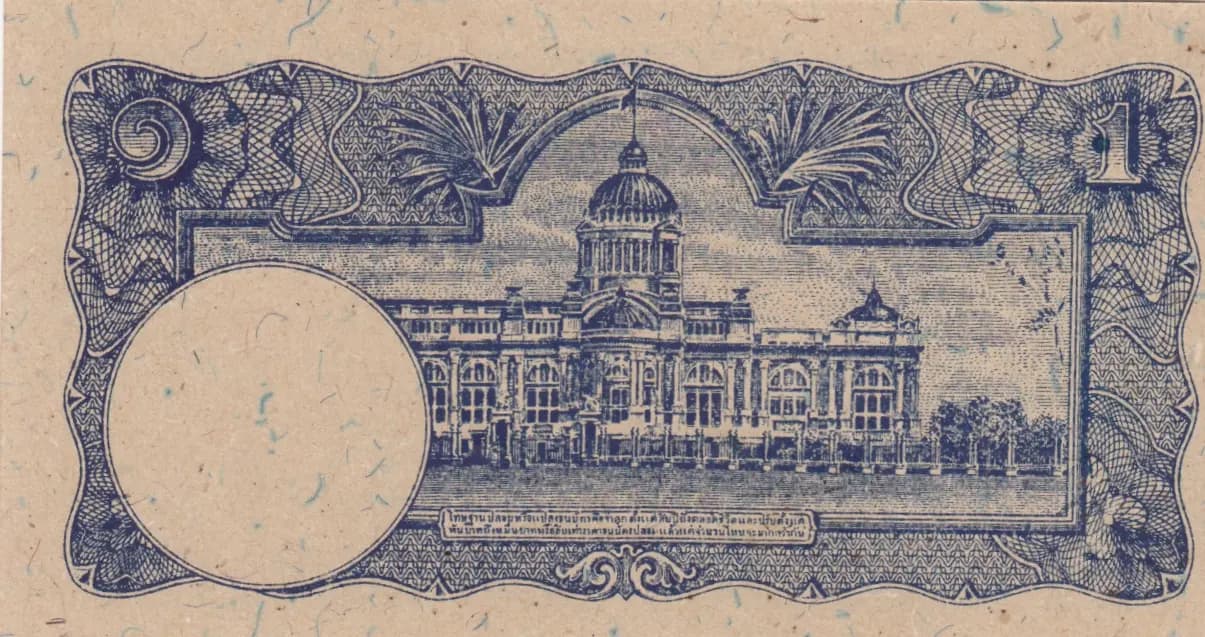
This is a 1945 Thai 1 Baht note (Pick P-54a) featuring King Rama VIII Ananda Mahidol in profile on the obverse, with the Phra Samut Chedi temple visible in the lower design, and a neoclassical Royal Throne Hall depicted on the reverse. The note displays the characteristic blue and red/pink printing on a beige/tan background with ornamental Thai-style borders and watermark areas. The specimen shows significant age-appropriate wear including foxing, discoloration, creasing, and staining consistent with eight decades of storage, reflecting the challenging preservation conditions faced by Thai notes from this wartime period.
Common. Ample market data from realbanknotes.com shows consistent eBay sales activity from 2011 through 2025, with numerous specimens trading in the $20-170 range. The 2016 catalog values indicate UNC specimens at only $20, and ongoing sales demonstrate ready availability across multiple condition grades. While this wartime-era note has historical interest, the print run was substantial enough to ensure continued circulation and preservation of multiple examples. The consistent pricing and regular sales confirm this is not a scarce or rare variety.
This banknote was issued during the reign of King Rama VIII (Ananda Mahidol, r. 1935-1946), a period marked by Japanese occupation of Thailand during World War II. The imagery emphasizing royal authority through the king's portrait and the prominent Royal Throne Hall reflects the Thai government's effort to maintain institutional legitimacy and national identity during the tumultuous wartime period. The 1945 issuance date places this note near the end of the war and the final year of Rama VIII's reign before his mysterious death in 1946.
The obverse features a three-quarter profile portrait of King Rama VIII Ananda Mahidol facing left, rendered in formal style wearing military dress with decorative collar, positioned on the left side of the note. The lower center showcases the Phra Samut Chedi temple, a significant Buddhist religious structure reflecting Thailand's cultural identity. The reverse displays a prominent neoclassical government building identified as the Royal Throne Hall, characterized by a substantial dome, multiple stories, arched windows, and classical columns, reinforcing the authority and institutional stability of the Thai state. Both sides feature ornamental Thai-style decorative borders with intricate scrollwork patterns, corner ornaments, and circular watermark areas, typical of mid-20th century Thai currency design.
Front side: 'ธนบัตรไทย' (Thai banknote); 'ธนบัตรประเภทหนึ่งที่ระหนึ่งกรรมการหนึ่ง' (One baht banknote); 'ห้องพิมพ์โรงการรัฐ' (Government printing house); partial serial number '850' visible. Back side: Denomination '1' appears in ornamental circles in upper corners; additional Thai text in fine print at base of building (not clearly legible in images but would identify the Royal Throne Hall).
Intaglio engraving (recess/line engraving), evidenced by the fine line work visible throughout the ornamental borders, detailed cross-hatching patterns, and the intricate scrollwork characteristic of this security printing method. The precision of the portrait rendering and the detailed architectural imagery on the reverse are consistent with steel plate engraving. This note was produced by the Thai Government Printing House (ห้องพิมพ์โรงการรัฐ) as noted in the inscriptions. The color printing appears to be two-color or three-color intaglio (blue and red/pink inks on the observed specimen).
This is identified as Pick P-54a, with the 'a' designation indicating a specific variety of the 1945 1 Baht issue. The visual analysis confirms characteristics consistent with P-54a including the blue and pink color scheme, the specific border designs, and the portrait orientation. The note shows a partial serial number visible ('850'), which would be consistent with notes from this printing series. No evidence of overprints, surcharges, or other distinguishing variety markers is apparent from the images provided. This represents a standard issue variety from the 1945 production run.