1 baht 1939
Market Prices
12 salesAbout This Note
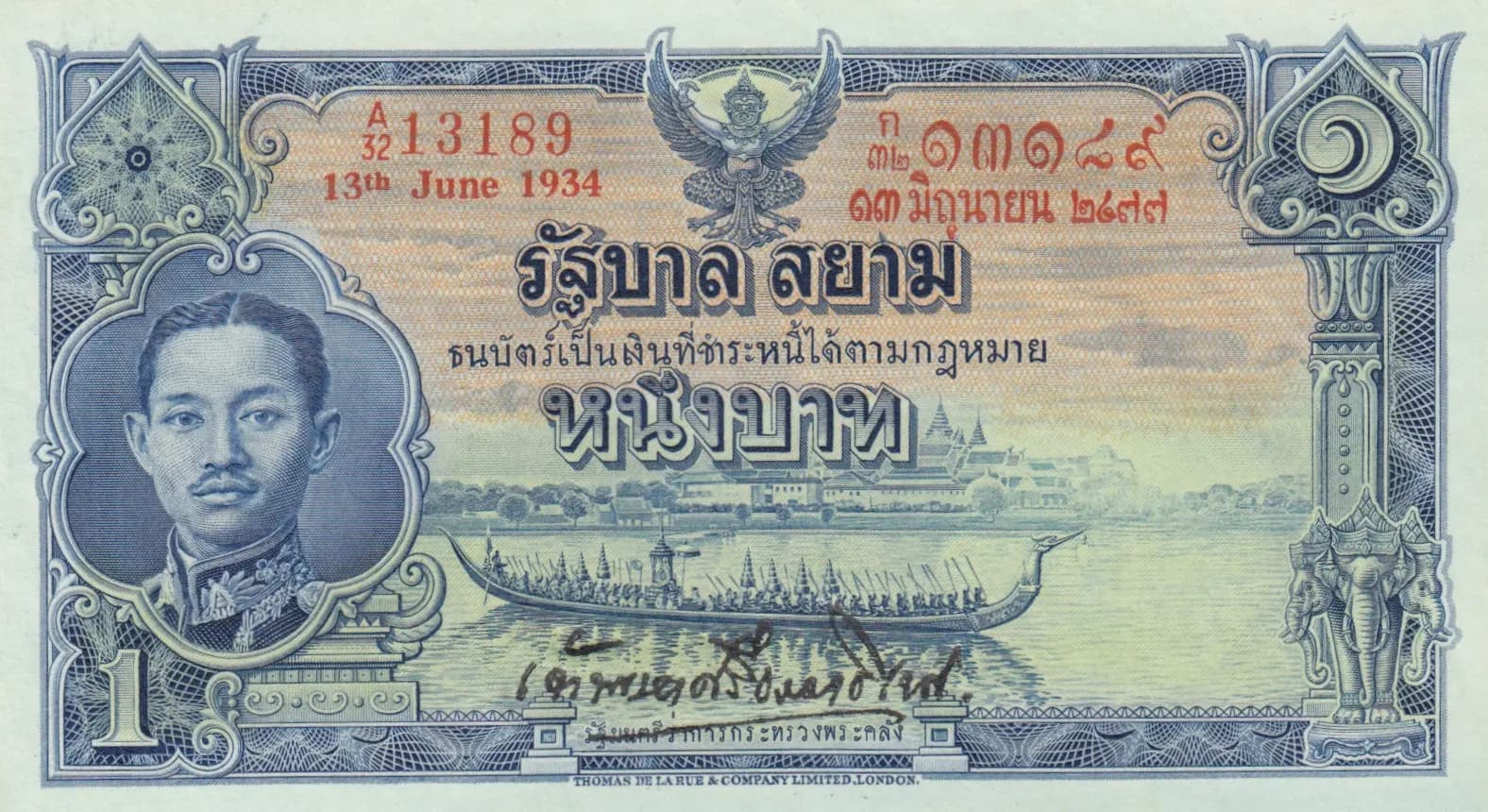
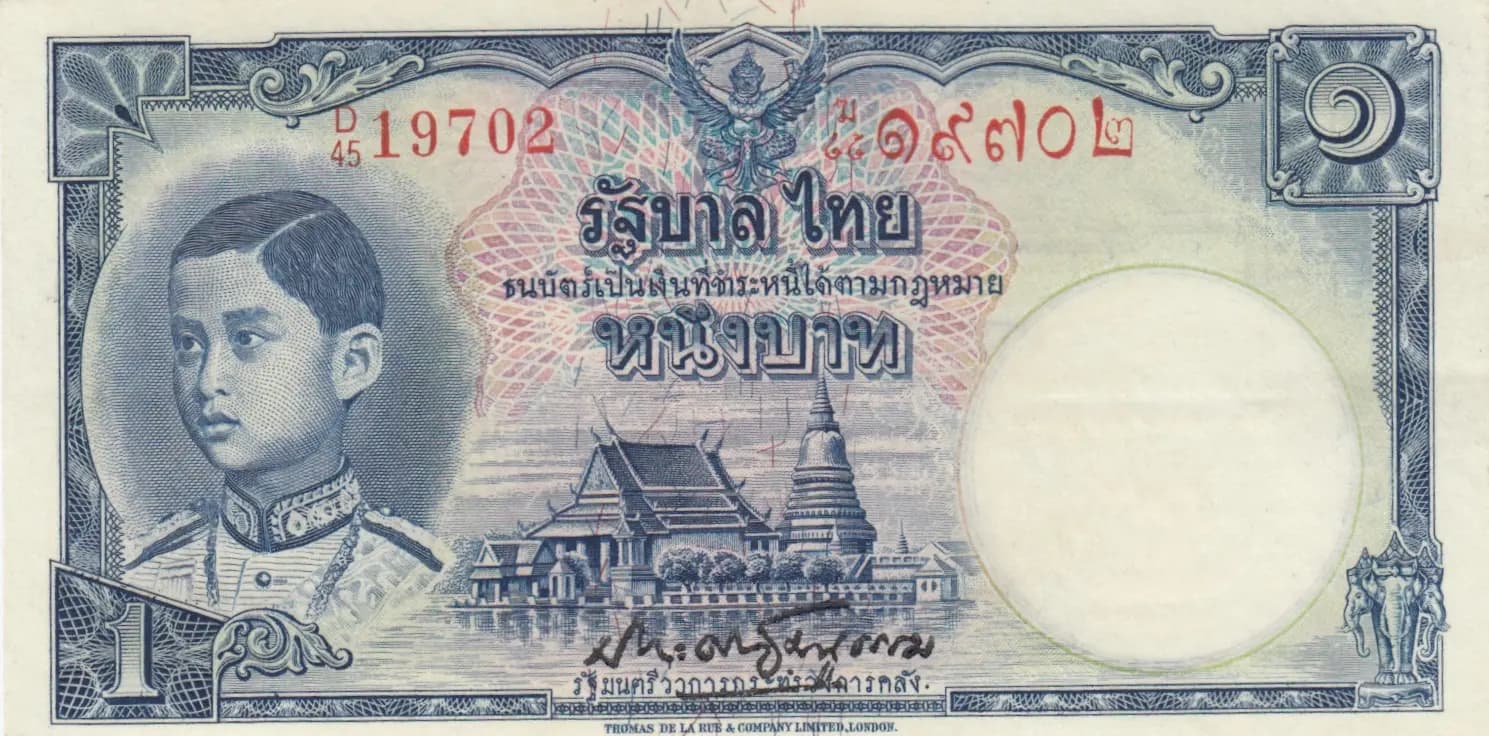
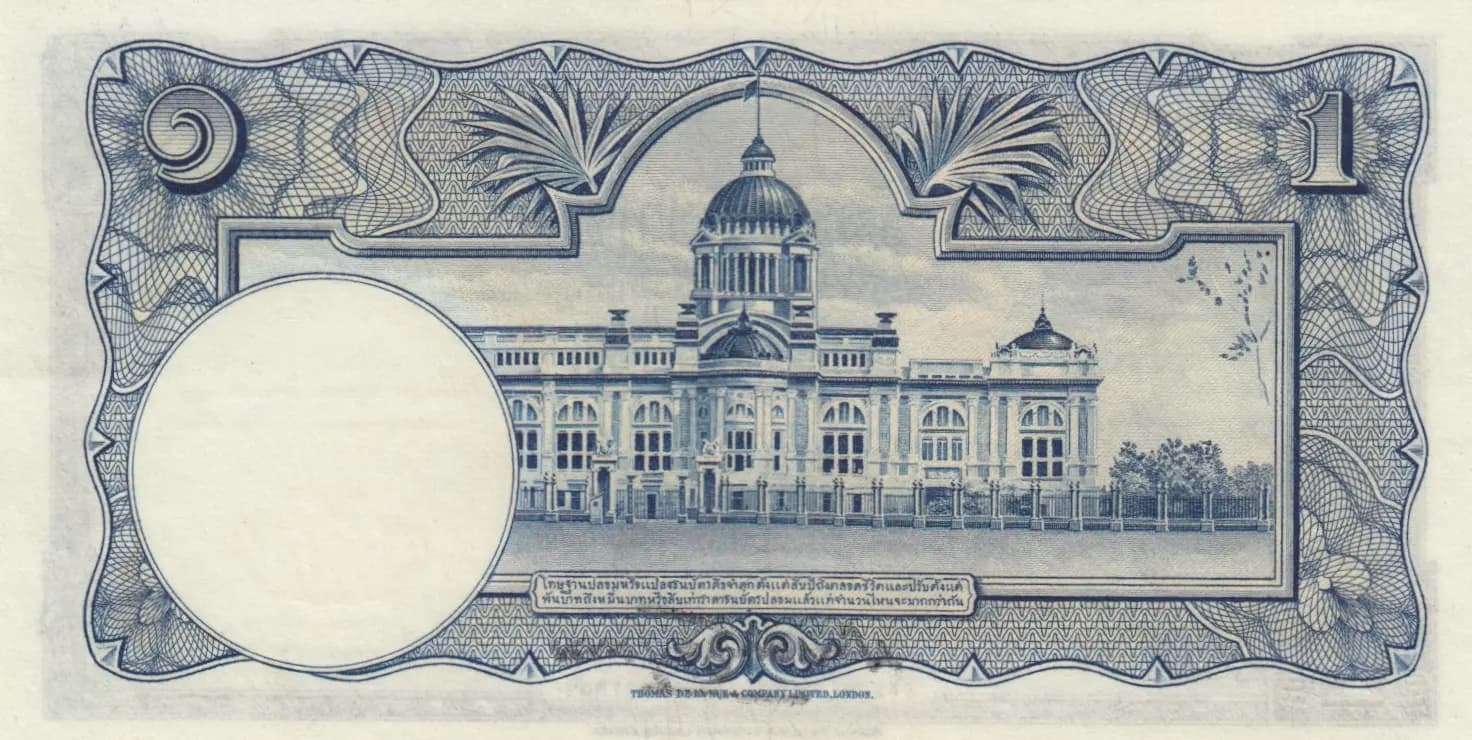
This is a Thai Government of Siam 1 Baht banknote from 1939 (Pick P-31a), printed by Thomas De La Rue in London, graded AU (About Uncirculated). The note features a striking portrait of King Rama VIII Ananda Mahidol in military uniform on the obverse, with the iconic Phra Samut Chedi temple complex reflected in water at center, while the reverse displays a neoclassical Royal Throne Hall. The note exhibits excellent preservation with fine engraved detail work intact, minimal wear, and vibrant color registers including blues, reds, and pink patterned backgrounds characteristic of this early Thai banknote issue.
Common. This is a regular issue from 1939 produced in substantial quantity by a major security printer (Thomas De La Rue). Market data from eBay shows consistent sales activity across multiple grades (F to PMG 65) with prices ranging from $10.62 to $183 depending on grade, indicating healthy collector availability. Even high-grade examples (PMG 65) have sold multiple times in the $144-183 range, suggesting adequate supply. The 2016 catalog value for UNC is only $30, well below the threshold for scarce notes. No indication of limited mintage, recall, or short-lived issue.
This note was issued during the reign of King Rama VIII (Ananda Mahidol, r. 1935-1946) under the Government of Siam, before the nation's official name change to Thailand in 1939. The dual imagery of the young monarch in military dress and the Phra Samut Chedi temple reflects Siam's royal authority and Buddhist heritage during a period of significant political transformation in Southeast Asia. The design represents an important transitional era in Thai numismatic history, issued just before Japanese intervention during World War II would lead to inferior quality replacement notes (P-39).
The obverse features a three-quarter facing portrait of King Rama VIII Ananda Mahidol positioned at left, depicted as a youth in formal military dress uniform with collar insignia and decorative chest insignia. The portrait is rendered in fine line engraving characteristic of De La Rue work. The central design showcases the Phra Samut Chedi temple complex—a significant Buddhist monument—with multiple traditional Thai spires reflected in water below, set within a large circular vignette. The background employs intricate cross-hatching and guilloche patterns in blue and pink tones. The reverse displays a prominent neoclassical European-style building identified as the Royal Throne Hall, featuring a domed cupola, columned entrance with arches, and ornamental railings, with smaller Thai architectural elements visible in the background. Both sides feature ornate decorative borders with fine detail work and the denomination '1' displayed prominently in corner medallions.
FRONT: Thai text reads 'ธนบัล ไทย' (Thai currency) and includes legal authorization text 'ธนบัญชีเป็นผ้นที่ระหนึ่งได้จำนวกฎหมาย' (Issued under the authority of law). Serial number visible as 'D 19702' in European characters with Thai numerals. English printer attribution reads 'THOMAS DE LA RUE & COMPANY LIMITED, LONDON.' BACK: Large numeral '1' displayed in decorative frames in top-left and bottom-right corners. Thai caption text appears beneath the Royal Throne Hall building image. English printer credit 'THOMAS DE LA RUE & COMPANY LIMITED, LONDON' repeated.
Intaglio engraving (letterpress/line engraving) produced by Thomas De La Rue & Company Limited of London, the premier British security banknote printer. The note exhibits the characteristic fine line engraving, intricate cross-hatching, detailed portrait work, and decorative guilloche patterns typical of De La Rue's high-security banknote production of this era. The multi-color registration across front (blue, red, pink, cream) and back (blue, cream, gray) demonstrates advanced color separation and printing alignment capabilities.
Pick P-31a represents the standard Thomas De La Rue printing of this 1939 issue. The note displays serial number format with European characters at left ('D 19702') and Thai numerals at right, consistent with Type II heading varieties described in standard references. Per catalog references, this issue should be distinguished from the similar P-30 (also TDLR) and the inferior quality wartime replacement P-39 (issued during Japanese intervention). The specific serial number prefix 'D' and numeral positioning confirm this as the catalogued P-31a variety. No overprints or special markings are evident beyond standard red stamp/notations visible on the front.