20 shillings 1966
Market Prices
11 salesAbout This Note
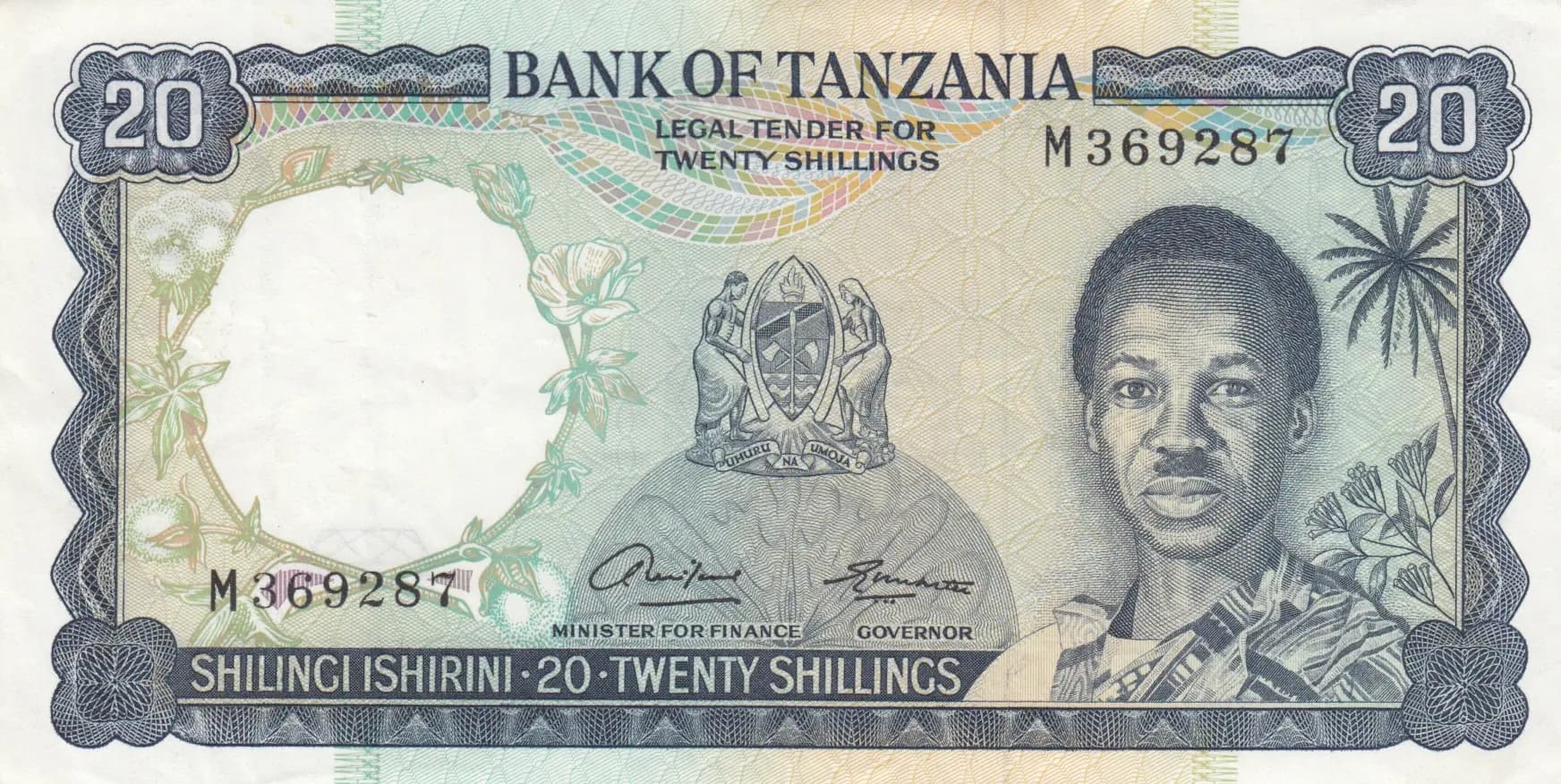
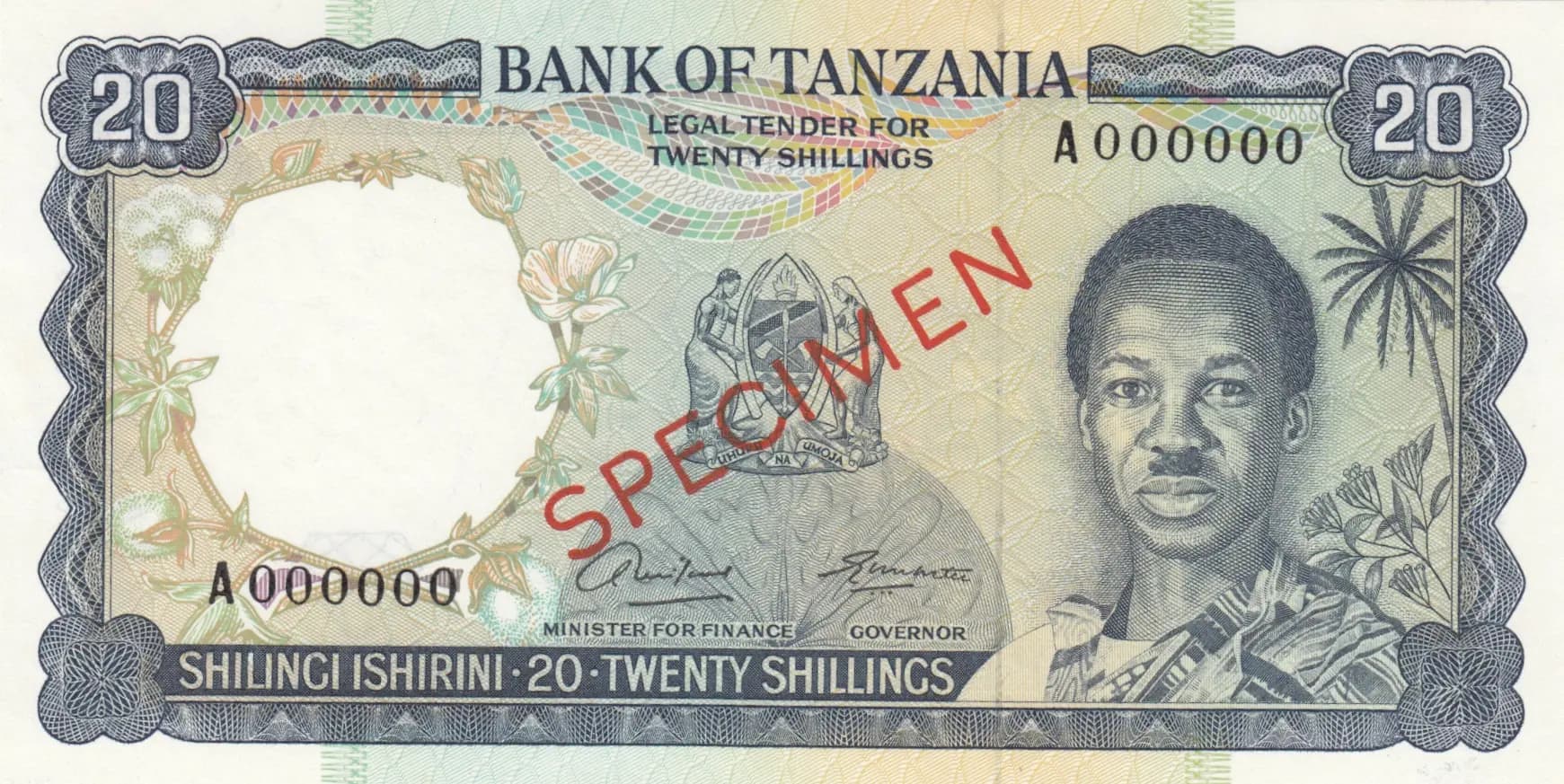
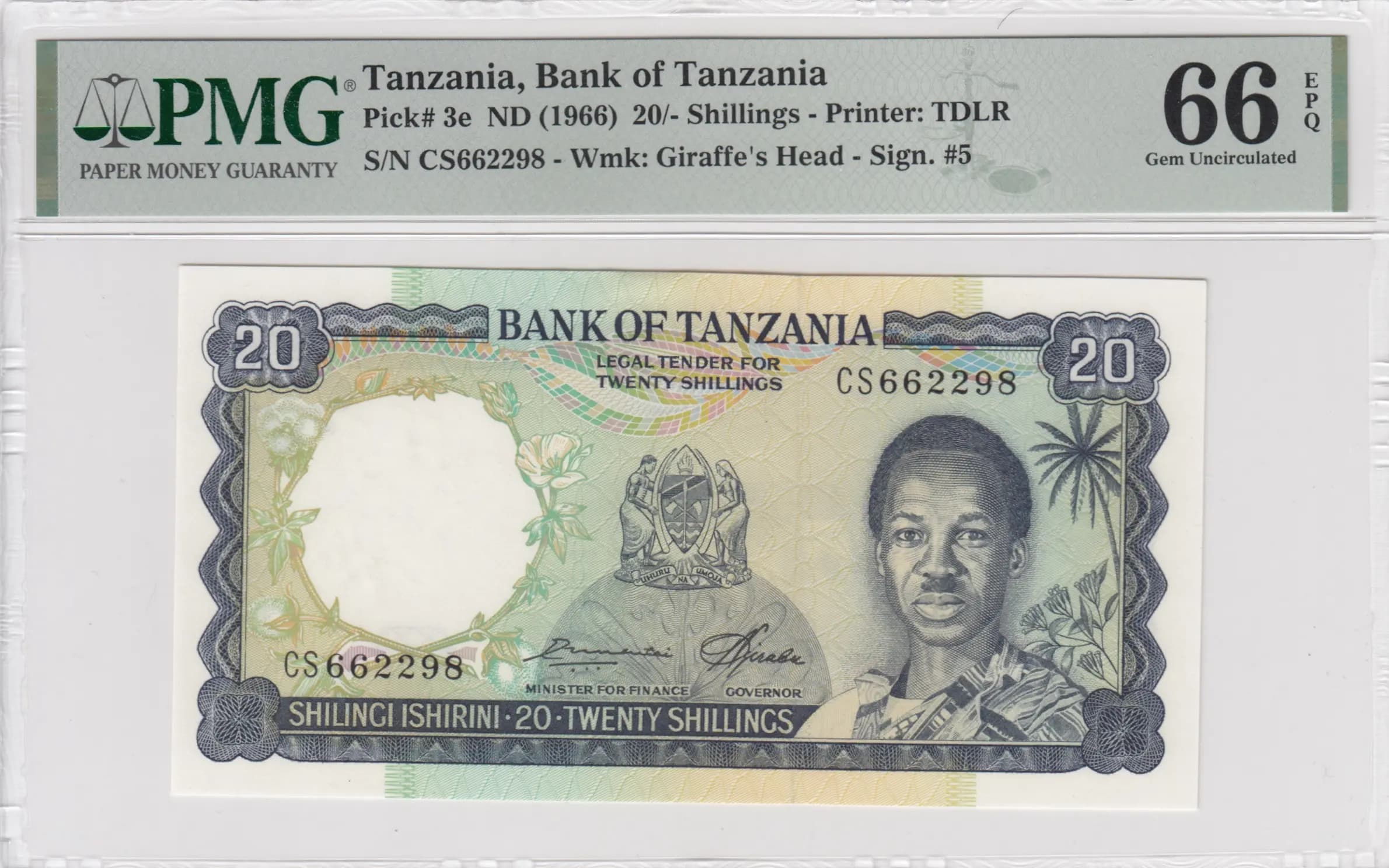
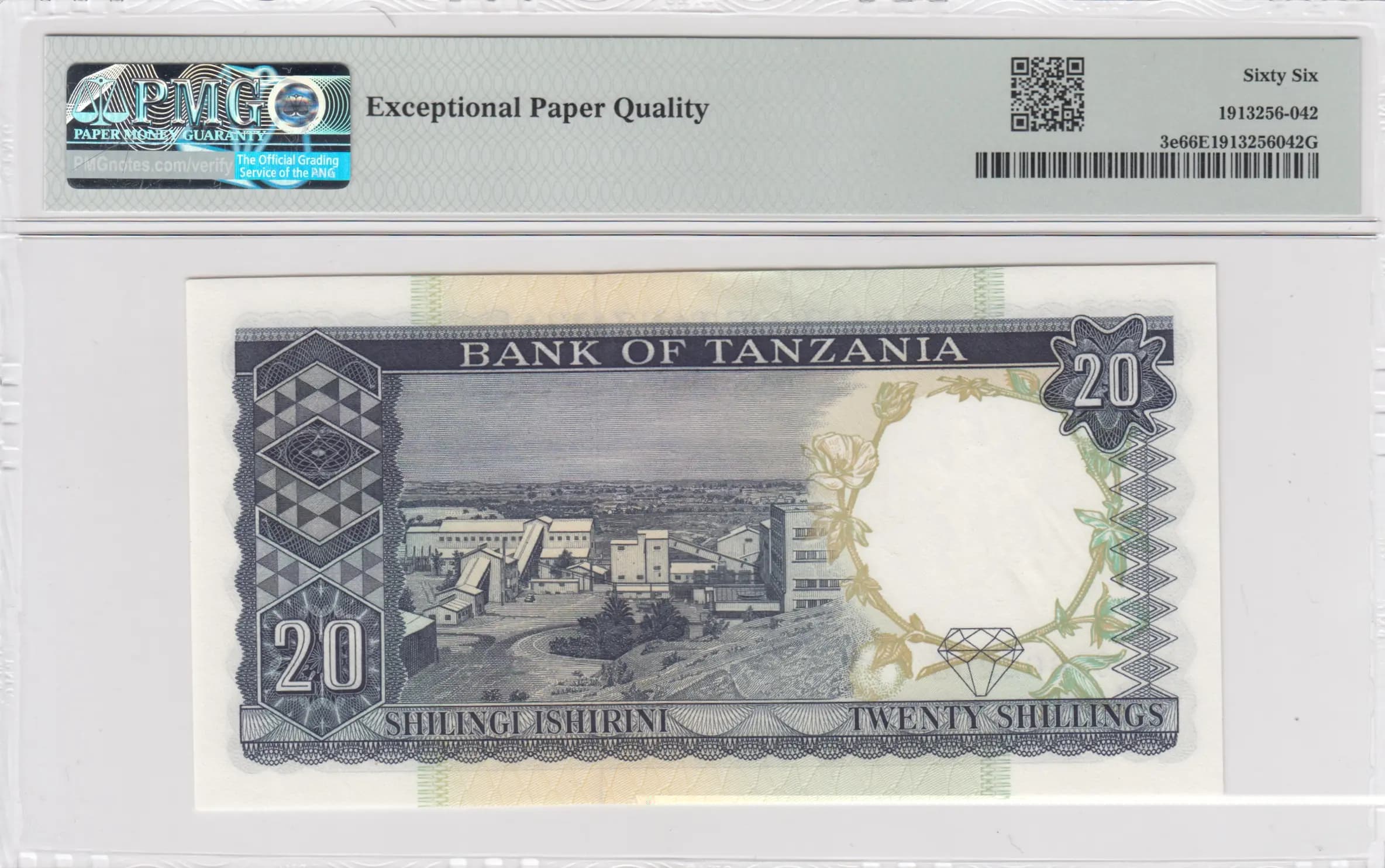
This is a pristine example of Tanzania's first independent banknote issue, the 20 Shillings from 1966, graded PMG 66 Gem Uncirculated with Exceptional Paper Quality. The note features a formal portrait of President Julius Nyerere on the obverse and an industrial complex on the reverse, both rendered in the elegant multicolor intaglio style characteristic of early African currency design. As one of the earliest denominations issued by the newly independent Bank of Tanzania, this note represents a significant numismatic artifact from East Africa's post-colonial period.
Common. This is a regular issue from Tanzania's initial 1966 banknote series and appears to have had a substantial print run. Market data from realbanknotes.com shows consistent eBay sales activity over multiple years, with PMG 66 examples selling in the $36-$39 range (2020-2021), and uncirculated examples regularly trading for $5-$21. The catalog value for UNC examples is listed at $9 (2019). The existence of multiple varieties (P-3a, P-3c, P-3d, P-3e) across different printers indicates substantial production. There are no indicators of rarity, short print runs, or recall issues for Pick P-3e.
Issued in 1966 following Tanzania's independence in 1964, this banknote marks the Bank of Tanzania's establishment of its own currency authority and monetary sovereignty. The portrait of President Julius Kambarage Nyerere, Tanzania's founding president, and the depiction of industrial development on the reverse reflect the nation's commitment to modernization and nation-building during the early years of independence. The bilingual inscriptions in English and Swahili underscore Tanzania's dual linguistic heritage and its identity as a post-colonial African state.
The obverse features a formal portrait of President Julius Kambarage Nyerere positioned on the right side, facing forward with dignified bearing. The center-top displays Tanzania's coat of arms—a shield featuring a crossed spear and staff with a giraffe's head, symbolizing the nation's wildlife and cultural heritage. Ornamental borders with floral patterns frame both sides of the obverse in green, tan, and blue-gray tones, with fine line engraving creating intricate decorative elements. The reverse depicts an industrial or institutional complex—likely representing a factory or government building—set against a rural landscape, emphasizing the nation's development aspirations. Geometric diamond patterns and decorative floral motifs (flower buds and leaves) ornament the borders, with a diamond-shaped symbol positioned in the bottom right corner. The color palette throughout combines gray, blue, tan, and green with black line work, creating a sophisticated and professional appearance.
Front Side: 'BANK OF TANZANIA' (English), 'LEGAL TENDER FOR TWENTY SHILLINGS' (English), '20' (denomination numeral), Serial Number 'CS662298', 'MINISTER FOR FINANCE' (official title), 'GOVERNOR' (official title), 'SHILLINGI ISHIRINI · 20 · TWENTY SHILLINGS' (Swahili and English denomination text). Back Side: 'BANK OF TANZANIA' (English), '20' (denomination numeral), 'SHILLINGI ISHIRINI · TWENTY SHILLINGS' (Swahili and English denomination text). All inscriptions are presented bilingually reflecting Tanzania's official languages.
This note was printed by TDLR (Thomas De La Rue), one of the world's preeminent security printers, using traditional intaglio (engraved steel plate) printing methods. The visual evidence of fine line engraving, precise color registration across multiple color separations, intricate border patterns, and the overall exceptional print quality are consistent with high-security banknote production standards. The watermark featuring a giraffe's head was incorporated during paper manufacture, adding an additional security layer typical of De La Rue's premium banknote production.
This note is cataloged as Pick P-3e, representing a specific variety within the 20 Shillings 1966 series. According to PMG records, the 20 Shillings denomination exists in at least 6 documented varieties (P-3a, P-3as, P-3c, P-3d, P-3e, P-3s), all printed by TDLR. Varieties are typically distinguished by signature variations, serial number prefixes (with replacement notes bearing ZZ and ZY prefixes noted in the references), and printing date variations. The observed serial number CS662298 on this specimen should be compared against known serial number ranges for the P-3e variety to determine if it represents a standard or replacement issue. Without access to detailed variety catalogs distinguishing these six types, the specific differentiating characteristics of P-3e cannot be definitively stated, though the TDLR printer attribution is confirmed.