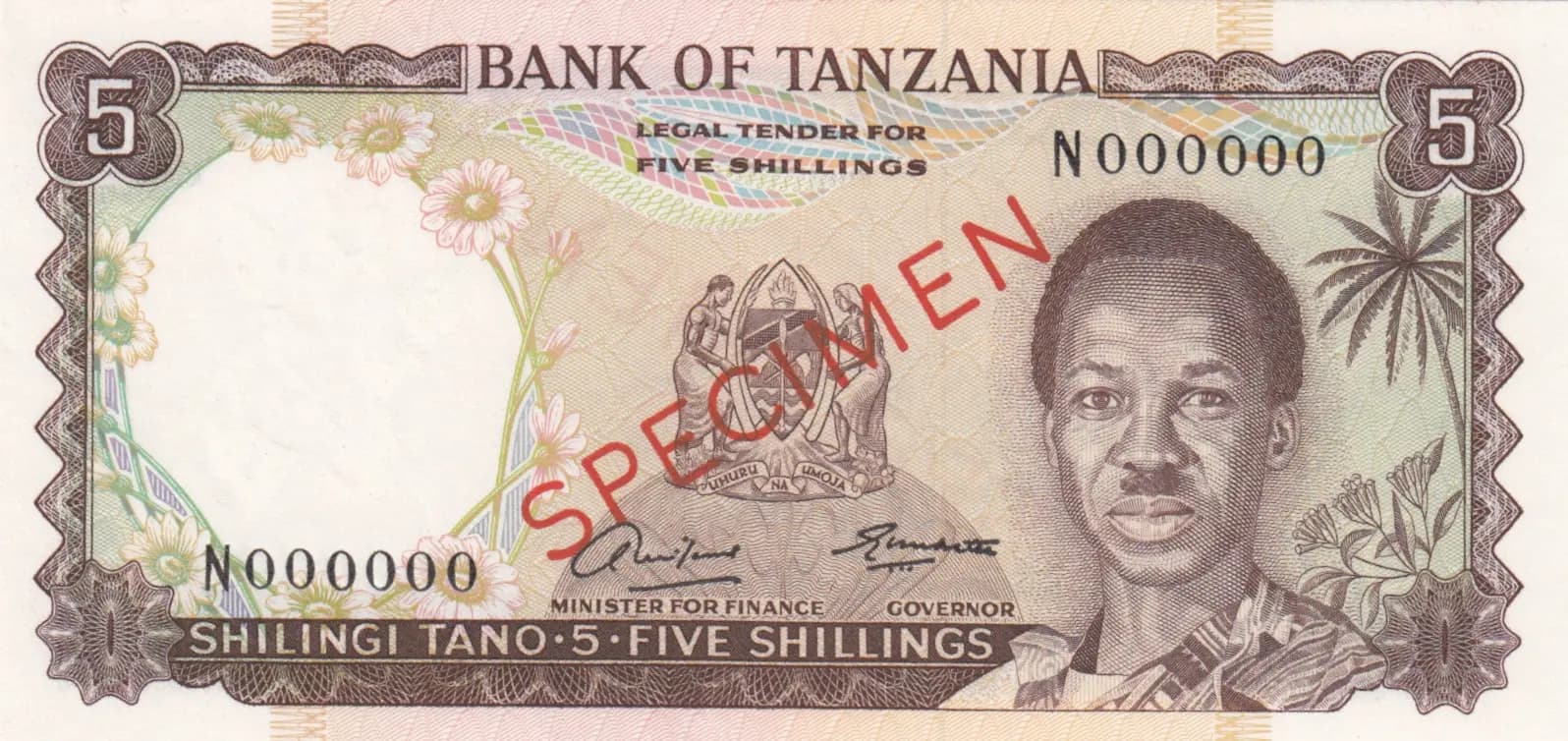
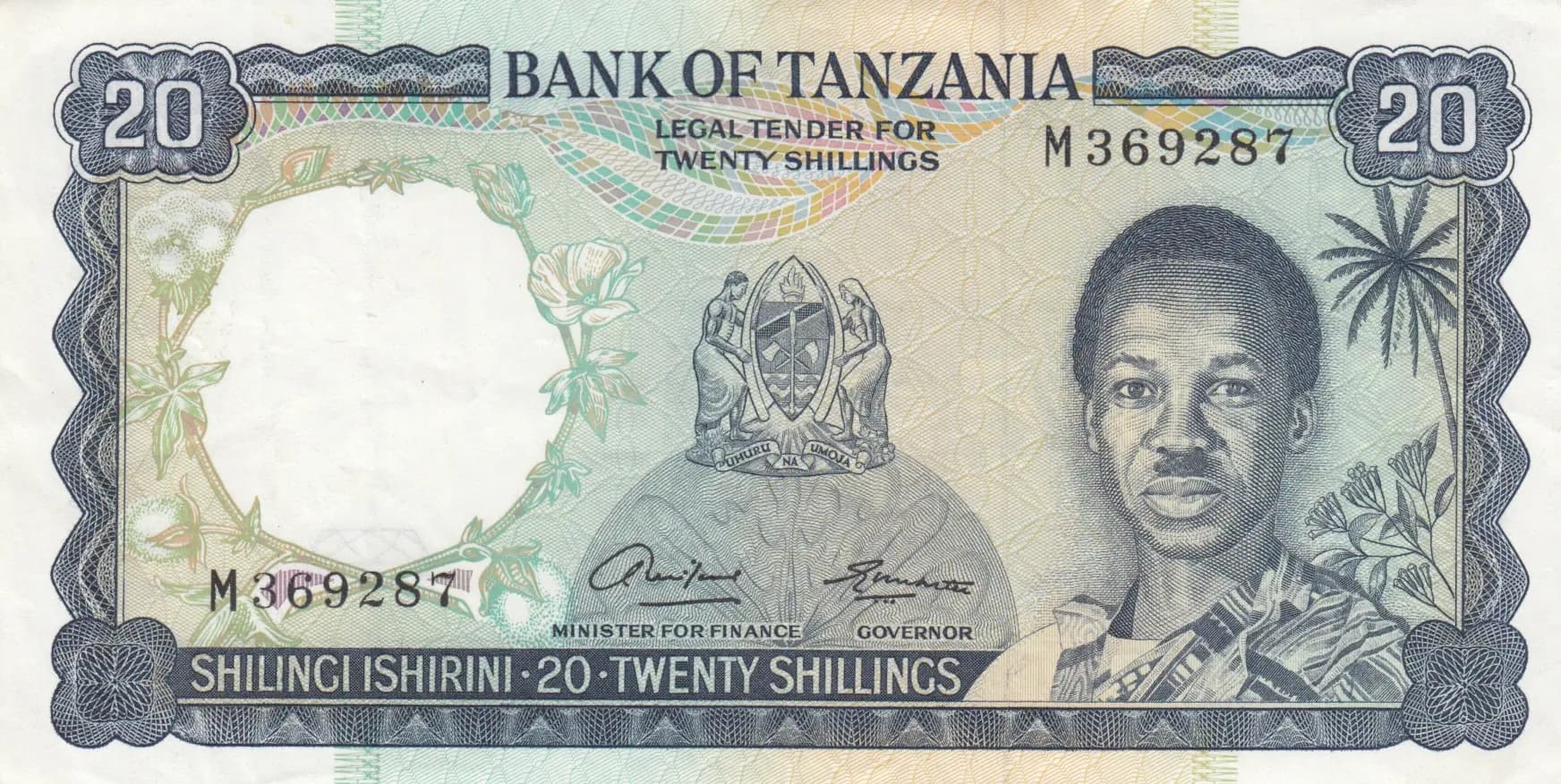
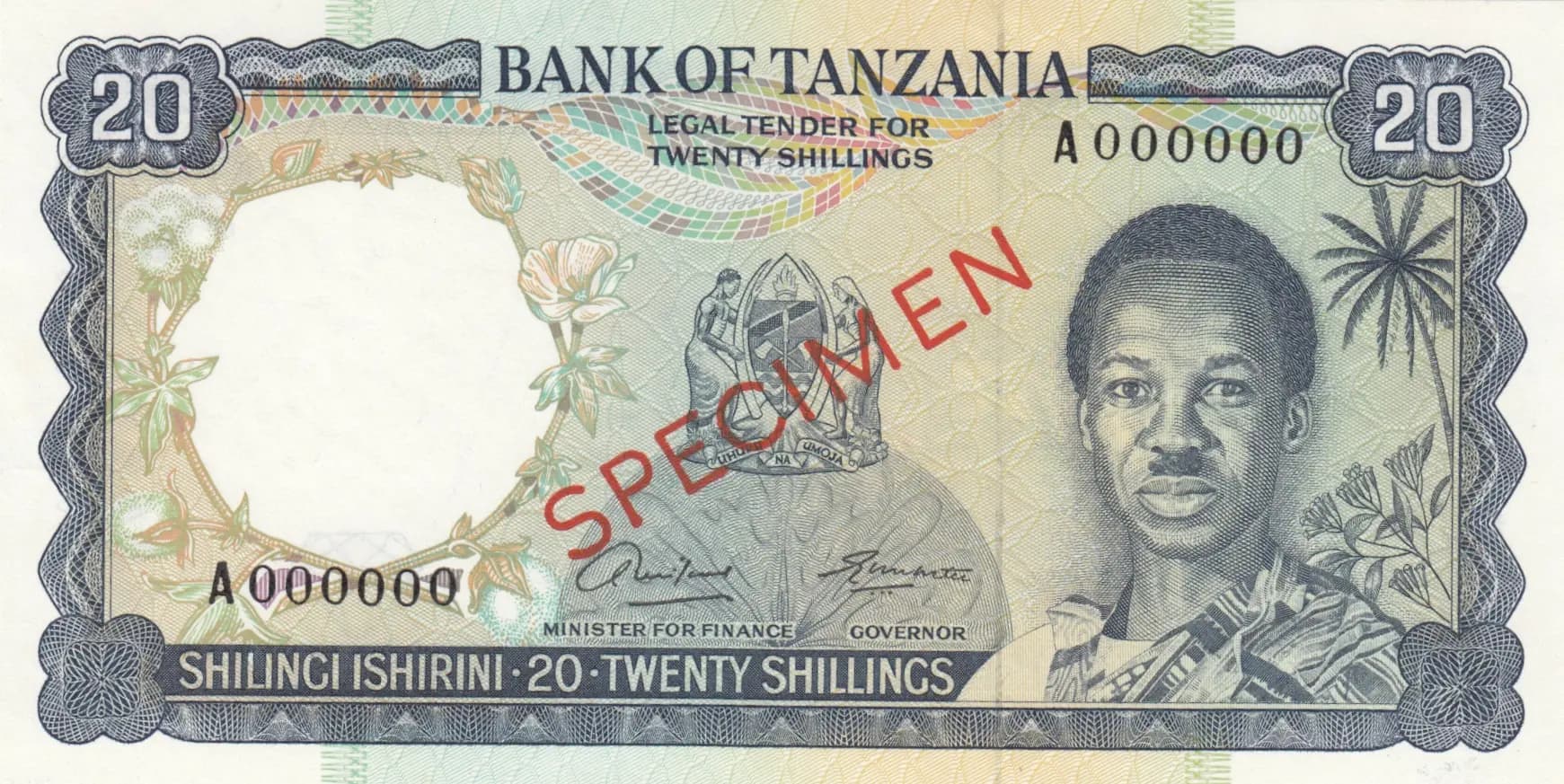
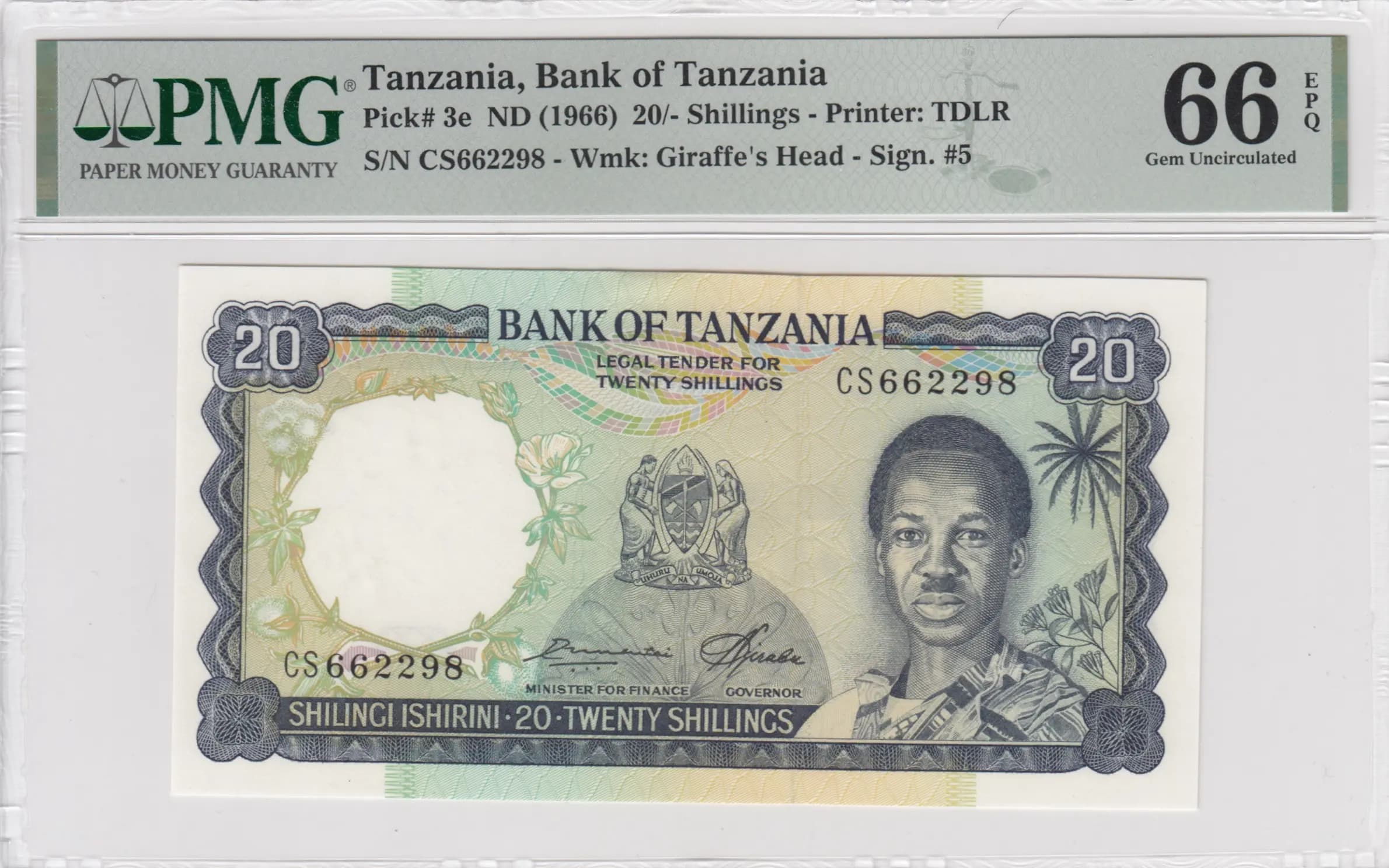
10 shillings 1966 specimen
Market Prices
10 salesAbout This Note
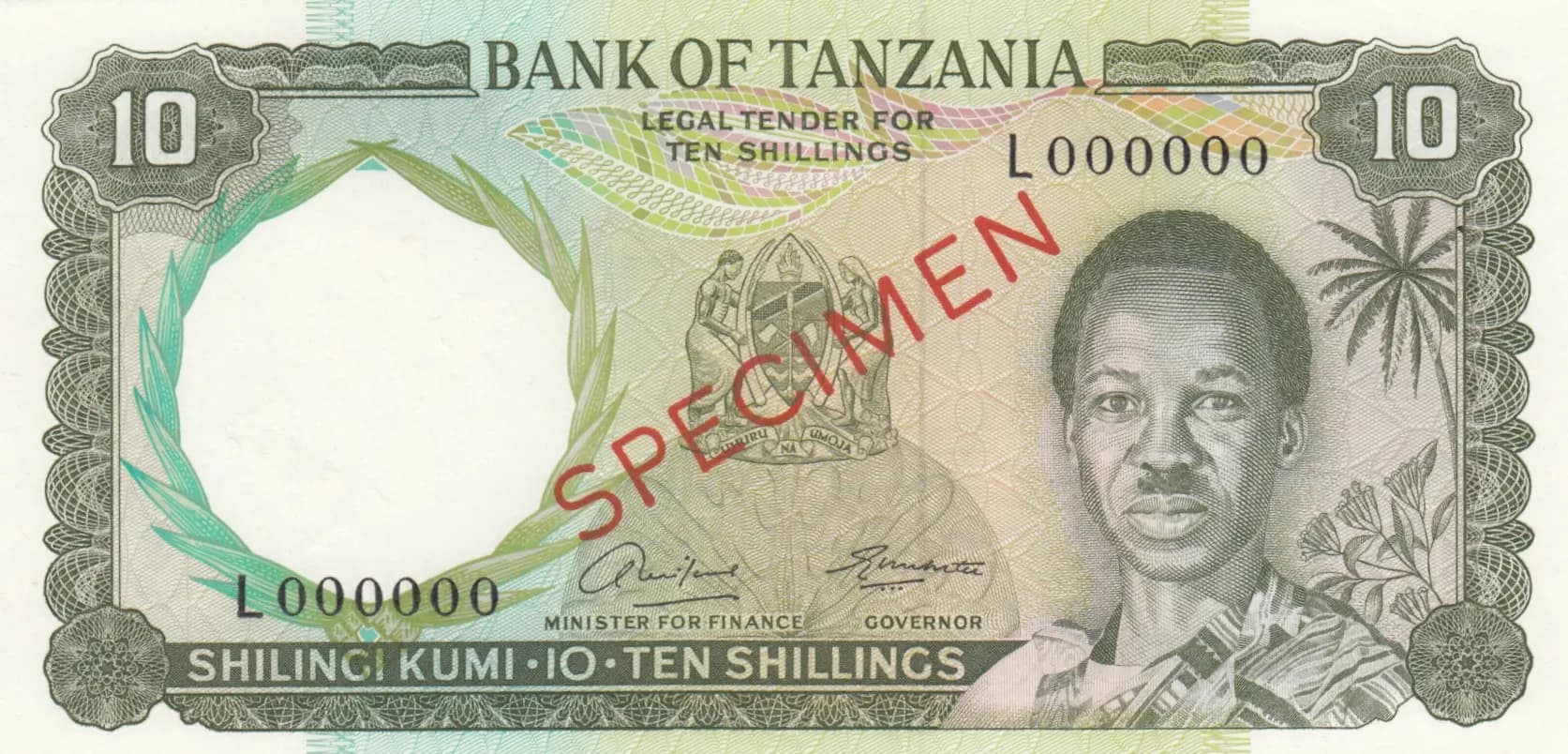
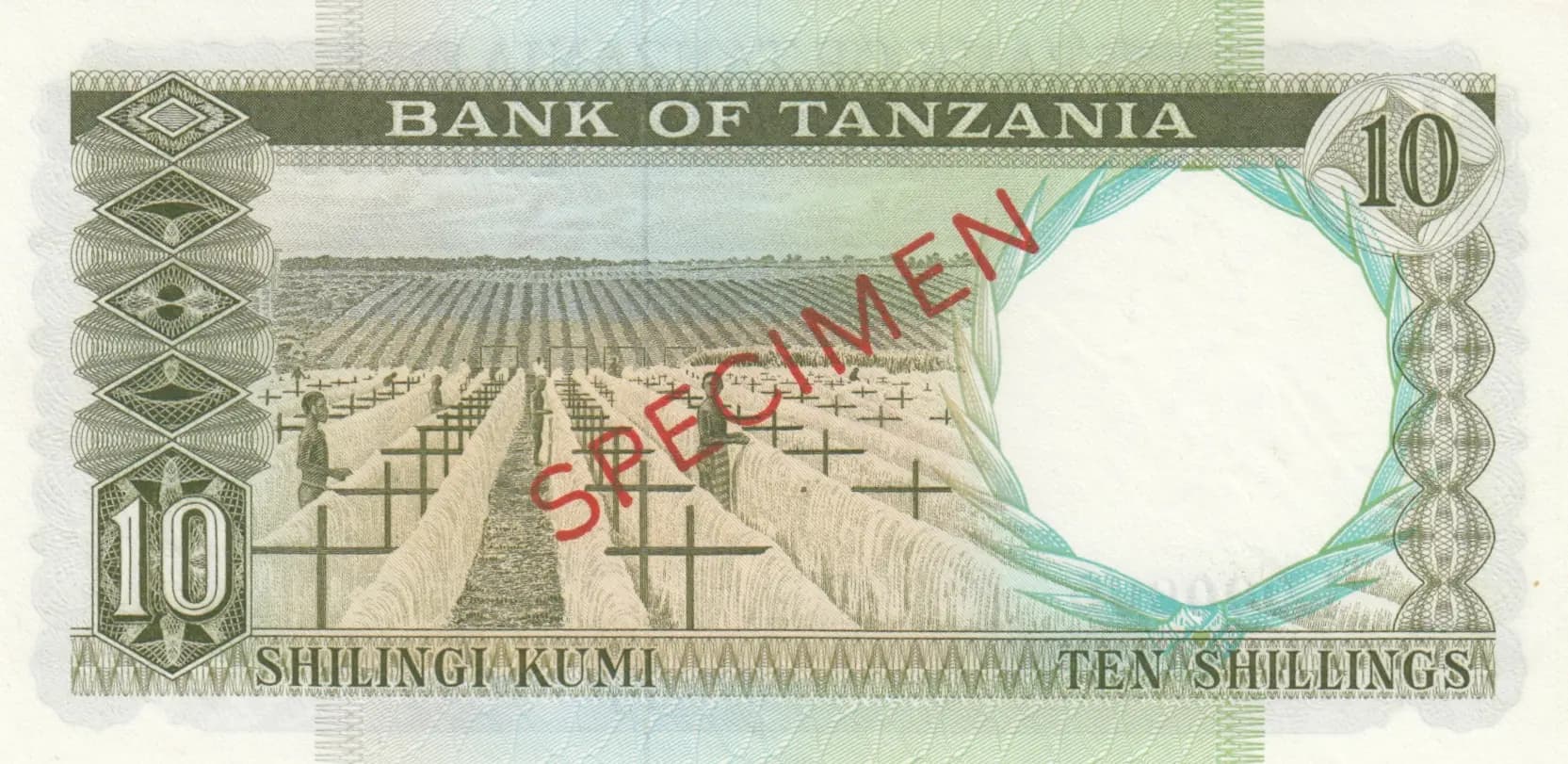
This is a pristine specimen note of Tanzania's first 10 shillings banknote from 1966, issued by the newly independent Bank of Tanzania. The note displays exceptional quality with vibrant green and multicolor printing, featuring President Julius Nyerere's portrait and the national coat of arms on the obverse, and a distinctive agricultural landscape with memorial crosses on the reverse—both marked with diagonal red SPECIMEN overprints. As an uncirculated specimen example of this historically significant first issue, it represents an important piece of East African numismatic history from the nation's early independence period.
Common. Market data from eBay sales shows this denomination trading consistently in the $3–$21.50 range depending on condition, with UNC examples cataloged at $9 (2019 values). Specimen notes, while technically not currency, are regularly produced for distribution to banks and collectors and are typically more common than circulation issues. The 1966 first issue had a substantial print run as the inaugural currency of the new central bank, and examples remain readily available in the numismatic market.
This note was issued in 1966, just five years after Tanzania gained independence from British rule, marking the Bank of Tanzania's inaugural currency issuance under the leadership of President Julius Kambarage Nyerere. The portrait of Nyerere on the obverse reflects his dominant role in the nation's founding and early development, while the reverse's depiction of what the catalog describes as sisal production represents a critical agricultural commodity for Tanzania's post-independence economy. The bilingual Swahili-English inscriptions demonstrate the new nation's commitment to Swahili as a national language while maintaining English as an official language during this transition period.
The obverse features President Julius Kambarage Nyerere positioned at right, rendered in fine detail with formal engraving typical of central bank currency. The Tanzania coat of arms—displaying a shield with cross and heraldic elements—occupies the central space. Ornamental leafy wreath designs frame the left border, while tropical palm frond motifs appear on the right, reflecting Tanzania's equatorial geography. The reverse depicts an agricultural field scene representing sisal production, with rows of white elements (likely representing drying sisal or agricultural plots) arranged in a perspectival landscape, bordered by geometric diamond and eye-motif patterns on the left margin. Complex guilloche patterns and fine line work appear throughout both sides, indicating high-security engraving standards.
Front side: 'BANK OF TANZANIA' (issuing authority); 'LEGAL TENDER FOR TEN SHILLINGS' (legal tender declaration); 'SHILINGI KUMI / TEN SHILLINGS' (denomination in Swahili and English); 'MINISTER FOR FINANCE' and 'GOVERNOR' (signature titles); '10' (numeral denomination); 'L000000' (specimen serial number); 'SPECIMEN' (specimen overprint in red). Reverse side: 'BANK OF TANZANIA' (issuing authority); 'SHILINGI KUMI' (denomination in Swahili); 'TEN SHILLINGS' (denomination in English); '10' (numeral denomination); 'SPECIMEN' (specimen overprint in red).
Intaglio (engraved) printing on banknote paper, evidenced by the fine guilloche patterns, intricate line work, and the precision of the portrait and heraldic details visible in the specimen. The multicolor printing technique combines green as the dominant color with brown/tan, cream, and black inks. The red diagonal SPECIMEN overprint is applied separately, as is standard practice for specimen notes. While the specific security printer for this Pick number variant (P-2as) is not definitively identified in the provided references, the catalog data references TDLR (Thomas De La Rue) as the printer for various other 10 shilling variants in the series.
This is the specimen variant (P-2as) of the first issue 10 shillings, as indicated by the red diagonal SPECIMEN overprint and specimen serial number (L000000). The PMG population report documents 25 variants of the P-2 base number, with varieties differentiated by printer (TDLR), watermark (Giraffe's Head), and specimen/regular issue designation. This specific note exhibits the characteristic giraffe head watermark and represents the specimen issue variant. Replacement notes (denoted by ZZ or ZY serial prefixes) exist but are not present on this specimen example.