20 shillings 1966
Market Prices
7 salesAbout This Note
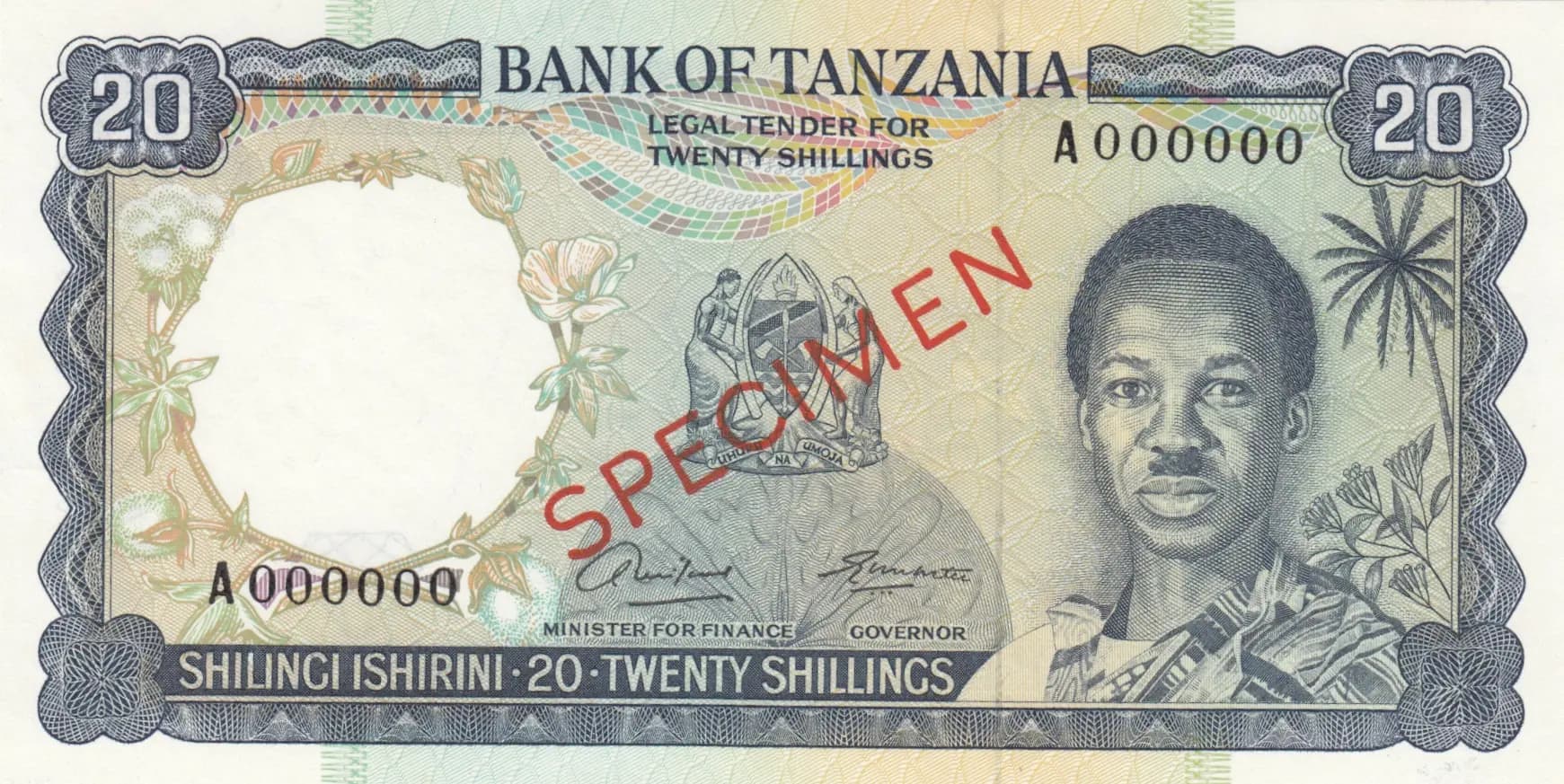
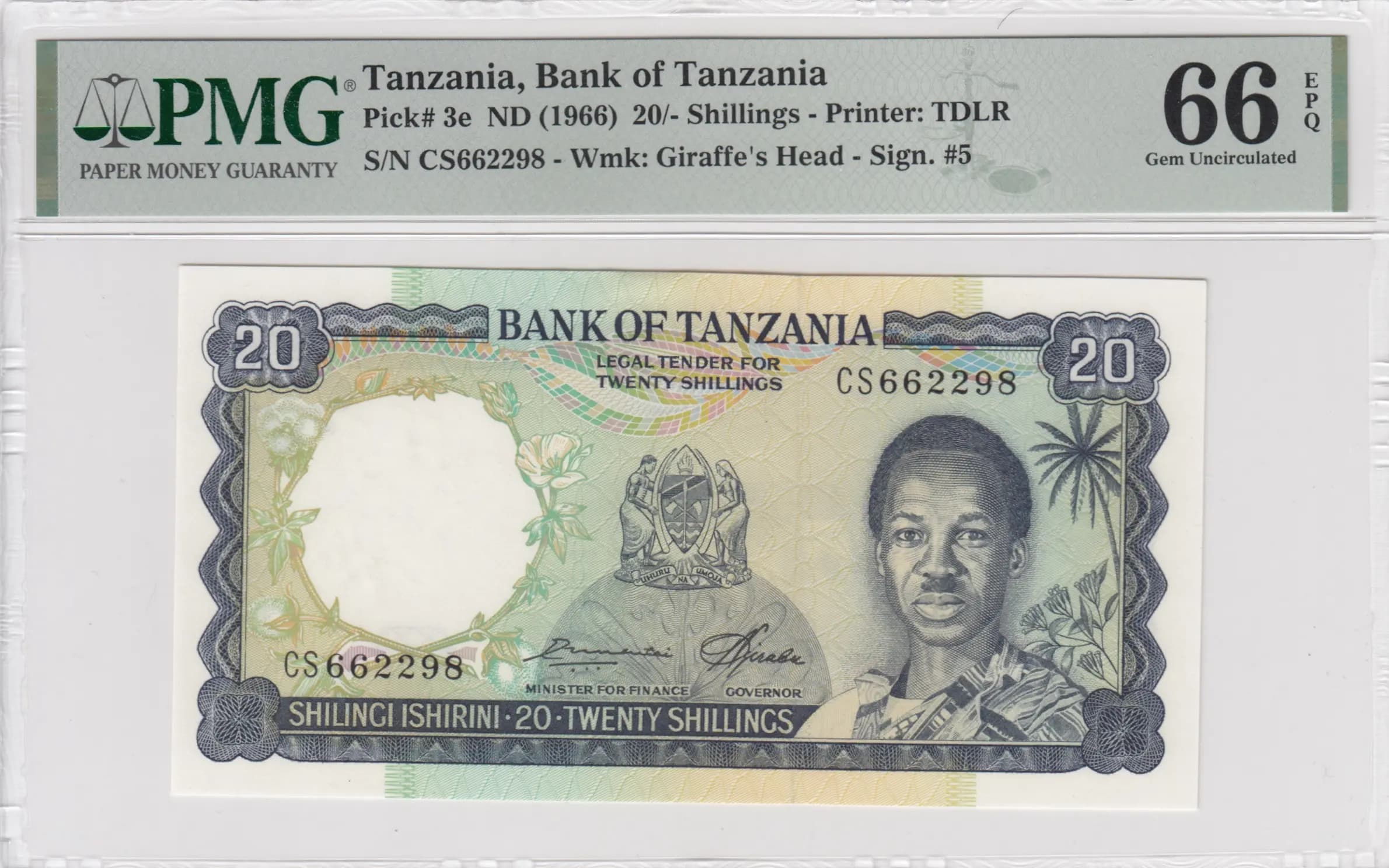
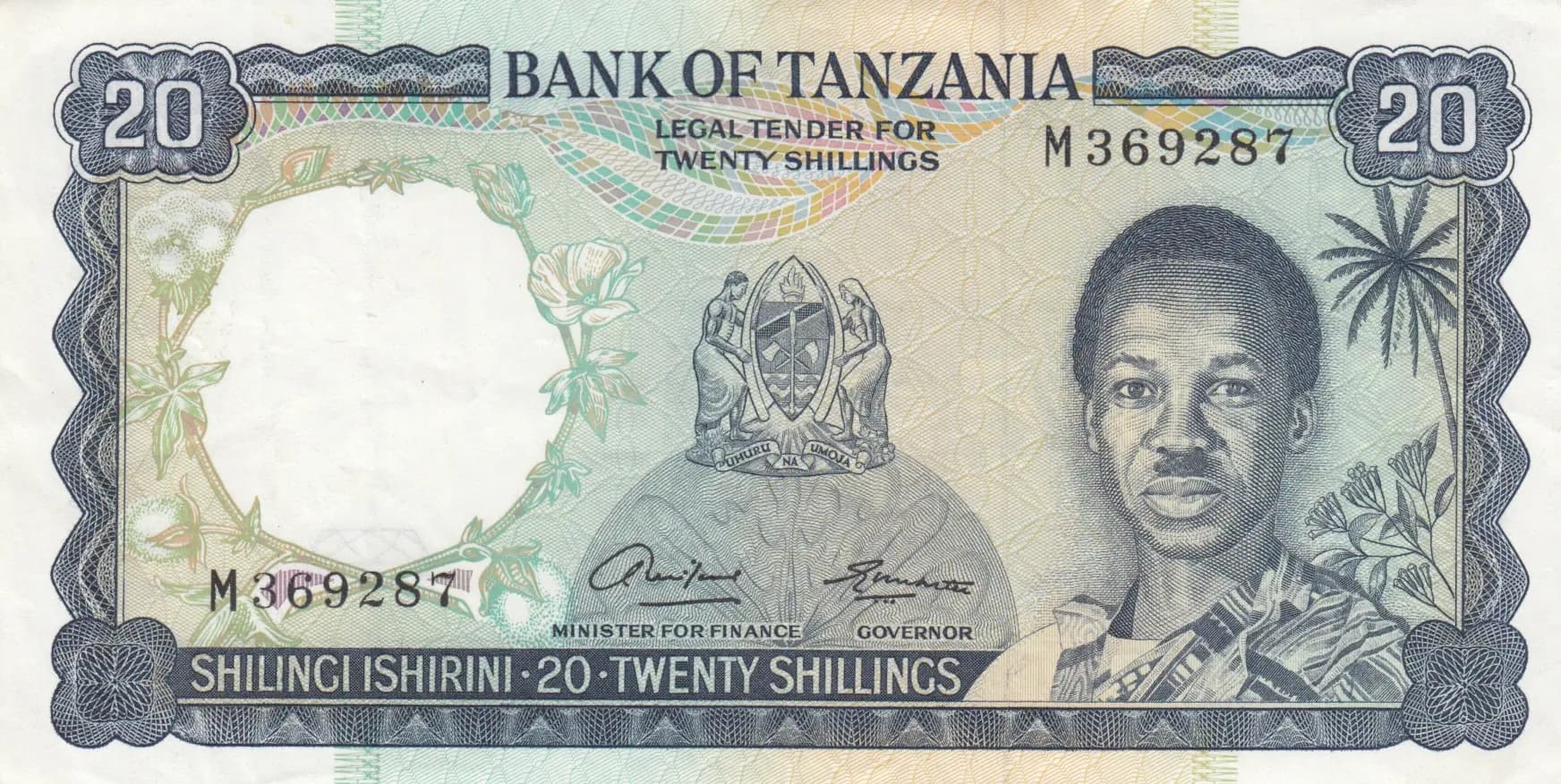
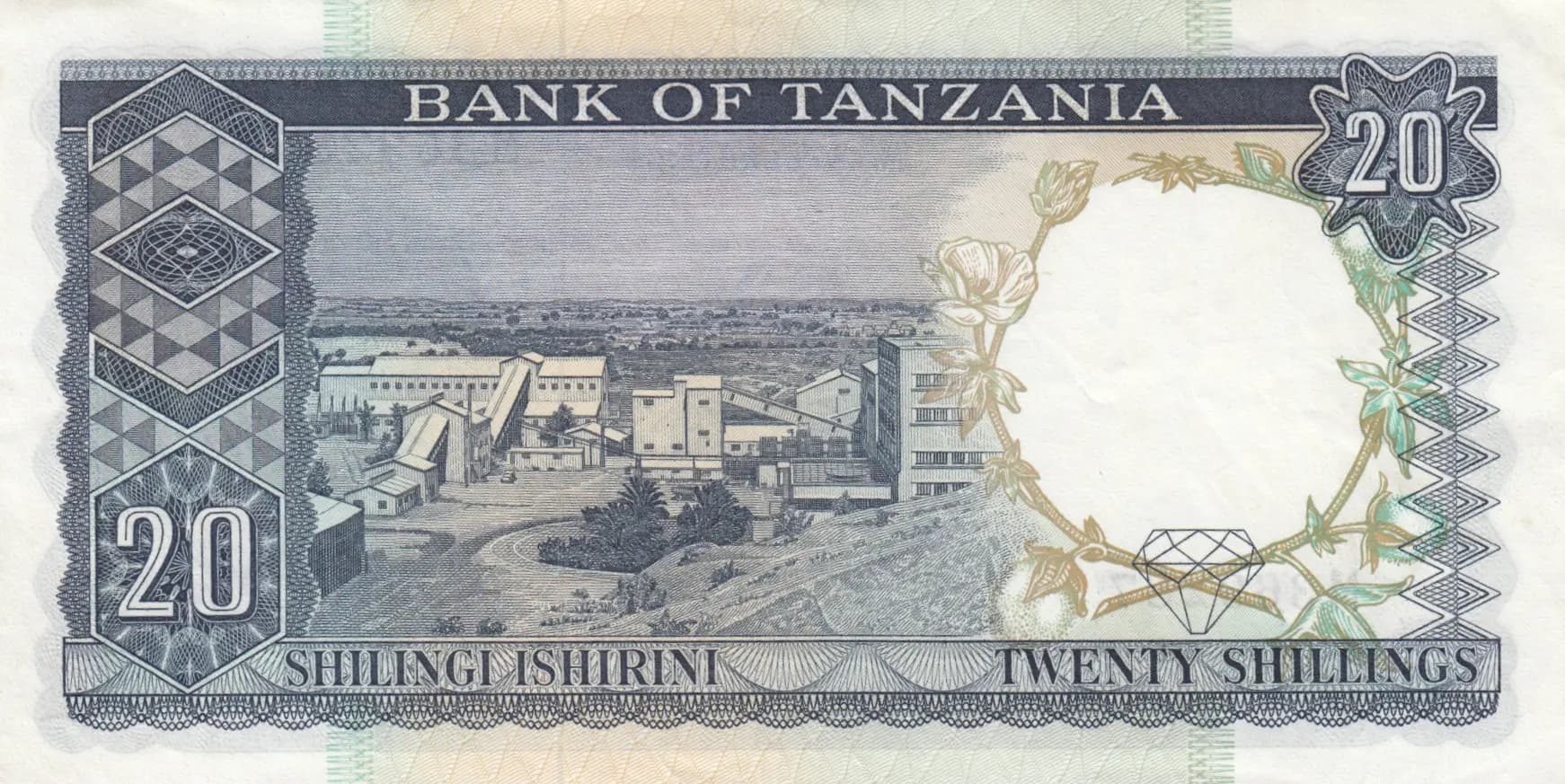
This is a crisp, well-preserved example of Tanzania's first banknote issue, the 20 Shillings P-3a from 1966, appearing to be in VF or near-UNC condition with no visible signs of circulation, creases, or wear. The note features a distinguished portrait of President Julius Nyerere on the obverse and an industrial factory complex on the reverse, representing the nation's development aspirations at independence. As one of the earliest notes from the newly established Bank of Tanzania, this example captures an important moment in East African numismatic history with its elegant green and blue color scheme and fine engraving work.
Common. This is a regular-issue banknote from Tanzania's first currency series with a substantial print run. The eBay market data provided shows VF examples selling in the $3–$9 range (2012–2018), with 2019 catalogue values at $5 for VF, indicating steady but modest collector demand. The note is readily available on the secondary market, and no factors suggest limited distribution or a recall. Most examples encountered are common in circulated to near-uncirculated grades.
This note was issued in 1966, just four years after Tanzania's independence, when the newly formed Bank of Tanzania began its currency operations under the leadership of President Julius Kambarage Nyerere. The reverse design's prominent factory imagery reflects the nation's post-colonial focus on industrialization and economic development during the early years of the Tanzanian state. The bilingual inscriptions in English and Swahili on the note symbolize the transition to Swahili as a national language, marking a deliberate break from the colonial past and assertion of national identity.
The obverse features a prominent right-facing three-quarter portrait of President Julius Kambarage Nyerere, the founding father of independent Tanzania, rendered in formal attire and positioned on the right side of the note. The center of the obverse displays the Tanzanian national coat of arms—a circular emblem featuring two figures (leopards or supporting figures) holding a shield with a flame above it and a text banner below, symbolizing national sovereignty. The left side is embellished with decorative botanical floral elements, while a palm tree appears on the right edge, evoking Tanzania's tropical landscape. The reverse presents an industrial landscape panorama depicting a factory complex with multiple manufacturing buildings, smokestacks, and industrial infrastructure set against hills or mountains in the background, framed by geometric diamond and hexagonal patterns on the left border and decorative floral botanical elements on the right. The overall palette emphasizes green, blue, cream, and beige tones with detailed black line engraving throughout.
Front side: 'BANK OF TANZANIA' (English) - issuing authority; 'LEGAL TENDER FOR TWENTY SHILLINGS' (English) - legal tender declaration; 'SHILINGI ISHIRINI · 20 · TWENTY SHILLINGS' (Swahili and English) - denomination in both languages; 'MINISTER FOR FINANCE' and 'GOVERNOR' (English) - signature lines for officials; Serial number 'M369287' (English). Back side: 'BANK OF TANZANIA' (English) - issuing authority; 'SHILINGI ISHIRINI' (Swahili) - twenty shillings; 'TWENTY SHILLINGS' (English) - denomination in English; '20' (numerals) - denomination markers in ornate cartouches.
The note was produced using intaglio engraving, evidenced by the fine line work, complex guilloche patterns, detailed security features, and the characteristic crisp impression visible throughout both obverse and reverse. The printer for P-3a was TDLR (likely Tanzania's De La Rue or a De La Rue printing operation), as indicated in the PMG population report. The scalloped decorative borders, geometric patterns, and intricate portraiture are hallmarks of high-security intaglio printing typical of 1960s banknote production.
This note is catalogued as P-3a, one of several varieties within the 20 Shillings issue. According to the PMG population report, the 20 Shillings base number includes at least six documented varieties: P-3a, P-3as (replacement notes with ZZ/ZY serial prefix), P-3c, P-3d, P-3e, and P-3s. The observed serial number prefix 'M' on the specimen shown is consistent with regular-issue P-3a notes. Replacement notes (P-3as) are distinguished by serial number prefixes ZZ and ZY. The specific variety here is P-3a (regular issue, TDLR printer), and the note appears to be a standard printing without replacement prefixes.