5000 francs 1985
About This Note
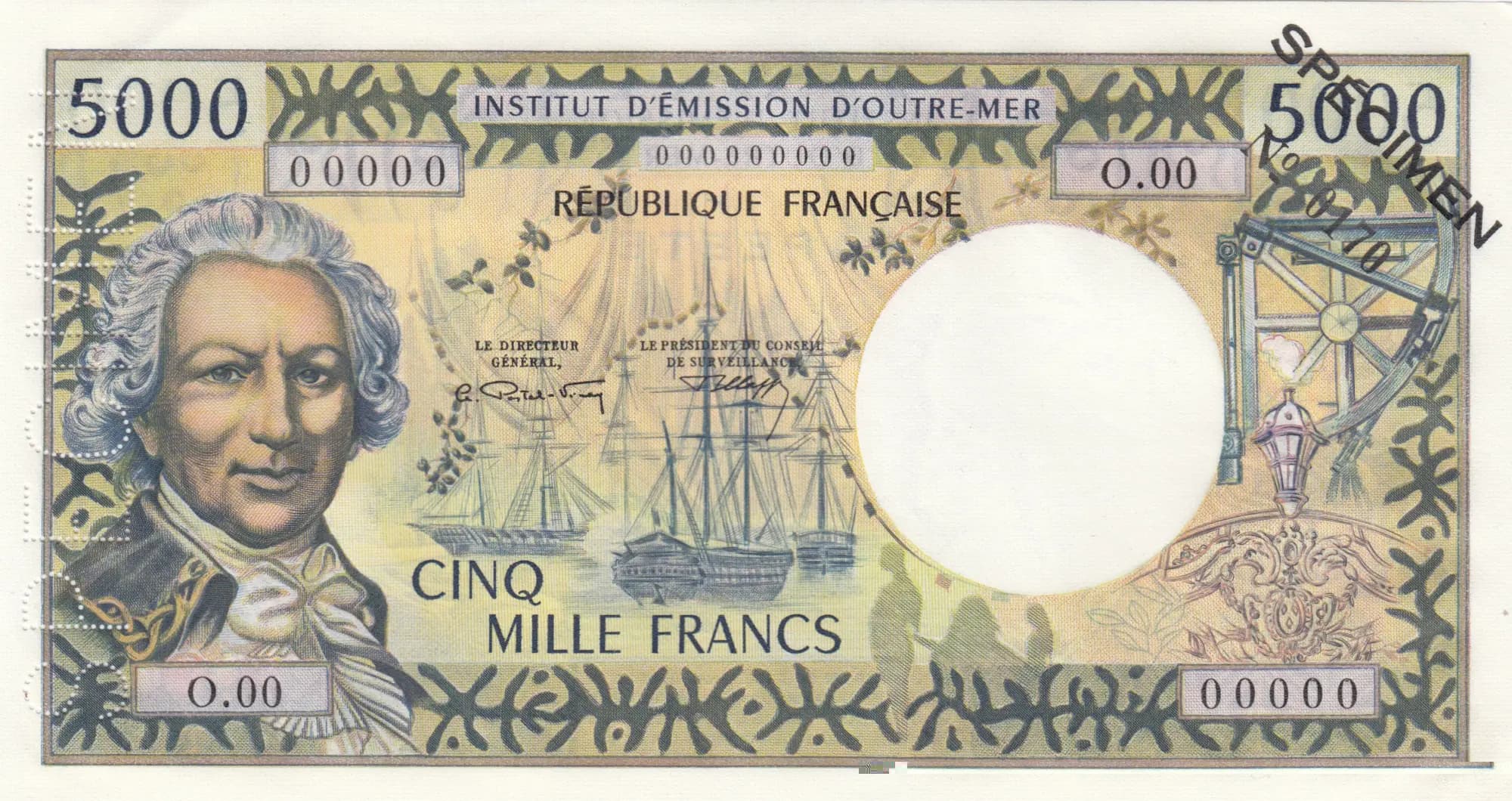
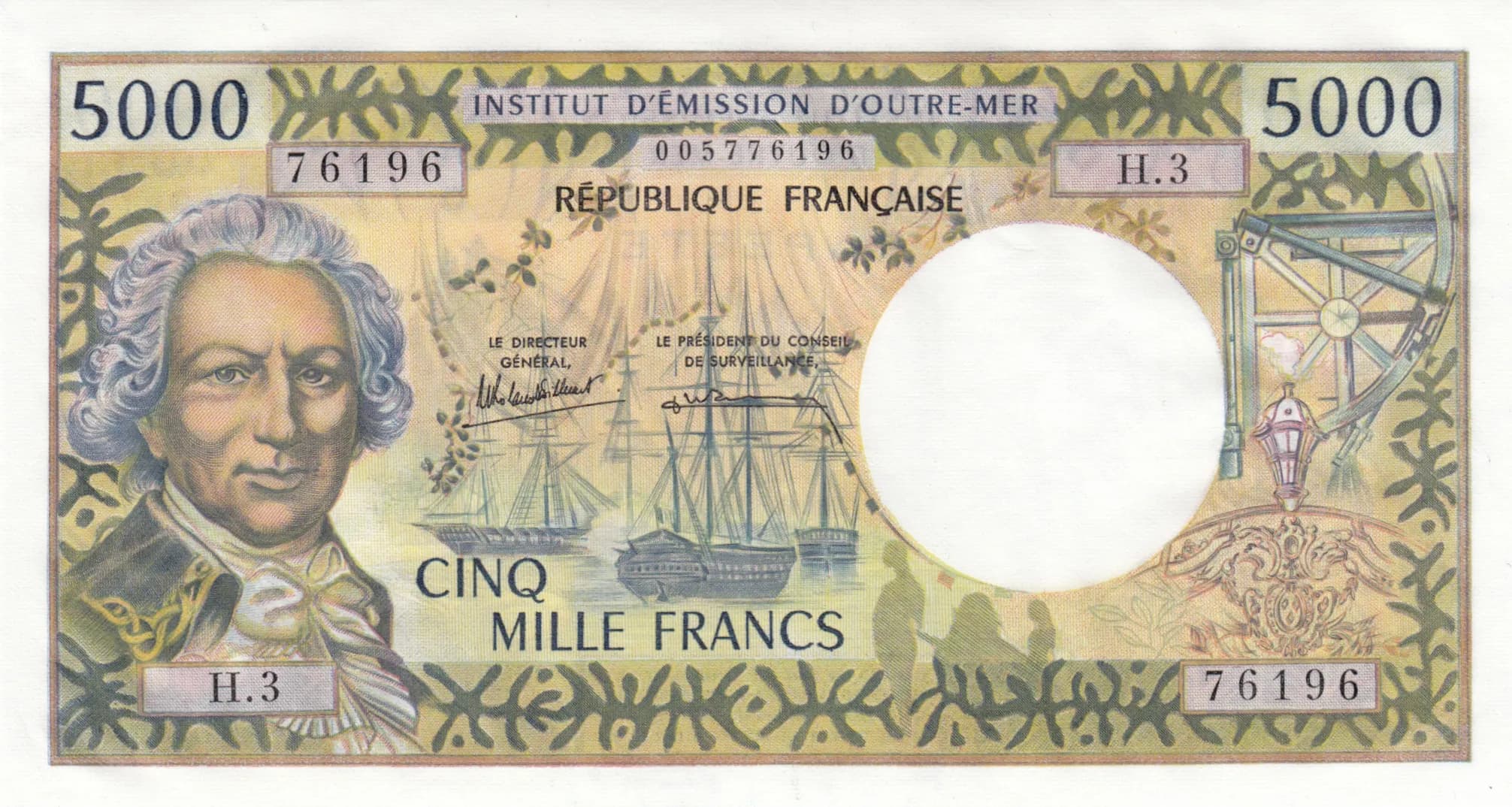
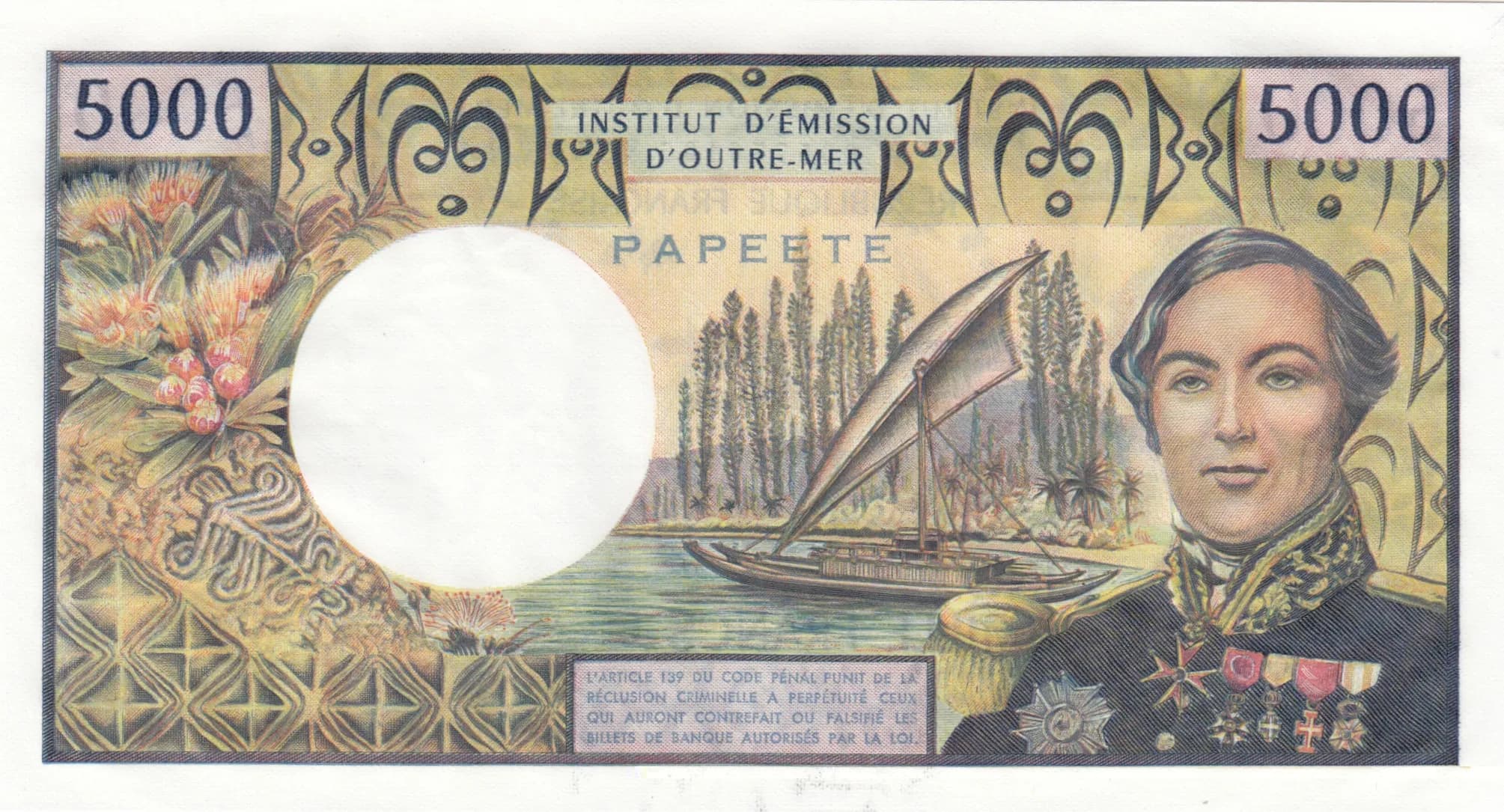
This is an exceptional example of the 1985 Tahitian 5000 Francs (Pick P-28d) issued by the Institut d'Emission d'Outre-Mer, presented in uncirculated condition with pristine surfaces and no signs of circulation. The note features elegant maritime and colonial imagery with a predominantly cream and beige palette enriched by green, gold, and blue-gray accents, showcasing sophisticated intaglio engraving throughout. The dual portraiture—an 18th-century historical figure on the obverse and a decorated military officer on the reverse—combined with detailed sailing ship vignettes and tropical landscape elements, makes this a visually compelling representation of French Polynesian currency.
Common. The 5000 Francs denomination from this 1985 issue was part of regular circulation currency for French Polynesia and is not known to have had a restricted print run or early recall. These notes were produced in significant quantities to meet transactional demand in Tahiti and other French Pacific territories. While uncirculated specimens are always more desirable than circulated examples, this Pick number itself shows no indicators of scarcity—no documented short print run, no recalled series, and no historical accounts of limitation. The condition grade of UNC adds collector value but does not alter the underlying common status of this catalog number.
Issued in 1985, this banknote reflects Tahiti's status as a French overseas territory during the mid-1980s, with the Institut d'Emission d'Outre-Mer serving as the issuing authority for French Pacific possessions. The iconography emphasizes colonial maritime heritage through the prominent depiction of full-rigged sailing ships on the obverse and a tropical river scene with traditional vessels on the reverse, while the military officer portrait likely commemorates a significant colonial administrator or naval figure. The note's design language, combining 18th-century European portraiture with Polynesian landscape elements, encapsulates the historical relationship between France and its Pacific territories.
The obverse features a portrait of a distinguished historical figure, likely from the 18th century, positioned on the left side with characteristic curled hair and formal period attire including a ruffled collar, rendered in fine intaglio detail. The central composition showcases multiple full-rigged sailing ships with elaborate rigging, symbolizing the maritime exploration and colonial trade routes that defined French expansion into the Pacific. Ornamental borders incorporate leaf and vine patterns with compass rose design elements, establishing a nautical theme throughout. The reverse presents a military or naval officer in uniform, shown in right-facing profile with visible medals, orders, and decorations on the chest, symbolizing colonial administrative authority. The landscape features a tropical river scene with palm trees, coniferous vegetation, mountainous backgrounds, and a traditional sailing vessel (possibly a Polynesian canoe), evoking the natural environment and indigenous maritime heritage of Tahiti. Watermarks are positioned prominently in circular areas on both sides, and signature lines are present for the Director General and President of the Supervisory Board.
FRONT: 'CINQ MILLE FRANCS' (Five Thousand Francs); 'INSTITUT D'EMISSION D'OUTRE-MER' (Overseas Issuing Institute); 'RÉPUBLIQUE FRANÇAISE' (French Republic); 'LE DIRECTEUR GÉNÉRAL' (The Director General); 'LE PRÉSIDENT DU CONSEIL DE SURVEILLANCE' (The President of the Supervisory Board); Denomination: '5000' (appears twice); Series/Plate: 'H.3'; Serial number segment: '76196'. BACK: 'INSTITUT D'EMISSION D'OUTRE-MER' (Overseas Issuing Institute); 'PAPETE' (Papeete, the capital); 'L'ARTICLE 139 DU CODE PÉNAL PUNIT DE LA DÉCHUSION CRIMINELLE À PERPÉTUITÉ CEUX QUI AURAIENT CONTREFAIT OU FALSIFIÉ LES BILLETS DE BANQUE AUTORISÉS PAR LA LOI' (Article 139 of the Penal Code punishes with permanent criminal degradation those who have counterfeited or falsified bank notes authorized by law); Denomination: '5000' (appears twice); Series/Plate: 'H.3'; Serial number segment: '76196'.
Intaglio (line engraving) printing method, evidenced by the finely detailed engraving visible throughout both sides, particularly in the portraiture, decorative borders, and landscape elements. The note exhibits the characteristic sharp lines, precise detail work, and subtle tonal gradations typical of high-security intaglio production. This printing technique was standard for French and French overseas banknote production during the 1980s. The printer is likely Banque de France or an affiliated security printer, as was customary for Institut d'Emission d'Outre-Mer currency production.
The observed specimen is identified as Pick P-28d, which represents a specific series variant of the 1985 5000 Francs issue. The series designation 'H.3' and serial number segment '76196' visible on the specimen may represent plate or batch variants within this Pick number. The specific signature combination and exact serial number range would define finer varieties, but without comprehensive comparative documentation of all 1985 series variants, the most precise identification available is the P-28d designation itself, which encompasses this printing period and issuer type.