100 francs 1971 specimen
About This Note
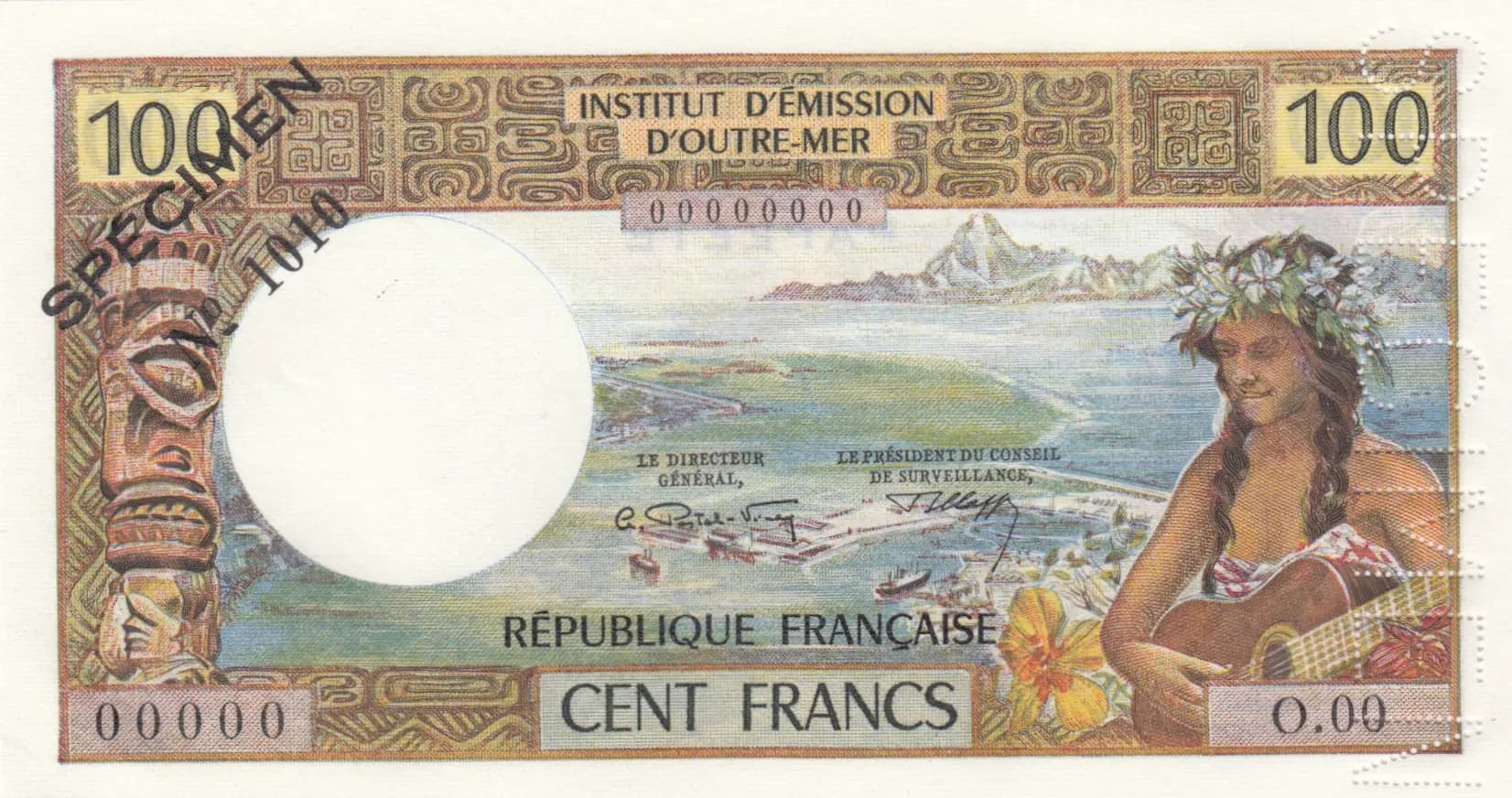
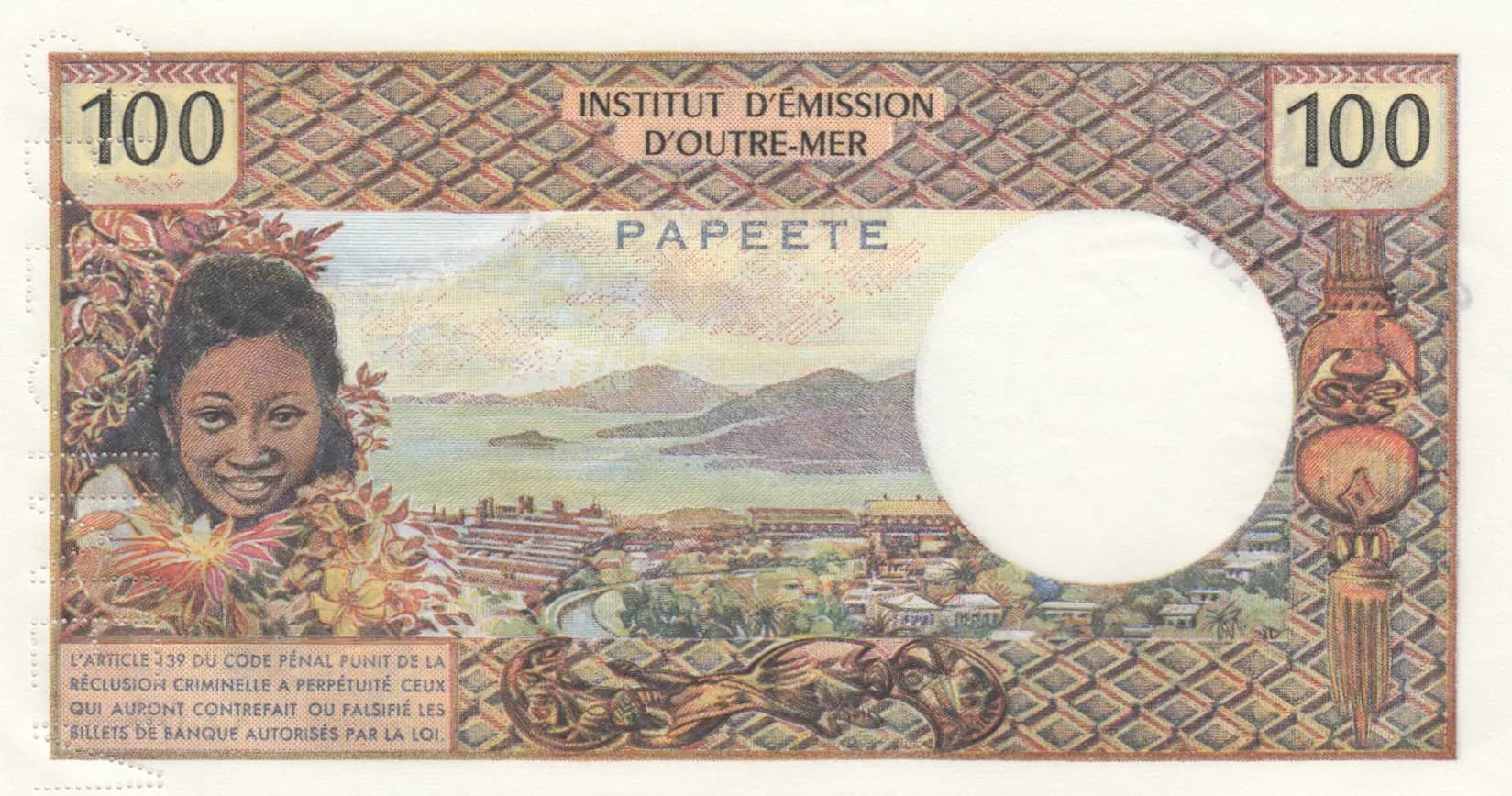
This is an uncirculated 1971 specimen note from Tahiti featuring vibrant tropical imagery and authentic Polynesian cultural elements. The front showcases a woman in traditional dress playing a guitar against a coastal mountain backdrop, while the reverse presents a smiling woman's portrait with floral decoration adjacent to a colonial-era Papeete settlement. As a specimen note from the Institut d'Emission d'Outre-Mer, this piece represents the French colonial monetary system in French Polynesia during the early 1970s, with exceptional clarity in its engraved details and pristine condition.
Common. This is a specimen note from the Institut d'Émission d'Outre-Mer's regular series for Tahiti/French Polynesia, issued in 1971. While specimen notes were produced in limited quantities compared to circulation notes, 100 franc denominations from this issuer and period are regularly encountered in the collector market. The Pick catalog (P-24s designation) indicates this is a documented, standard variety with no indication of exceptional scarcity. Specimen notes from this region and era typically trade in modest price ranges, and this note shows no characteristics suggesting it is from an unusually restricted mintage.
This note was issued during the final era of French colonial monetary control in Polynesia, when the Institut d'Émission d'Outre-Mer managed currency for overseas French territories. The depicted imagery—including the tropical coastal scenery, Papeete's colonial port buildings, and romanticized representations of Polynesian women in traditional dress—reflects how France presented its Pacific territories during this period. The 1971 date marks a transitional moment in Polynesian cultural representation on currency, balancing indigenous imagery with French colonial aesthetic traditions.
The front features a multipart composition with ornamental geometric and indigenous tiki-pattern borders framing a central scene. The prominent figure is a Polynesian woman adorned with a flower crown (lei), wearing traditional dress and holding a guitar, positioned against a tropical coastal landscape showing mountains, ocean, beach, and anchored boats. The circular watermark space occupies the center-left. The reverse employs similar decorative borders with diamond and cross-hatch geometric patterns and tiki-face designs in the corners. A Polynesian woman's portrait appears on the left, smiling and surrounded by floral ornamentation, with a second circular watermark area in the center-right. The background landscape depicts the colonial settlement of Papeete with period buildings, palm vegetation, mountains, and a bay. The color palette throughout emphasizes browns, tans, greens, blues, and rust tones, creating a tropical atmosphere while the intricate line work demonstrates classical banknote engraving tradition.
Front side: '100' / 'CENT FRANCS' (One Hundred Francs) / 'INSTITUT D'ÉMISSION D'OUTRE-MER' (Overseas Issuance Institute) / 'RÉPUBLIQUE FRANÇAISE' (French Republic) / 'LE DIRECTEUR GÉNÉRAL' (The Director General) / 'LE PRÉSIDENT DU CONSEIL DE SURVEILLANCE' (The President of the Supervisory Board) / 'SPECIMEN' (Specimen). Back side: '100' / 'INSTITUT D'ÉMISSION D'OUTRE-MER' (Overseas Issuance Institute) / 'PAPEETE' (Papeete, the capital of Tahiti) / 'L'ARTICLE 139 DU CODE PÉNAL PUNIT DE LA RÉCLUSION CRIMINELLE À PERPÉTUITÉ CEUX QUI AURAIENT CONTREFAIT OU FALSIFIÉ LES BILLETS DE BANQUE AUTORISÉS PAR LA LOI.' (Article 139 of the Penal Code punishes with life imprisonment those who have counterfeited or falsified banknotes authorized by law.)
Intaglio (copperplate) engraving with multi-color printing. The detailed geometric patterns, fine line work, and gradational shading visible throughout both sides are characteristic of high-security intaglio printing. The complex border ornamentation, tiki design elements, and detailed background landscape scenery required multiple engraved plates. This note was produced by the security printers engaged by the Institut d'Émission d'Outre-Mer, consistent with French banknote production standards of the early 1970s.
This is cataloged as Pick 24s, indicating the 's' suffix designates it as a specimen note. Specimen notes typically feature printed or overprinted 'SPECIMEN' markings (observed on this note), punch holes, or other defacement marks to prevent them from circulating. The specific signature varieties, serial number prefix patterns, and any date variations would be documented in comprehensive Pick or IBNS references for Tahitian currency, but the visual analysis confirms the standard specimen marking present on this example.