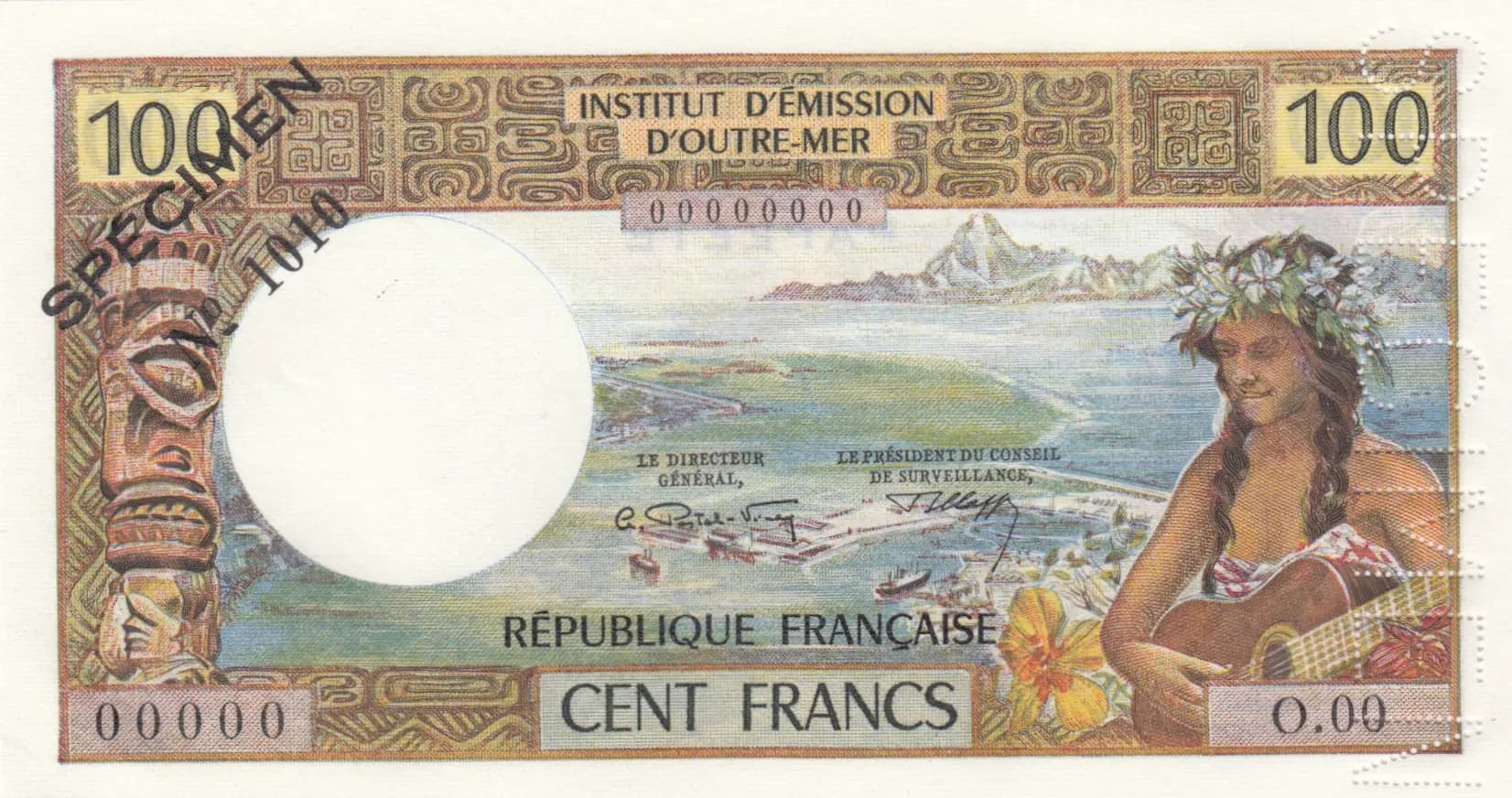
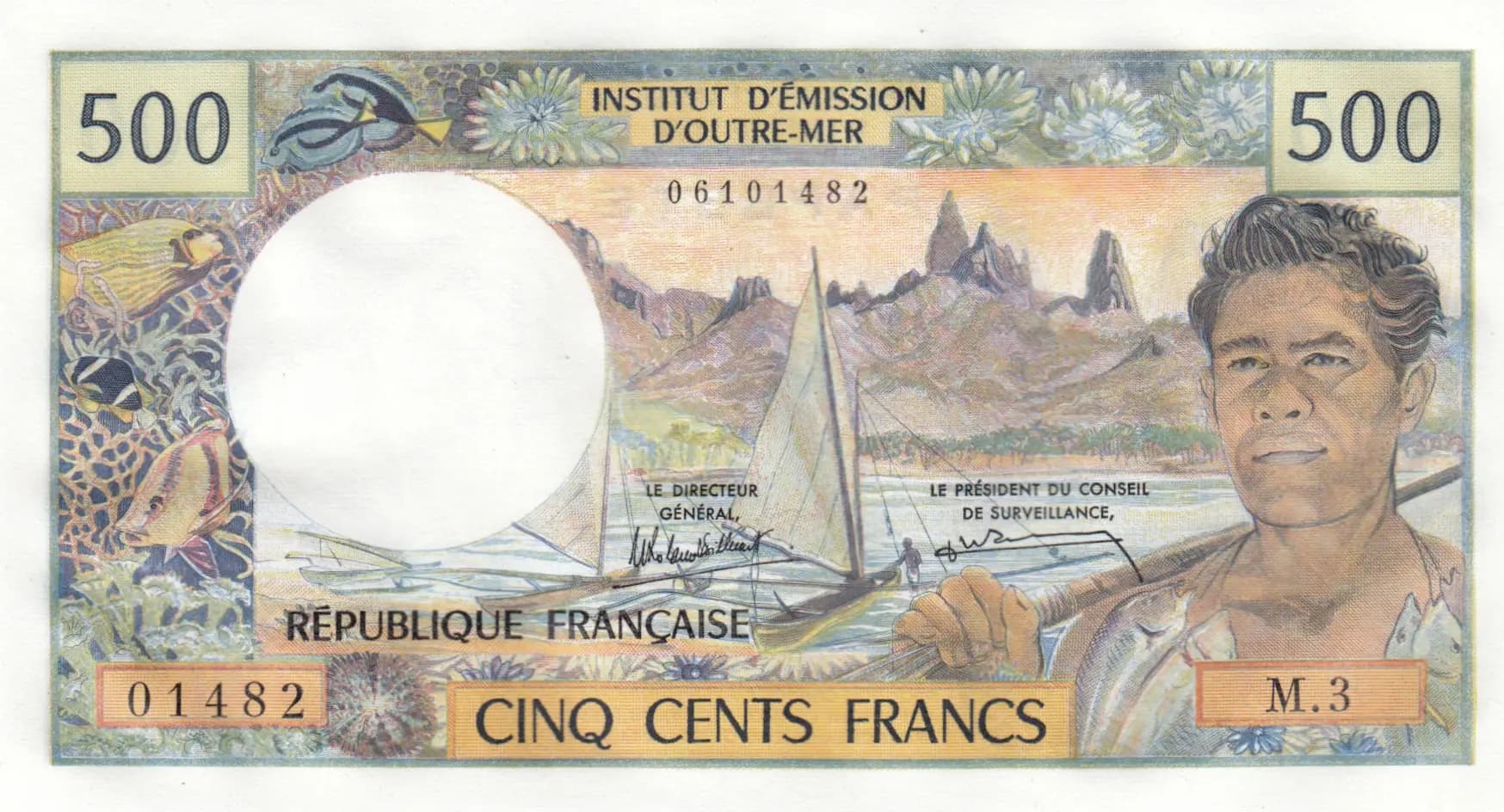
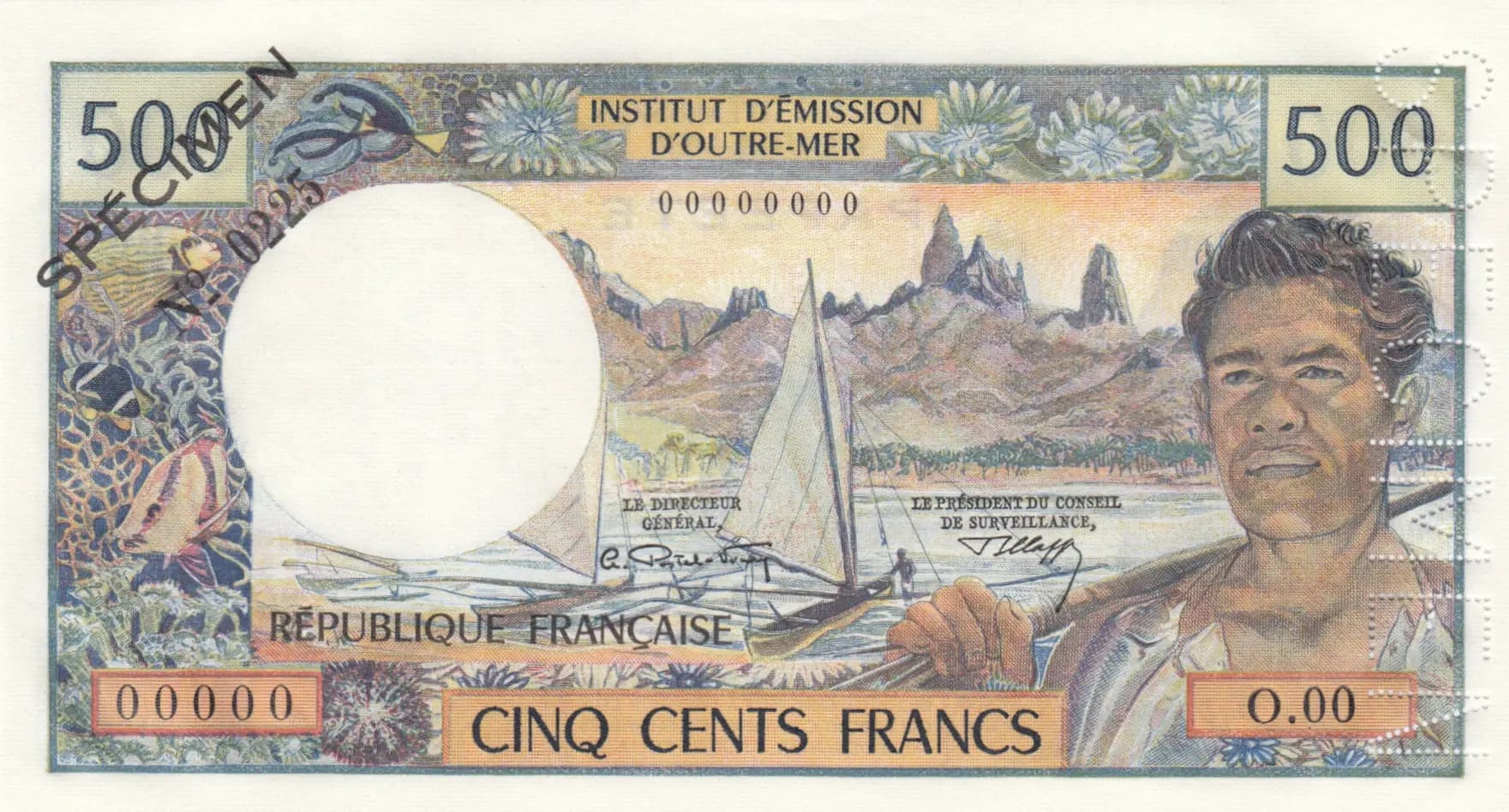
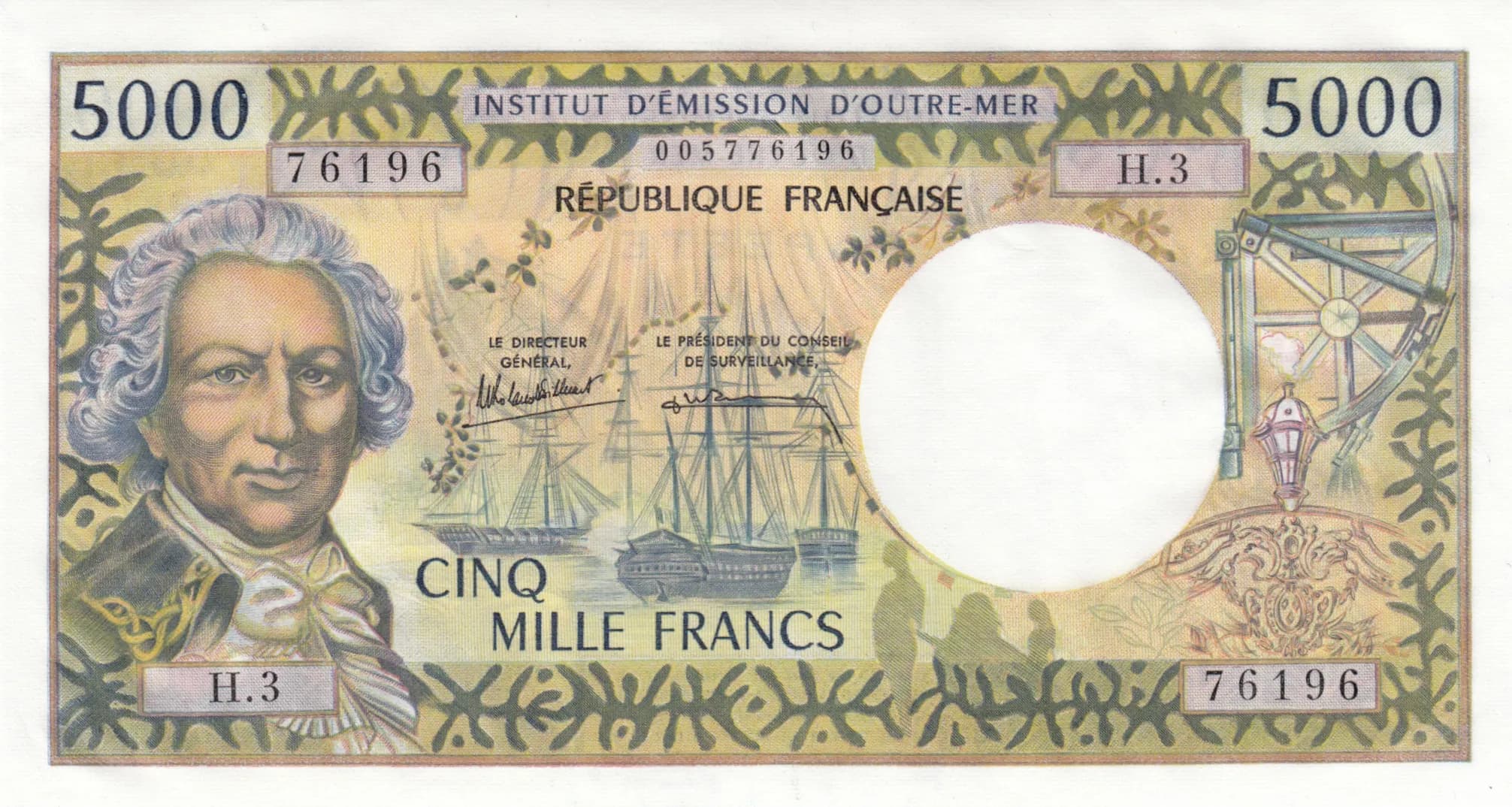
1000 francs 1971 specimen
About This Note
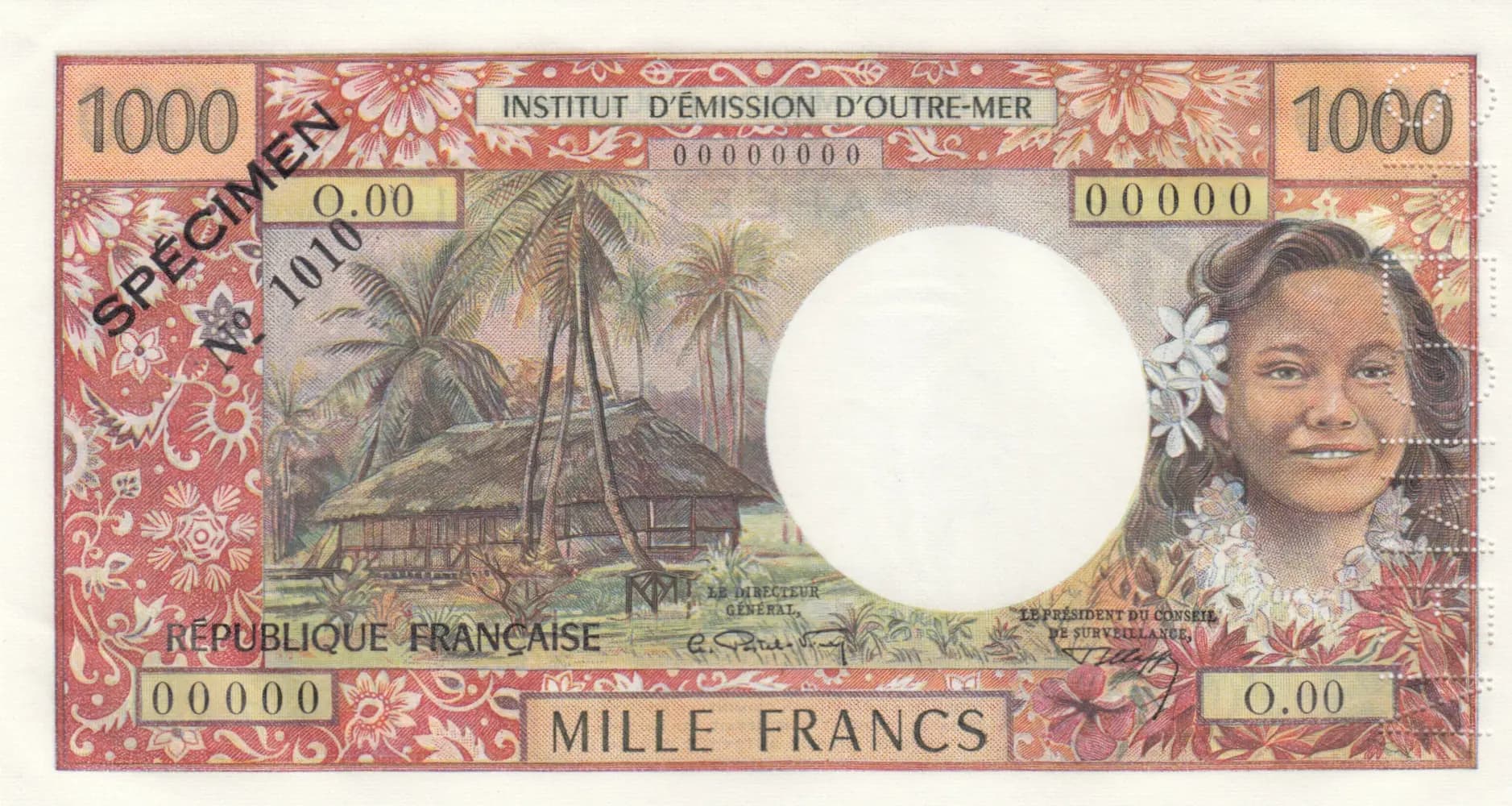
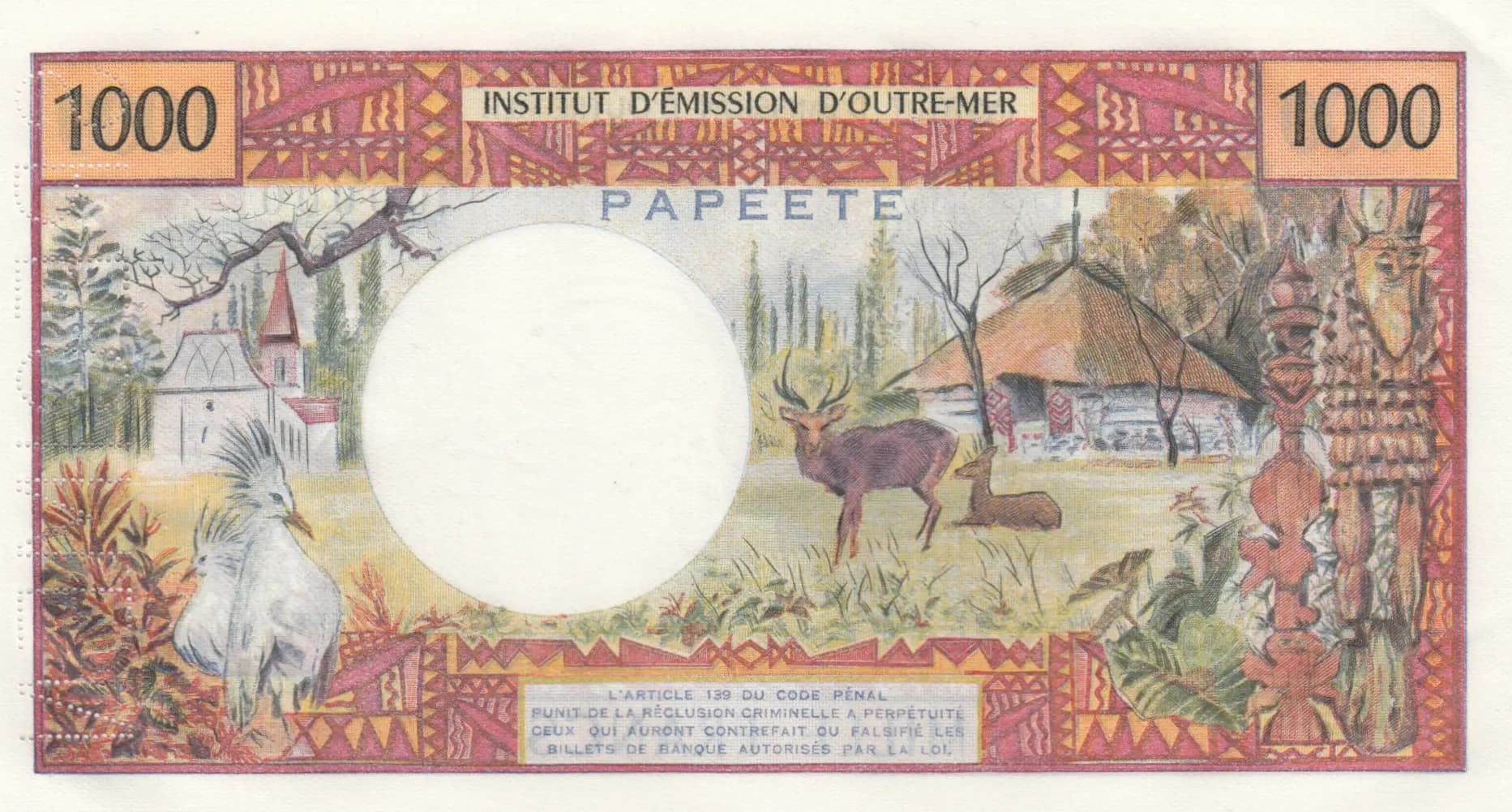
This is a 1971 Tahitian 1000 francs specimen note issued by the Institut d'Emission d'Outre-Mer, graded UNC. The note features vibrant, well-preserved artwork depicting Polynesian culture on both sides, with a woman adorned with white flowers on the obverse and a Papeete landscape including a church, tropical wildlife, and traditional architecture on the reverse. As a specimen note with all-zero serial numbers, this example represents an institutional or archival piece rather than currency in circulation, making it a desirable item for collectors of French overseas territories and Polynesian numismatics.
Common. While this is a specimen note from a French overseas territory with limited total circulation compared to metropolitan French notes, specimen examples of this Pick number appear with reasonable regularity in the market. The 1971 1000 francs Tahitian specimen is not from a particularly short print run, and specimen notes were produced specifically for distribution to banks and archives, resulting in substantial surviving quantities. Collector demand is moderate, and such notes typically trade in the $15–35 range, indicating common market availability.
This note was issued during a period when Tahiti and French Polynesia remained overseas territories of France under the Institut d'Emission d'Outre-Mer. The imagery—featuring the Papeete church, traditional Polynesian stilt houses, tropical flora, and indigenous cultural elements—reflects mid-20th century French colonial administration's romanticized presentation of Polynesian life. The 'République Française' inscription underscores Tahiti's status as a French overseas possession, while the specimen designation indicates this was a presentation piece for banking or governmental archives rather than circulation currency.
The obverse features a decorative border in red and cream tones framing the composition. The central vignette area is left blank (as is typical for specimens), while the right side displays a portrait of a Polynesian woman with dark hair crowned with white tropical flowers, symbolizing the indigenous beauty of Tahiti. The left side depicts a tropical landscape with palm trees and a traditional Polynesian stilt house with thatched roof, representing the vernacular architecture of the islands. The reverse showcases a detailed Papeete scene dominated by the iconic white church with a red steeple—a colonial-era landmark—surrounded by tropical cypress and vegetation. A white cockatoo perches on the left, while a deer or antelope occupies the center landscape, alongside traditional Polynesian buildings and a carved wooden totem or sculpture on the right, creating a comprehensive tableau of Tahitian cultural and natural elements. The geometric and floral border patterns in red, purple, and gold enhance the decorative appeal.
FRONT SIDE: '1000' and 'MILLE FRANCS' (One Thousand Francs) — denomination; 'INSTITUT D'EMISSION D'OUTRE-MER' (Overseas Emission Institute) — issuing authority; 'SPECIMEN' — indicates this is a non-circulating specimen note; 'REPUBLIQUE FRANCAISE' (French Republic) — state authority; 'LE MEILLEUR' (The Best); 'LE PRESIDENT DU CONSEIL DE SURVEILLANCE' (President of the Supervisory Board) — official signature line. BACK SIDE: '1000' — denomination; 'PAPEETE' — location (capital of Tahiti); 'INSTITUT D'EMISSION D'OUTRE-MER' (Overseas Emission Institute) — issuing authority; 'L'ARTICLE 139 DU CODE PÉNAL PUNIT DE LA RÉCLUSION CRIMINELLE À PERPÉTUITÉ CEUX QUI AURAIENT CONTREFAIT OU FALSIFIÉ LES BILLETS DE BANQUE AUTORISÉS PAR LA LOI' (Article 139 of the Criminal Code Punishes with Life Imprisonment Those Who Have Counterfeited or Forged Banknotes Authorized by Law) — anti-counterfeiting legal warning.
This note exhibits characteristics of intaglio printing combined with lithography, typical of French banknote production during the 1970s. The fine detail work, particularly visible in the portrait, architectural elements, and decorative borders, reflects the multi-color intaglio process. The vibrant, well-defined color gradations in the floral borders and landscape scenes indicate photolithographic enhancement. These notes were produced by the French state printing authority (Banque de France's contracted printers), with the security features including geometric border patterns and fine line work designed to deter counterfeiting. The specimen overprint and all-zero serial numbers were applied as final security identifiers.
This is identified as Pick-27s, with the 's' suffix specifically denoting this as a specimen issue. Specimen notes characteristically display 'SPECIMEN' overprinted on the obverse, all-zero serial numbers (shown as '00000' and similar formats), and typically feature blank or white vignette areas where portraits would normally appear on circulation notes. The variety presented here corresponds to the standard 1971 specimen production with no observed variations in overprint placement, signatures, or serial numbering format beyond the standard specimen characteristics.