10 kronor 1962
Market Prices
9 salesAbout This Note
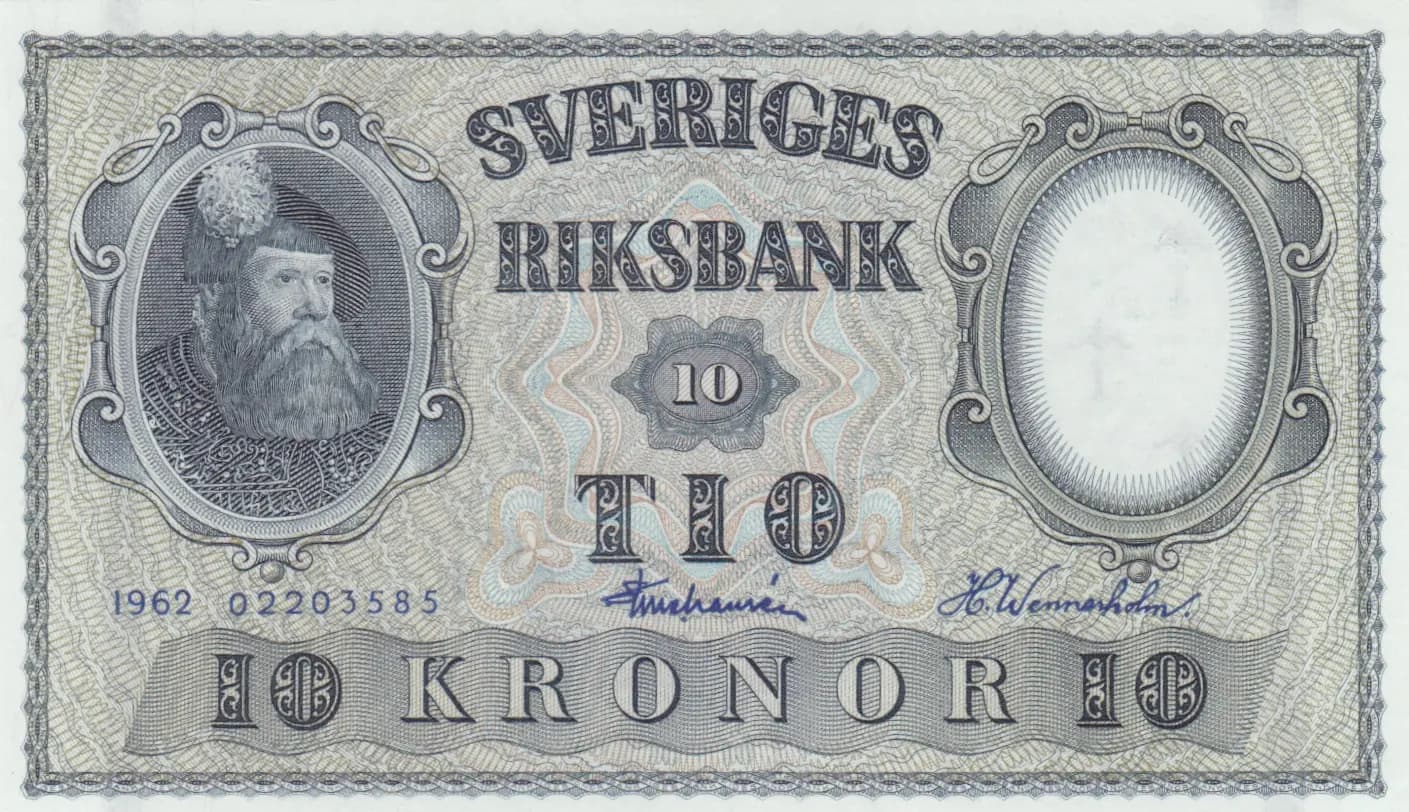
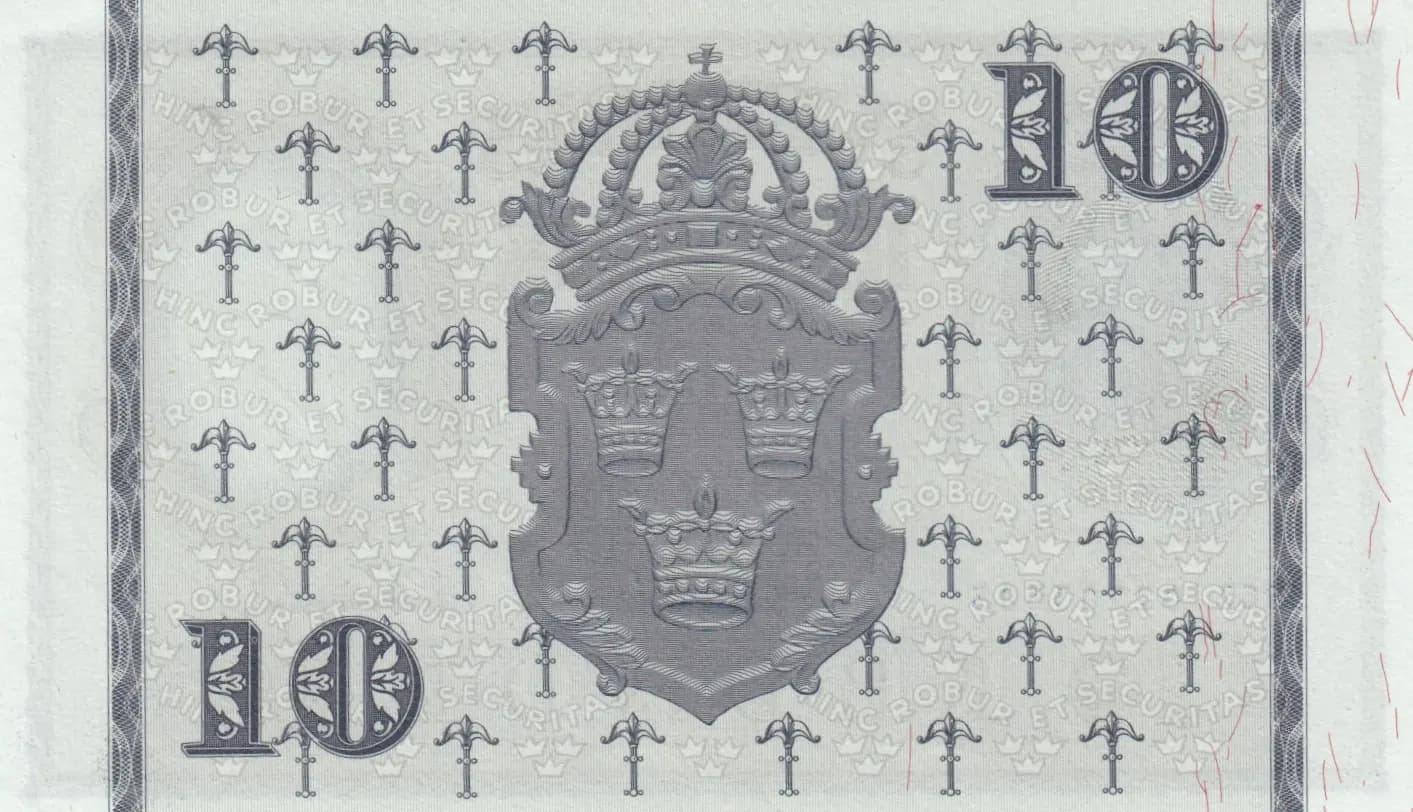
This is a pristine example of the Swedish 10 Kronor from 1962 (Pick P-43i), depicting King Gustav Vasa in an ornate oval portrait frame on the obverse, rendered in gray-blue tones with fine security printing throughout. The reverse displays the Swedish royal coat of arms with three crowns (Tre Kronor) centered on a cross-pattern background. In uncirculated condition with no visible wear, folds, or creases, this note represents an excellent specimen of mid-20th century Swedish currency design and engraving craftsmanship.
Common. The 10 Kronor denomination was a regular issue maintained from 1953-1962 with substantial circulation and print runs. eBay market data shows consistent trading in the $5-$16 range across various grades, with UNC specimens averaging around $5-$7, indicating strong supply and modest collector demand. This is a standard circulating denomination from Sweden's mid-20th century currency series.
This note was issued during the post-WWII period when Sweden's currency was stabilizing under the Bretton Woods system. King Gustav Vasa (1496-1560), depicted on the obverse, was chosen as the historical symbol of Swedish sovereignty and national identity—he founded the Vasa dynasty and is revered for establishing Sweden as an independent nation. The three crowns (Tre Kronor) on the reverse have been Sweden's national symbol since the Middle Ages, representing the union of the three Scandinavian kingdoms and reinforcing national identity during the Cold War era.
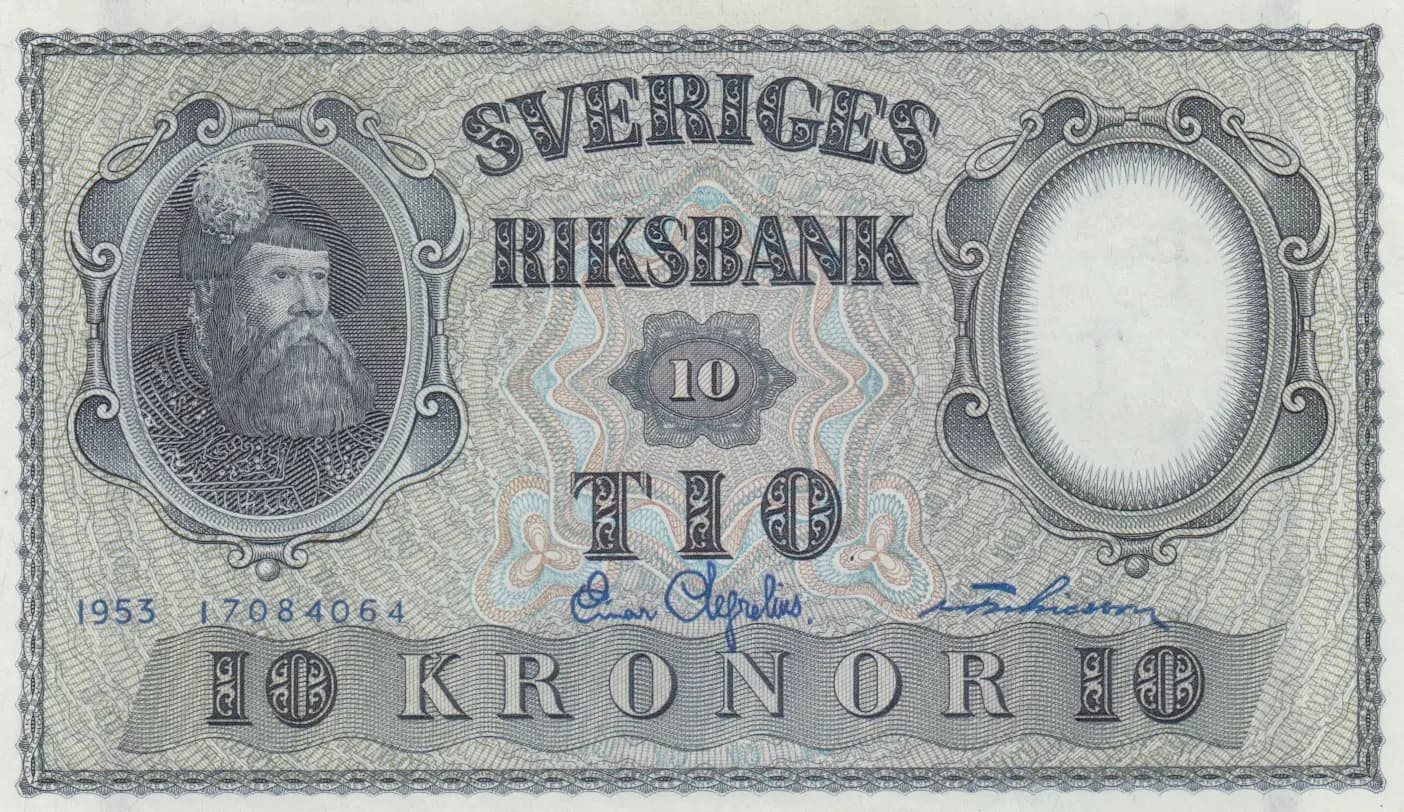
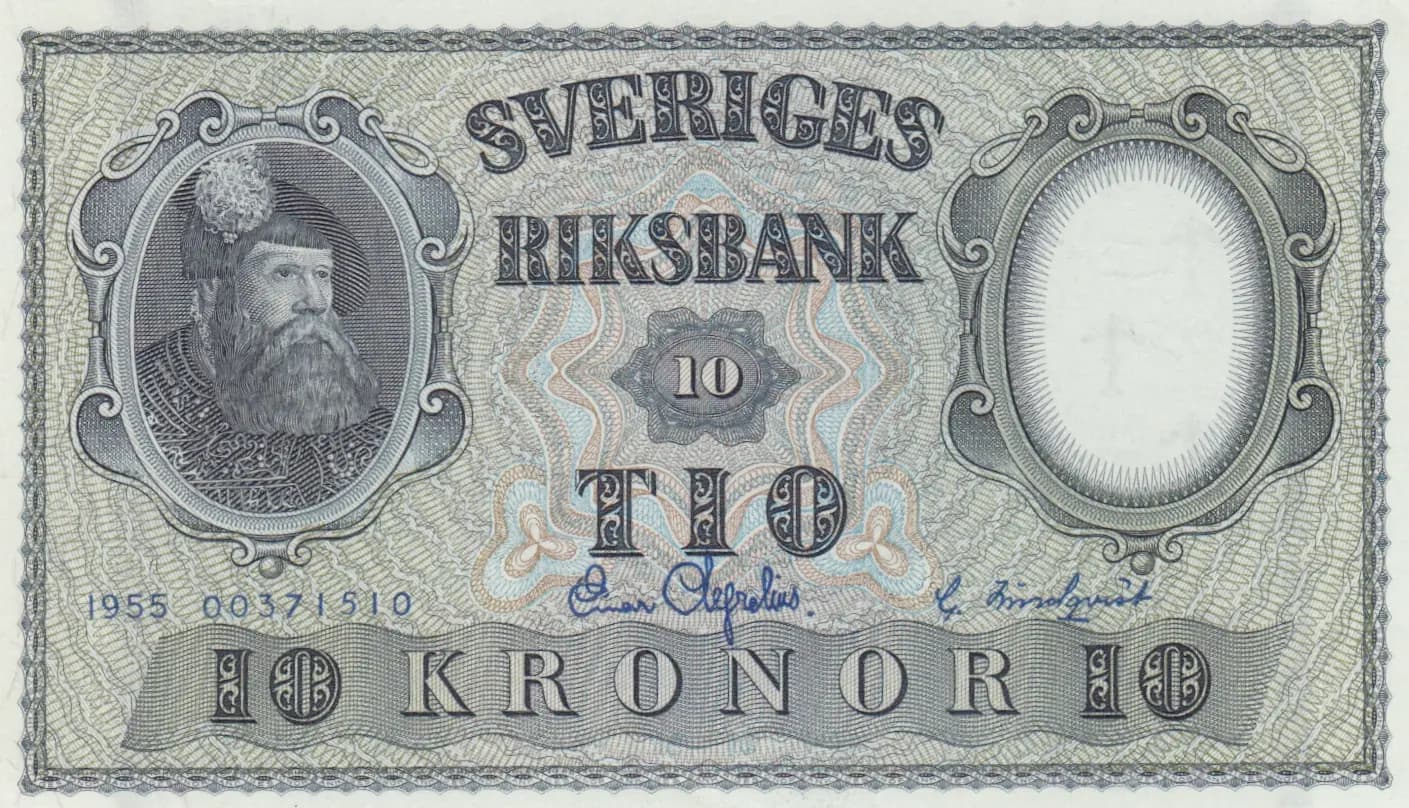
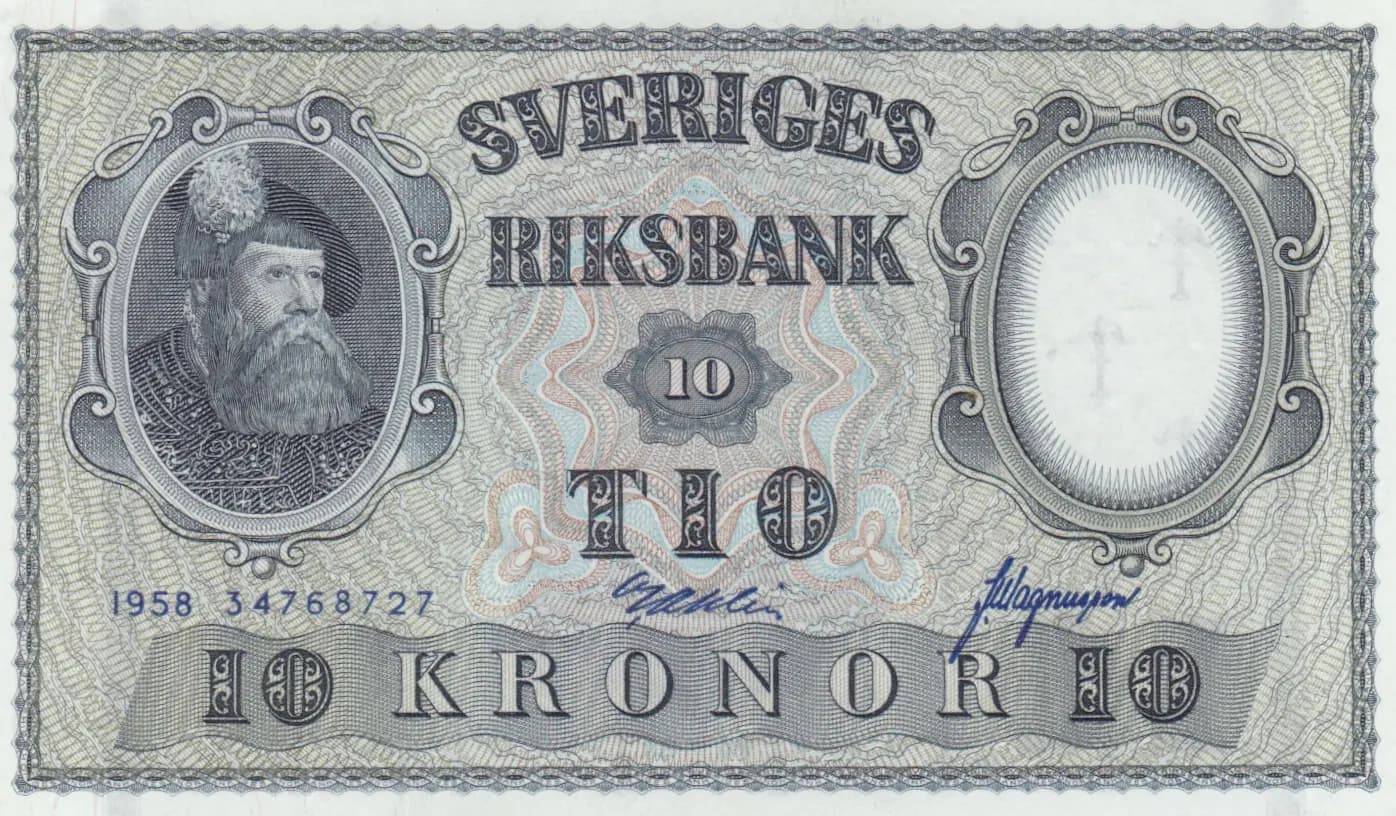
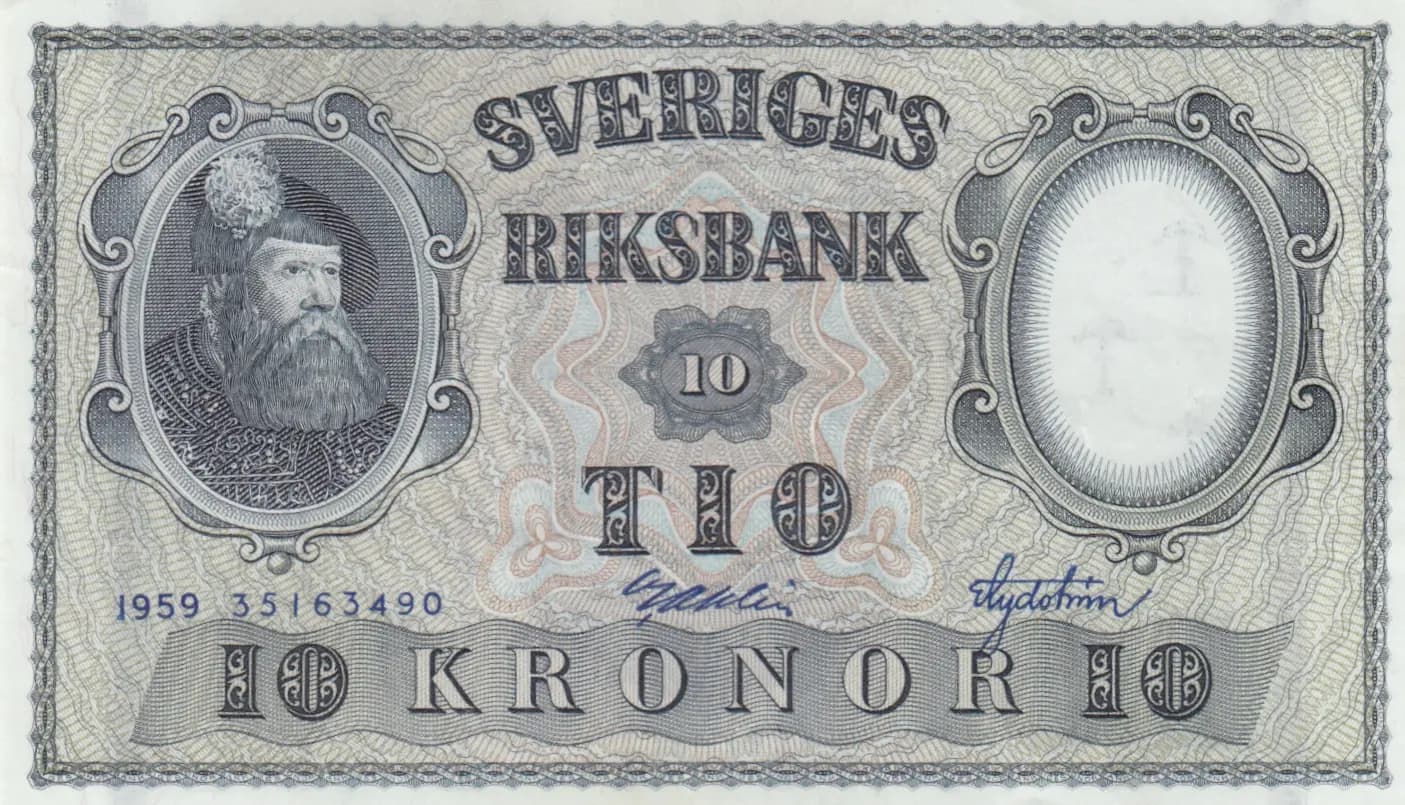
The obverse features a left-facing profile portrait of King Gustav Vasa (1496-1560), the founder of the Vasa dynasty and transformational figure in Swedish history, rendered in detailed engraving within an ornate oval frame with decorative scrollwork. The center contains the denomination and issuer name (Sveriges Riksbank) framed by a decorative diamond shape. A large empty oval frame with elaborate border work occupies the right side of the design. The reverse displays the Royal Coat of Arms of Sweden—a shield with the three crowns (Tre Kronor) stacked vertically, topped with an ornate crown. The background of both sides employs fine guilloche line work and cross-pattern security printing typical of high-security currency production.
Front side: 'SVERIGES RIKSBANK' (Sweden's National Bank); '10' and 'TIO' (Ten in Swedish); '10 KRONOR 10'; '1962' (issue year); '02203585' (serial number); signature of 'A. Wennerholm' and an undeciphered second signature. Back side: '10' appears in both the upper right and lower left corners.
Intaglio (engraving) printing on the primary design elements, combined with fine line guilloche background patterns and cross-hatching for security. The detailed portraiture, ornamental frames, and coat of arms demonstrate the deep relief characteristic of engraved currency printing. These notes were produced by Sweden's central bank printing facilities using traditional high-security banknote production methods standard for the mid-20th century.
This note is identified as Pick P-43i, one of several cataloged variants of the 1962 10 Kronor issue (PMG has cataloged variants P-43f and P-43g as well). Varieties may be distinguished by signature combinations, date variations, or serial number prefix differences. The observed signature of 'A. Wennerholm' with a second undeciphered signature should be noted for variety identification. Serial number '02203585' is specific to this individual specimen and does not denote a variety group.