10 kronor 1953
Market Prices
7 salesAbout This Note
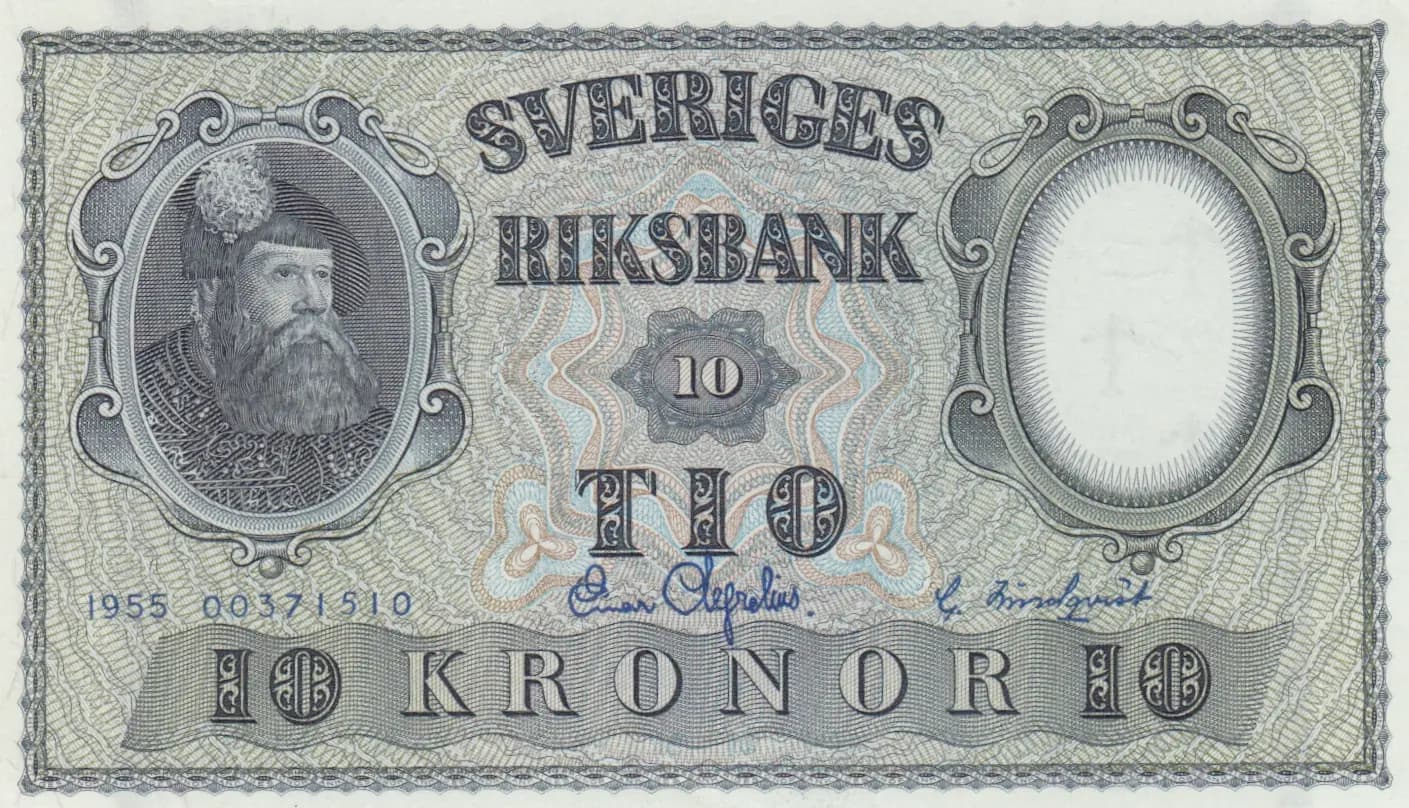
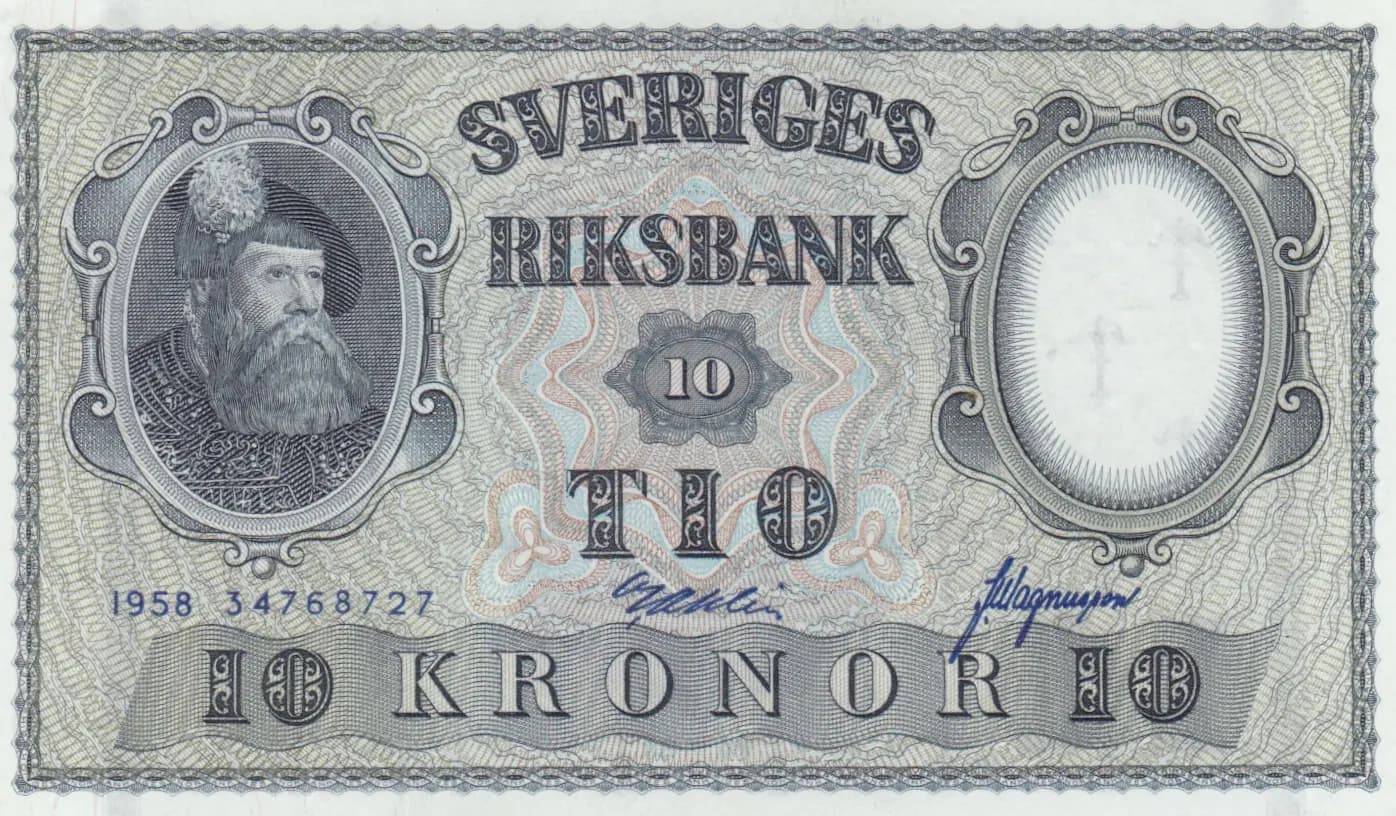
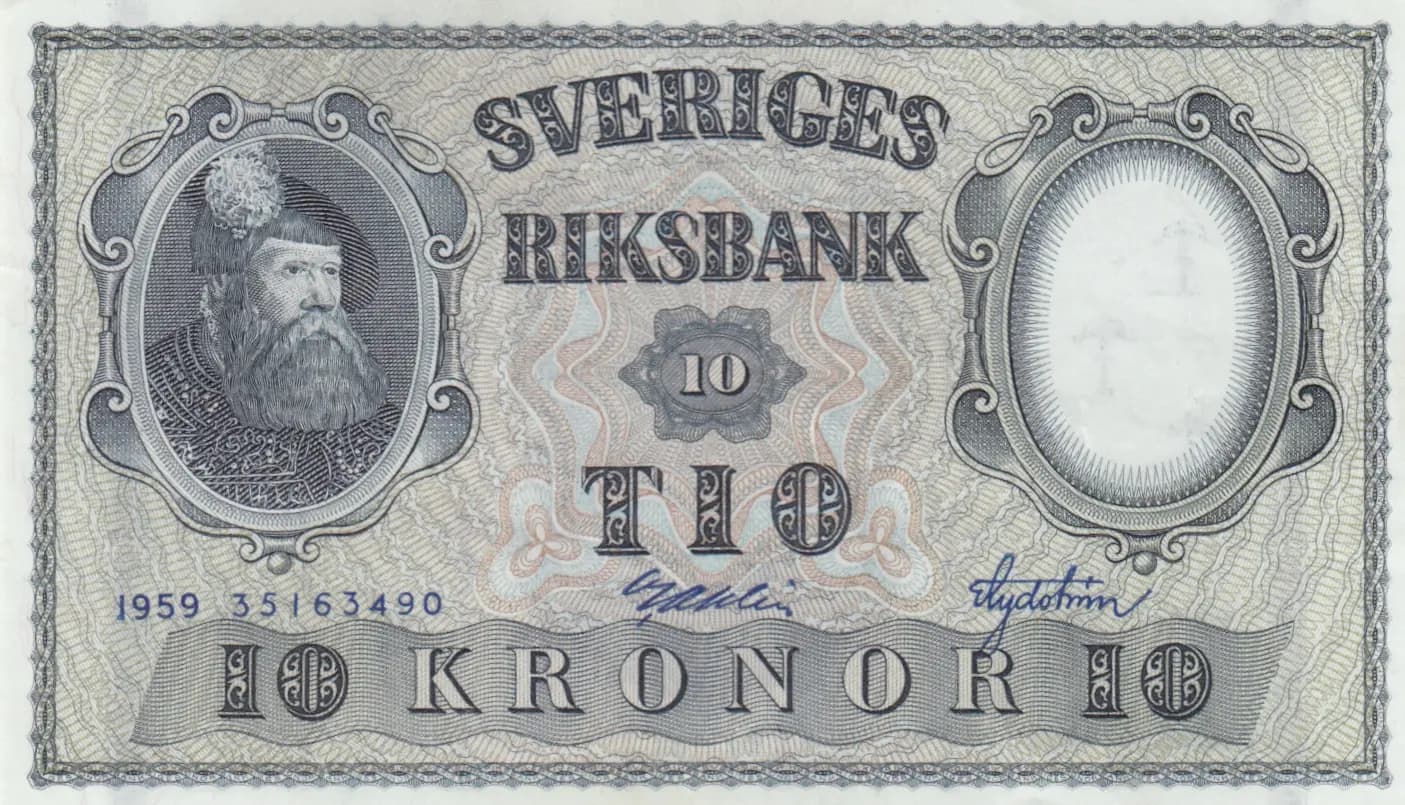
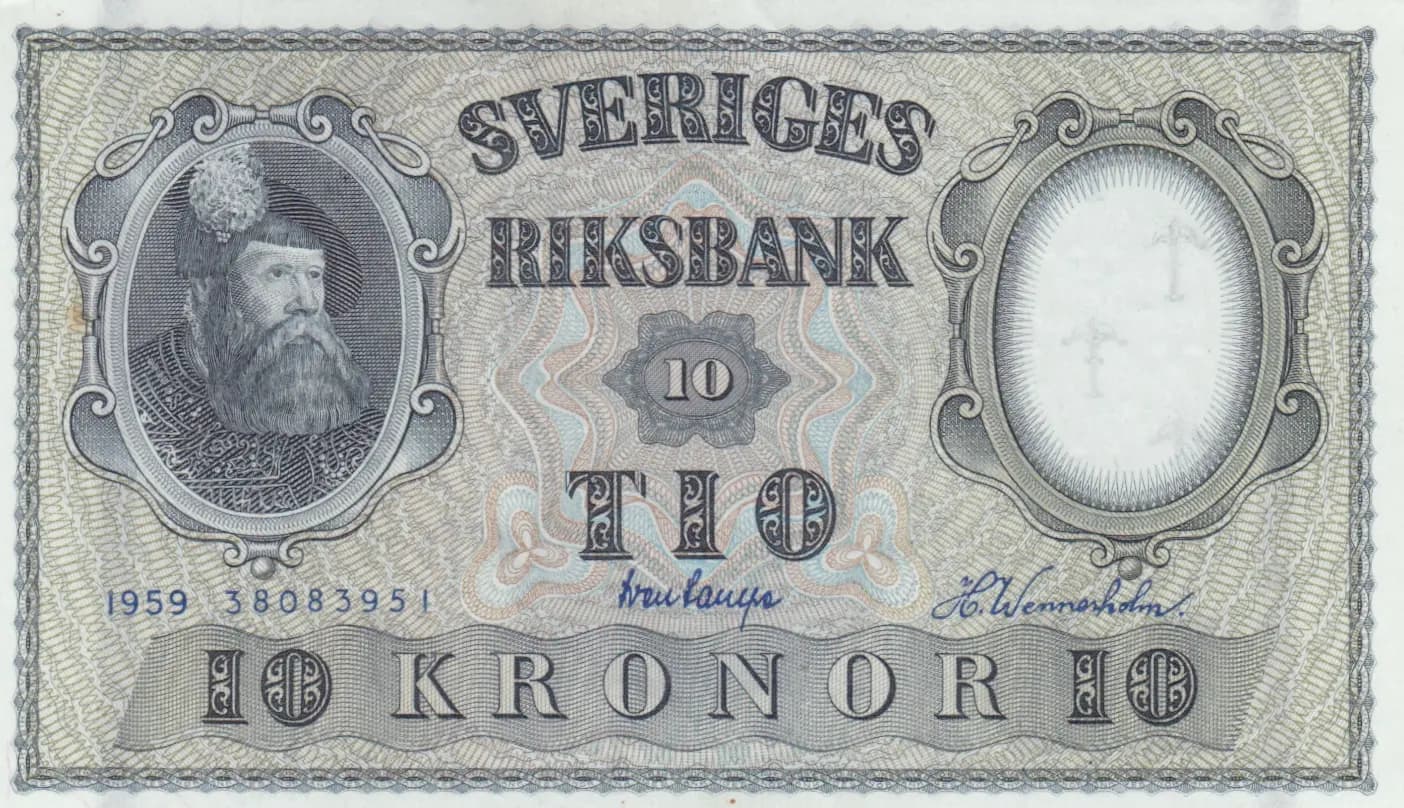
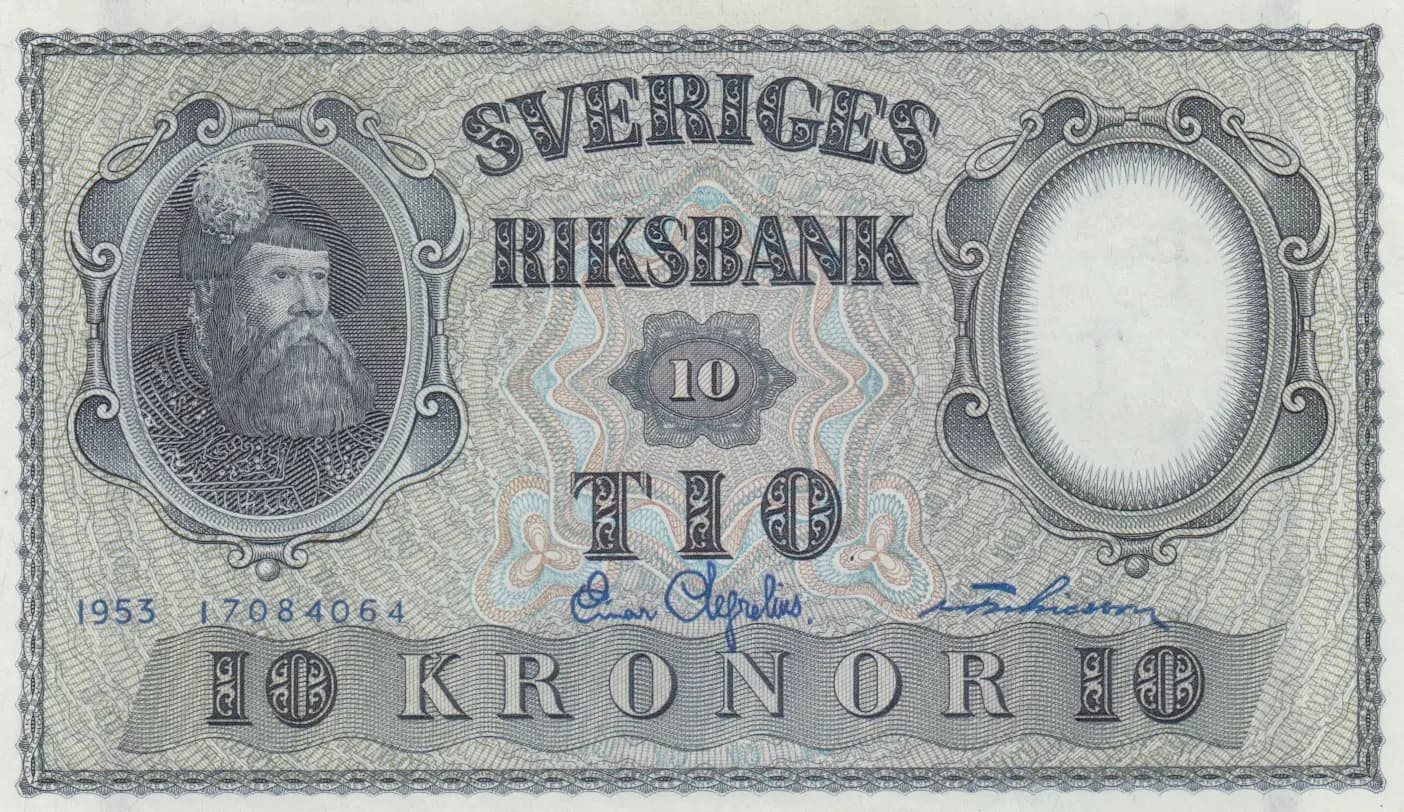
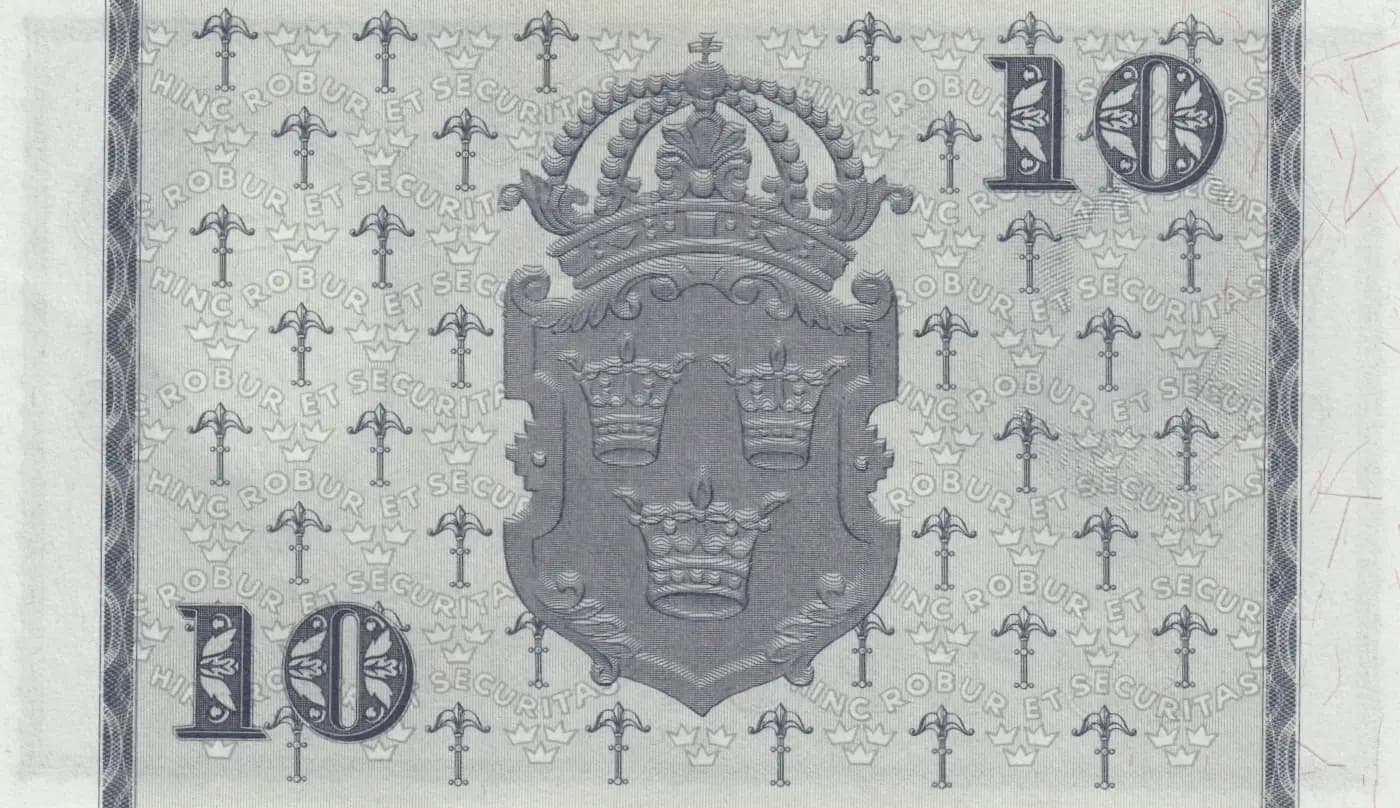
This is a well-preserved 1953 Swedish 10 kronor note (Pick P-43a) from Sveriges Riksbank in UNC condition. The obverse features a finely engraved portrait of King Gustav Vasa in profile on the left, complemented by intricate security printing with geometric patterns and wavy lines throughout. The reverse displays Sweden's iconic three-crown coat of arms centered within an ornate shield, topped by a decorative royal crown, set against a background of repeating security text and cross patterns—all rendered in crisp black and gray tones that attest to its excellent preservation.
Common. The 1953 10 kronor note (P-43a) is a regular-issue banknote from a major circulation period (Pick catalog notes similar issues circulated 1953–1962). Market data shows UNC examples selling for $4.76–$6 on the secondary market, with graded examples in the $13–$27 range depending on precise grade. These prices are consistent with common banknotes. While not heavily circulated today, the large original print run and lack of any special commemorative or limited status make this a standard, widely available note for Swedish currency collections.
This banknote was issued during the post-World War II period when Sweden sought to modernize its currency security features while honoring national symbols. King Gustav Vasa (1496–1560), depicted in profile on the obverse, was the founder of the modern Swedish state and remains a revered historical figure, making his portrait appropriate for regular-issue currency of this era. The reverse's three-crown coat of arms, topped with an ornate crown and inscribed with the Latin motto 'Robur et Securita' (Strength and Security), reinforces national sovereignty and stability during a period of economic reconstruction in Europe.
The obverse features King Gustav Vasa, the 16th-century founder of modern Sweden, rendered in profile facing left within an ornate oval medallion frame with scrollwork borders. His distinctive long beard and classical profile treatment emphasize his historical stature. The note's center displays the denomination in Gothic-style lettering within a star-shaped element. A second empty oval frame on the right balances the composition. The entire field is protected by fine-line engraving with intricate geometric patterns and wavy security lines. The reverse showcases Sweden's national coat of arms: a shield containing three crowns stacked vertically (representing the historical union of Sweden, Norway, and Denmark), surmounted by an ornate royal crown with floral elements. The background is filled with a repeating pattern of small crosses interspersed with the security motto 'Robur et Securita,' serving both decorative and anti-counterfeiting purposes.
Front side: 'SVERIGES RIKSBANK' (Bank of Sweden); '10' and 'TIO KRONOR' (Ten Kronor); '1953' (issue year); serial number '17084064'; signature of 'Olle Oigulins' (or similar spelling). Back side: '10' (denomination, top right and bottom left corners); 'ROBUR ET SECURITA' (Latin: 'Strength and Security', repeated throughout the background pattern as security text).
This banknote was produced using intaglio (engraved line) printing, the standard security printing method for Swedish currency of this period. The fine-line engraving is evident in the detailed portrait rendering, ornamental borders, intricate geometric background patterns, and the precision of the coat of arms. The multiple passes required to create the layered security elements—including the wavy line patterns, cross-hatching, and repeating text—are characteristic of high-security intaglio production used by Sveriges Riksbank's designated security printer.
This note is cataloged as Pick P-43a, with PMG records indicating at least two other variants (P-43f and P-43g) exist for this base Pick number, likely differentiated by signature varieties or minor design features. The observed signature 'Olle Oigulins' (or similar) on this example may represent one such variant. The serial number '17084064' and the specific blue date/serial number printing observed are consistent with the P-43a classification. Without access to authoritative Swedish currency catalogs detailing the specific distinguishing features between P-43a, P-43f, and P-43g, precise variety attribution based on signatures or other minor details would require specialist reference materials.