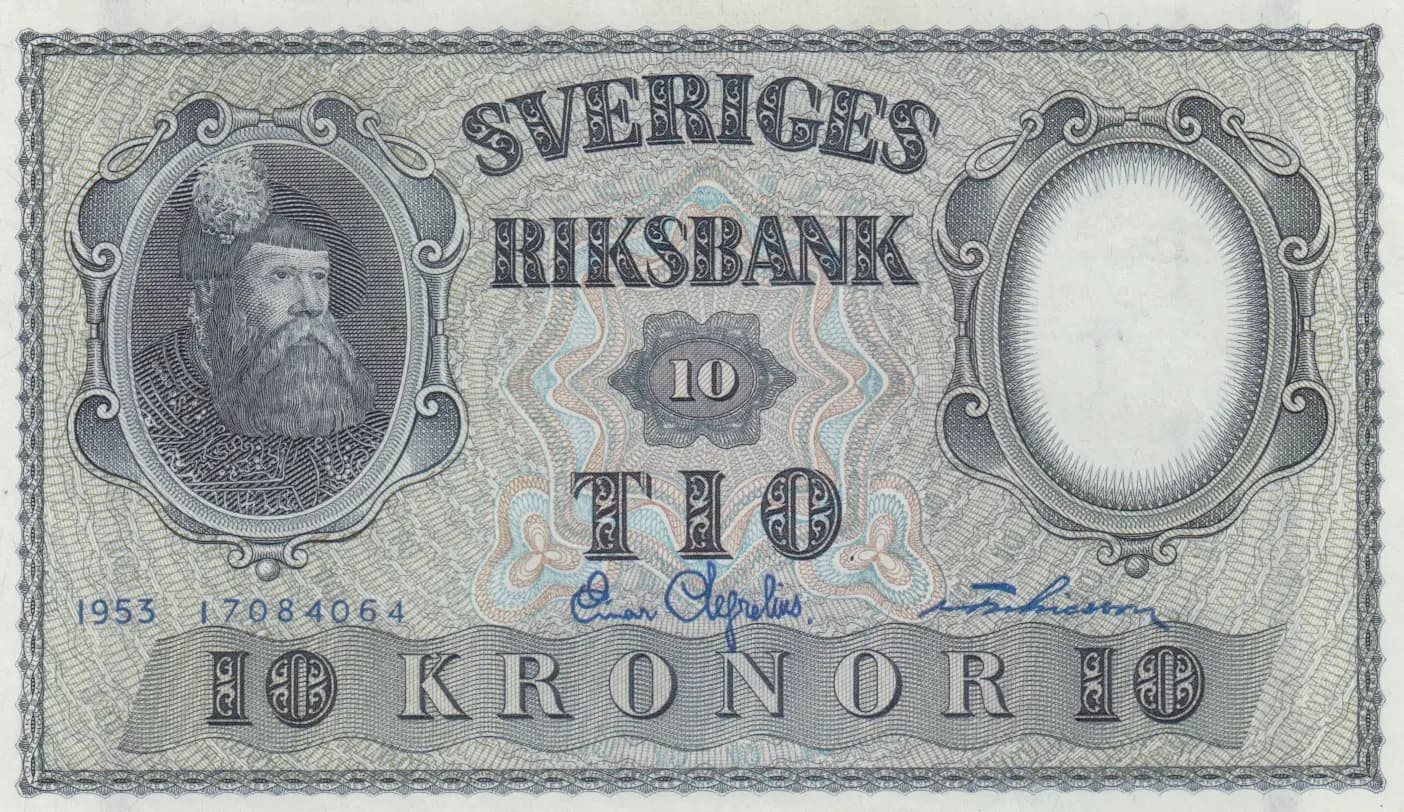
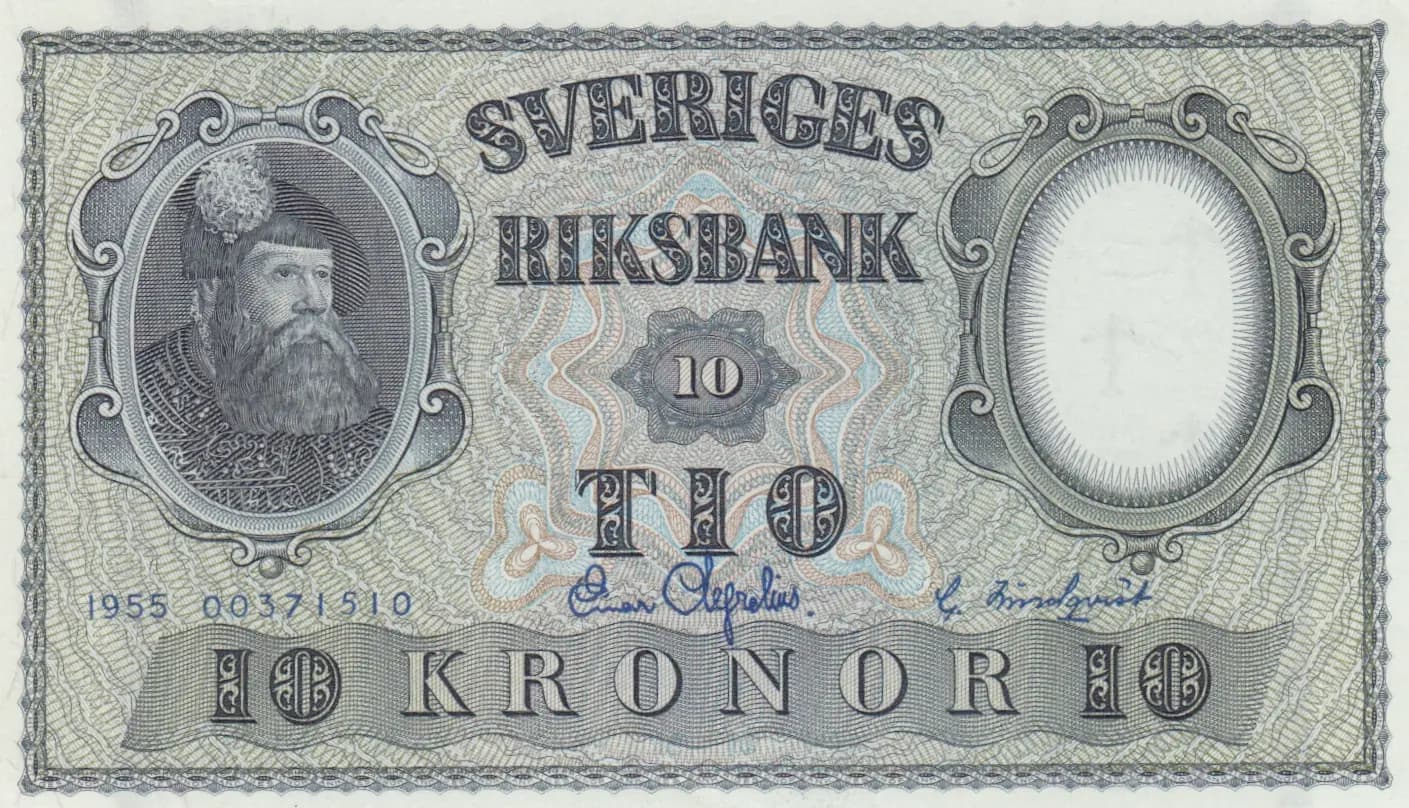
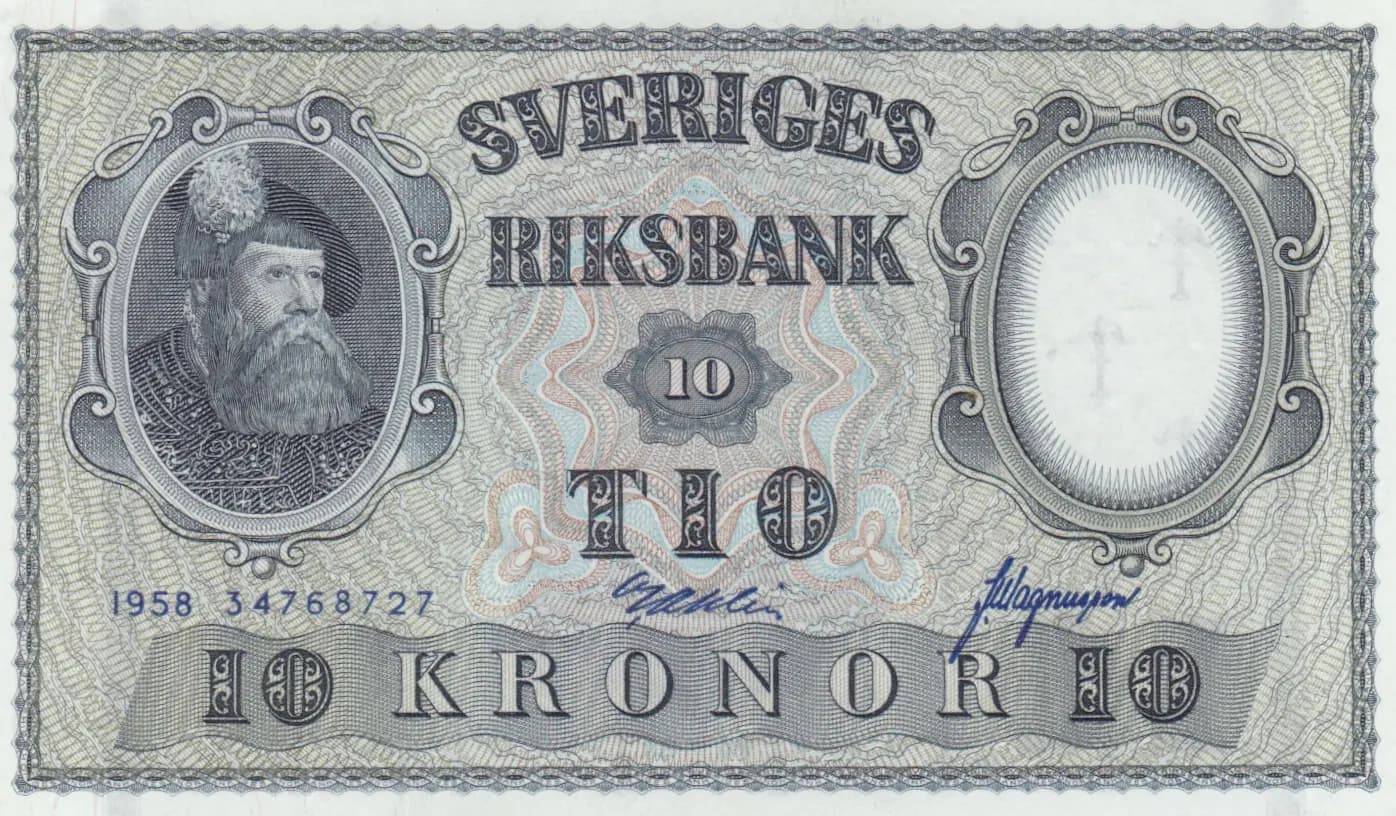
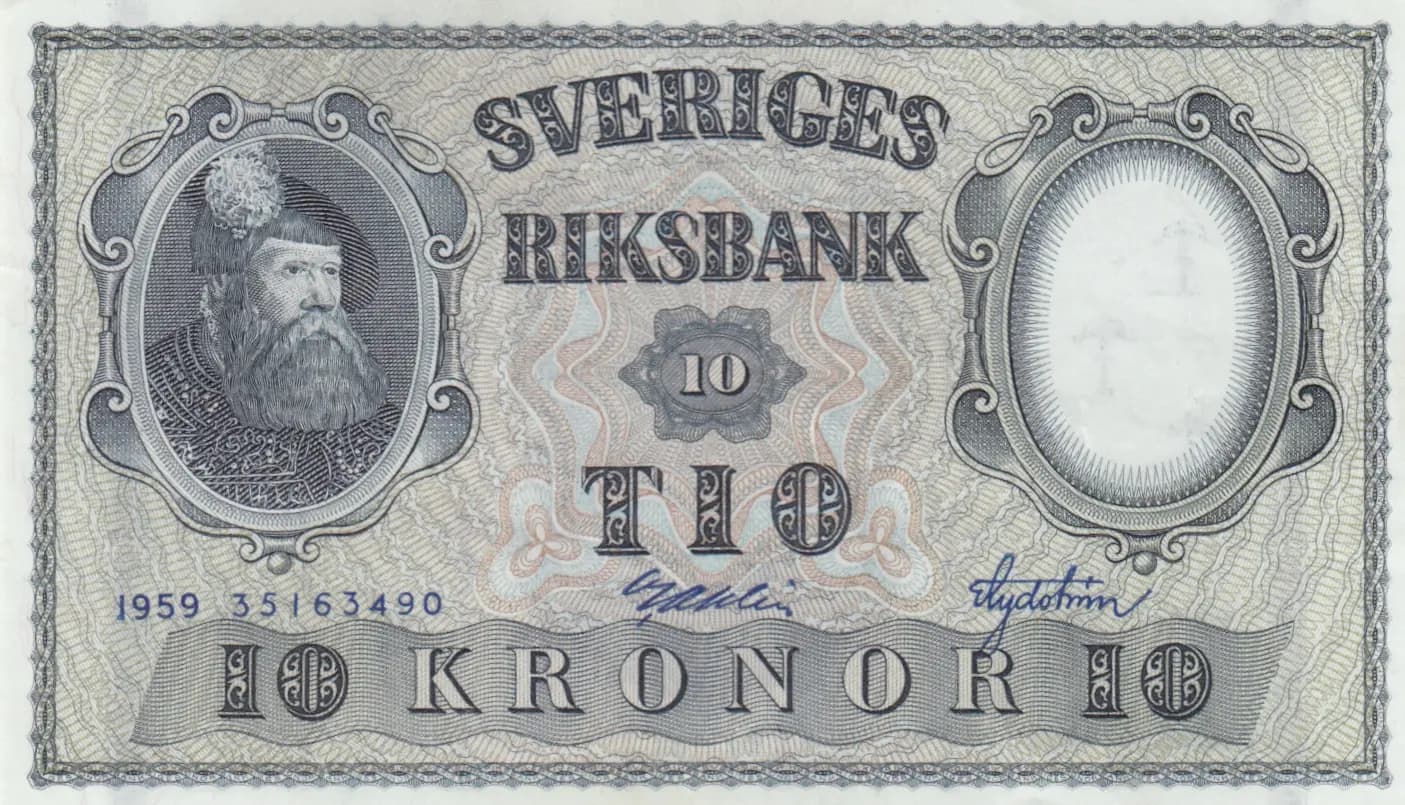
10 kronor 1959
Market Prices
23 salesAbout This Note
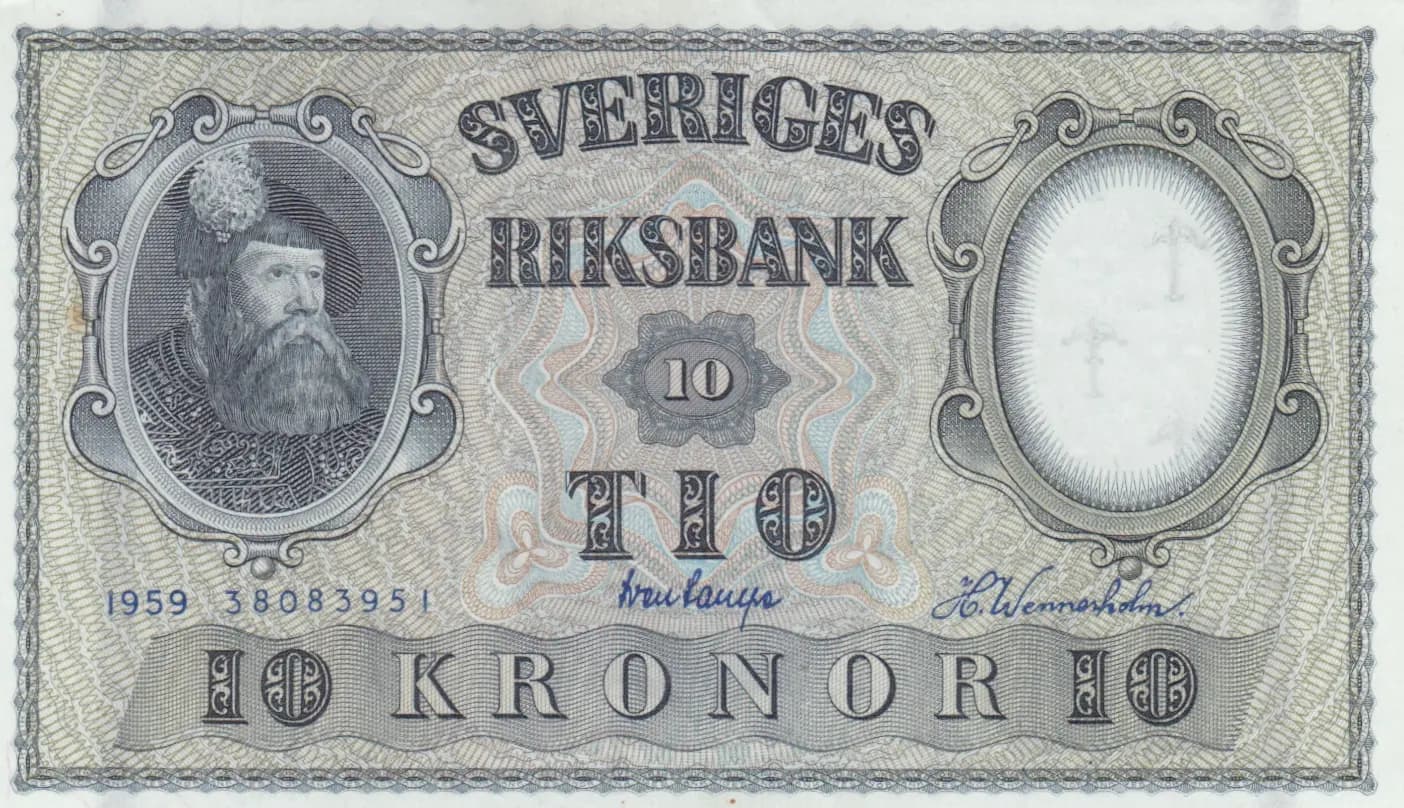
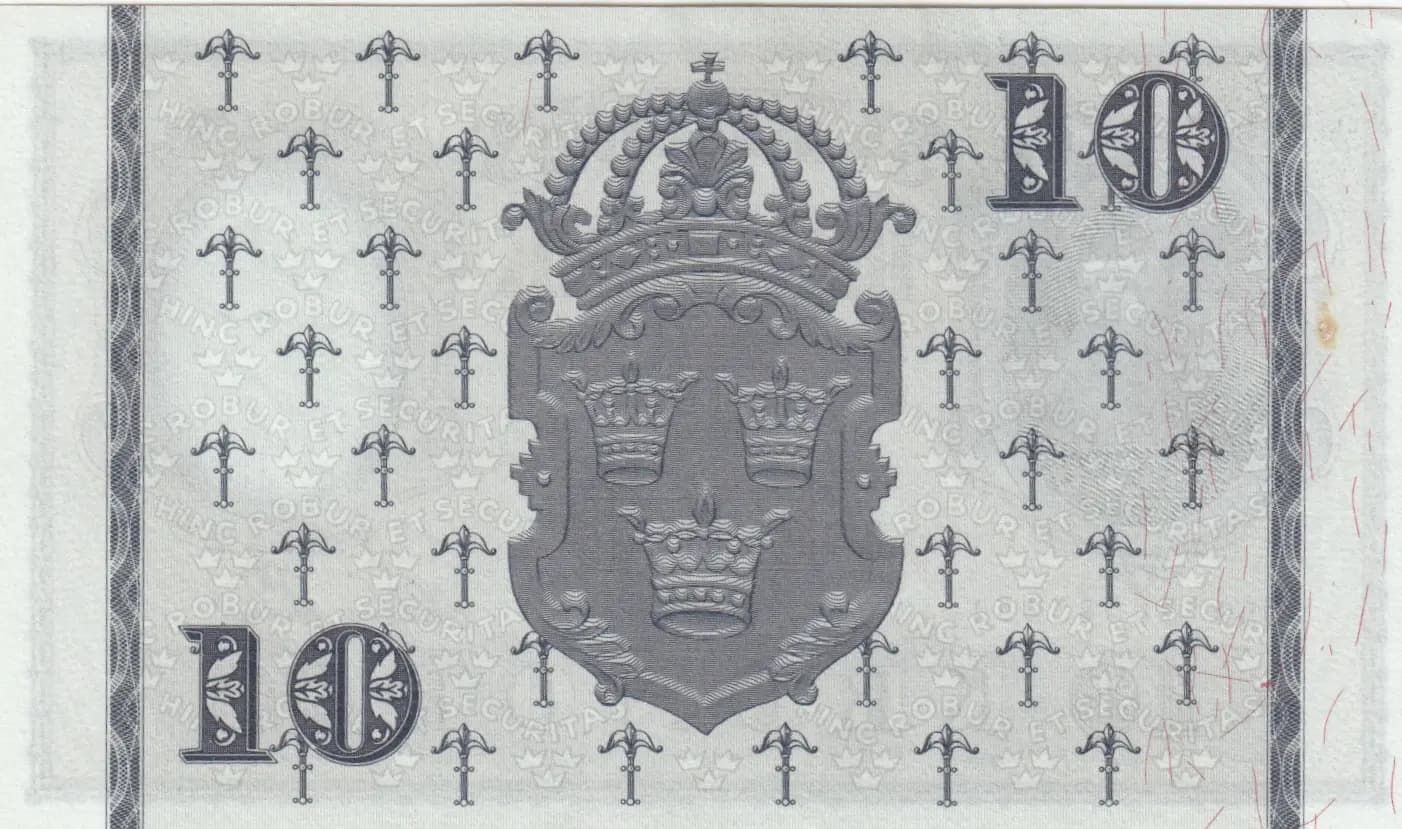
This is an excellent example of a Sweden 10 kronor banknote from 1959 (Pick-43g), presented in uncirculated condition with sharp, crisp printing throughout. The obverse features a classical portrait medallion of King Gustav Vasa on the left within an ornate oval frame, complemented by elaborate scrollwork borders and intricate geometric crosshatching for security purposes. The reverse displays the Swedish royal coat of arms with a crowned shield and four heraldic chambers, set against a repeating fleur-de-lis background pattern, representing the pinnacle of mid-20th century Swedish banknote design.
Common. This is a regular issue note from a 10-year series (1953-1962) produced by a major European central bank in significant quantities. eBay market data confirms common status, with UNC examples consistently selling for $5-35 USD historically, and more recent sales of lower grades (VF, F) bringing under $10. The 2019 catalog value for UNC is listed at $5, confirming its common circulation in the collector market. While the 1959 date and UNC condition are desirable to collectors, the note is neither scarce nor valuable in absolute terms.
Issued by Sveriges Riksbank during the 1953-1962 series, this note commemorates King Gustav Vasa (1496-1560), the founder of modern Sweden who established the Vasa dynasty and unified the nation in the 16th century. The heraldic coat of arms on the reverse reflects Sweden's royal heritage and national identity during the Cold War era, when this note was in circulation. The classical engraving style and security features demonstrate the high technical standards of Swedish currency production in the post-World War II period.
The front of the note features King Gustav Vasa, the 16th-century founder of modern Sweden and establishing figure of the Vasa dynasty, portrayed in a classical medallion format on the left side with period clothing and facial hair characteristic of Renaissance nobility. The design employs elaborate oval frames for portrait medallions (with the right frame left blank for symmetry), connected by ornamental scrollwork in all four corners. The central denomination display uses a distinctive diamond-shaped element containing the numeral '10'. The back presents the Swedish royal coat of arms—a quartered shield topped with a three-point crown—surrounded by meticulous repeating fleur-de-lis or cross motifs that serve both aesthetic and security purposes. The entire note employs fine line engraving with intricate geometric crosshatching throughout the background.
Front side: 'SVERIGES RIKSBANK' (Sweden's National Bank), '10 KRONOR' (10 kronor), 'TIO KRONOR' (ten kronor in Swedish text), date '1959', serial number '29998330', and two signatures (Mallery and Boringer, likely officials of the Riksbank). Back side: Denomination '10' appearing in upper right and lower left corners. All inscriptions are in Swedish or numeric format appropriate for Swedish currency.
Intaglio engraving (relief printing) on high-quality banknote paper, utilizing multiple passes to achieve the complex layered security patterns, fine linework, and portrait details. The geometric crosshatching, elaborate borders, and heraldic details are characteristic of the Scandinavian banknote printing tradition of this era. This note was produced by Sveriges Riksbank's printing facilities, which maintained some of Europe's highest standards for security printing during this period.
This note is catalogued as Pick-43g, one of two variants identified by PMG for the base 10 kronor Pick number (the other being P-43f). The variant designation likely reflects differences in signatures, serial number ranges, or minor printing characteristics between different production runs within the 1959 issue year. The observed signatures 'Mallery' and 'Boringer' are consistent with documented Riksbank officials from this period. The serial number 29998330 and the specific date of 1959 confirm this as the P-43g variety rather than earlier or later variants in the series.