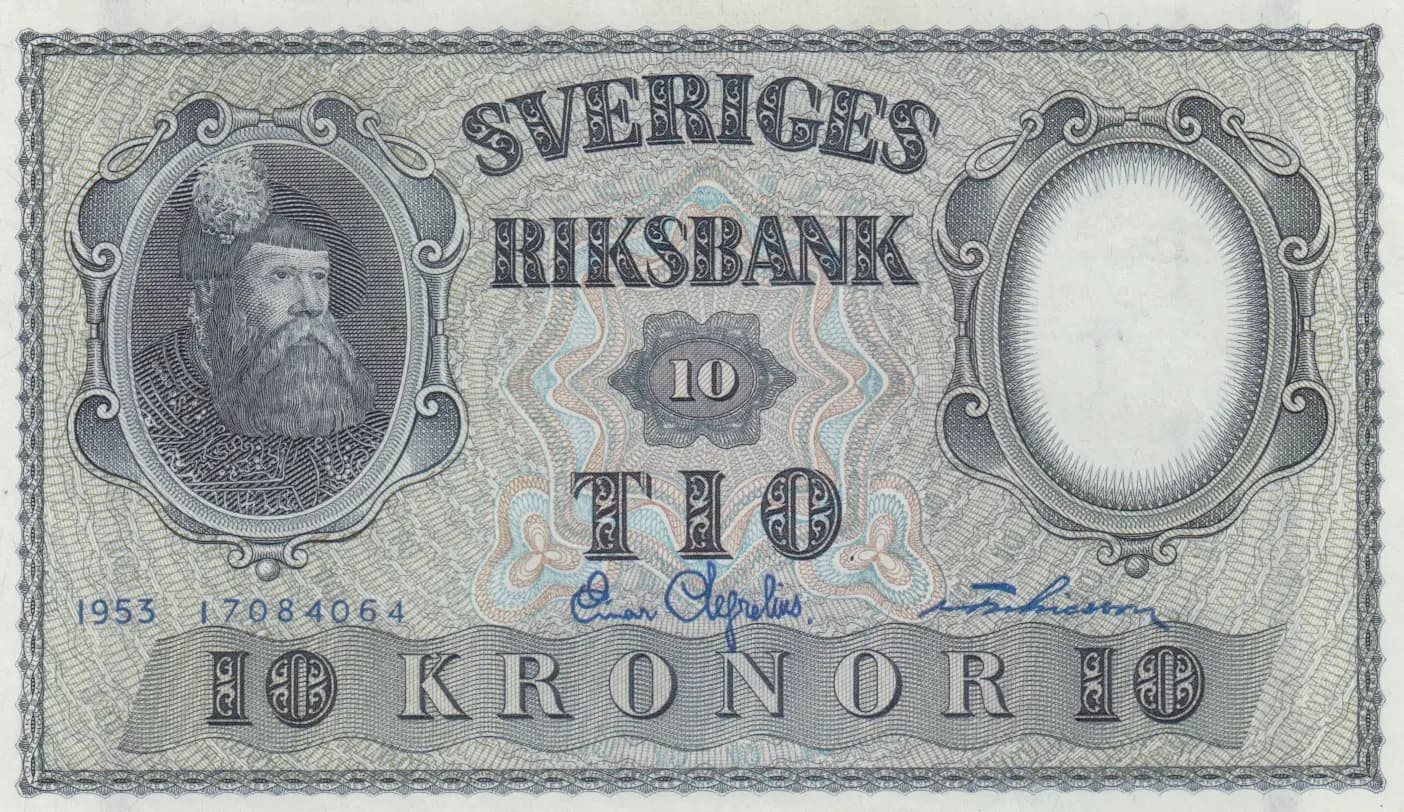
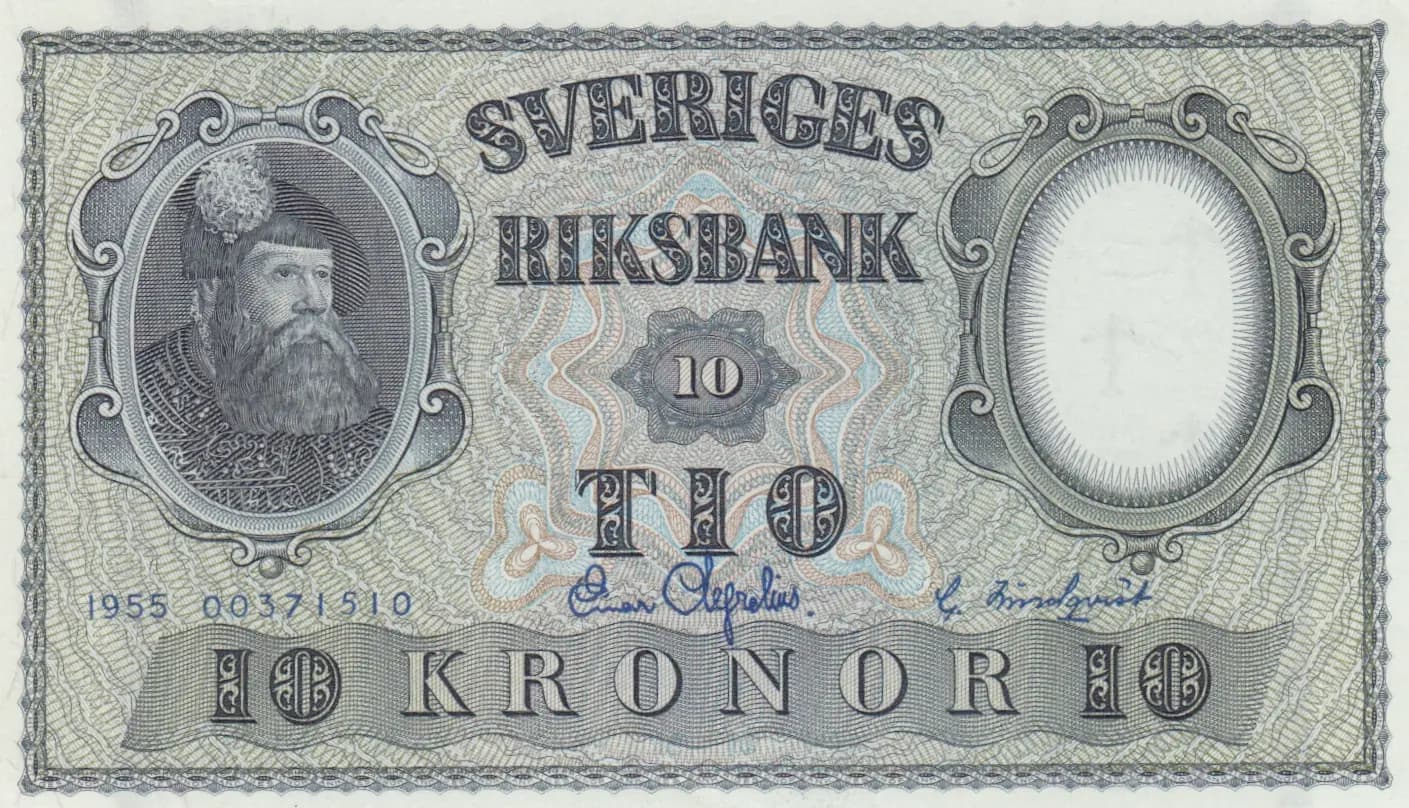
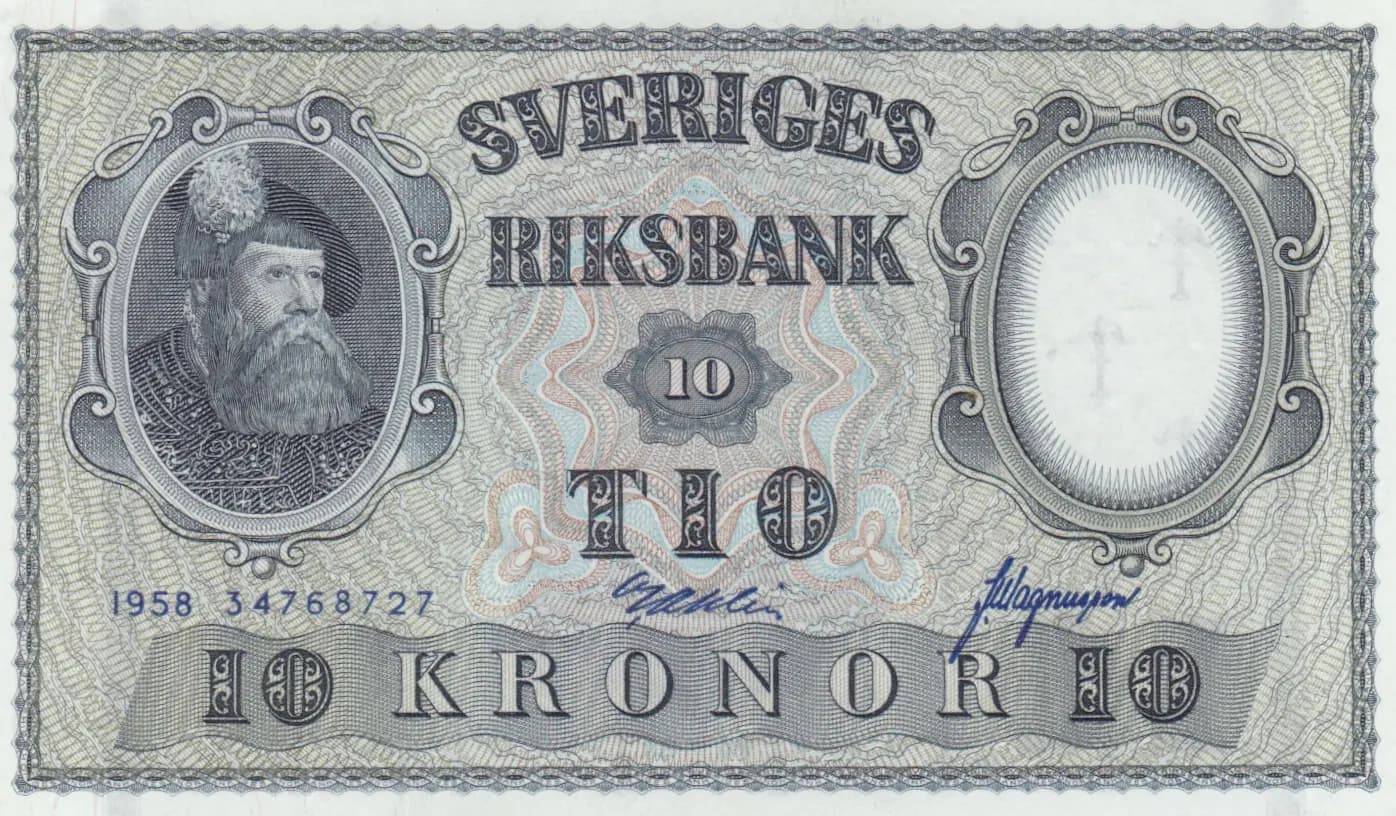
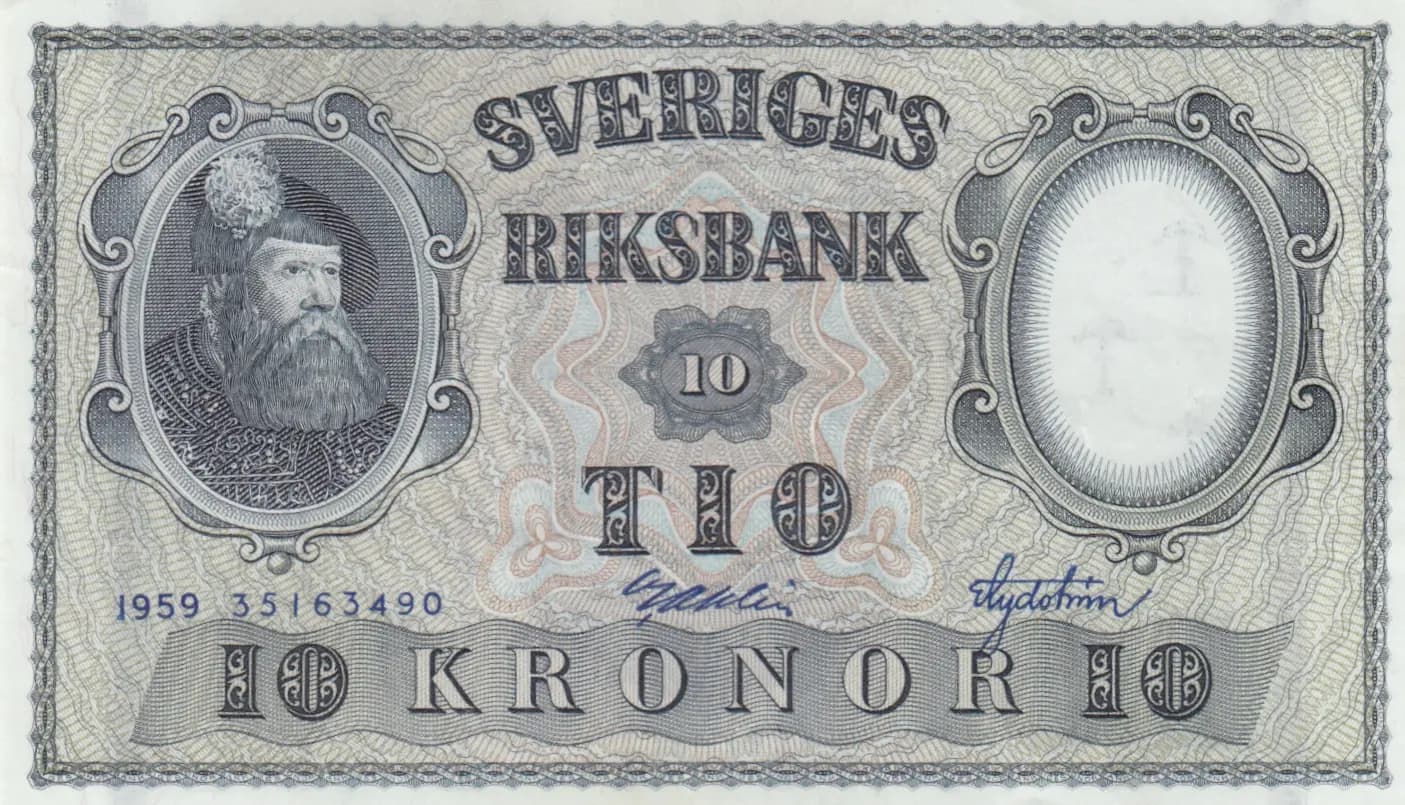
10 kronor 1959
Market Prices
23 salesAbout This Note
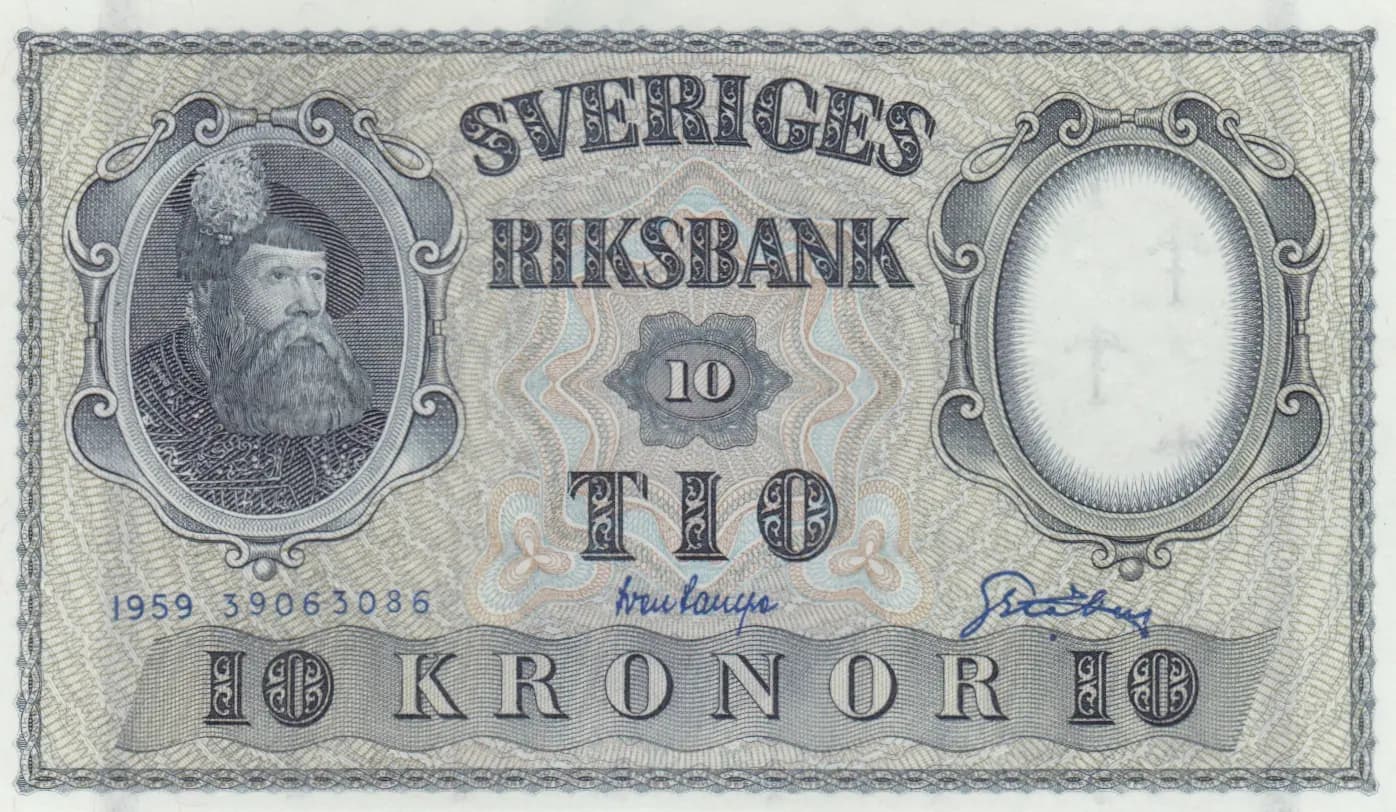
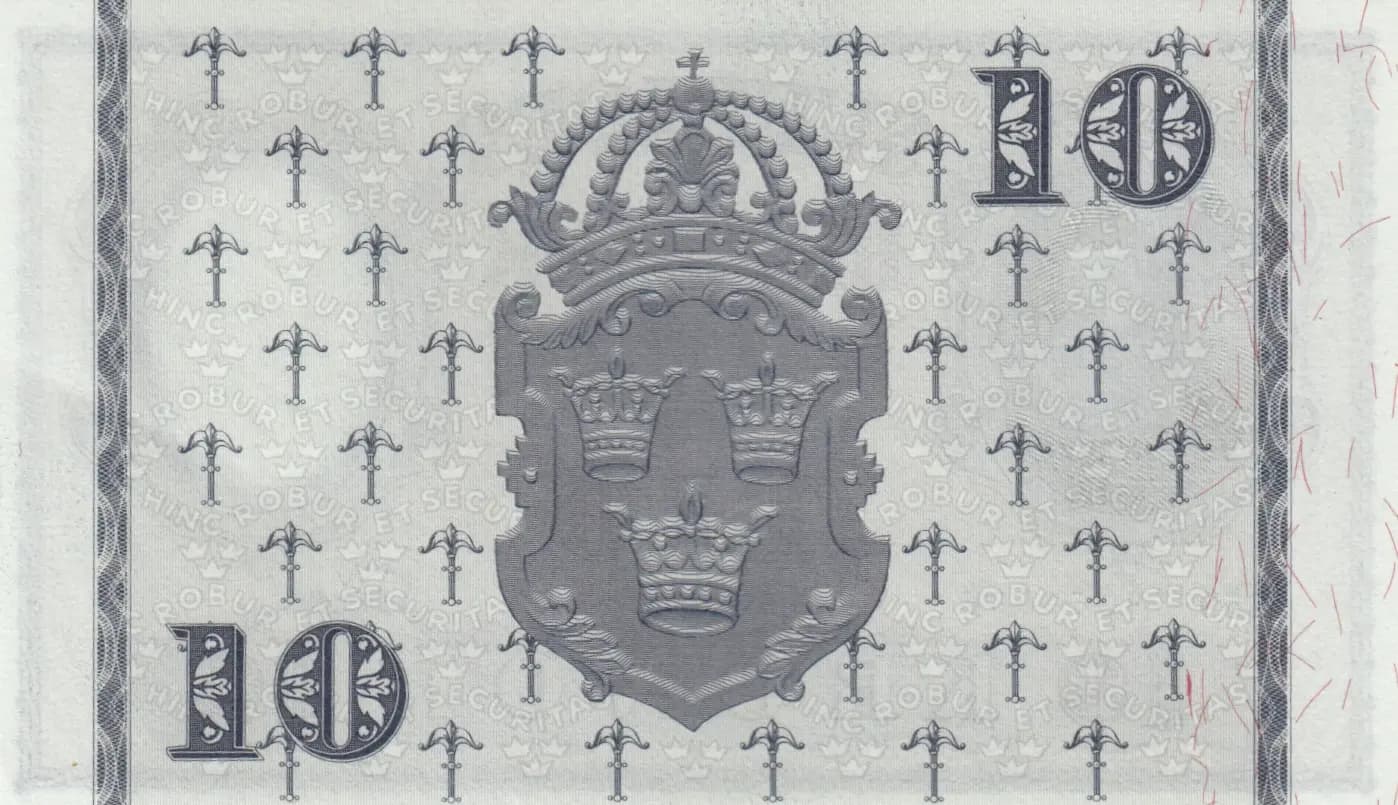
This is a beautifully preserved 1959 Swedish 10 kronor note (Pick-43g) in AU condition, featuring the iconic portrait of King Gustav Vasa on the obverse within an ornamental oval frame. The note displays crisp engraving with no visible circulation wear, clean surfaces, and excellent print quality throughout, making it an attractive example of mid-20th century Scandinavian currency design. The reverse displays Sweden's heraldic coat of arms with three crowns beneath an ornate crown, characteristic of this classic banknote series.
Common. This note is from a regular issue series (P-43g) produced between 1953-1962 with significant circulation. The eBay price data shows consistent sales ranging from $2-$47 depending on condition grade, with most uncirculated examples selling for $5-$11 in the 2009-2015 period and catalog values (2019) showing only $5 for UNC condition. The high volume of sales records and modest pricing across multiple decades indicate this is a widely available note in the collector market. AU condition examples are neither scarce nor particularly valuable relative to rarer issues.
This note was issued during the later years of the 1953-1962 series, a period when Sweden maintained stable currency backed by the riksbank system. King Gustav Vasa, depicted on the obverse, was chosen to honor the 16th-century Swedish monarch who founded the Vasa dynasty and established Sweden's independence, reflecting national pride during Sweden's post-WWII period of economic growth and stability. The heraldic arms featuring the three crowns on the reverse represent the historical Swedish coat of arms, reinforcing the connection between the nation's medieval heritage and modern monetary authority.
The obverse features King Gustav Vasa (1496-1560), the founder of the Vasa dynasty, portrayed as a bearded man in historical dress within an ornamental circular frame on the left side of the note. The portrait is rendered in fine detail with period-appropriate clothing reflecting his 16th-century status. The composition includes elaborate decorative elements: interlocking chain-pattern borders at top and bottom, ornamental scrollwork framing the portrait, a decorative rosette containing the denomination in the center, and geometric wave patterns in blue-grey tones forming the background security pattern. The reverse displays Sweden's heraldic coat of arms—a shield containing three crowns stacked vertically, crowned with an ornate royal crown featuring elaborate detailing and a cross finial at its apex. The background is filled with a repeating trefoil cross motif pattern characteristic of Swedish banknote design of this era. The overall aesthetic is formal, symmetrical, and reflects classical heraldic principles.
Front side: 'SVERIGES RIKSBANK' (Bank of Sweden), '10 KRONOR 10' (denomination), '10 FEM' (10 Five), date '1959' with serial number '39063036', and signatures 'Millancko' and 'Svenström'. Back side: '10' appears in upper right and lower left corners as denomination markers. All text is in Swedish, the official language of Sweden.
Intaglio (engraved) printing, evidenced by the fine line engraving throughout, precise hatching patterns in the background, intricate geometric designs, and the crisp definition of all design elements. The security features rely on the complexity of the engraved lines and the repeating background patterns typical of Swedish banknote production in the 1950s-1960s period. This is consistent with standard security printing practices of Sveriges Riksbank during this era.
This specific note is cataloged as Pick-43g, representing one of two known variants within the base Pick-43 designation (the other being P-43f). The visual analysis confirms the presence of signatures 'Millancko' and 'Svenström,' which may represent a specific signatory combination within the P-43g variety. The 1959 date and serial number '39063036' indicate this is from the mid-period of the series' production run. Without access to detailed Pick catalog specifications for the distinguishing features between P-43f and P-43g, the exact variety-determining characteristic cannot be definitively identified from the images alone, but the cataloging as P-43g is confirmed by the provided metadata.