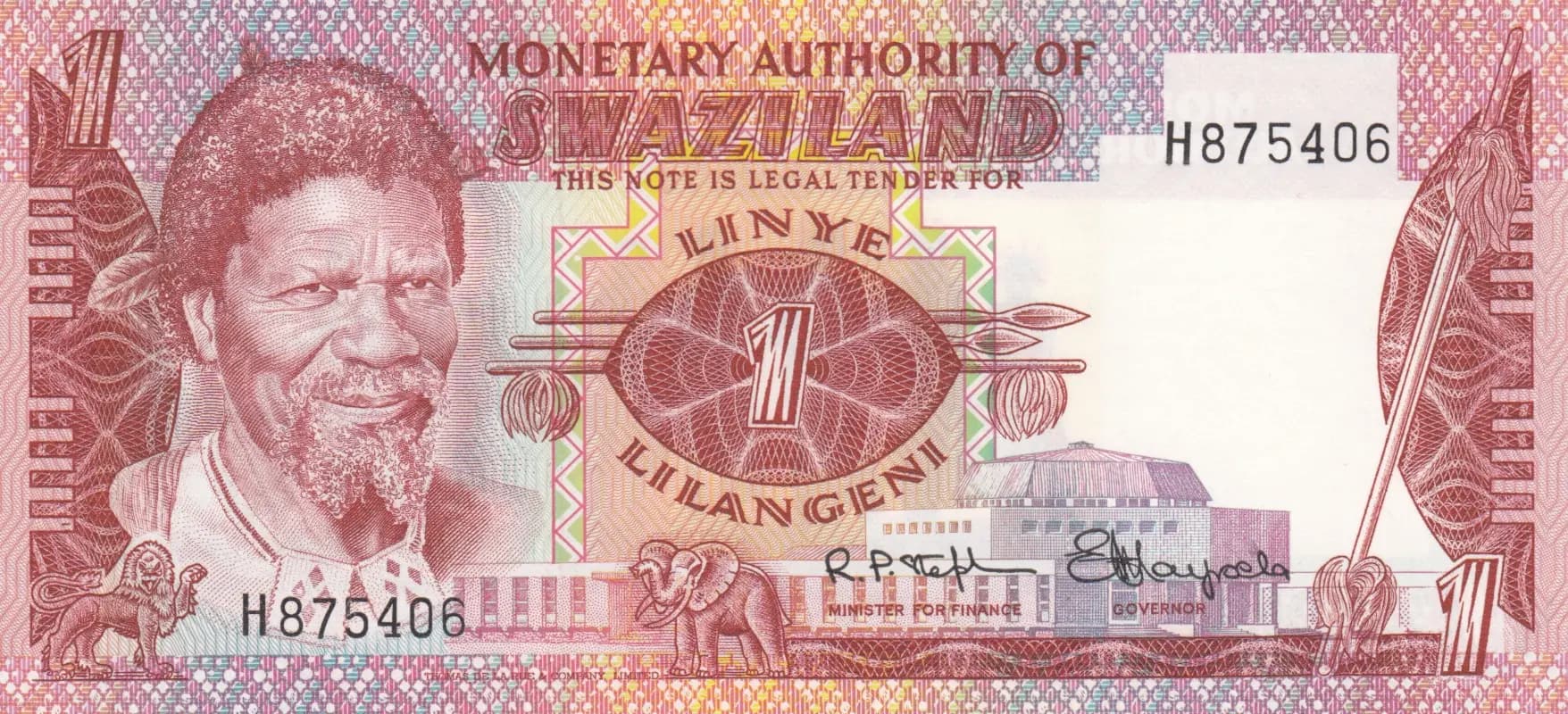
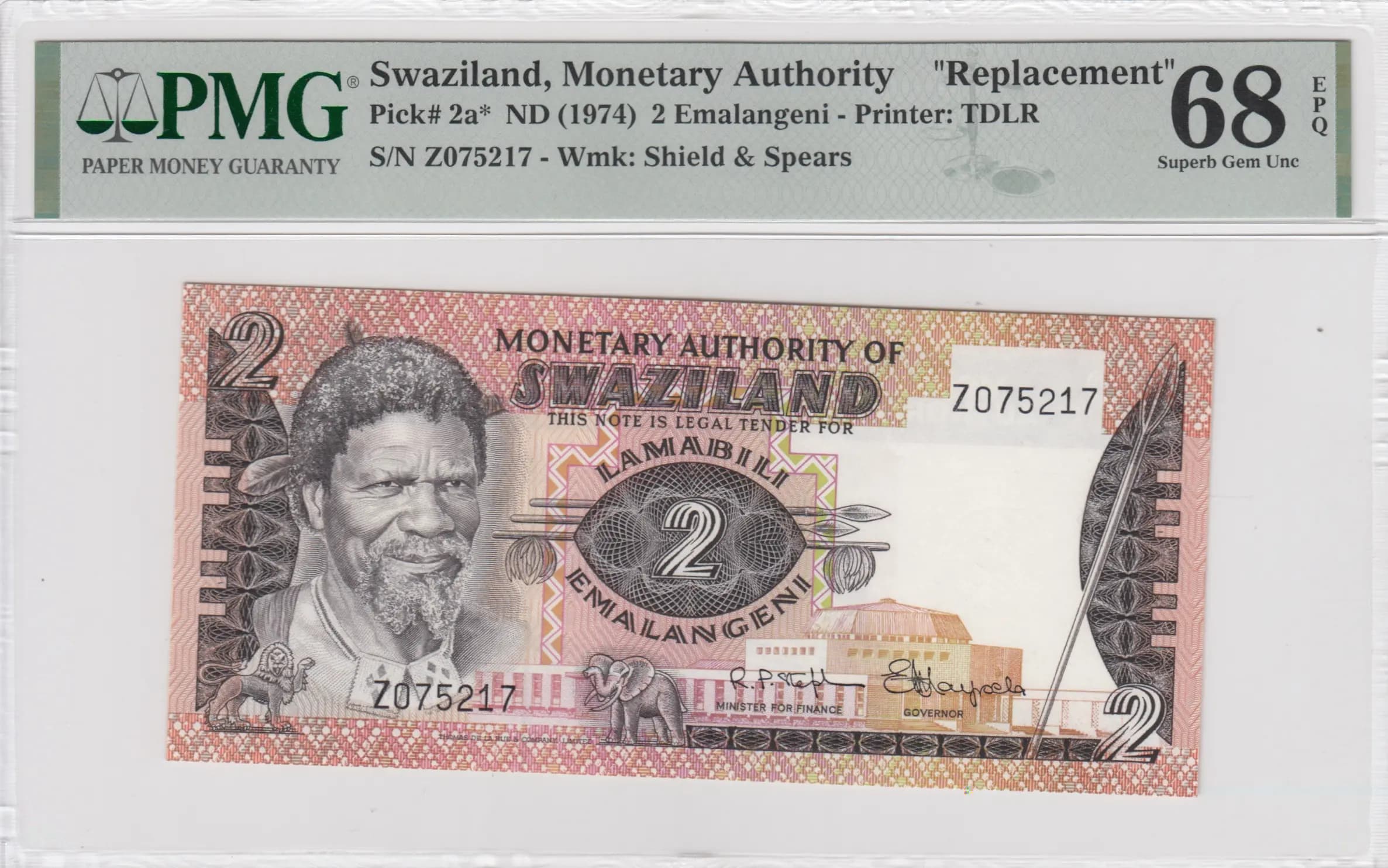
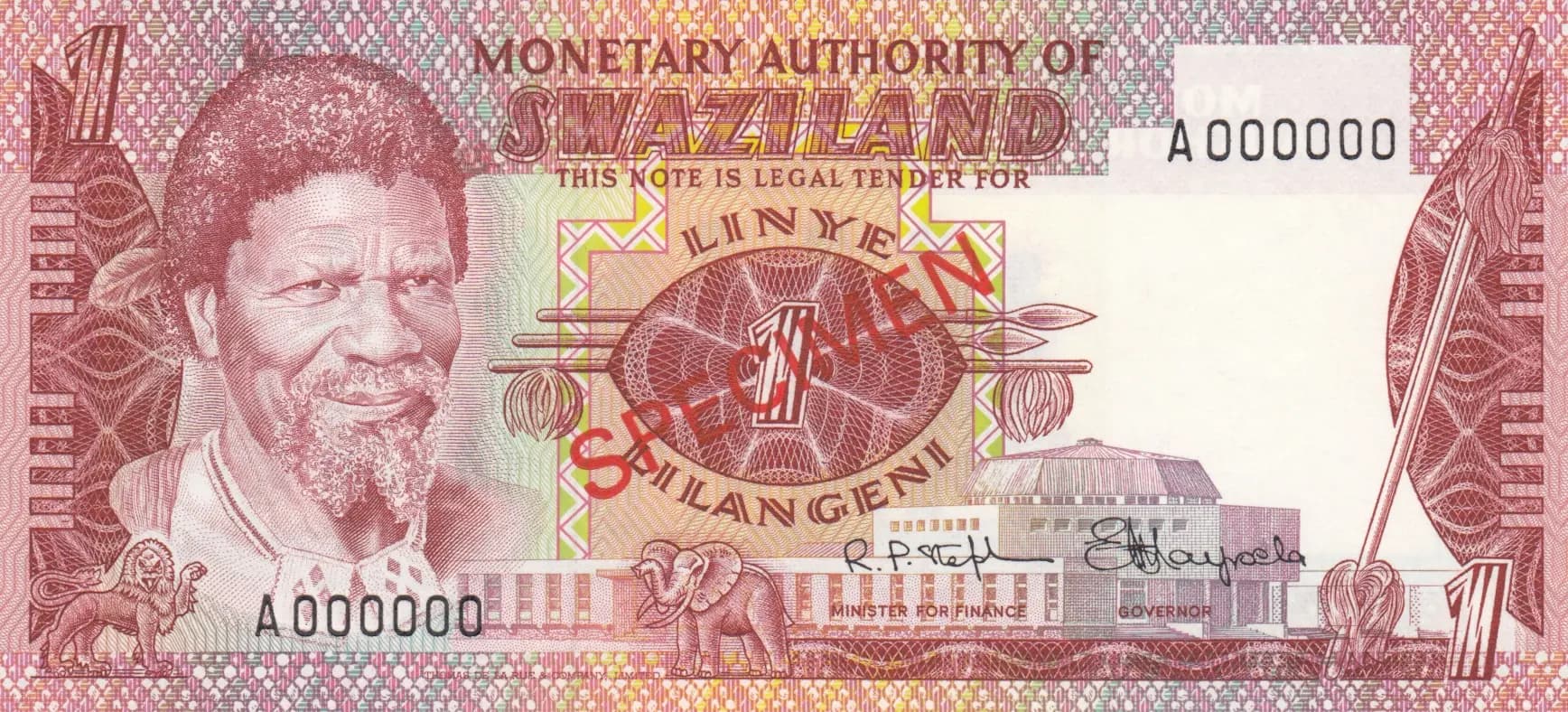
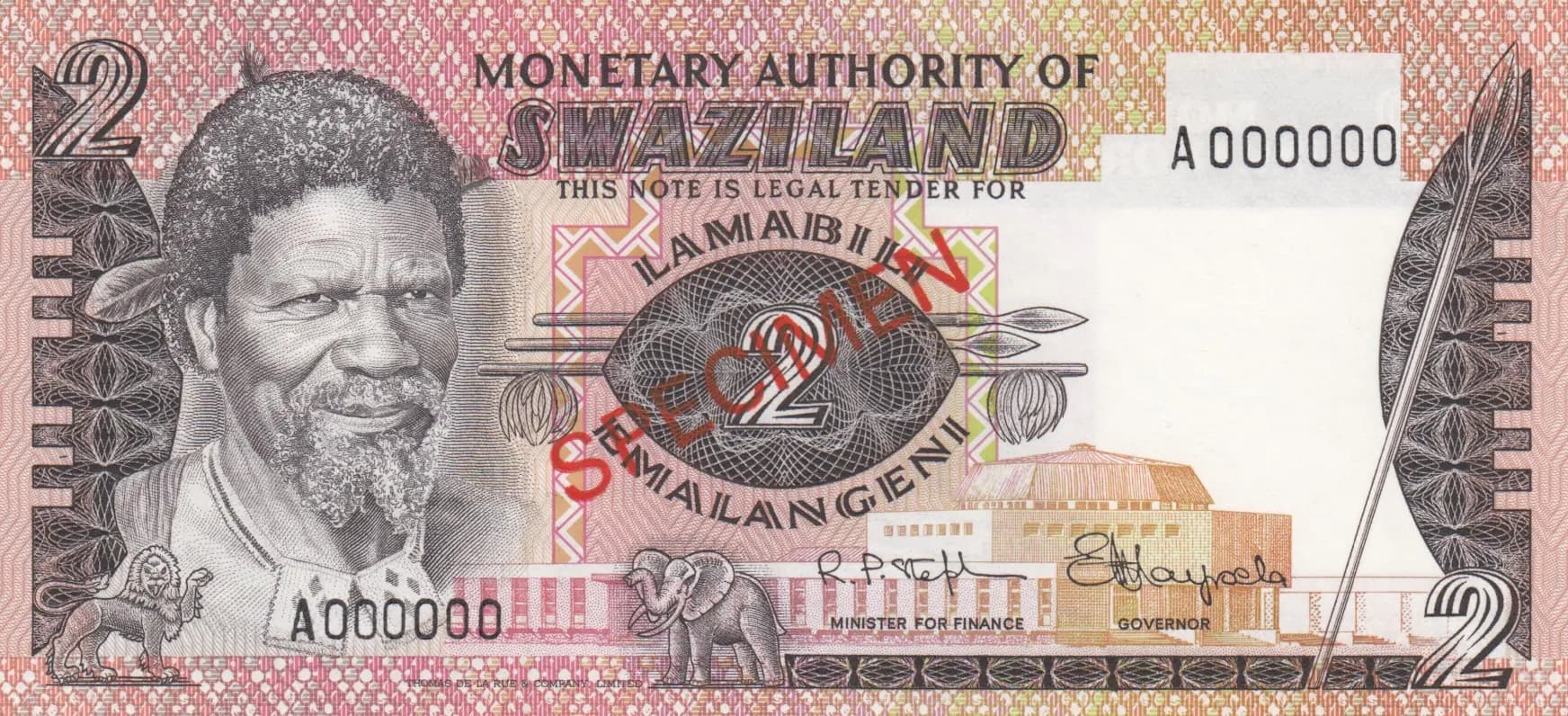
5 emalgeni 1974 specimen
Market Prices
2 salesAbout This Note
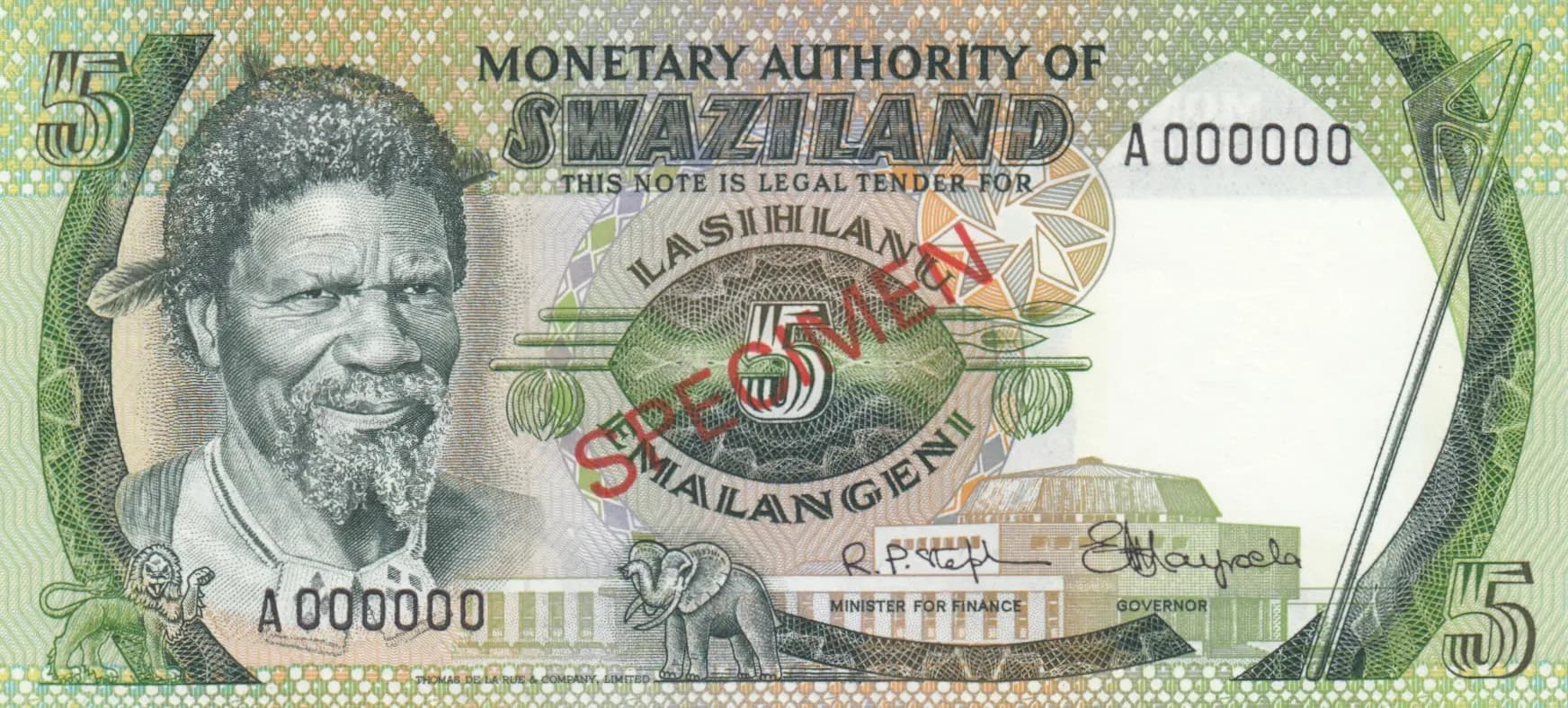
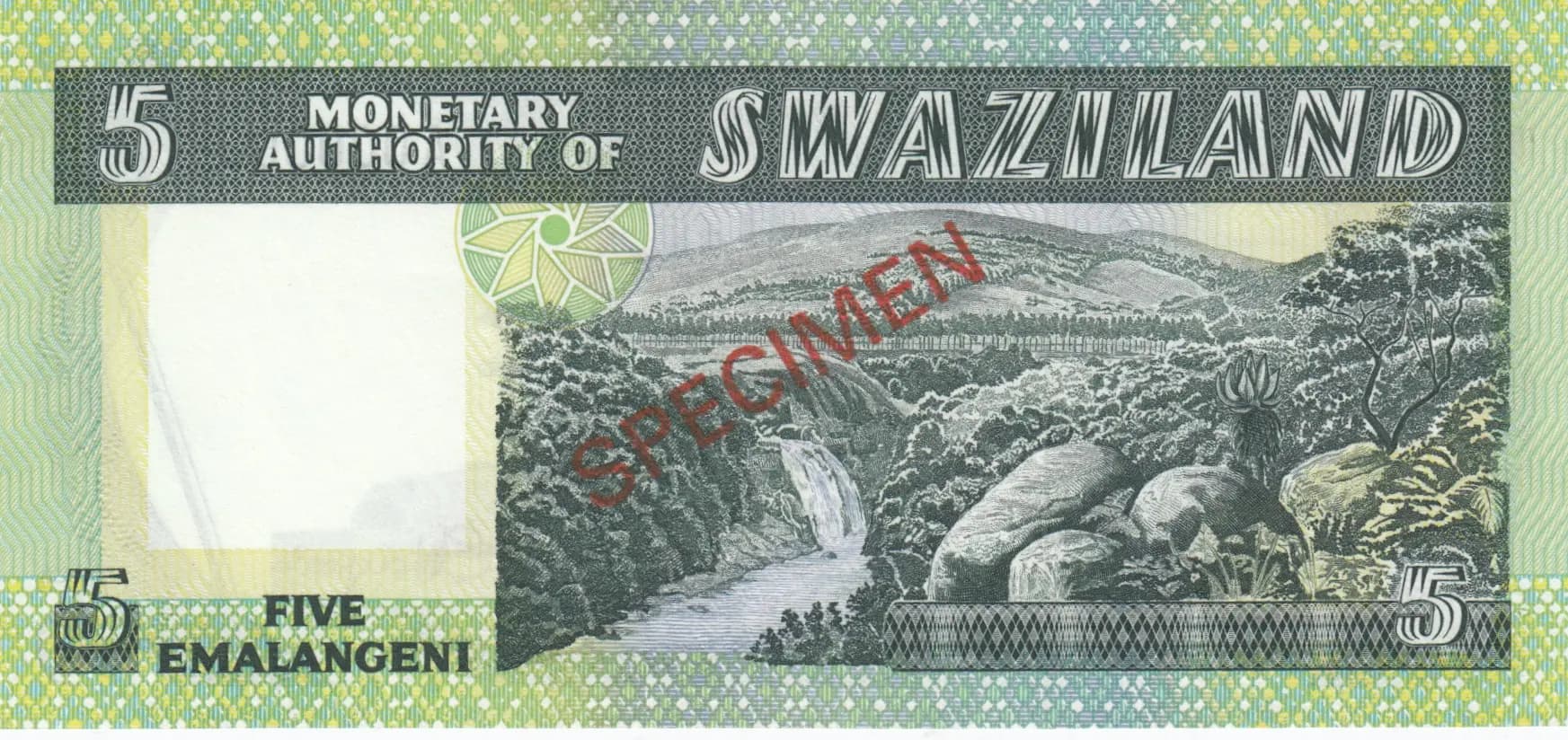
This is a 1974 Swaziland 5 Emalangeni specimen note issued by the Monetary Authority of Swaziland and printed by Thomas de la Rue in London. The note displays King Sobhuza II's portrait on the obverse and features Mantenga Falls landscape on the reverse, both with the prominent red diagonal 'SPECIMEN' overprint across the center. In uncirculated condition with sharp detail throughout the engraving and bilingual English/Siswati inscriptions, this specimen represents an early issue from Swaziland's post-independence currency period.
Common. The eBay price data shows a PMG 67 example selling for $55.88 in 2021 with catalog values around $65 for UNC specimens. These specimen notes from the 1974 Swaziland issue were produced in standard quantities typical of specimen distribution to banks and collectors, and they remain relatively available in the market. The specimen designation and modest pricing indicate this is not a scarce variety.
This note was issued in 1974, just two years after Swaziland gained independence from British rule in 1968, reflecting the new nation's establishment of its own monetary authority and currency system. The portrait of King Sobhuza II, who reigned for 61 years, underscores his central role as the symbol of Swaziland's sovereignty during this formative period. The depiction of Parliament House in Mbabane and natural landmarks like Mantenga Falls on the reverse emphasize the nation's institutional development and natural heritage during the early post-colonial era.
The obverse features a formal portrait of King Sobhuza II positioned at the left side, rendered in traditional banknote engraving style. The center of the note displays bilingual text with the monetary authority designation in large decorative letters. An elephant illustration appears in the lower center section, symbolizing Swaziland's wildlife heritage. The reverse presents a detailed landscape engraving of Mantenga Falls, one of Swaziland's significant natural landmarks, showing a river flowing through forested hills with fine line-work engraving typical of high-security banknote production. Both sides employ geometric pattern backgrounds in greens and cream tones for anti-counterfeiting purposes, with decorative floral emblems as corner ornaments.
Front side: 'MONETARY AUTHORITY OF SWAZILAND' (English); 'THIS NOTE IS LEGAL TENDER FOR' (English); 'ILASIHHLANI' (Siswati: 'Five'); 'SMAILANGENI' (Siswati: 'Emalangeni/currency units'); 'SPECIMEN' (English, overprint); 'MINISTER FOR FINANCE' and 'GOVERNOR' (signature lines, English); denomination '5' (Arabic numeral). Back side: 'MONETARY AUTHORITY OF' and 'SWAZILAND' (English); 'FIVE EMALANGENI' (English); 'SPECIMEN' (English, overprint); denomination '5' (Arabic numeral).
Intaglio (engraved) printing by Thomas de la Rue, London, utilizing fine line engraving for the portraits, landscapes, and security patterns. The geometric background patterns and detailed landscape work on the reverse demonstrate classical banknote engraving techniques characteristic of TDLR's security printer standards. The specimen overprint was applied separately in red ink.
This is Pick 3s, the specimen variety of the 5 Emalangeni 1974 issue printed by Thomas de la Rue (TDLR). The visual analysis confirms the specimen overprint and shows serial number prefix 'A000000,' consistent with specimen note production. The PMG population report confirms P-3s as a documented variant, and catalog data indicates this is distinguishable from the standard circulating note (P-3a/P-3) by the red 'SPECIMEN' overprint and non-circulating serial numbering.