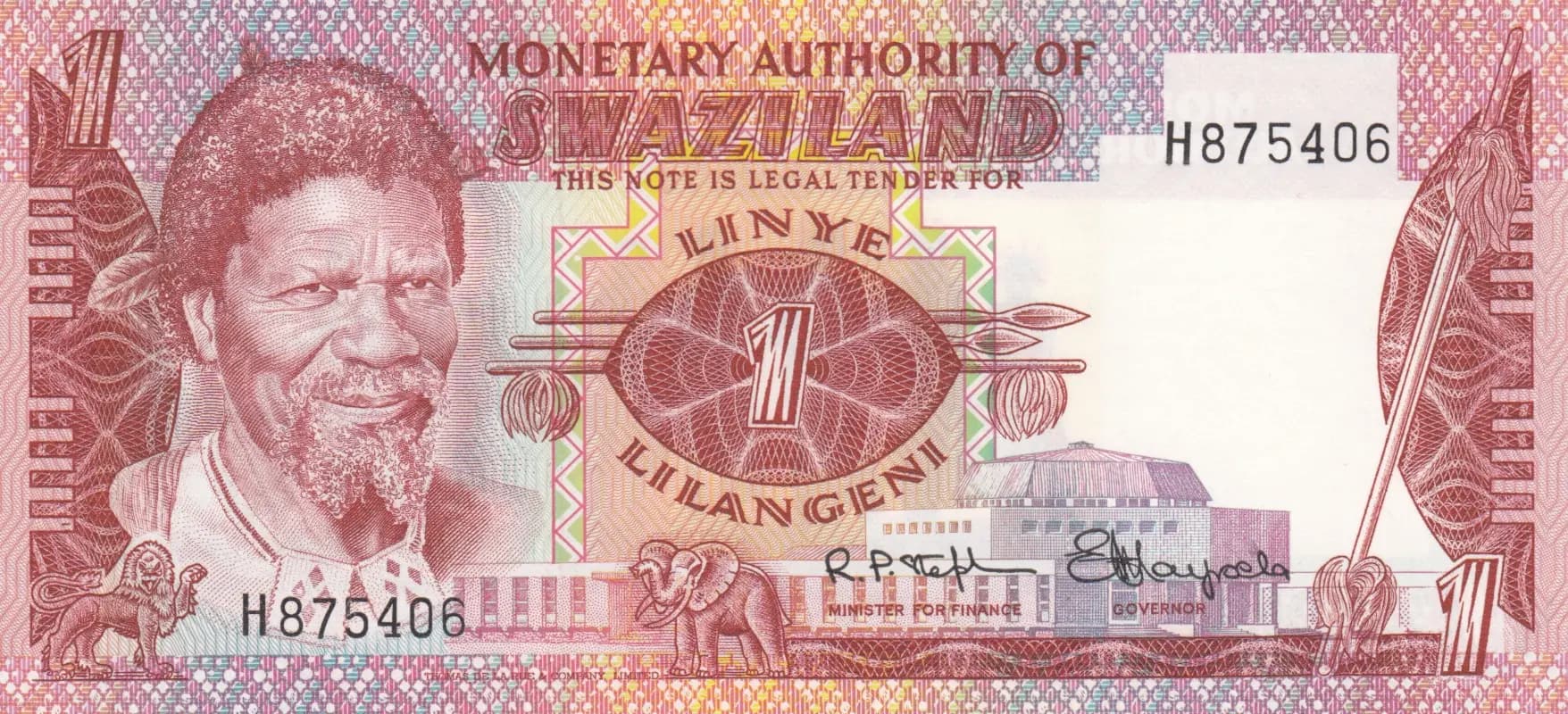
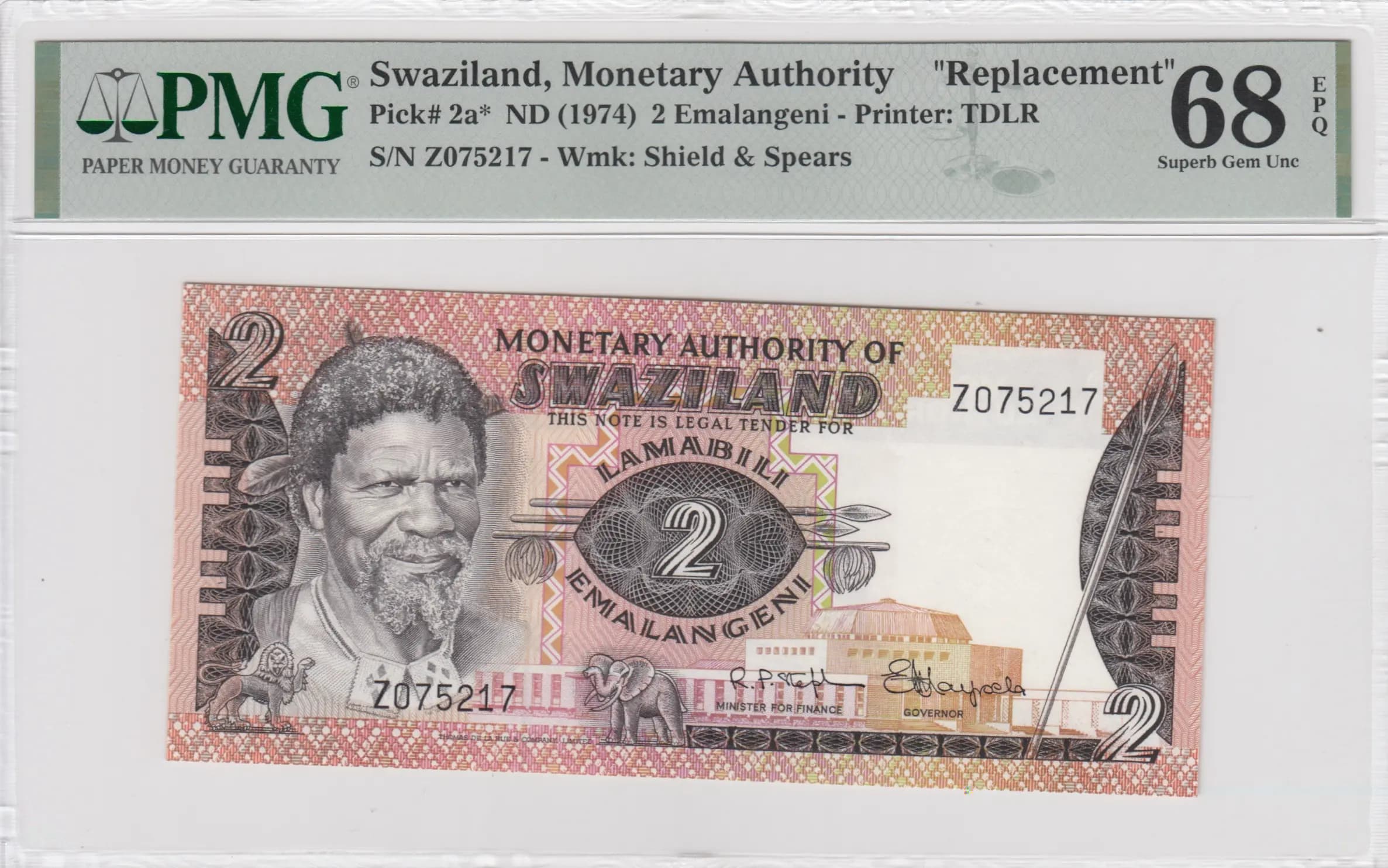
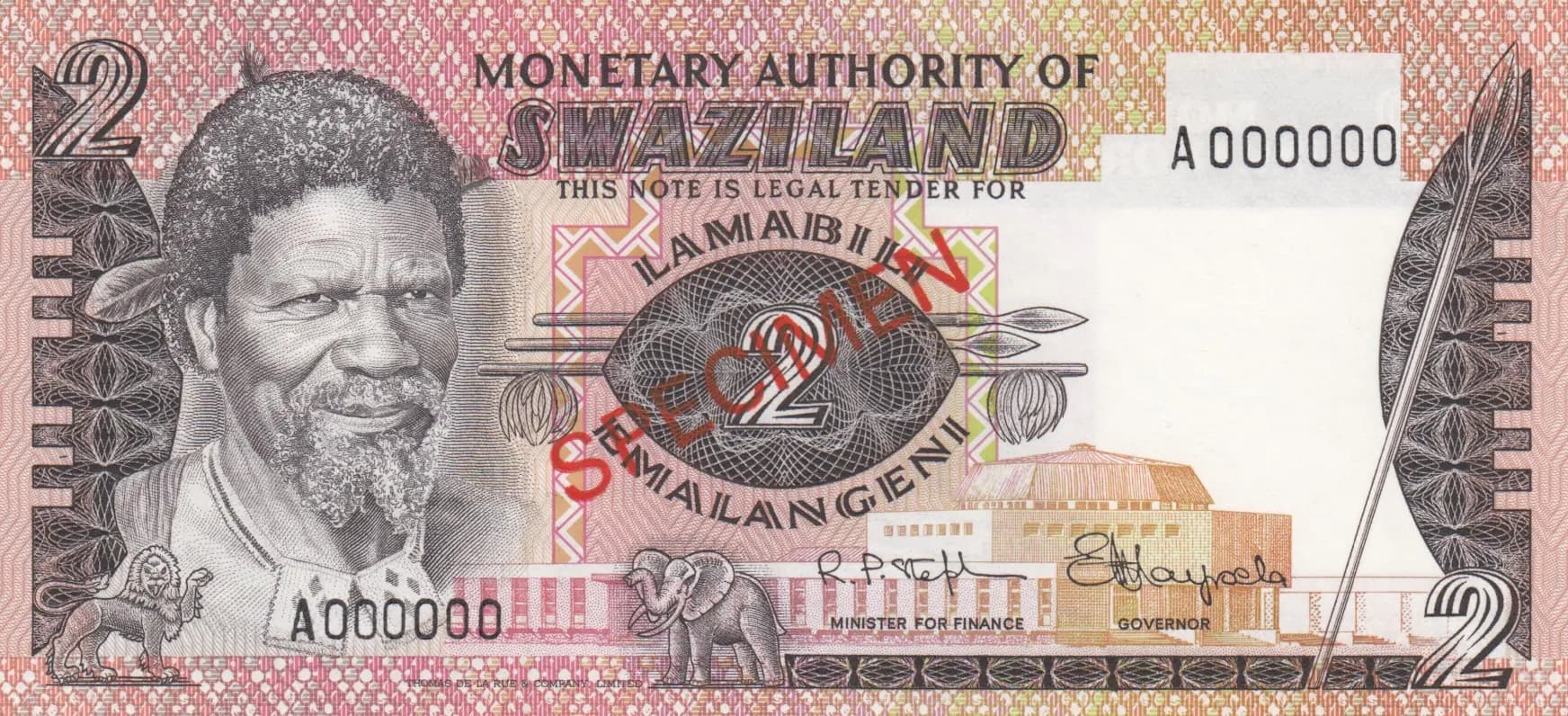
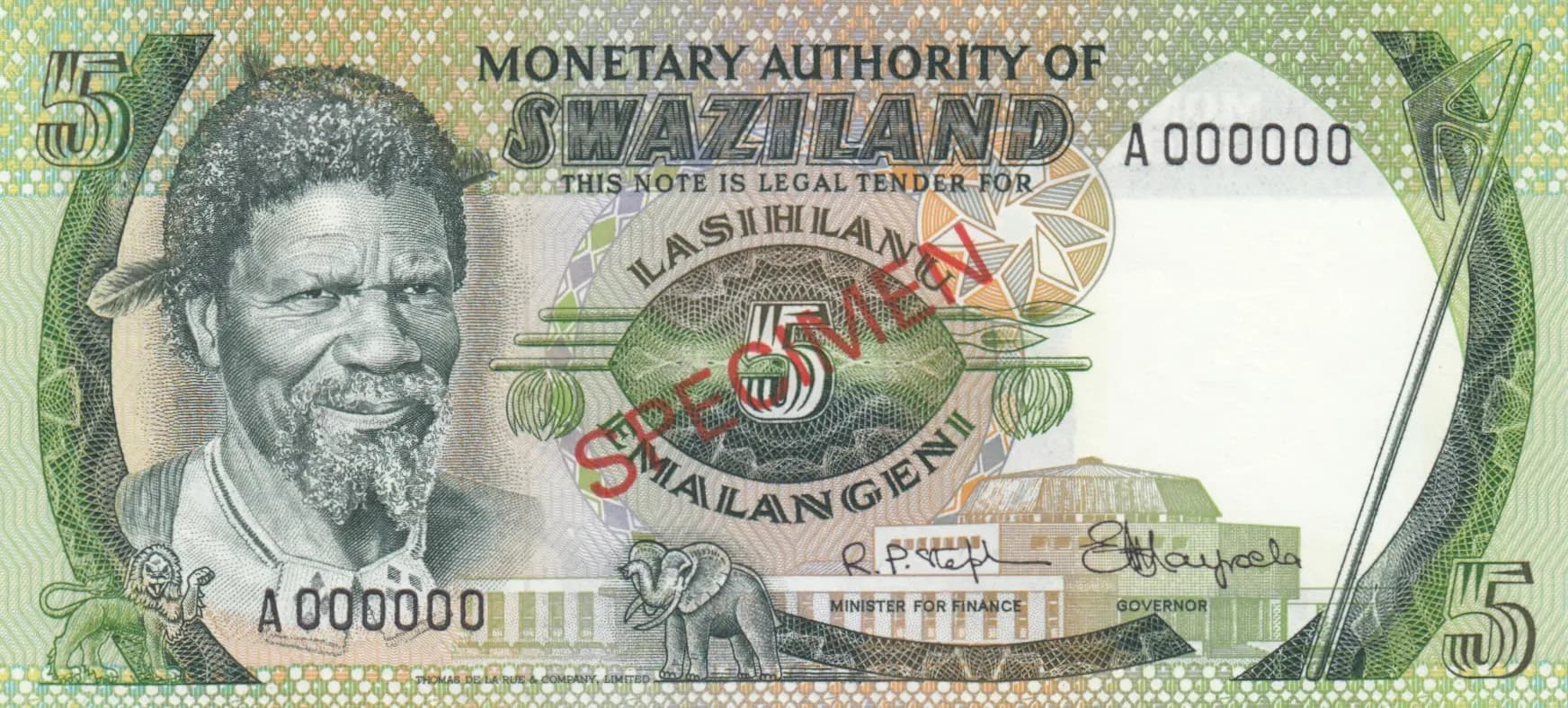
1 lilangeni 1974 specimen
Market Prices
1 saleAbout This Note
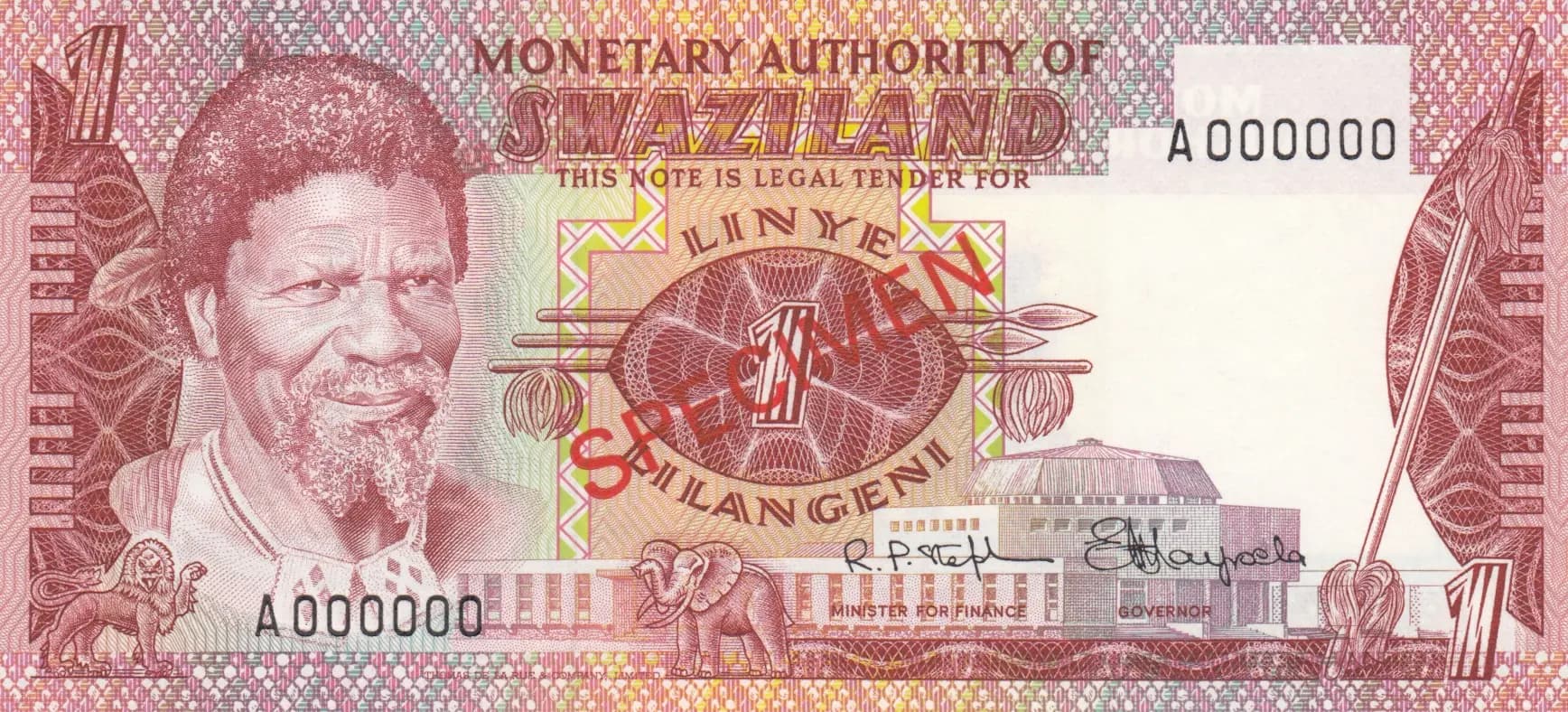
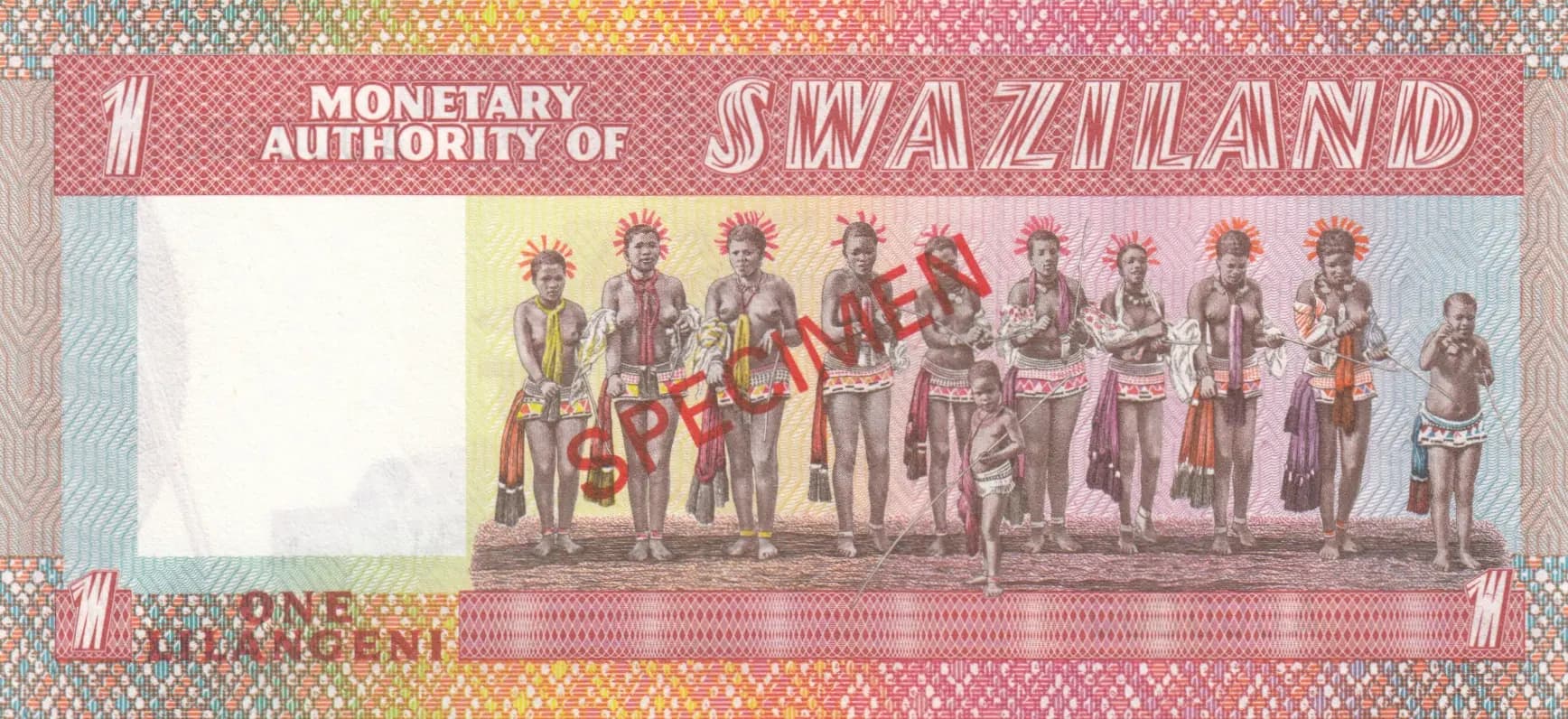
This is a pristine specimen note of the 1 Lilangeni from Swaziland's inaugural 1974 banknote issue, representing the Monetary Authority of Swaziland's first currency emission. The note displays exceptional uncirculated condition with sharp intaglio printing throughout, featuring King Sobhuza II in profile on the obverse and a striking depiction of princesses in traditional ceremonial dress (Ncwala ceremony) on the reverse, both rendered in a sophisticated multicolor scheme dominated by pink, magenta, and green tones. As a specimen note with red diagonal overprint and serial prefix 'A000000', this piece is particularly significant for early Swaziland numismatic collections.
Common. This specimen note appears frequently in the collector market with eBay transaction prices ranging from approximately $5.00 to $19.99 USD, with most sales clustering between $8–$10.50 for UNC examples. The 2019 catalog value of $65 USD reflects catalog pricing conventions rather than actual market scarcity, as demonstrated by consistent sub-$20 selling prices. The 1974 inaugural 1 Lilangeni issue had substantial print runs, and specimen notes were produced in reasonable quantities for institutional and collector distribution by the Monetary Authority of Swaziland.
This 1 Lilangeni note was issued in 1974, marking Swaziland's establishment of its monetary authority following independence in 1968, with King Sobhuza II depicted as the reigning monarch and highest authority. The obverse prominently features Parliament House in Mbabane, symbolizing the nation's governmental institutions, while the reverse celebrates Swazi cultural heritage through the Ncwala ceremony—the sacred kingship rite central to Swazi national identity and royal authority. The bilingual inscriptions (English and Siswati) reflect Swaziland's commitment to both colonial administrative language and indigenous cultural preservation.
The obverse features a left-facing portrait of King Sobhuza II rendered in fine intaglio detail, with his distinctive bearded profile serving as the primary portrait element. Parliament House in Mbabane appears at bottom center-right, rendered as a classical institutional building with architectural clarity. The central focal point is an elaborate medallion containing a shield with crossed spears (a traditional Swazi symbol) surmounted by a lion head emblem, representing royal authority and national sovereignty. Ornamental guilloche patterns and decorative floral/geometric borders frame the entire design in cream and off-white tones. The reverse presents approximately 10-12 figures in full traditional ceremonial dress, identifiable as princesses participating in the Ncwala (kingship ceremony), distinguished by their distinctive tall, ornate red/pink headdresses and formal ceremonial attire. The composition celebrates Swazi cultural pageantry and the sacred role of royal women in the nation's most important annual ritual.
Front side: 'MONETARY AUTHORITY OF SWAZILAND' (English), 'THIS NOTE IS LEGAL TENDER FOR' (English), 'LILANGENI' / 'SIHLANGENI' (currency denomination in English and Siswati), 'MINISTER FOR FINANCE' and 'GOVERNOR' (designations for authorized signatories), 'A000000' (specimen serial number). Back side: 'MONETARY AUTHORITY OF SWAZILAND' (English), 'SPECIMEN' (red overprint designation, English), 'ONE' (denomination word, English). The bilingual approach emphasizes the note's official status and cultural context.
Multi-color intaglio (steel engraving) printing by Thomas de la Rue (TDLR), London—the premier British security printer. The note displays characteristic fine-line guilloche patterns, intricate background work, and precise color registration visible throughout both sides. The watermark area featuring shield and spears was integrated into the paper during manufacture. The specimen overprint on the reverse was applied in red, likely via a separate printing pass after initial intaglio production.
This note is cataloged as P-1s (specimen variety) by Pick. The visual analysis confirms the specimen designation through the 'A000000' serial number with prefix 'A' and red diagonal 'SPECIMEN' overprint. The PMG population report indicates P-1s is one of at least 23 documented variants of Pick 1, including regular circulation varieties (P-1a, P-1a*) and a commemorative variant (P-1CS1). This specimen exhibits the characteristic serial number format for specimen notes of this issue, distinguishing it from circulation examples that would carry different serial prefixes (G prefix noted in the reference data indicates another specimen variety exists).