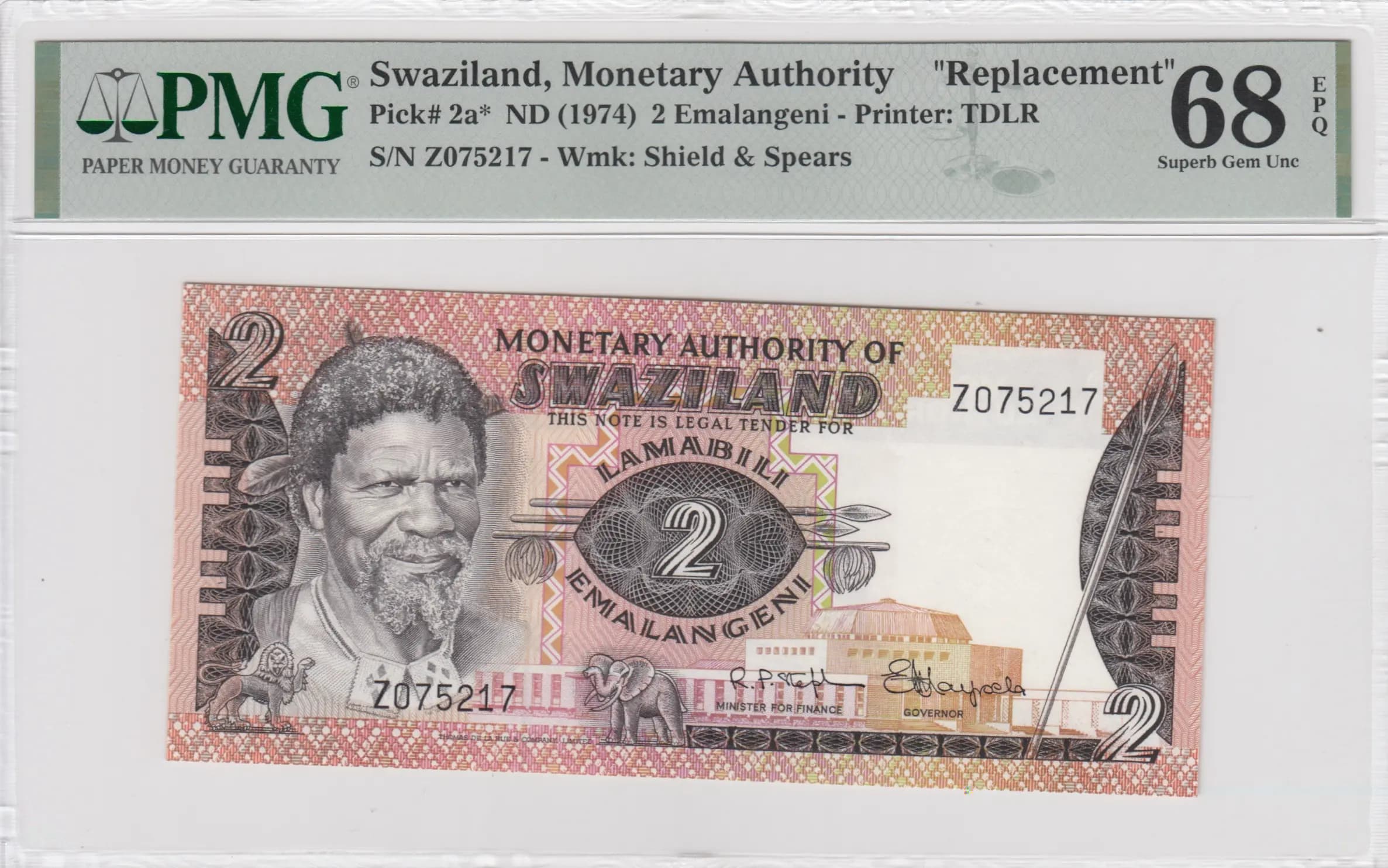
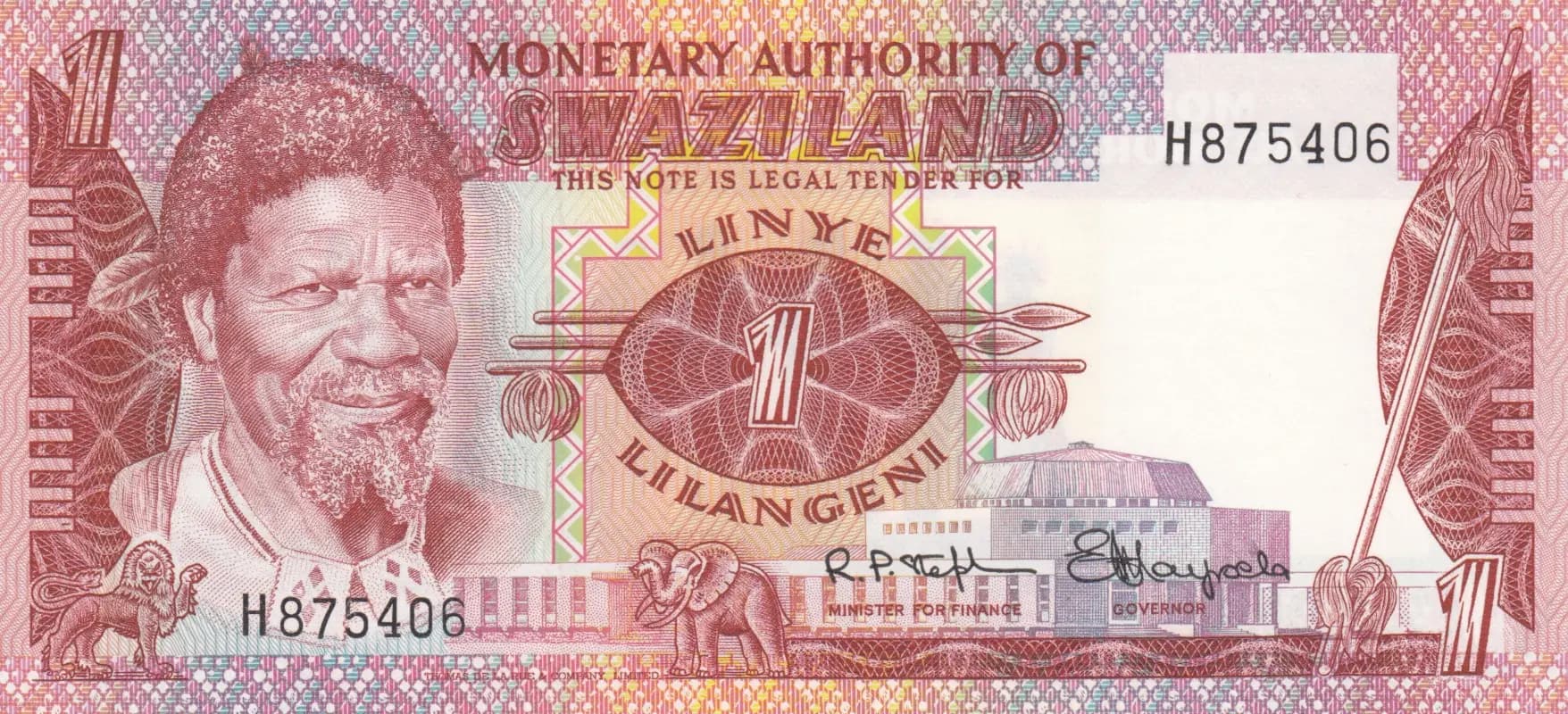
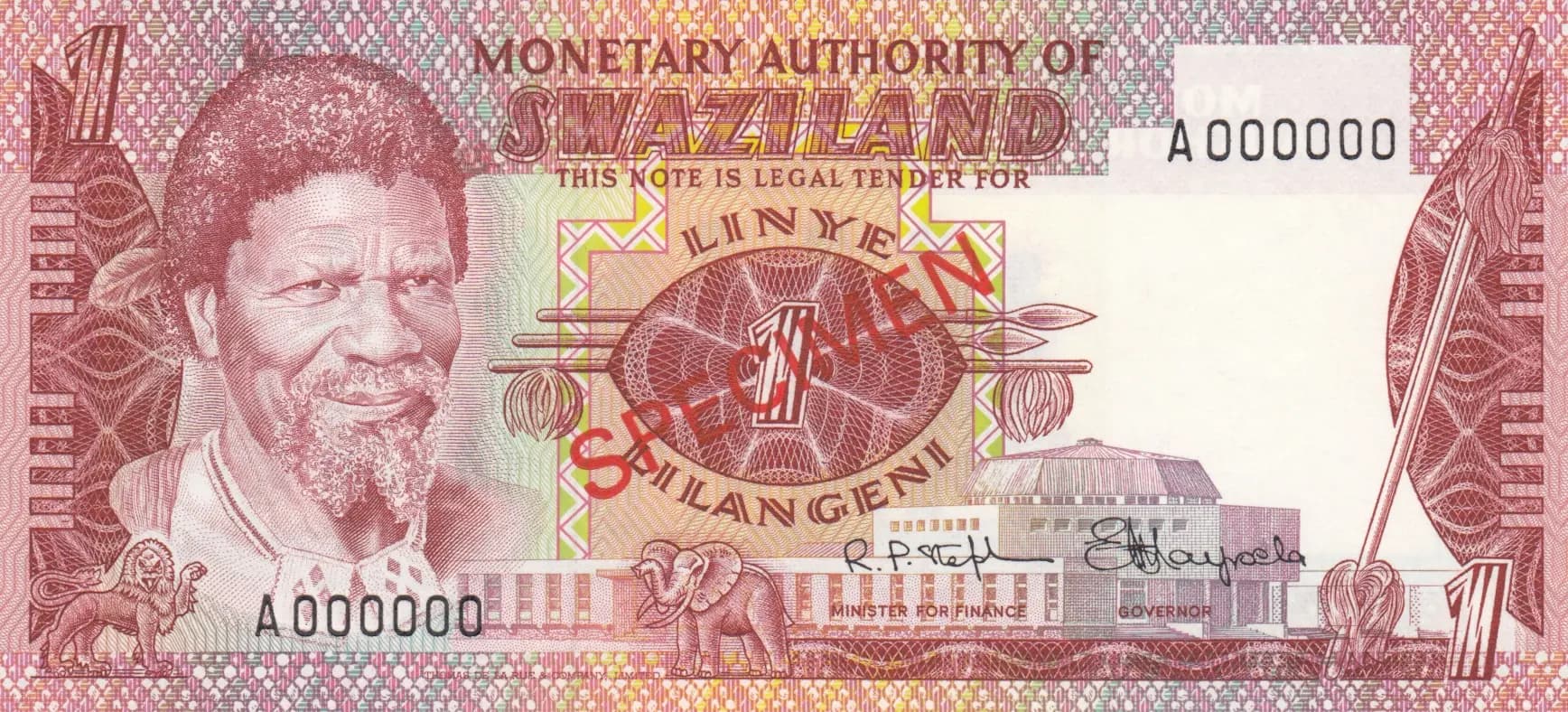
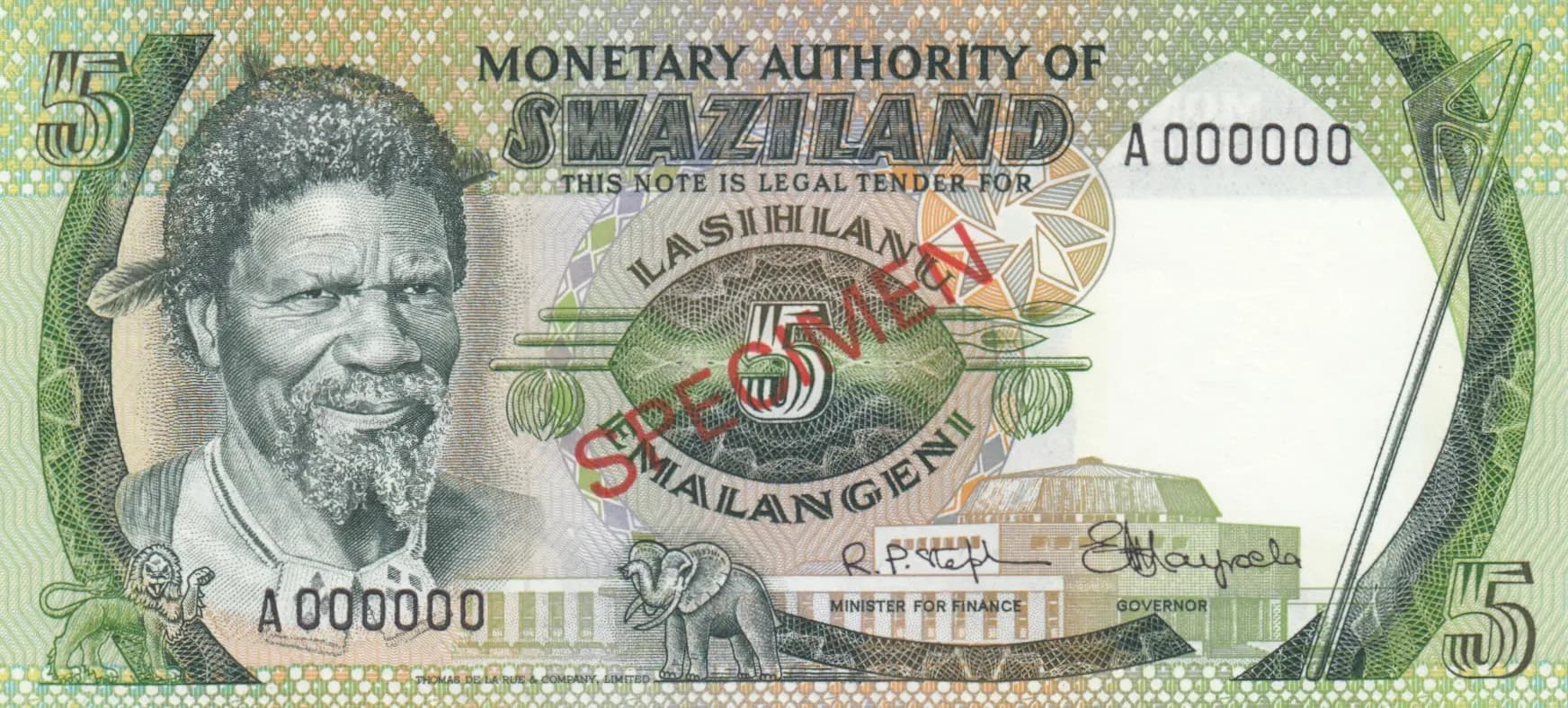
2 emalgeni 1974 specimen
Market Prices
1 saleAbout This Note
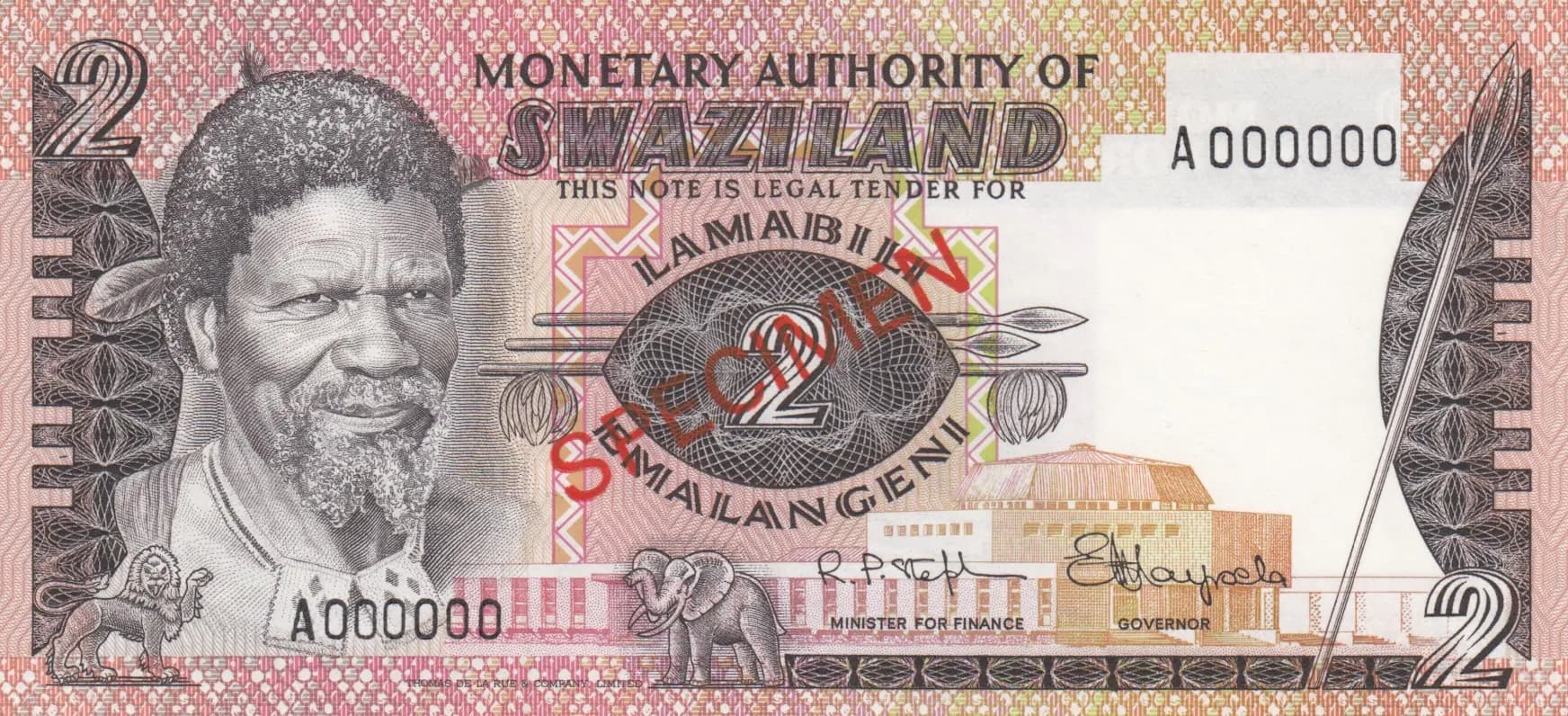
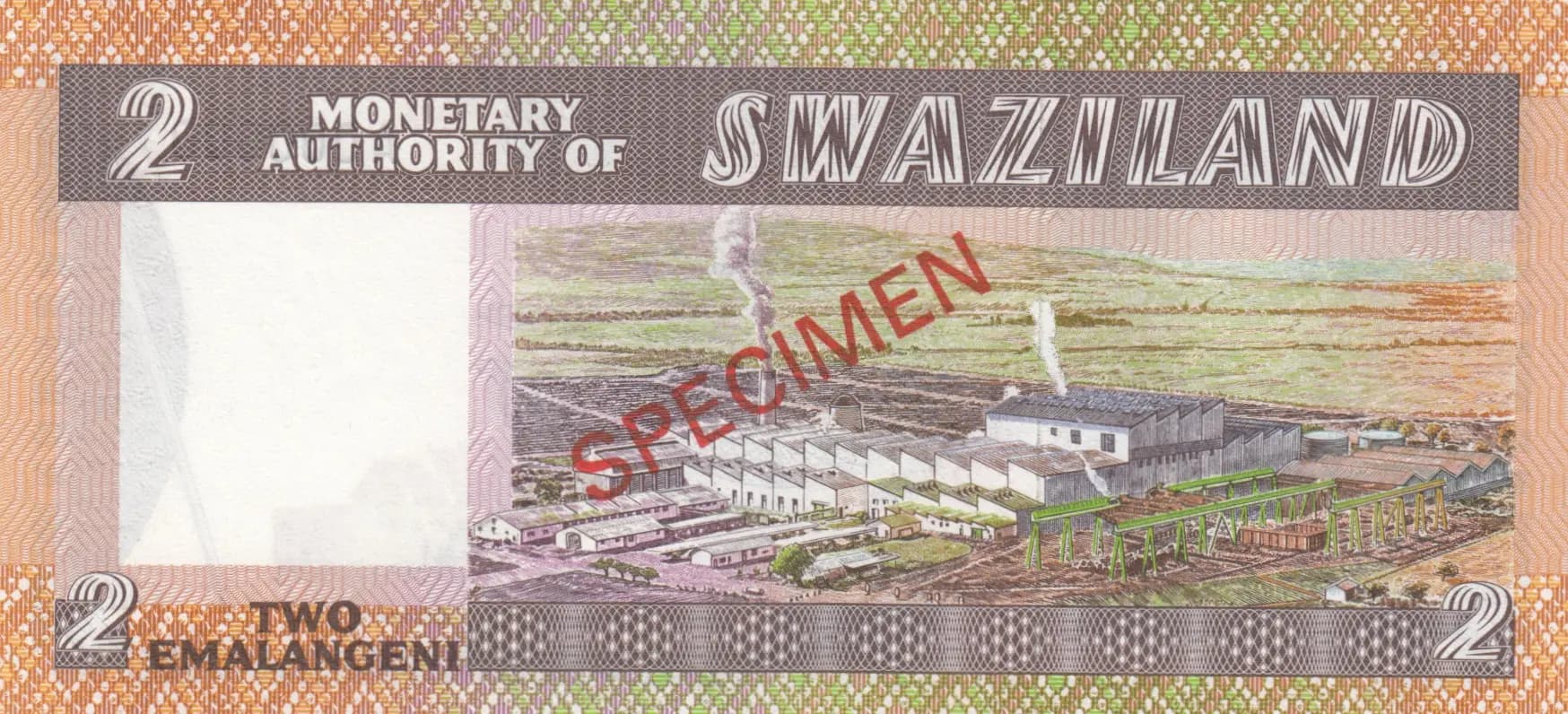
This is a pristine UNC specimen note of the 2 Emalangeni from Swaziland's inaugural 1974 issue by the Monetary Authority of Swaziland. The note features King Sobhuza II in profile on the obverse with Parliament House in Mbabane, while the reverse depicts a sugar refinery—key economic symbols of the newly independent nation. As a specimen note with serial prefix 'A000000' and prominent SPECIMEN watermark, this is a non-circulating sample that exemplifies the fine line engraving work characteristic of Thomas de la Rue's security printing.
Common. This specimen note, while technically non-circulating, appears to have been produced in substantial quantities for distribution to banks and collectors. eBay market data shows numerous UNC examples selling in the $2–$45 range, with a 2019 catalogue value of $65 indicating moderate collector interest but broad availability. Specimen notes from the 1974 Swaziland series are encountered regularly in the secondary market and do not command premiums suggesting limited production.
This 1974 specimen note was issued during Swaziland's transition period following independence in 1968, when the Monetary Authority of Swaziland established its own currency to replace the South African Rand. The obverse portrait of King Sobhuza II reflects his central role as the reigning monarch, while the Parliament House in Mbabane and sugar refinery on the reverse celebrate the nation's governance infrastructure and its significant agricultural-industrial economy, positioning sugar production as a cornerstone of national wealth.
The obverse features a left-facing profile portrait of King Sobhuza II rendered in classical engraved style, accompanied by a central oval frame containing the numeral '2' with ornamental decorative elements. The right side displays Parliament House in Mbabane, a multi-story building illustrative of the nation's governmental seat. An elephant figure appears below the central design, symbolizing wildlife and natural heritage. The reverse presents an expansive industrial landscape showing a sugar refinery complex with multiple buildings and structures, surrounded by agricultural fields with visible crop rows—reflecting Swaziland's economic dependence on sugar production. Both sides feature pink, red, orange, and yellow base colors with intricate geometric security patterns and fine line engraving throughout. Bilingual inscriptions in English and Siswati appear on both sides.
Front: 'MONETARY AUTHORITY OF SWAZILAND' (English); 'THIS NOTE IS LEGAL TENDER FOR' (English); 'LILAMBILI' (Siswati, meaning currency/money); 'EMALANGENI' (Siswati, plural of lilangeni); 'MINISTER FOR FINANCE' and 'GOVERNOR' (English, signature titles); Serial number 'A000000' (specimen marking). Back: 'MONETARY AUTHORITY OF SWAZILAND' (English); 'SPECIMEN' (English, watermark); 'TWO' (English); 'EMALANGENI' (Siswati); Denomination numerals '2' in bottom corners.
Intaglio (line engraving) on multicolor printed base stock, characteristic of Thomas de la Rue's security printing. The fine detail work, geometric security patterns, and crisp portrait rendering are consistent with TDLR's high-security currency production standards of the 1970s. Specimen notes were produced using the same engraving plates as circulation notes but overprinted with specimen markings and printed with serial numbers like A000000.
This is Pick P-2s, the specimen variety of the 2 Emalangeni from the 1974 issue. The serial number prefix 'A' with format 'A000000' is the standard specimen identifier. The PMG population report confirms P-2s as a catalogued variant distinct from P-2a (regular circulation issue) and P-2CS1 (commemorative). The note was printed by Thomas de la Rue, London (TDLR), and exhibits the watermark of shield and spears as documented in reference sources. No signature varieties or date variants are apparent on this specimen note.