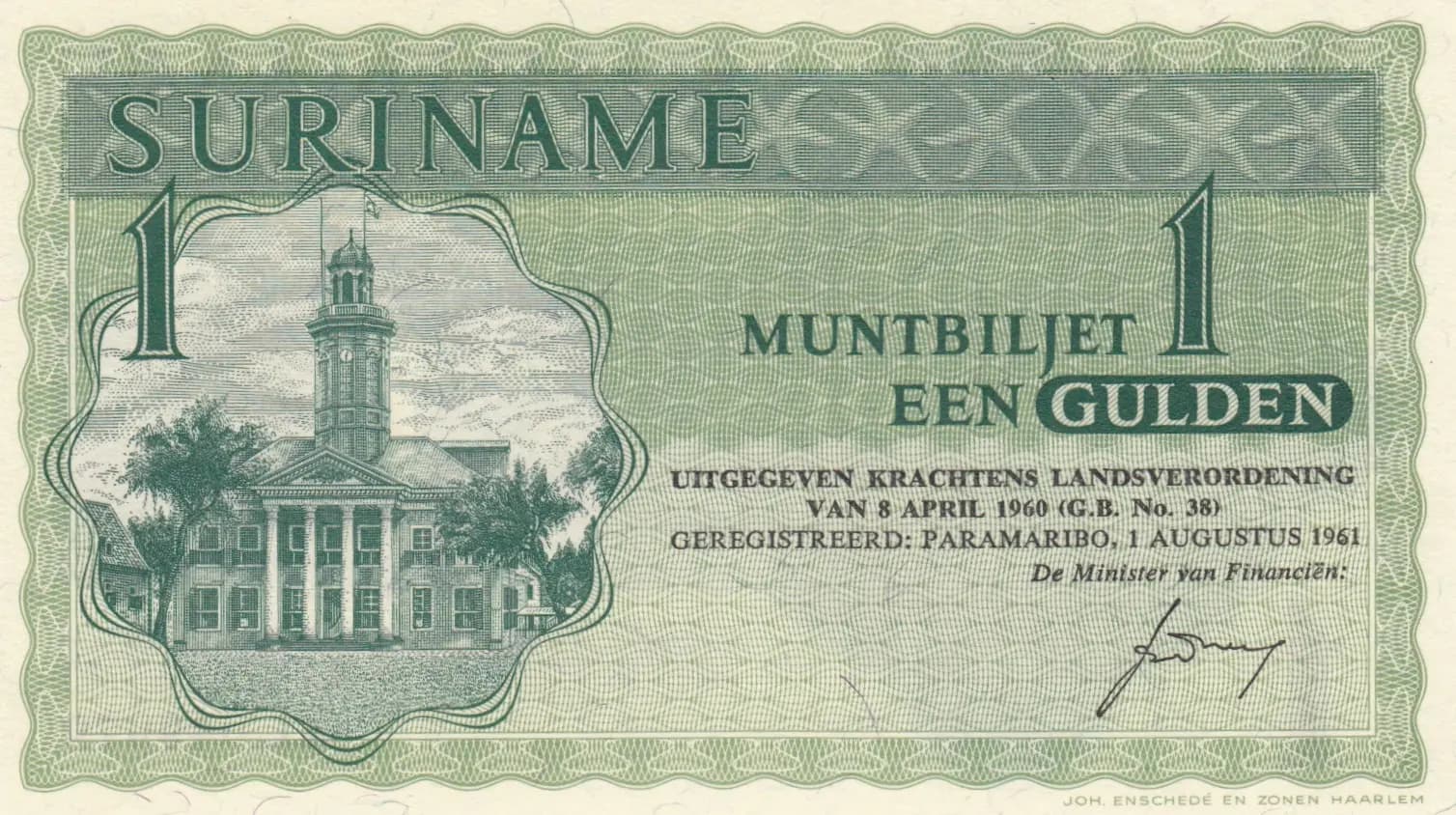
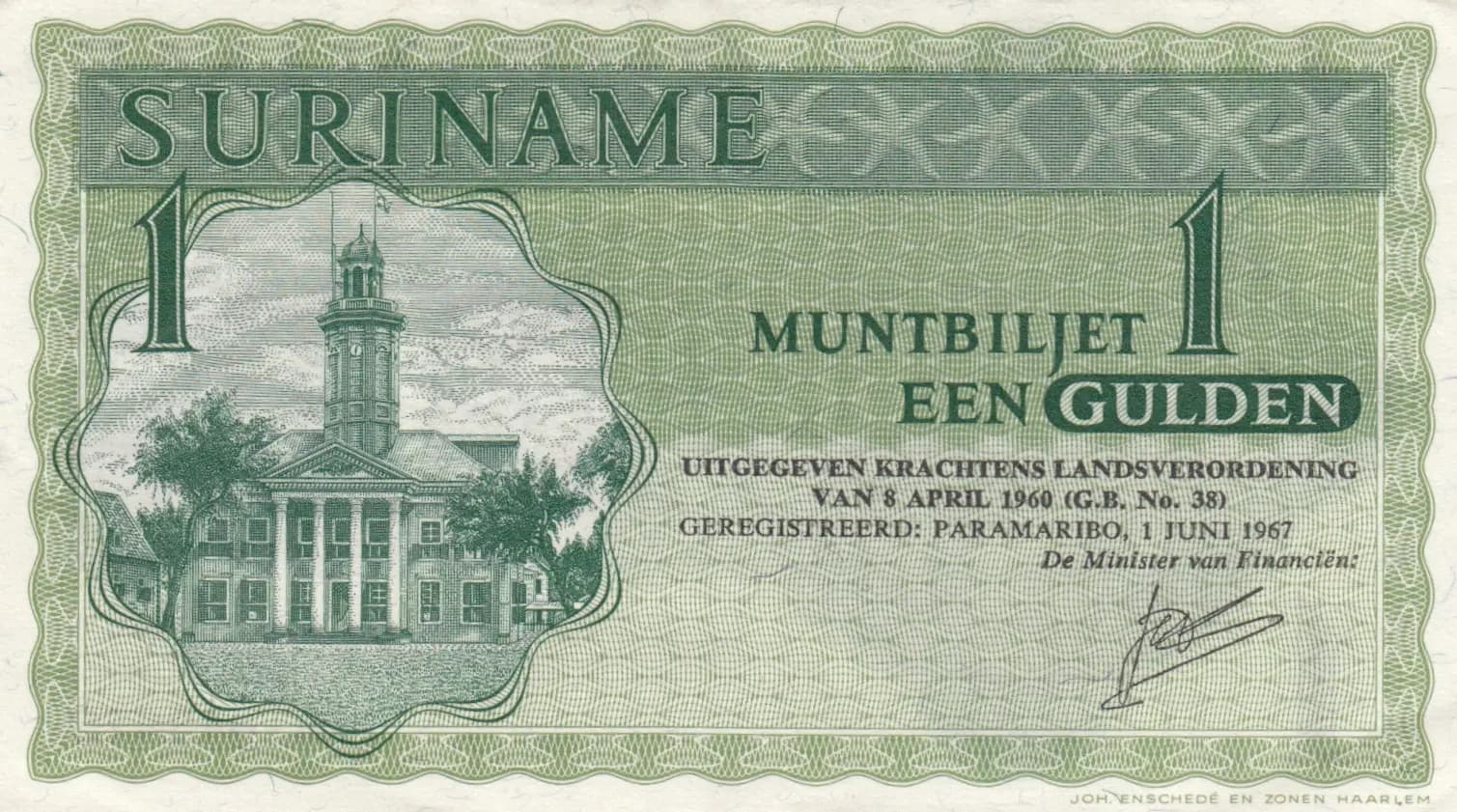
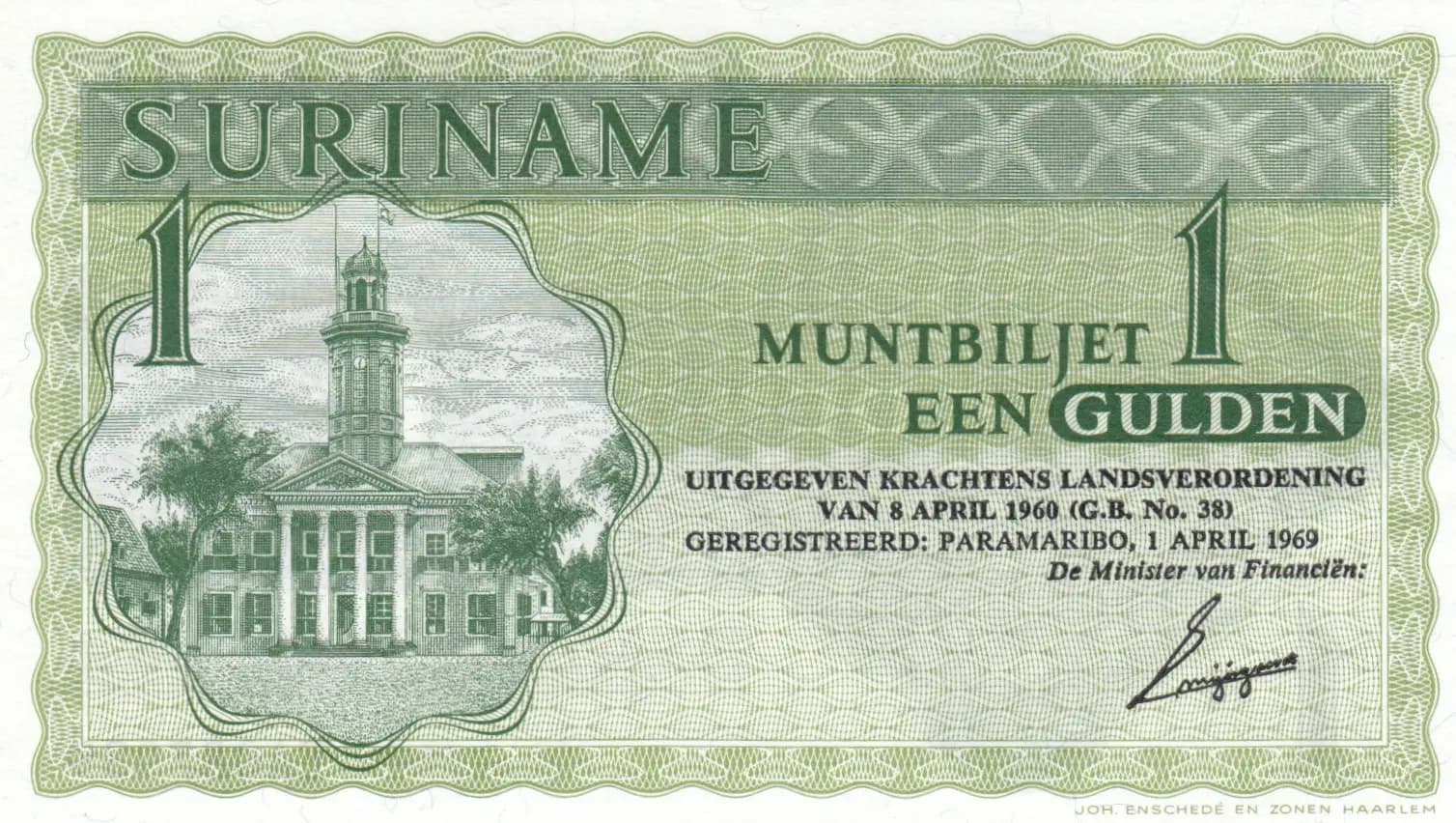
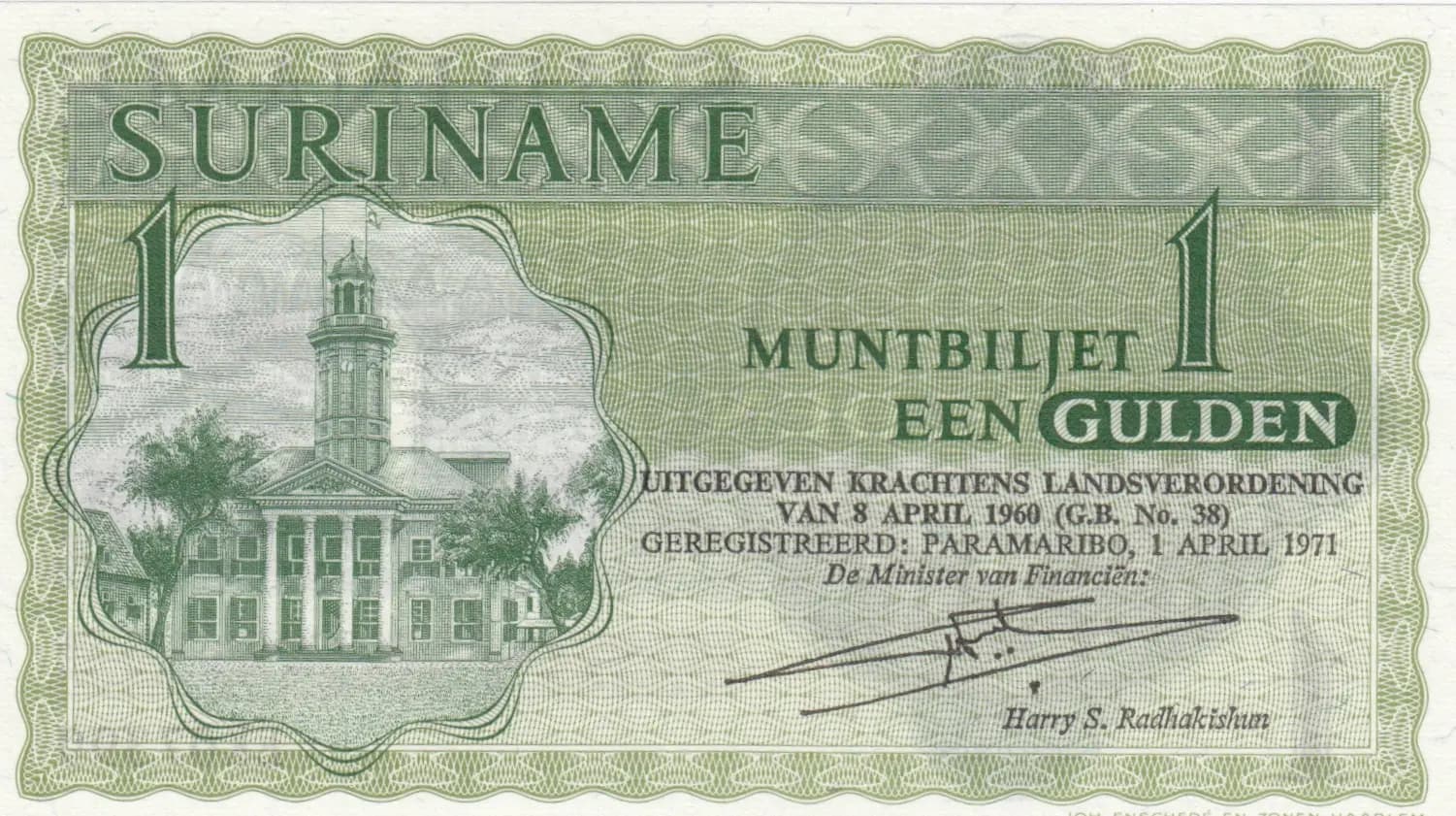
1 gulden 1974
Market Prices
10 salesAbout This Note
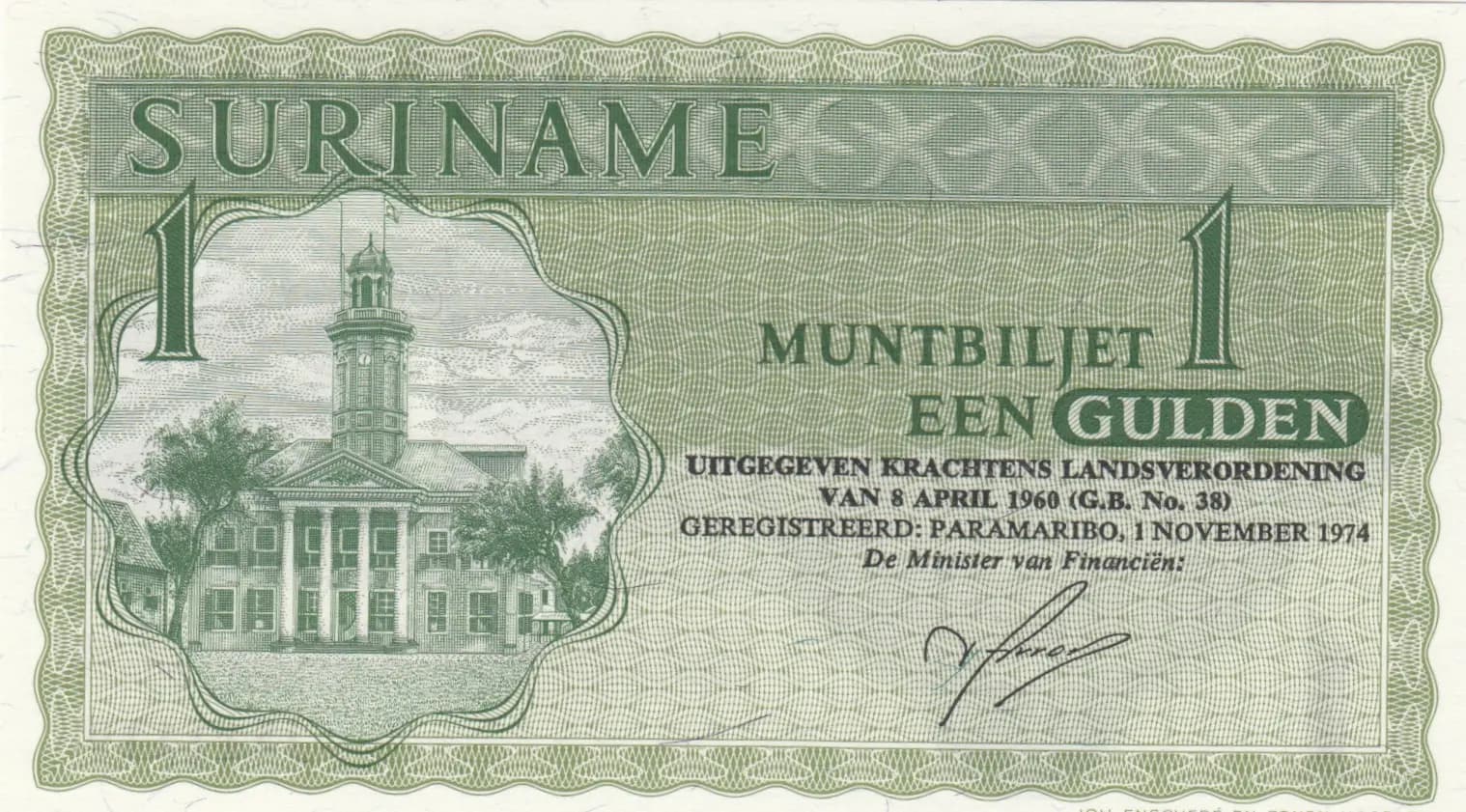
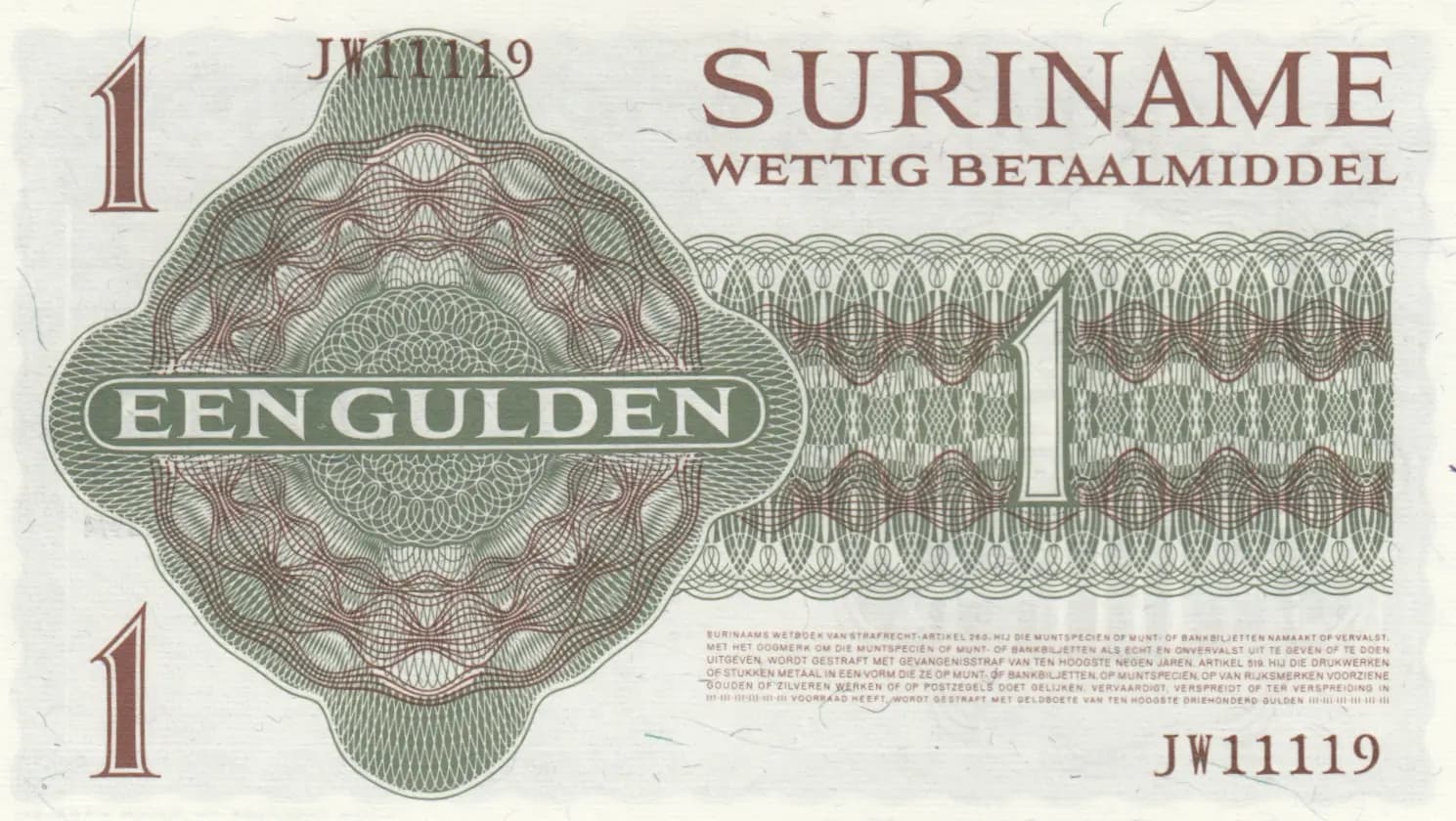
This 1974 Surinamese 1 gulden note (Pick P-116d) presents a well-preserved example of post-colonial currency design featuring a distinctive colonial-era government building with central tower prominently displayed on the obverse. The note exhibits the characteristic green coloration and intricate line-work security patterns typical of Johan Enschede printing, with a striking ornate circular medallion design on the reverse. While showing age-appropriate patina and light handling marks consistent with circulation during the 1970s, the note remains in excellent condition with all text and security details clearly legible—a desirable specimen for collectors of Surinamese numismatics.
Common. The catalog value of $5.50 UNC (2019) and consistent eBay sales data showing UNC specimens trading at $2.25–$4.55 from 2013–2021 demonstrate abundant supply in the market. The note had a relatively long circulation period (1974–1986 according to external catalog reference) and represents a standard-issue denomination from Suriname's post-independence monetary system. Print run data and scarcity indicators do not suggest limited production, and the steady presence of multiple examples in secondary markets confirms this as a common issue.
Issued under authority of the National Ordinance of 8 April 1960 (registered 1 November 1974), this banknote reflects Suriname's post-independence monetary sovereignty following the nation's August 1975 independence from the Netherlands. The prominent architectural landmark—the High Court building in Paramaribo—symbolizes the newly independent nation's institutional authority and judicial heritage during a transformative period in Surinamese history. The Dutch-language inscriptions and the central tower imagery represent the colonial architectural legacy that remained influential in the young nation's official symbolism throughout the 1970s.
The obverse features the High Court building (Hoge Raad) of Paramaribo as the primary architectural landmark, depicted in profile with a distinctive central cupola/tower and surrounding vegetation within an ornamental rectangular frame. The reverse showcases an elaborate circular medallion containing intricate geometric and floral filigree patterns in the mandala or rosette style, characteristic of 1970s banknote design aesthetic. The denomination '1' appears in large numerals on the reverse with 'EEN GULDEN' inscribed below. Both sides employ fine-line engraving techniques with layered green and brown/red coloration. The note features decorative wavy borders framing the entire design, with government seals and official authentication marks positioned strategically on the obverse near the Minister of Finance's signature line.
FRONT SIDE: 'SURINAME' (Suriname); 'MUNTBILLET' (Banknote); 'EEN GULDEN' (One Gulden); 'UITGEGEVEN KRACHTENS LANDSVERORDENING VAN 8 APRIL 1960 (G.B. No. 38)' (Issued under the authority of the National Ordinance of 8 April 1960, Government Bulletin No. 38); 'GEREGISTREERDE: PARAMARIBO, 1 NOVEMBER 1974' (Registered: Paramaribo, 1 November 1974); 'De Minister van Financiën:' (The Minister of Finance:). BACK SIDE: 'SURINAME' (Suriname); 'WETTIG BETAALMIDDEL' (Legal Tender); 'EEN GULDEN' (One Gulden); Serial number 'JW11119'; Extended legal text regarding counterfeiting penalties under Articles 245 and 248 of Surinamese criminal law, specifying imprisonment of minimum nine years for counterfeiting and substantial fines for related offenses.
Intaglio (engraved) printing by Johan Enschede (JEZ mark visible), the renowned Dutch security printer. The note exhibits characteristic fine-line work, detailed filigree patterns, and multi-color layering achieved through separate intaglio plates. The intricate geometric patterns in the circular medallion and the precise architectural rendering of the High Court building demonstrate the high-quality security printing standards of this period, with security features embedded directly into the engraved design rather than as separate applied elements.
This specimen is identified as Pick P-116d, one of four cataloged variants for the 1 gulden 1974 base issue (P-116c, P-116d, P-116h, P-116i exist in PMG records). The P-116d variant is associated with the JEZ (Johan Enschede Zonen) printer mark. The serial number observed on this specimen is 'JW11119,' with the 'JW' prefix potentially indicating a specific printing batch or series. The registered date of 1 November 1974 is consistent with the Pick catalog identification. No overprints, signature variations, or notable printing anomalies are evident from the visual analysis that would elevate this specimen to a special variety status.