1 gulden 1961
Market Prices
8 salesAbout This Note
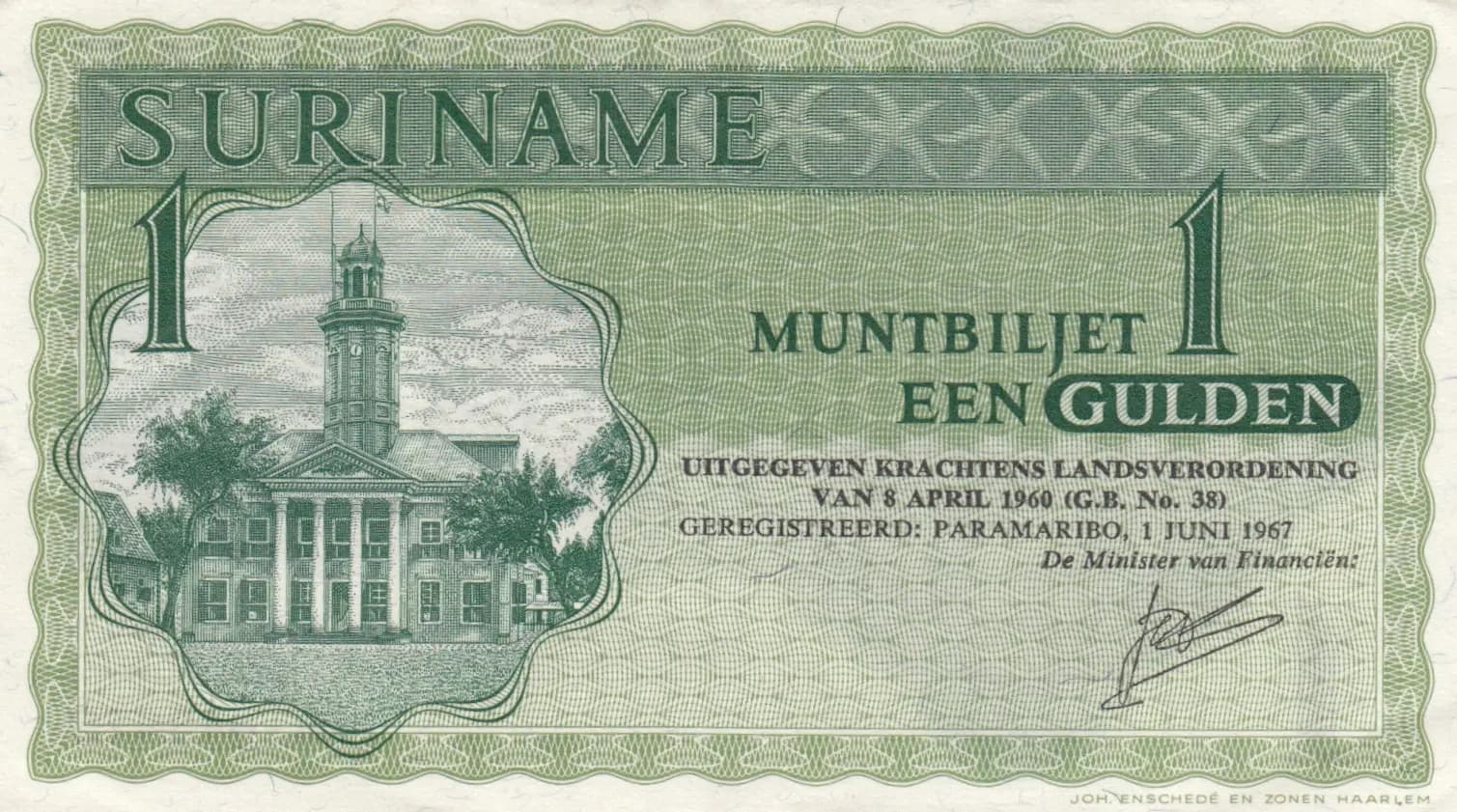
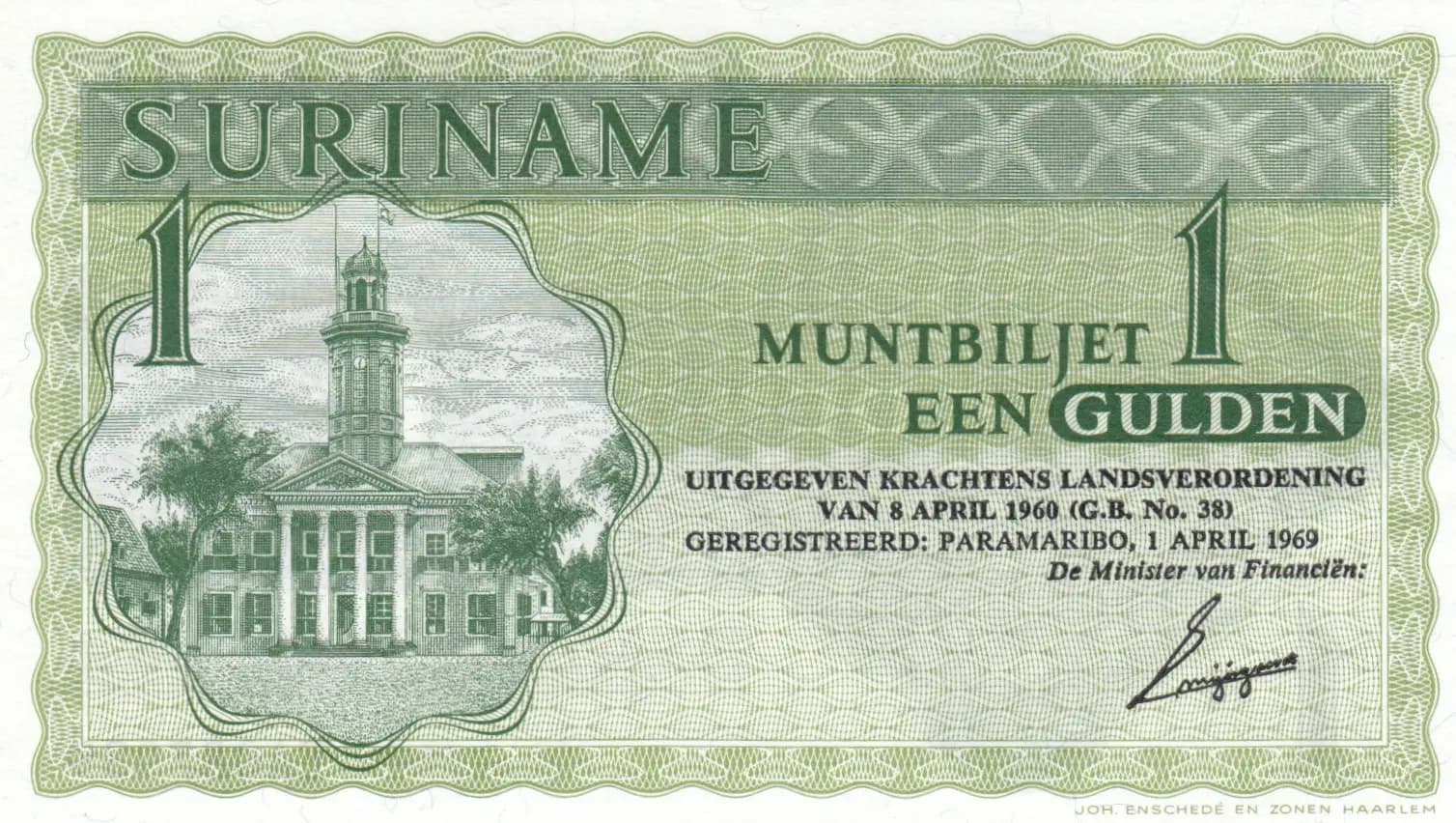
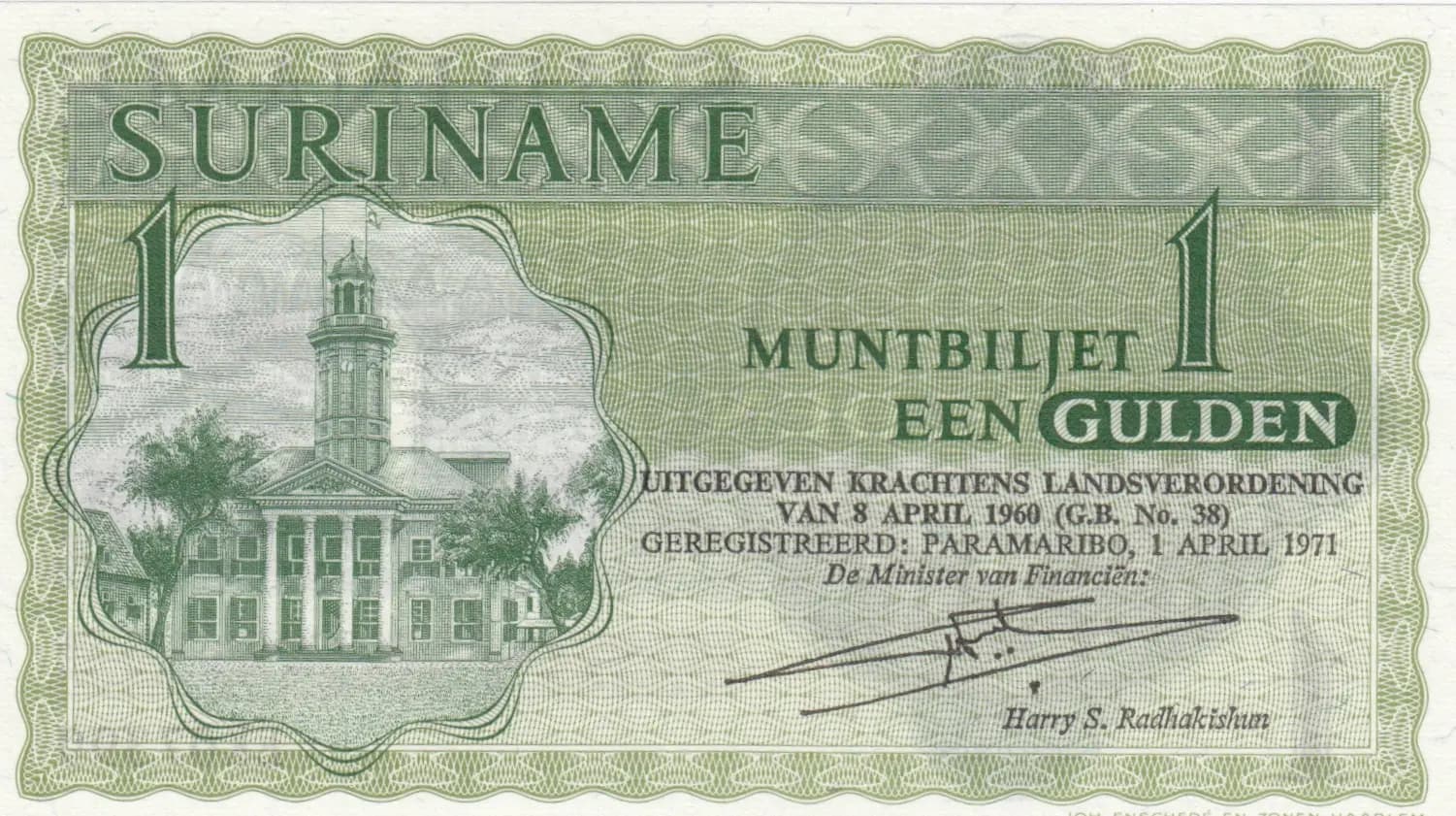
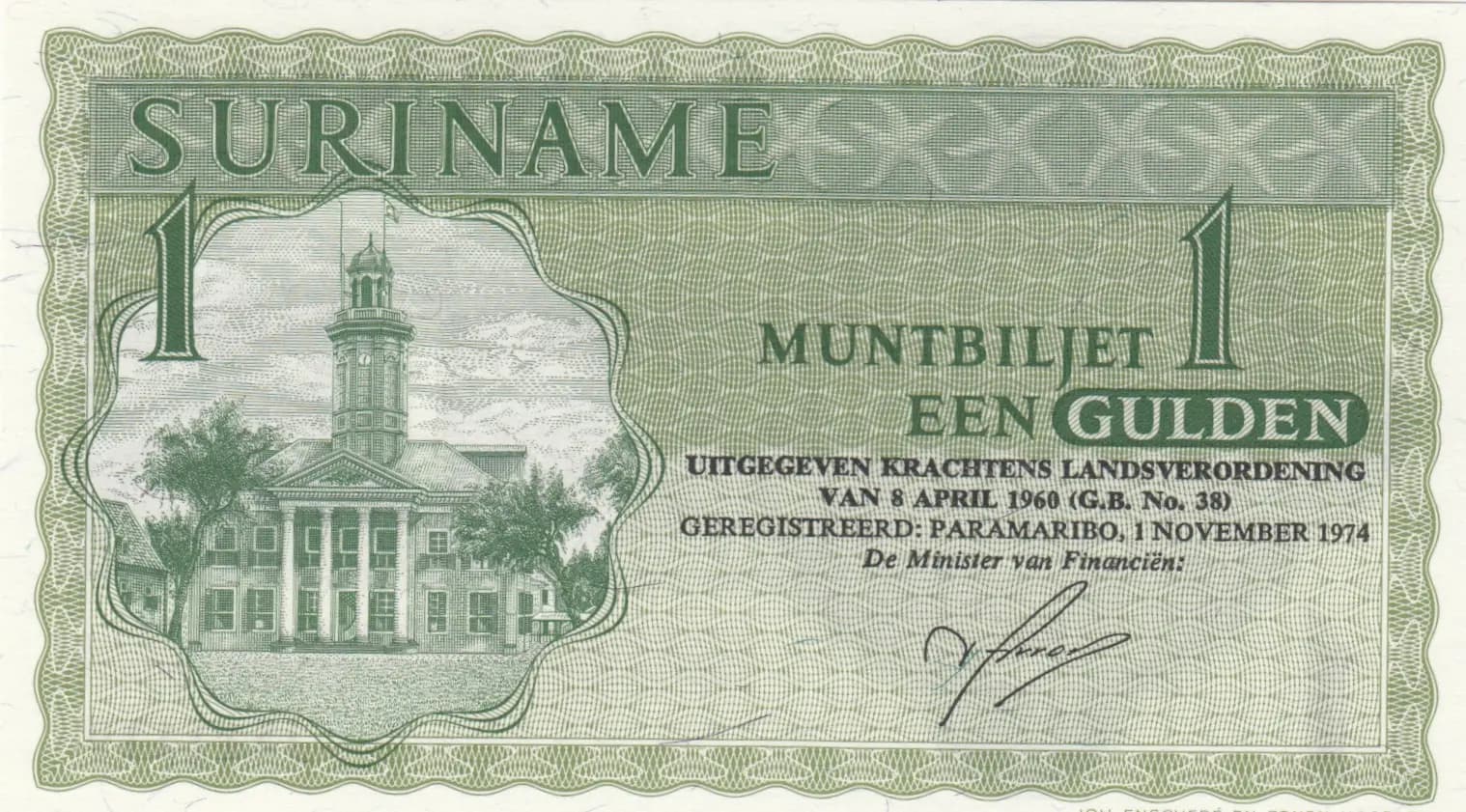
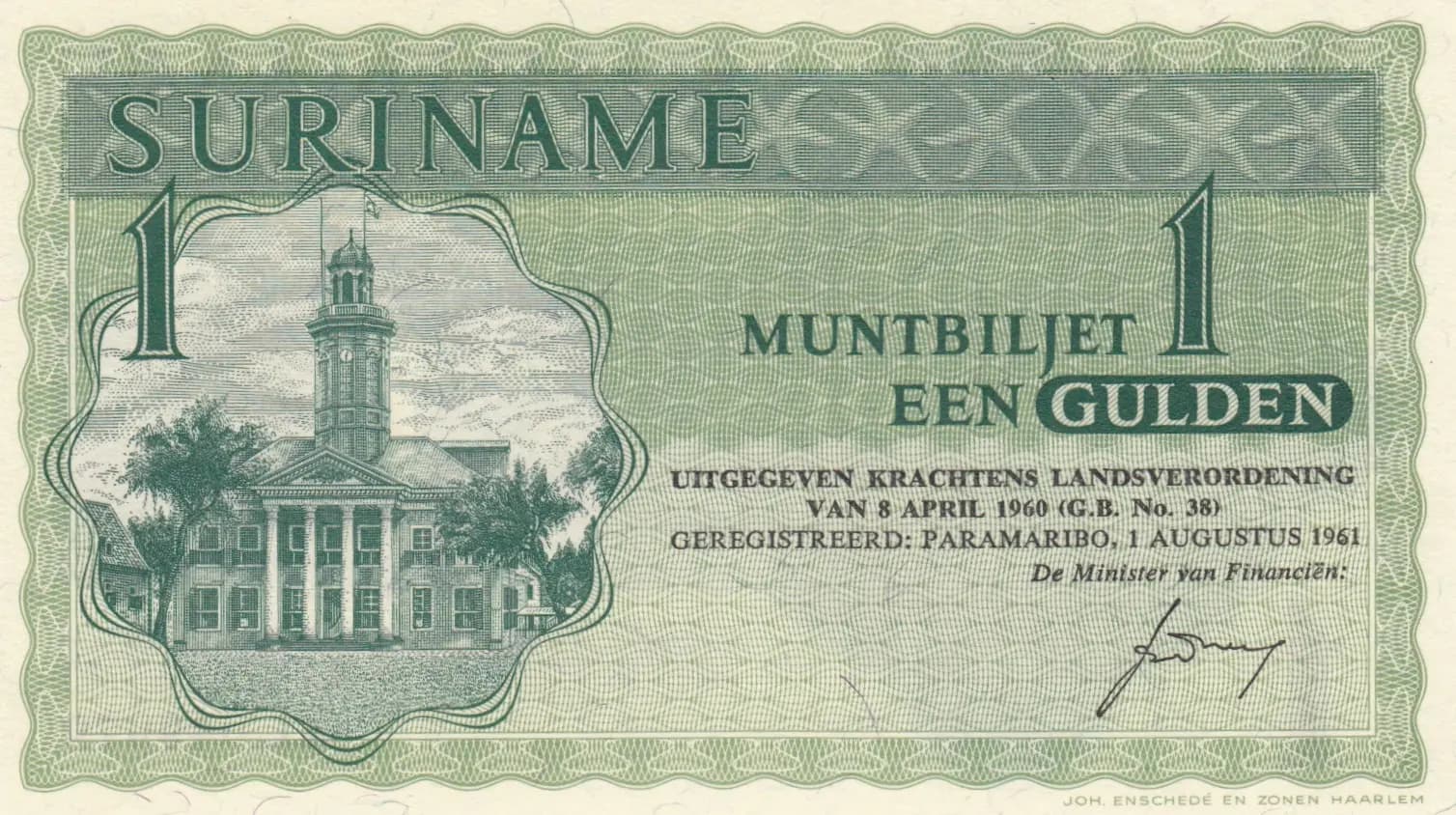
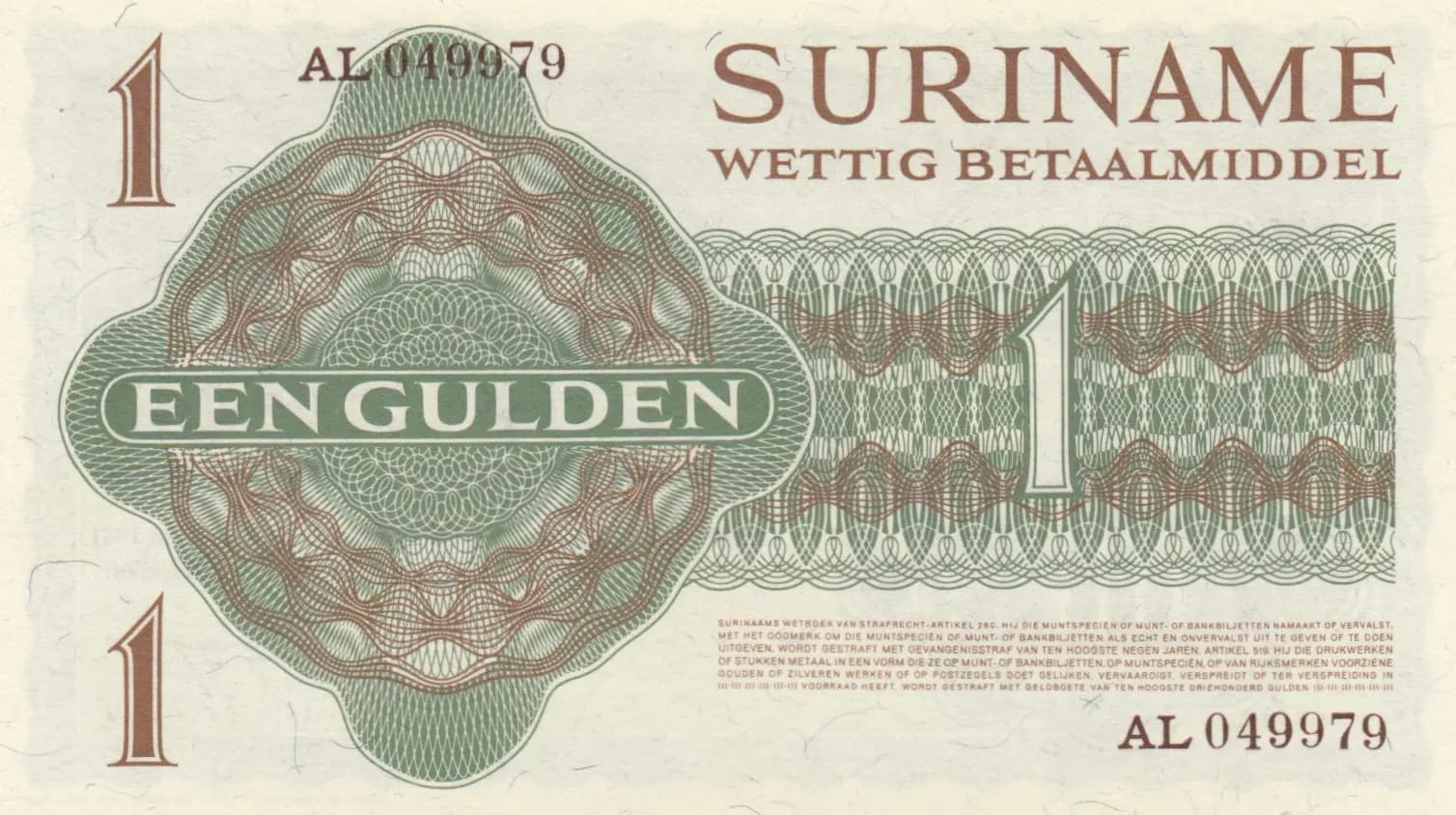
This is a stunning UNC example of the 1961 Suriname 1 Gulden (Pick-116a), the first regular issue banknote from the newly autonomous nation. The note features an exquisite architectural vignette of the High Court building in Paramaribo with its distinctive clock tower, rendered in elegant green and black engraving on the obverse, while the reverse showcases masterful security printing with an intricate circular medallion and complex guilloche patterns. The pristine condition and crisp engraving details make this an excellent representative of Johan Enschedé's Netherlands printing quality.
Common. The catalog value of $10 UNC and historical eBay pricing data showing notes sold regularly between $3-$21 across various grades consistently indicate this is a widely available issue. The 1961 regular issue 1 Gulden was produced in substantial quantities for circulation during Suriname's autonomous period, and it remains commonly encountered in the collector market. The UNC condition is desirable but does not confer rarity given the consistent availability of well-preserved examples.
Issued on August 1, 1961, following Suriname's transition to autonomy on December 15, 1954, this banknote represents the nation's economic sovereignty during a critical period of post-colonial development. The depicted High Court building with its clock tower symbolizes the establishment of governmental authority and the rule of law in the newly autonomous territory. The legal ordinance date of April 8, 1960, references the formal legal framework that enabled this currency issue during Suriname's path toward independence.
The obverse features a classical architectural vignette centrally positioned at the left, depicting the High Court (Hof van Justitie) in Paramaribo—a colonial-era building characterized by its prominent clock tower, columned portico with pediment, and surrounding tropical vegetation including palm trees. The building is surrounded by an ornate rectangular frame with a distinctive wavy border pattern typical of security printing. The right side contains denomination and text in Dutch, with the denomination '1' and words 'EEN GULDEN' clearly marked. The reverse displays a more abstract security design, dominated by a large circular medallion on the left filled with intricate geometric and floral patterns in green, brown, and cream tones, characteristic of guilloche work. The right side of the reverse features the large numeral '1' with elaborate decorative background patterns. Both sides employ fine-line engraving throughout, with no portraits present—the design emphasizes institutional authority through architecture and elaborate security patterns.
FRONT: 'SURINAME' (Suriname), 'EEN GULDEN' (One Gulden), 'MUNTBILLET' (Banknote), 'UITGEGEVEN KRACHTENS LANDSVERORDENING VAN 8 APRIL 1960 (G.B. No. 38)' (Issued by virtue of National Ordinance of 8 April 1960, Government Bulletin No. 38), 'GEREGISTREERD: PARAMARIBO, 1 AUGUSTUS 1961' (Registered: Paramaribo, 1 August 1961), 'De Minister van Financien:' (The Minister of Finance:), 'JOH. ENSCHEDÉ EN ZONEN HAARLEM' (Joh. Enschedé and Sons, Haarlem—printer). BACK: 'SURINAME' (Suriname), 'WETTIG BETAALMIDDEL' (Legal Tender), 'EEN GULDEN' (One Gulden), Serial number 'AL049979', and extensive text from the 'SURINAAMS WETBOEK VAN STRAFRECHT' (Surinamese Criminal Code) Articles 208 and 519 detailing penalties for counterfeiting and forgery of currency.
Intaglio (copperplate) engraving by Johan Enschedé en Zonen (JEZ), Haarlem, Netherlands. The note exhibits characteristic features of security printing including: fine-line engraving with considerable detail in the architectural vignette, complex guilloche patterns on the reverse providing anti-counterfeiting security, multiple color printing (green, black, and brown underprints visible), and precision engraving of ornamental borders and frames. The 'JEZ' printer mark confirms production by the renowned Dutch security printer.
This is cataloged as Pick-116a, indicating it is the first variety of the 1961 1 Gulden issue. The PMG population report shows at least four variants (116c, 116d, 116h, 116i) exist for this base Pick number, suggesting variations in printer marks, signatures, or serial number prefixes. This specific specimen carries serial number AL049979 and exhibits the 'De Minister van Financien' signature title without a printed individual name, consistent with the standard issue design. The 1961 registration date and April 8, 1960 ordinance reference are standard for this variety.