5 rupees 1943
About This Note
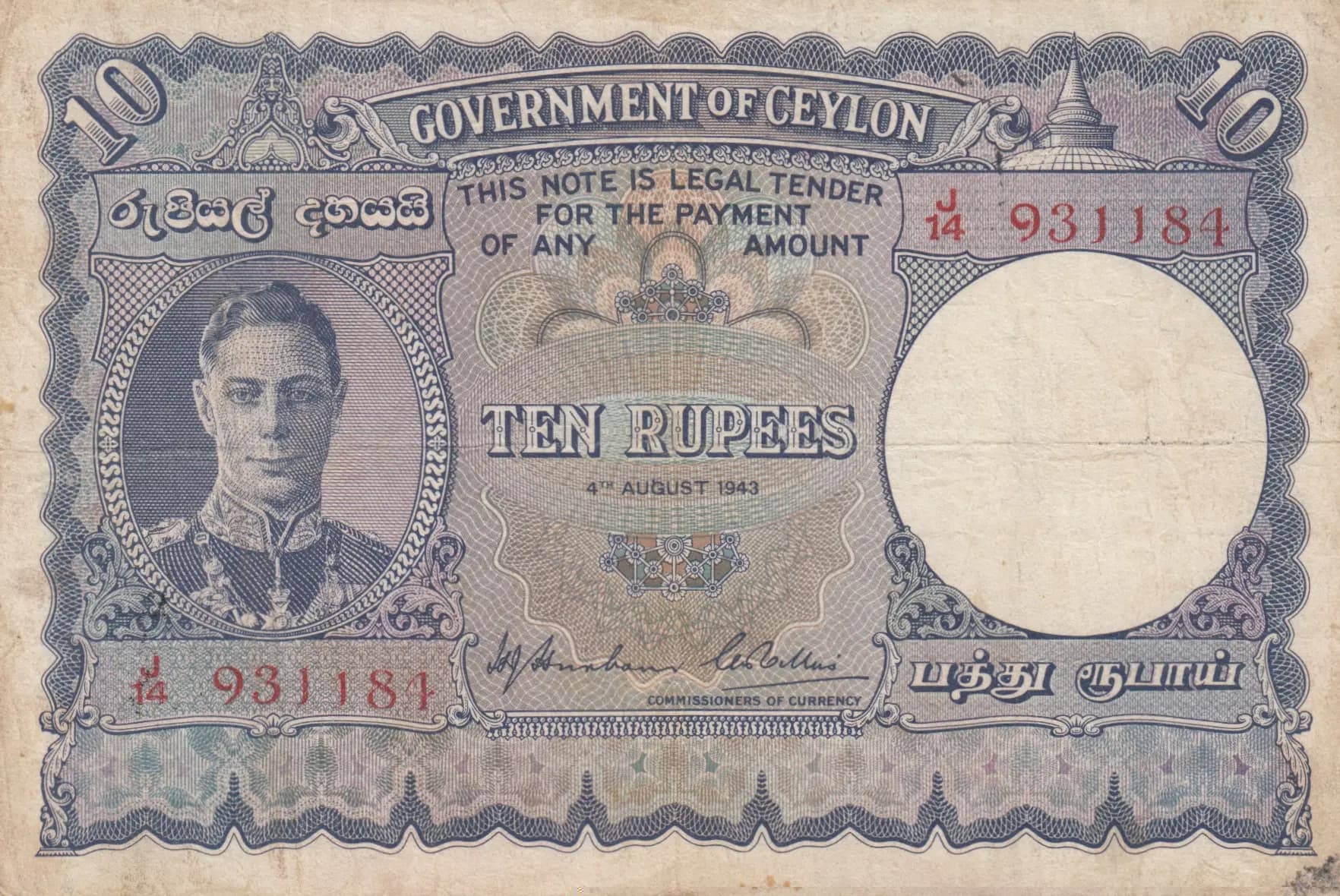
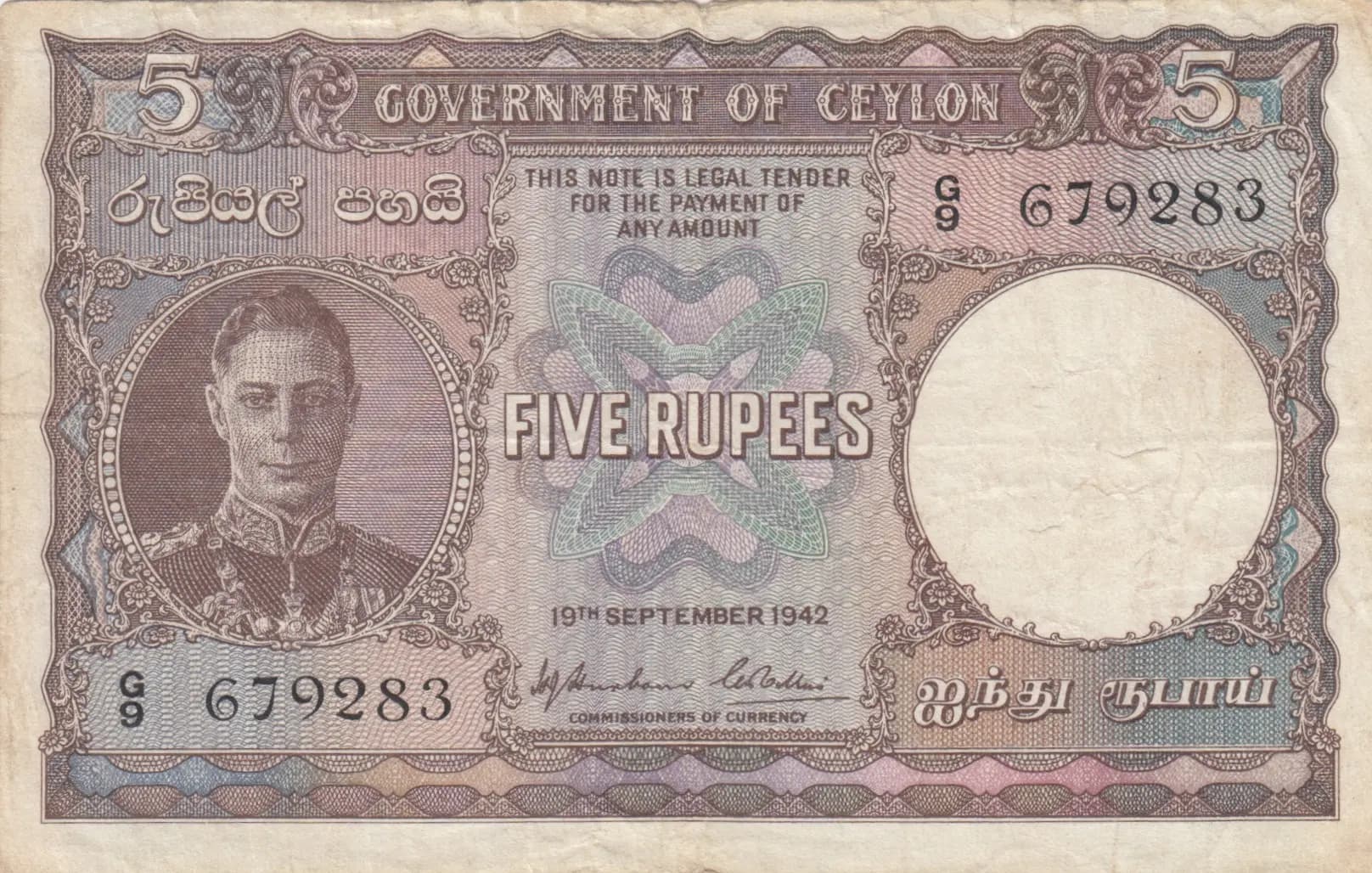
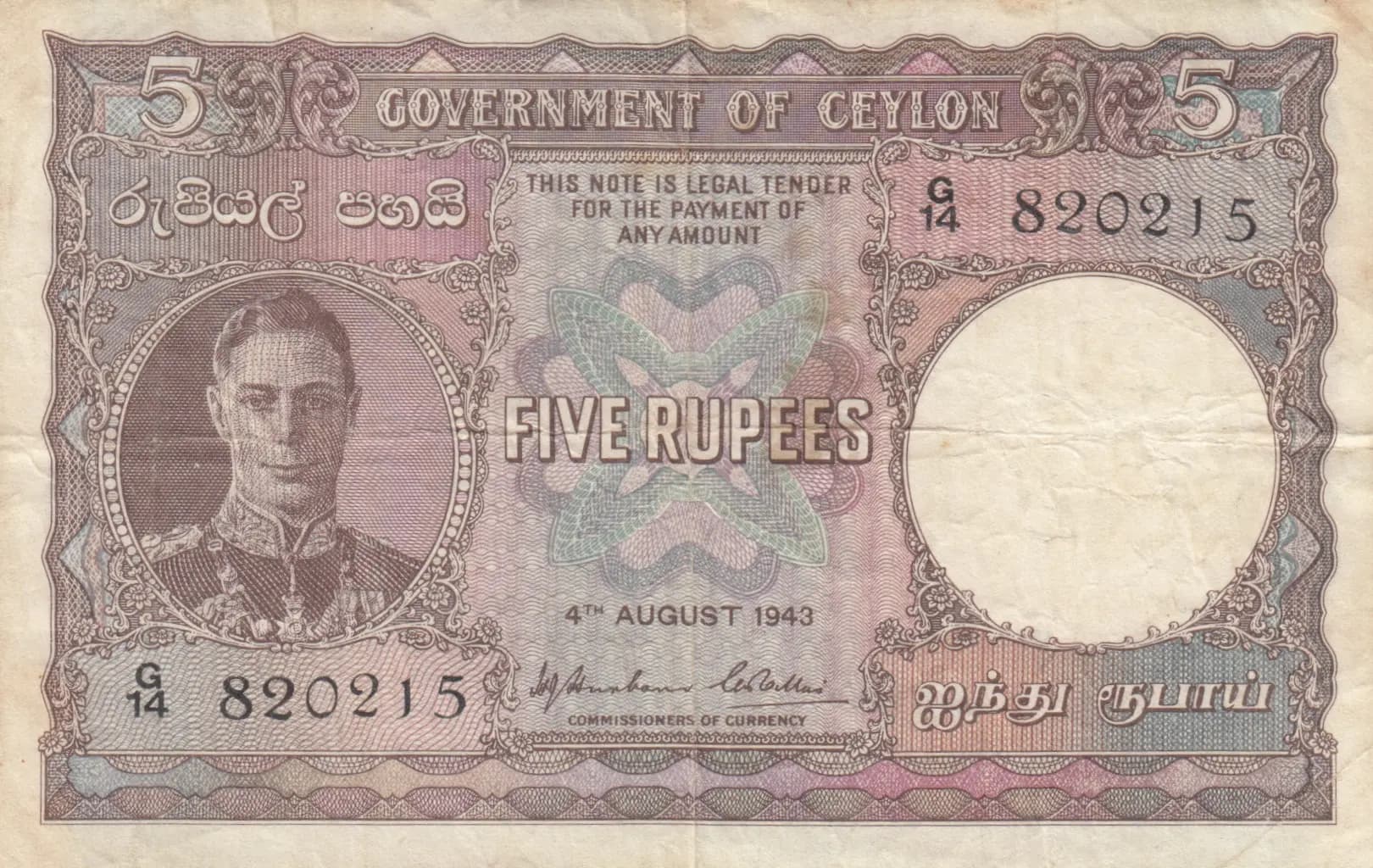
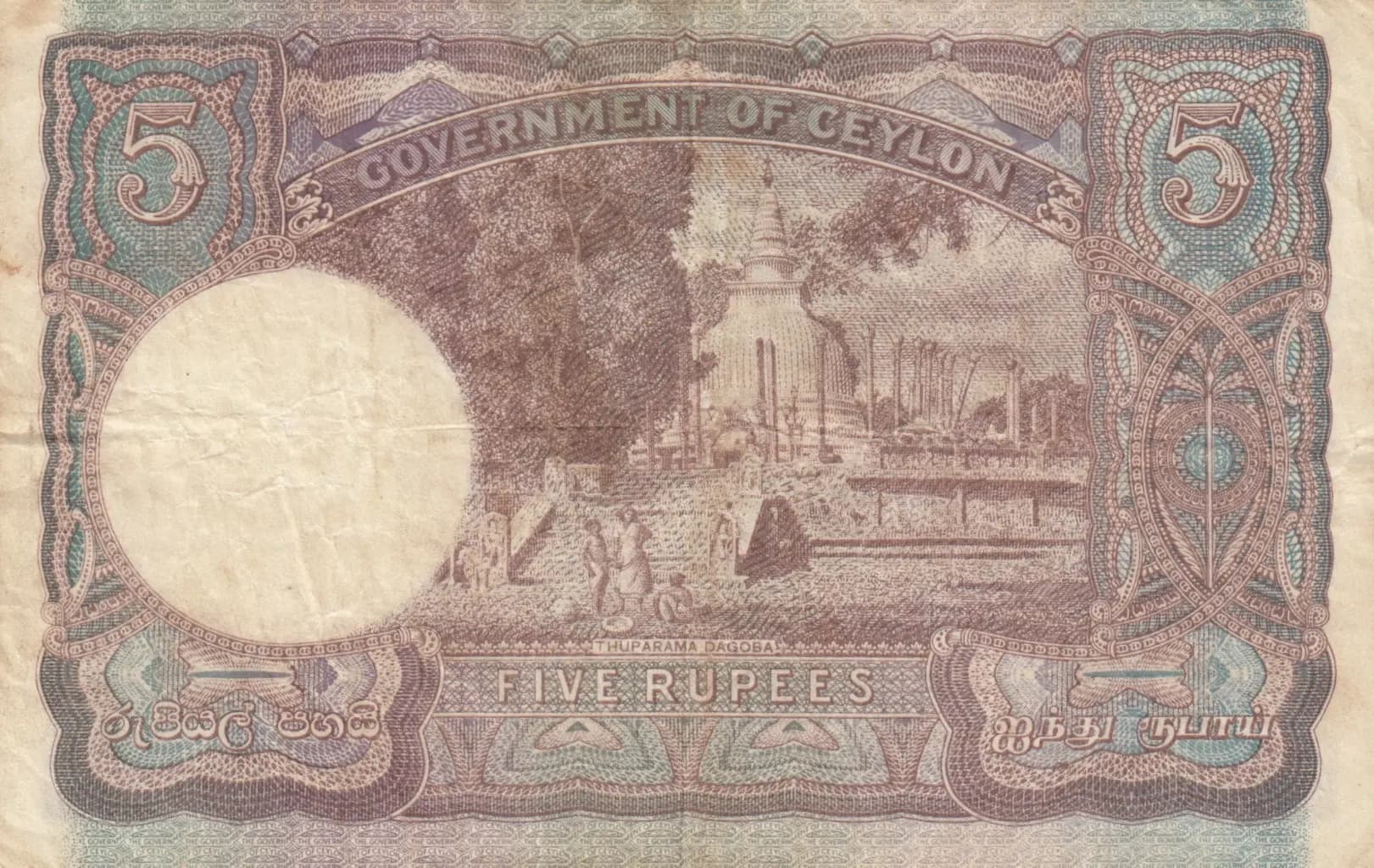
This is a VF-graded 5 Rupees banknote from the Government of Ceylon dated 4th August 1943 (Pick P-36a), featuring a formal portrait of King George VI in military dress on the obverse and the iconic Thuparama Dagoba (pagoda) of Anuradhapura on the reverse. The note displays the characteristic wear patterns of a genuinely circulated historical piece, with visible creasing and age-related patina, yet maintains strong visual integrity with no significant tears—a desirable example of mid-wartime Ceylon currency.
Common. The 5 Rupees P-36a was issued in substantial quantities from 1941-1949 as the standard circulation denomination for Ceylon during and immediately after World War II. This denomination and series remain frequently encountered in collections and the secondary market. VF-graded examples represent typical post-circulation finds rather than exceptional scarcities. No evidence of restricted print runs, recalls, or short-lived issuance supports a rarer classification.
Issued during World War II when Ceylon remained under British sovereignty, this note represents the Government of Ceylon's currency authority during the transitional period before independence in 1948. The prominence of King George VI's portrait reflects Ceylon's status as a British dominion, while the reverse's depiction of the Thuparama Dagoba—one of Buddhism's most sacred sites in Anuradhapura—demonstrates the cultural significance of Buddhist heritage in Ceylon's national identity even under colonial administration.
The obverse features King George VI in profile, facing left, rendered in formal military dress uniform with shoulder insignia within an ornate circular medallion frame—a classical numismatic portrait treatment reflecting British sovereignty. The reverse presents the Thuparama Dagoba (or Stupa) of Anuradhapura, one of Buddhism's most revered monuments in Ceylon, depicted as a domed religious structure within an architectural vignette centered on the note. Both sides employ matching ornamental borders of scrollwork, floral motifs, and geometric patterns executed in brown, purple, pink, and green tones. Corner medallions on the reverse contain the denomination numeral '5' in circular frames. The design philosophy balances imperial iconography with local cultural landmarks, typical of late-period British Commonwealth currency design.
FRONT SIDE: 'GOVERNMENT OF CEYLON' (issuing authority); 'THIS NOTE IS LEGAL TENDER FOR THE PAYMENT OF ANY AMOUNT' (legal tender declaration); 'FIVE RUPEES' (denomination); '4TH AUGUST 1943' (issue date); 'COMMISSIONERS OF CURRENCY' (authorized body); 'ශ්රී ලංකා' (Sinhala: Sri Lanka); Serial number 'G 14 820215'. BACK SIDE: 'GOVERNMENT OF CEYLON'; '5' (denomination numerals in corners); 'FIVE RUPEES'; 'THUPARAMA DAGOBA' (identification of the depicted temple structure); 'ශ්රී ලංකා' (Sinhala: Sri Lanka).
Intaglio printing (recess printing), evidenced by the deep, finely-detailed line work visible throughout the ornate borders, the portrait's subtle tonal gradations, and the complex geometric and floral patterns. The security features include intricate scrollwork, fine-line geometric patterning, and the dimensional quality characteristic of intaglio processes. This note was likely produced by a British or Commonwealth security printer—De La Rue or similar security printers commonly handled Ceylon currency of this period, though specific attribution requires additional documentation.
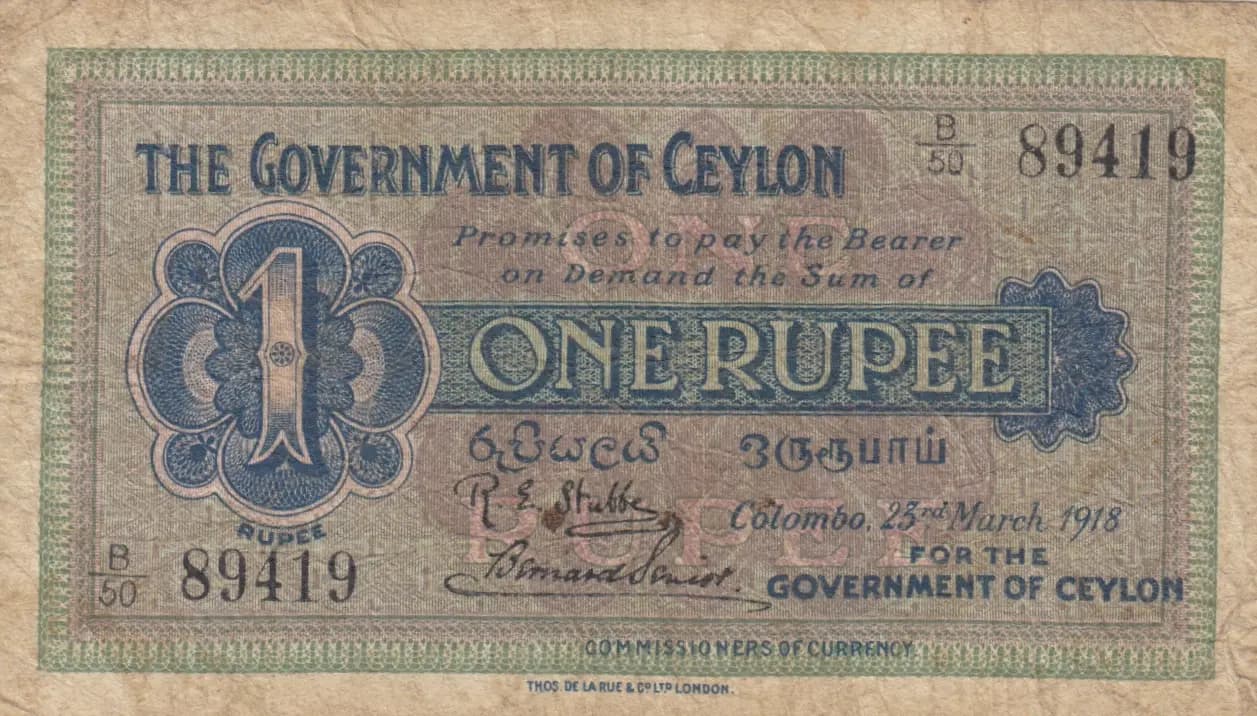
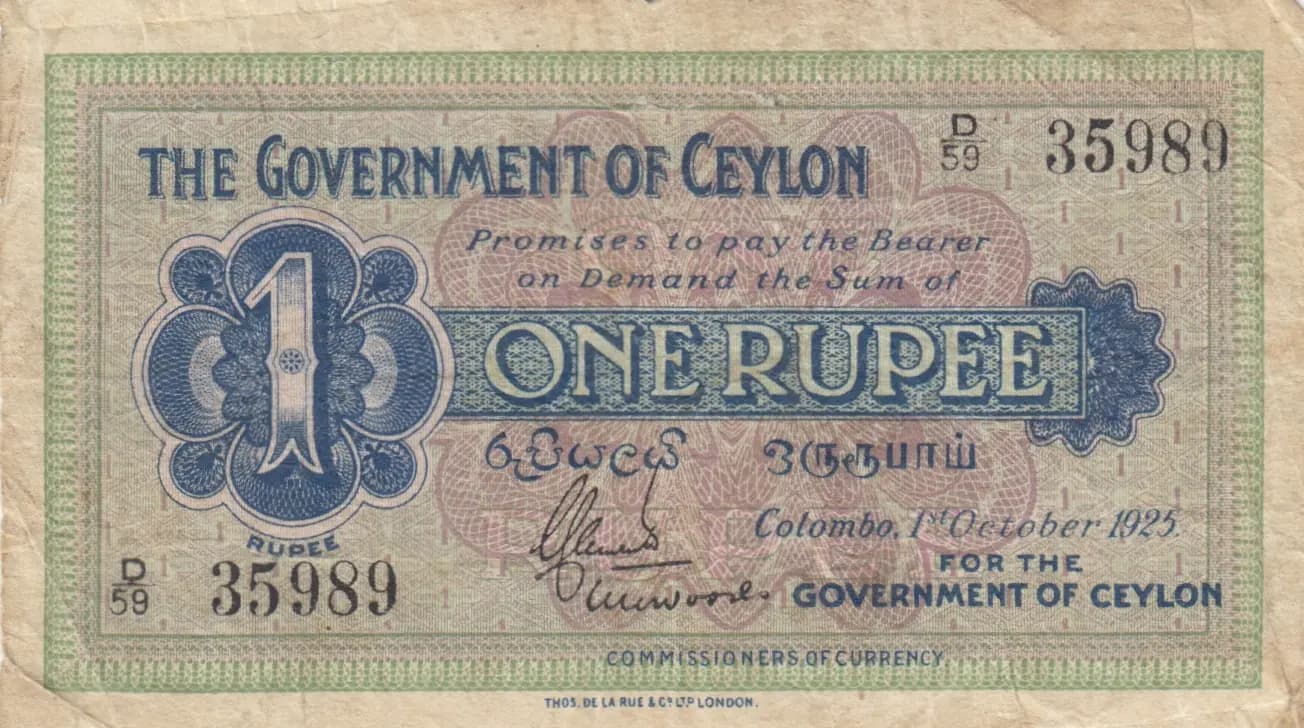
This specific note is identified as the 'G 14' series variant with serial number G 14 820215, representing the early wartime printing period (dated 4th August 1943). The catalog designation P-36a indicates this is a recognized variety within the 1941-1949 5 Rupees issue. Known varieties for this denomination include differences in signature authorities (Commissioners of Currency) and serial number prefixes corresponding to different printing batches. The presence of Sinhala text ('ශ්රී ලංකා') alongside English is standard for this later colonial-period series, distinguishing it from earlier P-32 notes which bore the 'Promises to Pay' text format.