10 rupees 1943
About This Note
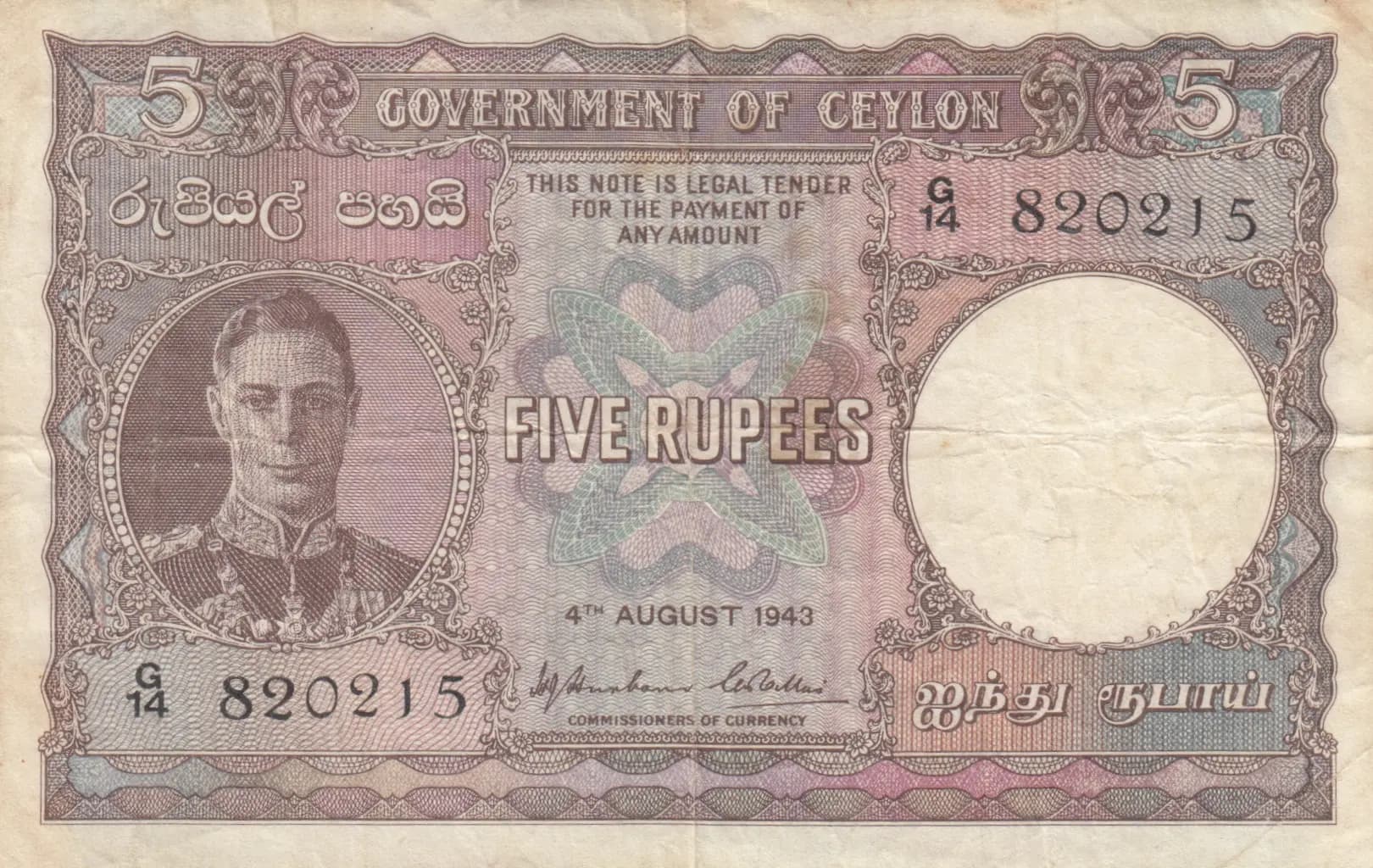
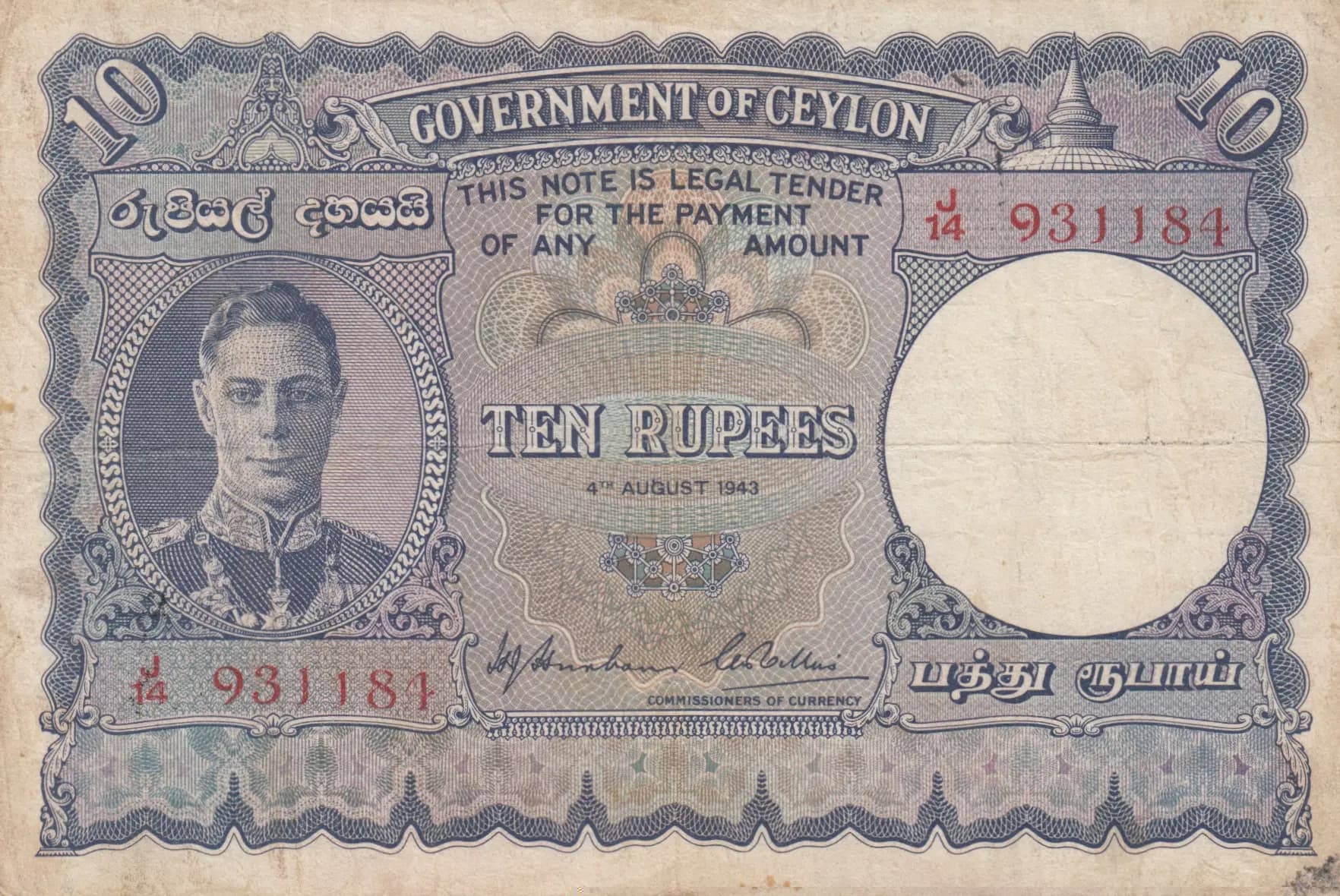
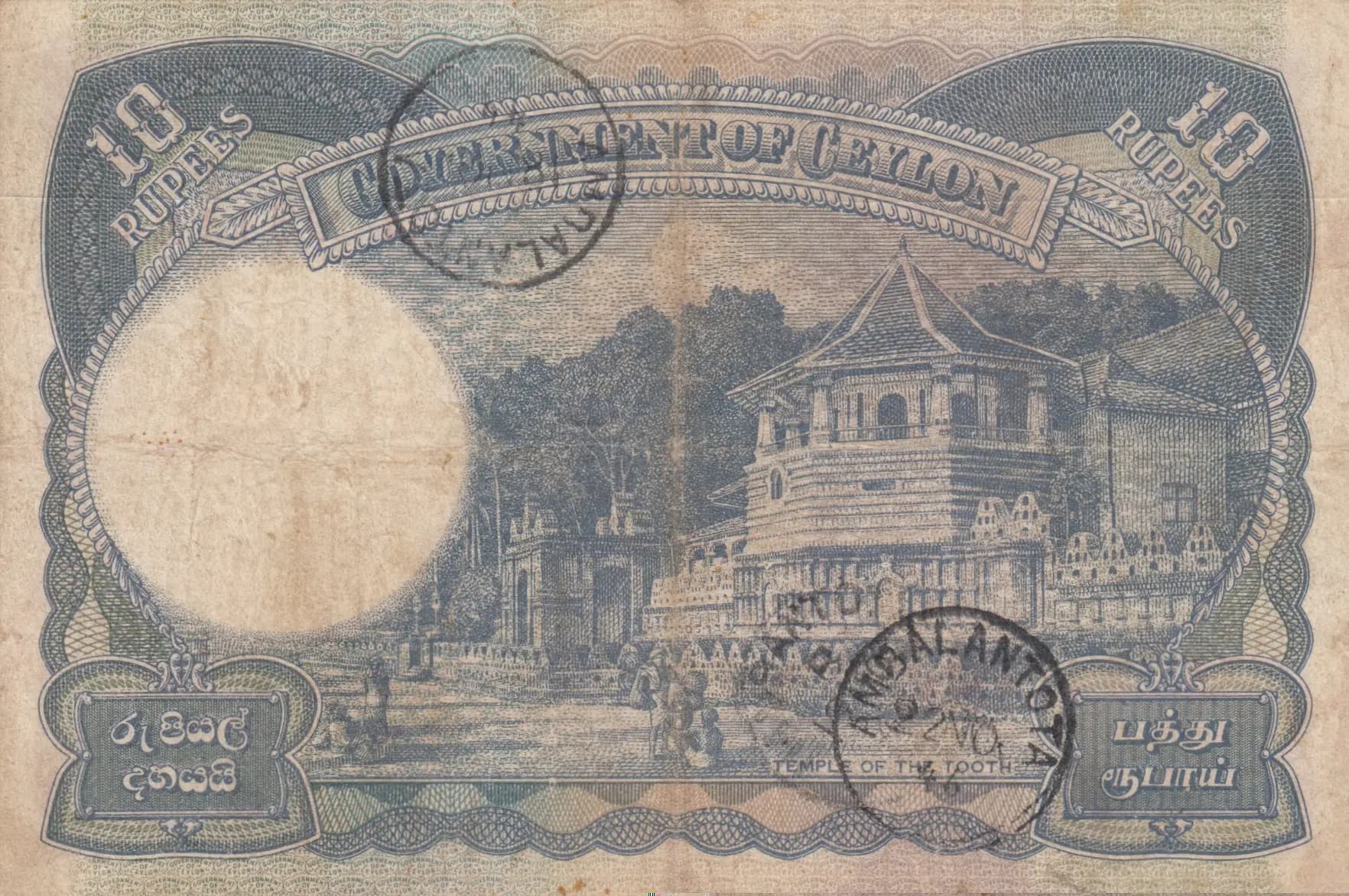
A Government of Ceylon 10 Rupees banknote dated 4th August 1943, issued during World War II under British colonial rule. The note displays fine engraving with ornate decorative borders, a portrait of King George VI in military dress on the obverse, and a detailed rendering of the Temple of the Tooth on the reverse. In Fine condition, it shows expected aging with horizontal creasing, foxing, and staining consistent with mid-20th century circulation.
Common. The 10 Rupees denomination from the 1941-1949 Government of Ceylon series was a regular circulation issue with substantial print runs. The P-36A variety remains widely available in the collector market across various condition grades, with no historical evidence of short print runs, recall campaigns, or scarcity factors. Notes of this type and period typically trade at modest prices reflecting their common status.
This note was issued during the final years of Ceylon under direct British governance, before independence in 1948. The portrayal of George VI in military uniform reflects the wartime context of 1943, while the reverse depicts the sacred Temple of the Tooth (Dalada Maligawa) in Kandy, one of Buddhism's most important pilgrimage sites and a symbol of Ceylonese cultural identity. The bilingual English-Sinhala-Tamil inscriptions represent the multi-ethnic composition of the island during the colonial period.
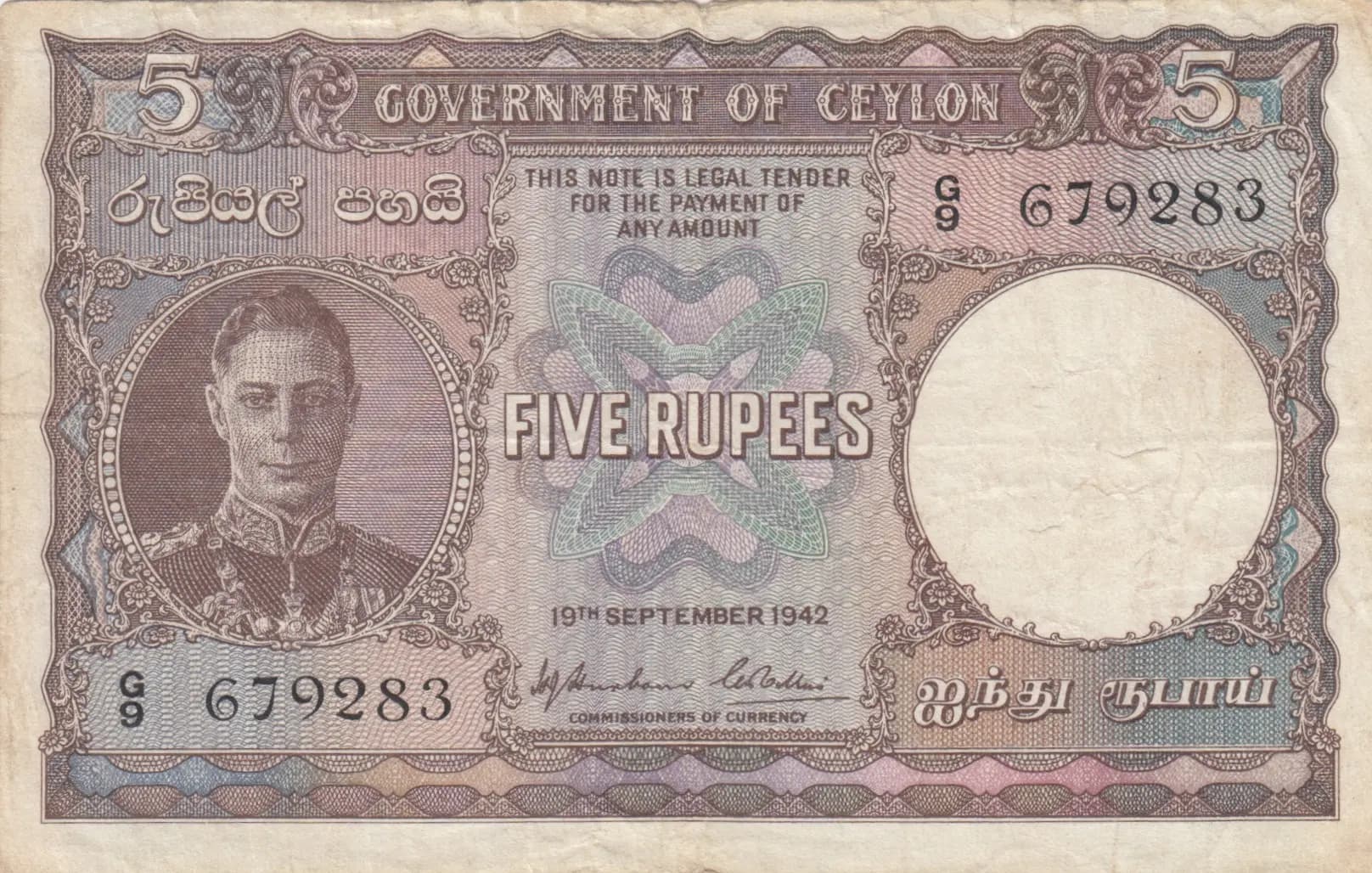
The obverse features a left-facing profile portrait of King George VI in full dress military uniform with decorated chest within an ornate oval frame, accompanied by an ornamental crown or royal emblem at the top center. The design incorporates elaborate decorative borders with intricate floral and geometric patterns, scrollwork in the corners, and a blank circular watermark area on the right side. Bilingual legal tender text occupies the center. The reverse depicts the Dalada Maligawa (Temple of the Tooth) in Kandy, rendered as a detailed architectural engraving showing the multi-tiered spired structure with ornate details in its characteristic Sri Lankan Buddhist style, set within a landscaped environment with surrounding vegetation. The entire reverse composition is framed by decorative borders with cartouches containing bilingual text.
FRONT SIDE: 'GOVERNMENT OF CEYLON' (English) / 'THIS NOTE IS LEGAL TENDER FOR THE PAYMENT OF ANY AMOUNT' (English) / 'TEN RUPEES' (English) / '4th AUGUST 1943' (English) / 'COMMISSIONERS OF CURRENCY' (English) / Serial number '14 931184' (English) / 'ශ්රී ලංකා ඩොලර්' - Sri Lanka Rupees (Sinhala) / 'ரூபாய் பத்து' - Ten Rupees (Tamil). BACK SIDE: 'GOVERNMENT OF CEYLON' (English) / 'TEN RUPEES' (English) / 'TEMPLE OF THE TOOTH' (English) / 'ශ්රී ලංකා' - Sri Lanka (Sinhala) / 'பத்து ரூபாய்' - Ten Rupees (Tamil).
Line engraving, the standard security printing technique for banknotes of this era. The fine line work visible throughout the borders, portraits, and architectural details, combined with the crisp engraved elements and the elaborate intaglio patterns, are characteristic of high-security currency printing from the 1940s. Ceylon's banknotes during this period were typically produced by established currency security printers such as De La Rue or Waterlow & Sons, utilizing traditional engraving and printing methods.
This note represents the P-36A variety, characterized by the 'THIS NOTE IS LEGAL TENDER' legal tender clause on the obverse (distinguished from earlier P-32 issues which used the 'PROMISES TO PAY' clause). The observed specimen is dated 4th August 1943 with the serial number 14 931184 printed in red. The hand-signed commissioner signatures are typical of this series. No specific signature varieties or overprints are noted on this specimen.