5 rupees 1942
About This Note
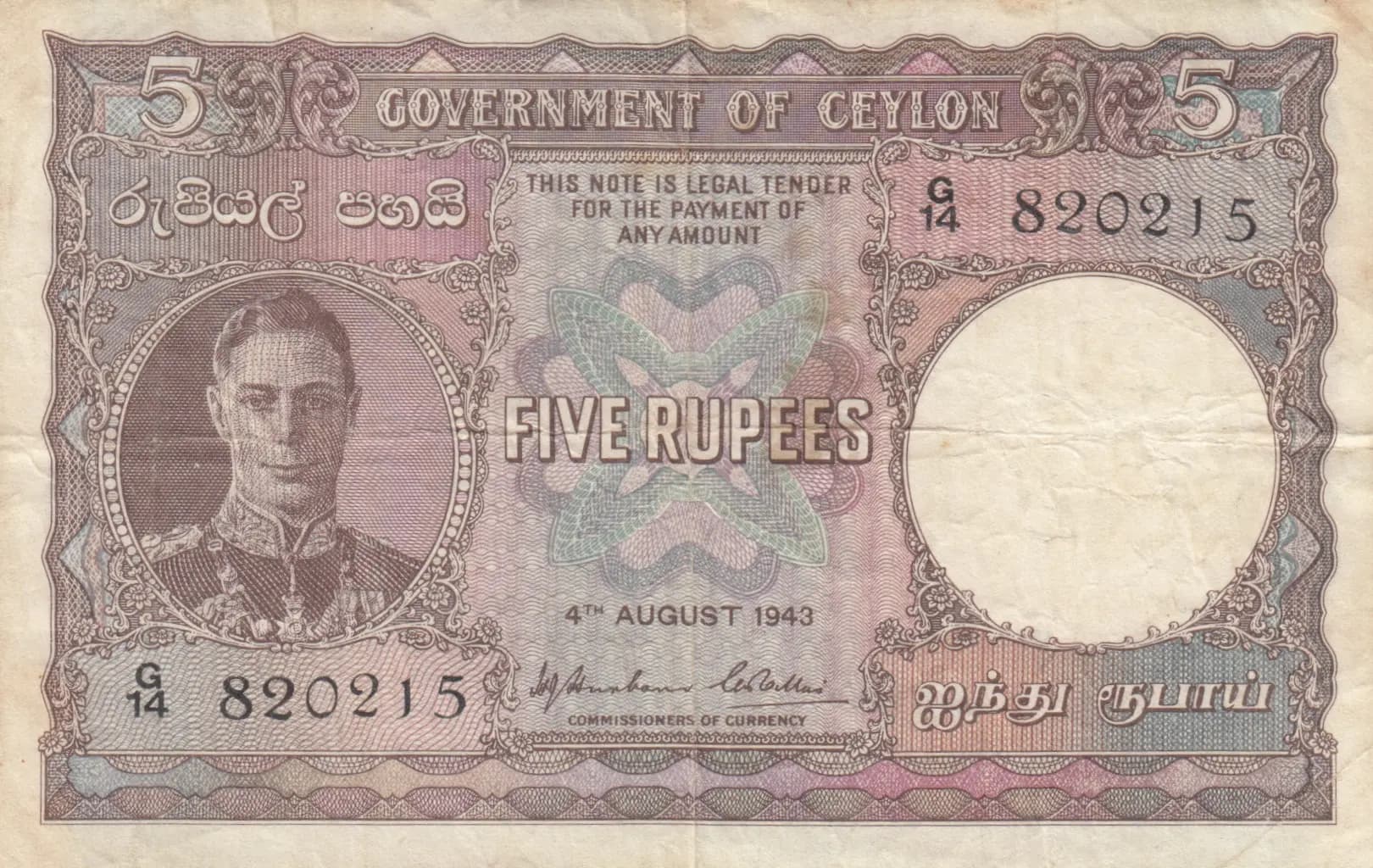
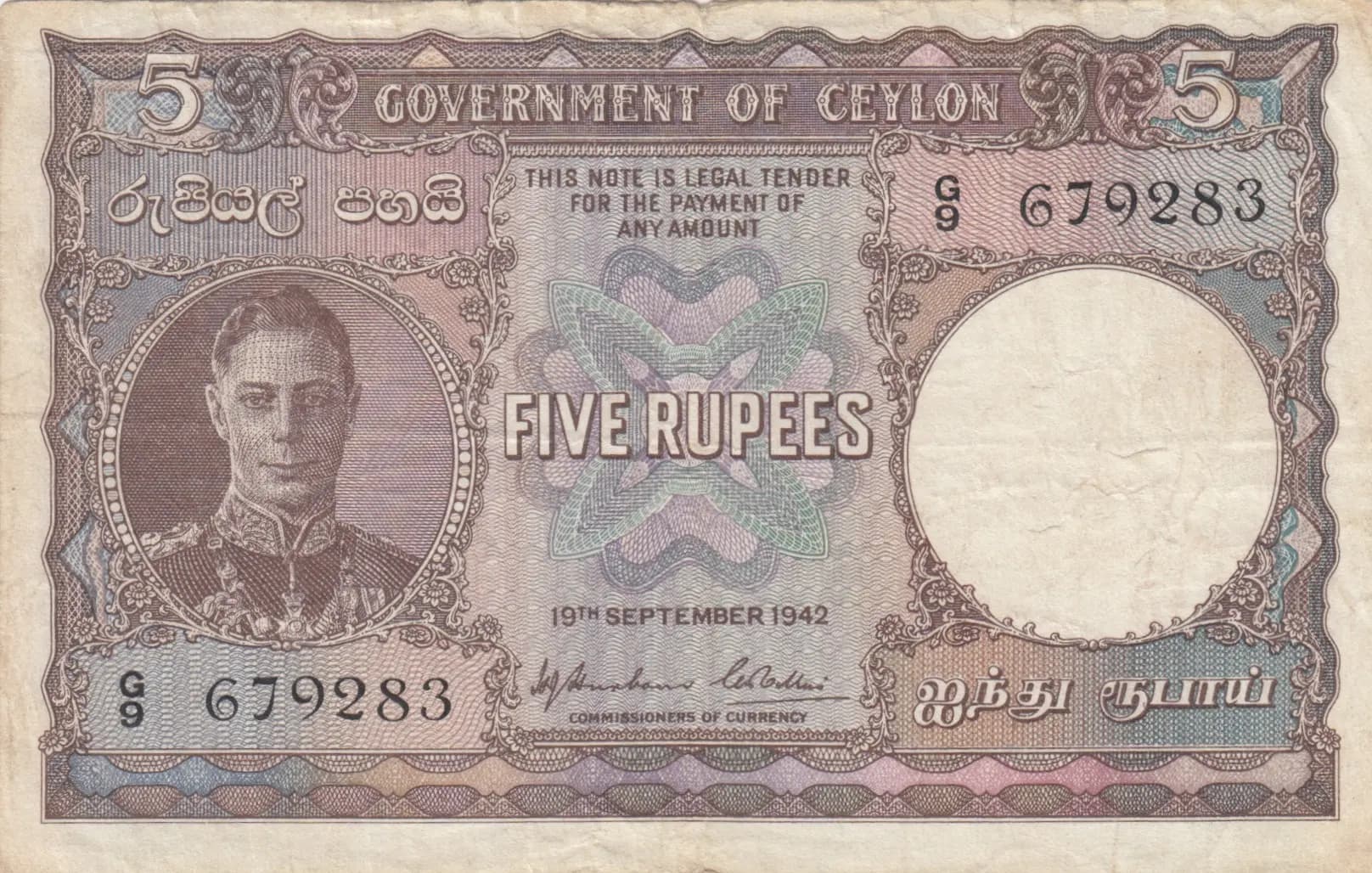
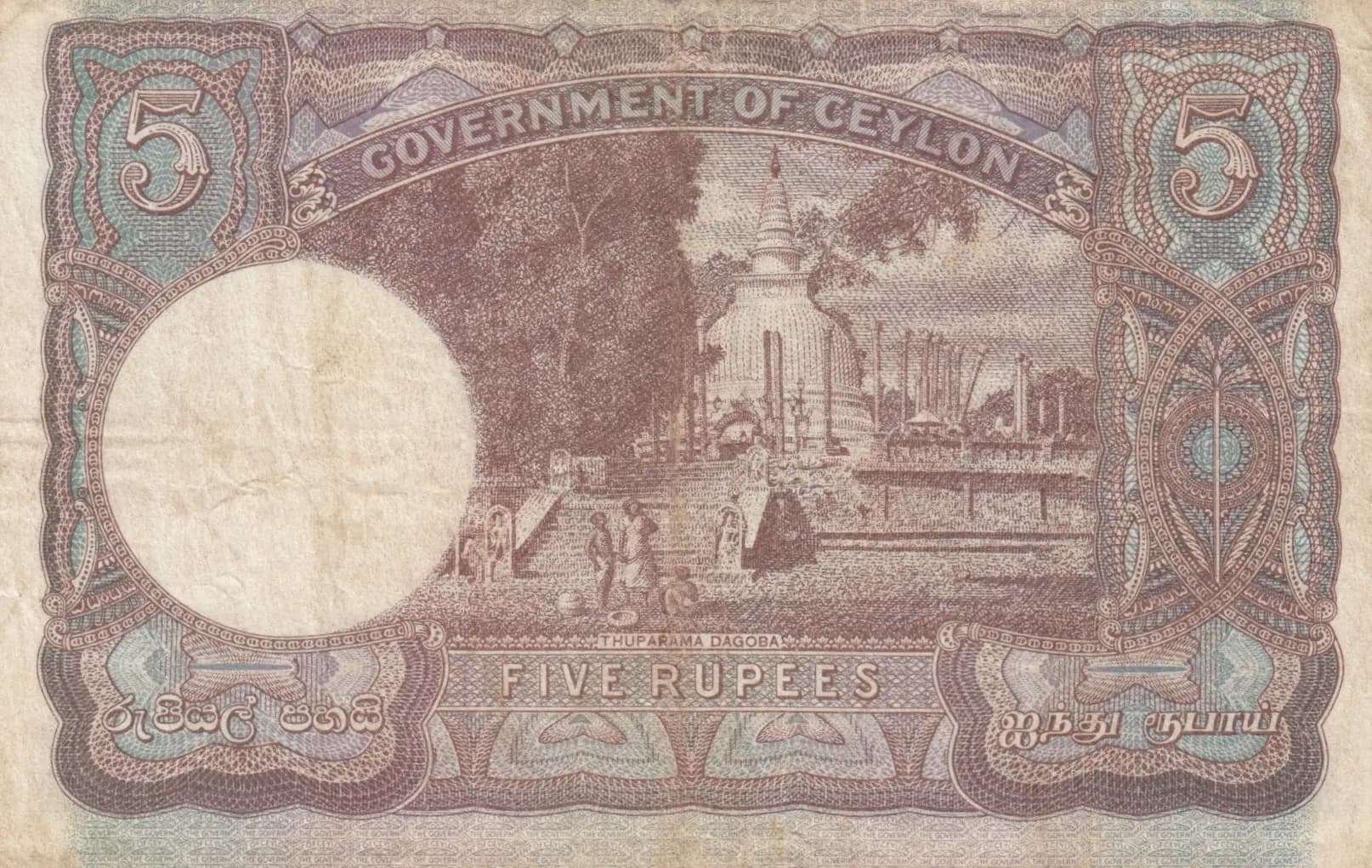
This is a Government of Ceylon 5 Rupees banknote dated 19th September 1942 (Pick P-36a), featuring a portrait of King George VI in military dress on the obverse and the Thuparama Dagoba on the reverse. The note exhibits honest wear consistent with its age and circulation history, with visible creasing, discoloration, and paper aging appropriate for a Fair condition grade. The intricate engraved design and bilingual inscriptions (English and Sinhala) reflect Ceylon's administrative practices during the WWII period.
Common. The 5 Rupees denomination from the 1941-1949 series was a standard circulation note with substantial print runs typical of regularly-issued banknotes during the WWII and immediate post-war periods. The Fair condition grade is consistent with a note that saw active circulation, suggesting this was not a limited or special issue. No historical evidence indicates this Pick number was short-lived, recalled, or produced in unusually small quantities. Collector demand for early Ceylon banknotes exists but is moderate, and notes of this denomination and condition remain readily available in numismatic markets.
This note was issued during the final years of British colonial rule in Ceylon, when the island was under wartime conditions during World War II. The portrayal of King George VI in military dress reflects Ceylon's status as a British Dominion, while the inclusion of Sinhala script and the Thuparama Dagoba—one of Buddhism's most sacred sites in Anuradhapura—demonstrates Ceylon's cultural identity alongside Commonwealth governance. The denomination and design reflect the currency framework established in the early 1940s as Ceylon prepared for post-war independence.
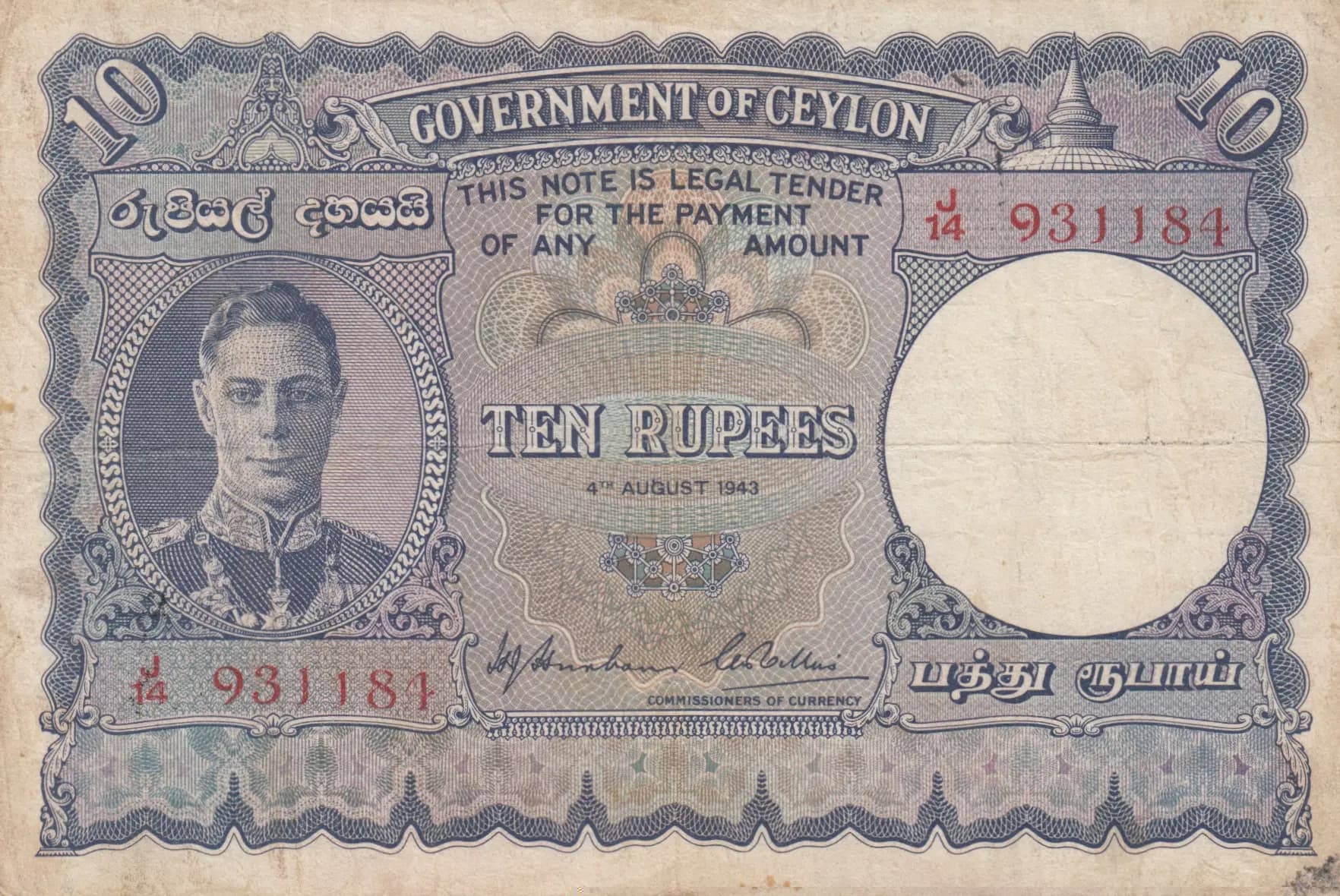
The obverse features a portrait of King George VI positioned on the left side, rendered in military dress uniform with ornate collar embroidery, within an intricate engraved border of geometric and floral patterns. The denomination 'FIVE RUPEES' is centered with a decorative four-pointed star motif above it. A blank circular frame on the right side indicates a watermark security feature. The reverse depicts the Thuparama Dagoba at Anuradhapura, one of Buddhism's oldest stupas, with its characteristic central spire and surrounding temple structures rendered in fine engraved detail. Large '5' numerals appear in decorative frames at the corners. Both sides employ matching ornate borders with geometric patterning and incorporate turquoise-cyan accent colors, with the overall palette dominated by browns, purple-browns, tans, and creams. The bilingual presentation (English and Sinhala) reflects the colonial administrative structure with acknowledgment of local culture.
FRONT SIDE: 'GOVERNMENT OF CEYLON' (issuing authority); 'THIS NOTE IS LEGAL TENDER FOR THE PAYMENT OF ANY AMOUNT' (legal tender declaration); 'FIVE RUPEES' (denomination); '19TH SEPTEMBER 1942' (issue date); 'COMMISSIONERS OF CURRENCY' (authorizing body); 'G 8 679283' and '8 679283' (serial number); 'ශ්රී ලංකා' [Sri Lanka in Sinhala script]. BACK SIDE: 'GOVERNMENT OF CEYLON'; 'THUPARAMA DAGOBA' (architectural landmark identification); 'FIVE RUPEES' (denomination); Large denomination numeral '5'; 'ශ්රී ලංකා' [Sri Lanka in Sinhala script].
This note was produced using intaglio engraving (line engraving/steel plate engraving), the standard security printing method for currency of this period. The fine line work visible throughout the design, intricate border patterns, and detailed architectural rendering of the Thuparama Dagoba are characteristic of high-quality intaglio production. The Waterlow & Sons security printer firm, known for producing Commonwealth currency during this era, is the likely printer for this issue, though attribution should be confirmed against archival records.
This specific note carries serial number 'G 8 679283', indicating the 'G' series prefix. The date of issue (19th September 1942) matches the catalog listing. The Pick designation P-36a distinguishes this variety from P-36 (earlier notes with 'PROMISES TO PAY...' text), confirming this belongs to the later 'LEGAL TENDER' series per banknote.ws reference data. No overprints or additional modifications are evident. Signature varieties and specific series prefixes may exist within the 1941-1949 date range; this specimen's 'G' prefix should be noted for detailed variety documentation.